BUYING GUIDE · NETWORKING
Industrial 4G & 5G Routers for Remote Sites
Construction compounds, pumping stations, pop-up sites, CCTV poles: where fibre doesn't go, a rugged cellular router is the WAN. Pick by bandwidth, temperature rating and how badly failure hurts.
The WAN in a metal box
An industrial 4g router does one job that matters: it keeps a remote site online without an engineer visit. The difference from the domestic router in your office is everything around the radio — DIN-rail mounting, wide temperature tolerance, dual-SIM failover, VPN tunnelling and I/O that survives a plant room rather than a living room.
The buying decision is bandwidth versus environment versus consequence. A telemetry cabinet needs kilobits and reliability; a CCTV pole needs steady upstream megabits; a pop-up office needs real throughput for people. Check coverage for each candidate network at the actual site first — Ofcom’s coverage checker is the honest baseline — then size the industrial 4g router to the duty.
The industrial 4g router line-up (and the 5G step-up)
From compact telemetry routers to full 5G site connectivity. All are unlocked — fit any operator’s SIM, or multi-network roaming SIMs for the best mast wherever the site lands.
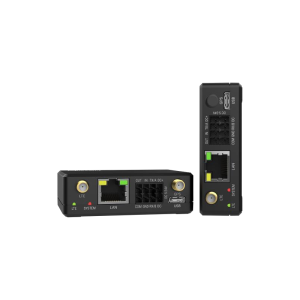 Telemetry & kiosksMilesight UR41 Mini Cellular Router
Compact cellular router for cabinets, kiosks and machines — small footprint, industrial build, does the job for kilobit duties.
From £86.04 ex VATView →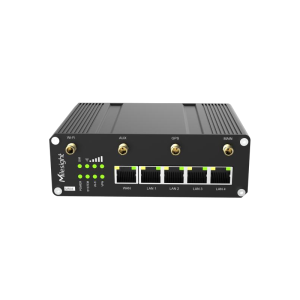 The site workhorseMilesight UR35 Industrial Cellular Router
DIN-rail 4G router with dual SIM, VPN suite and serial/IO — the default for pumping stations, plant and unattended sites.
From £149.63 ex VATView →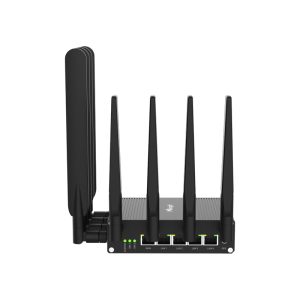 Bandwidth-hungry sitesMilesight UR75 5G Cellular Router
5G router for construction offices, CCTV clusters and anywhere 4G congestion bites.
From £460.12 ex VATView →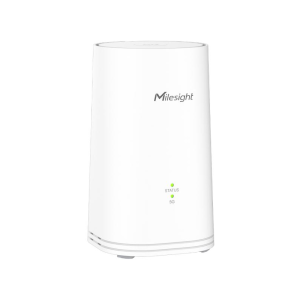 Fixed wireless accessMilesight UF51 5G CPE
5G CPE for premises-grade connectivity where fibre is absent or months away.
From £508.75 ex VATView →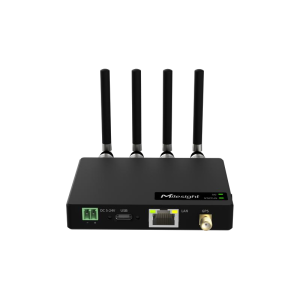 Instant laptop-grade 5GMilesight 5G Dongle
5G dongle for commissioning, surveys and temporary works — connectivity from a pocket.
£486.31 ex VATView →Compare routers and prices
| Product | Best for | Connectivity | Price (ex VAT) |
|---|---|---|---|
| Milesight UR41 Mini Cellular Router | Cabinets, telemetry | 4G LTE | From £86.04 |
| Milesight UR35 Industrial Cellular Router | Unattended sites, VPN | 4G LTE, dual SIM | From £149.63 |
| Milesight UR75 5G Cellular Router | High-bandwidth sites | 5G | From £460.12 |
| Milesight UF51 5G CPE | Fixed wireless premises | 5G | From £508.75 |
| Milesight 5G Dongle | Surveys, temporary | 5G USB | £486.31 |
Sizing, SIMs and staying online
Start with consequence of failure. If a dropped connection means a silent alarm or a blind camera, spec dual SIM on two networks and a router that watches its own link (the UR35 class does) — failover happens in seconds without a site visit. If it means a slow afternoon in a site office, a single good SIM is fine and the budget goes to bandwidth instead.
SIM strategy beats router strategy: multi-network roaming SIMs attach to the strongest local mast and remove the ‘wrong operator for this postcode’ gamble, which matters more than any spec-sheet number for mobile or multi-site fleets. For VPN back to base, IPsec and OpenVPN are standard across the range — a hub-and-spoke tunnel design serves most estates without drama.
- Dual SIM + link monitoring wherever failure means a silent alarm
- Multi-network roaming SIMs remove per-site operator roulette
- External antenna ports matter in metal cabinets — budget for antennas
- A wide-temperature industrial 4G router lives happily in unheated cabinets
- 5G earns its premium on CCTV backhaul and staffed site offices
- Serial/IO on the UR35 class doubles as a mini RTU for legacy plant
Where these fit in the bigger picture
Cellular routers carry whole remote sites; individual sensors mostly should not each carry a SIM. The economic pattern is a router (or LoRaWAN gateway with cellular backhaul) per site, with battery sensors hanging off it — connectivity once, sensed everything. CCTV poles pair a router with a PoE switch to power the cameras from the same cabinet.
SCADA and legacy plant ride the same links — see the SCADA & remote I/O solution for serial-to-cloud patterns, and IoT for construction for the temporary-site playbook.
Two further options are quoted rather than listed. The ATOP CR5201B is a very low-power LTE gateway built for solar, battery and other power-constrained outstations, and the ATOP CWR5805 is a 5G/4G/Wi-Fi router for harsh field deployments. Both are rugged-housing, wide-temperature, high-EMC units priced per project rather than per box — ask for a quote and we will come back within one working day.
Why buy from Indiott
Everything here ships from UK stock with GBP pricing and a human on the end of the phone. If you are rolling out across multiple sites, ask for volume pricing — quotes normally come back within one working day.
Frequently asked questions
Which network's SIM should we use?
Whichever is strongest at that site — check Ofcom’s coverage map, then verify on the ground with a phone on each candidate network. For fleets or mobile assets, multi-network roaming SIMs sidestep the question entirely by attaching to the best available mast; every router we sell is unlocked, so you are never tied to an operator.
Do we need 5G, or is 4G enough?
4G comfortably carries telemetry, SCADA, payment terminals and a small office. 5G earns its premium when the duty is multiple CCTV streams, large file movement or a staffed site office with real users — or where local 4G is congested. Buying 5G ‘for the future’ on a telemetry cabinet is money better spent on a second SIM.
Can these VPN back to our head office?
Yes — IPsec, OpenVPN and similar tunnelling are standard, and the usual design is hub-and-spoke back to your firewall so remote sites appear as branch networks. We can advise on tunnel architecture if your IT team wants a second opinion.
What is the difference between an industrial 4g router and a LoRaWAN gateway?
An industrial 4g router connects a site (Ethernet/Wi-Fi devices) to the internet; a LoRaWAN gateway connects battery sensors to a network. They are complements, not rivals — many sites run a UG65 gateway for the sensors with a UR35 router providing its backhaul.
Get the right box for the site
Tell us what runs at each site and how much a dropped link costs you, and we will spec the industrial 4g router (or 5G) fleet with pricing within one working day.
The short answer
What makes a 4G router industrial rather than consumer?
Four things, none of them speed: a wide DC input rather than a mains plug, an operating range that starts at -40 degrees C, DIN rail mounting, and serial ports with a Modbus gateway so field equipment can reach the network. A consumer 4G router has none of these and is not specified to run unattended for years.
Related
Buying this in the UK
- Supplied by Indiott, a trading name of PSI Technologies Limited (Companies House 03689664, VAT GB 730 2340 83), Hampshire, United Kingdom.
- Every price is published ex VAT at indiott.com — no quote needed to see it.
- Typically dispatched within 14 working days from the UK, on a VAT invoice.
- Call 023 9223 3611 or request a quote.
Next step
Scope it with an engineer.
Tell us the site, the assets and the constraint. You get a bill of materials and a straight answer within one working day.
- A bill of materials sized to your site
- Priced ex VAT, UK entity, no login wall
Rather talk it through? Call 023 9223 3611
Received. An engineer has it.
You will hear back within one working day with the parts, the prices and the lead time. A confirmation is on its way to your inbox.
If it is urgent, call 023 9223 3611.
More buying guides