Milesight Level Sensors Compared: EM400, EM500 and the Radar Models
Last updated: 5 August 2026
Short answer: pick a Milesight level sensor by the medium and the shape of the space, not by the range. Use the EM400-MUD (from £86.79 ex VAT) for bins, hoppers and open containers. Use the EM400-TLD (from £86.79) where foam or a narrow opening defeats ultrasound. Use the EM410-RDL (from £224.45) for sewers, wet wells and anything with vapour, and step up to the EM411-RDL (from £314.23) only when you need ATEX Zone 0.
That one-line answer hides the decision that actually goes wrong on site. Almost every Milesight level sensor datasheet leads with a measuring range, so buyers compare 450 cm against 12 m and choose on that number alone. Range is rarely the constraint. Beam angle, the medium’s surface, and whether the chamber has walls close to the level sensor are what decide whether the reading is trustworthy, and none of those appear in a range column.
On this page:
- What does a Milesight level sensor actually measure?
- Ultrasonic, laser or radar: which technology suits your medium?
- How do the models compare on range, beam and price?
- Why beam angle matters more than range
- Which Milesight level sensor fits your job?
- What else do you need besides the sensor?
- Frequently asked questions
What does a Milesight level sensor actually measure?
Every Milesight level sensor here measures distance, not level. The unit sits at the top of a tank, bin or chamber, fires a signal downwards, times the echo and reports the gap between itself and the surface below. Level is what you calculate afterwards by subtracting that gap from a known mounting height. Get the mounting height wrong and every reading is wrong by the same amount, which is the single most common commissioning error.
All six level sensors are LoRaWAN devices. They send a short packet on a schedule, run for years on lithium thionyl chloride cells, and need no mains power or cabling at the measurement point. If LoRaWAN is new to you, our plain-English guide to LoRaWAN covers the radio side before you spec hardware.
The distance a level sensor reports is only as good as the surface reflecting the signal. A flat, still liquid returns a clean echo. Foam, floating debris, steep angles of repose in a grain hopper, and heavy vapour all scatter or absorb it. That is the whole basis of the technology choice below.
Ultrasonic, laser or radar: which technology suits your medium?
Ultrasonic sends sound, radar sends microwave, and laser sends light. Sound is cheapest and works well on stable open surfaces. Microwave passes through vapour and foam that stop sound. Light gives a very tight beam but wants a reasonably reflective target.
The failure mode of ultrasonic is well documented across the process instrumentation industry: foam absorbs sound waves, vapour distorts them, and condensation on the transducer deflects the signal, all of which produce false or drifting readings. Suppliers who sell both technologies are blunt about it, noting that radar remains unaffected by foam, vapour, turbulent surfaces or condensation, while ultrasonic suits simple, stable environments where its lower cost wins.
That is not an argument for always buying radar. A wheelie bin, a salt store or a plastic water butt has no vapour and no foam, and an ultrasonic head costs a third of a radar head. The rule that holds up on site is simple: if you can see through the space with your eyes, ultrasound will probably work; if it is steamy, foaming or chemically aggressive, buy radar.
How do the models compare on range, beam and price?
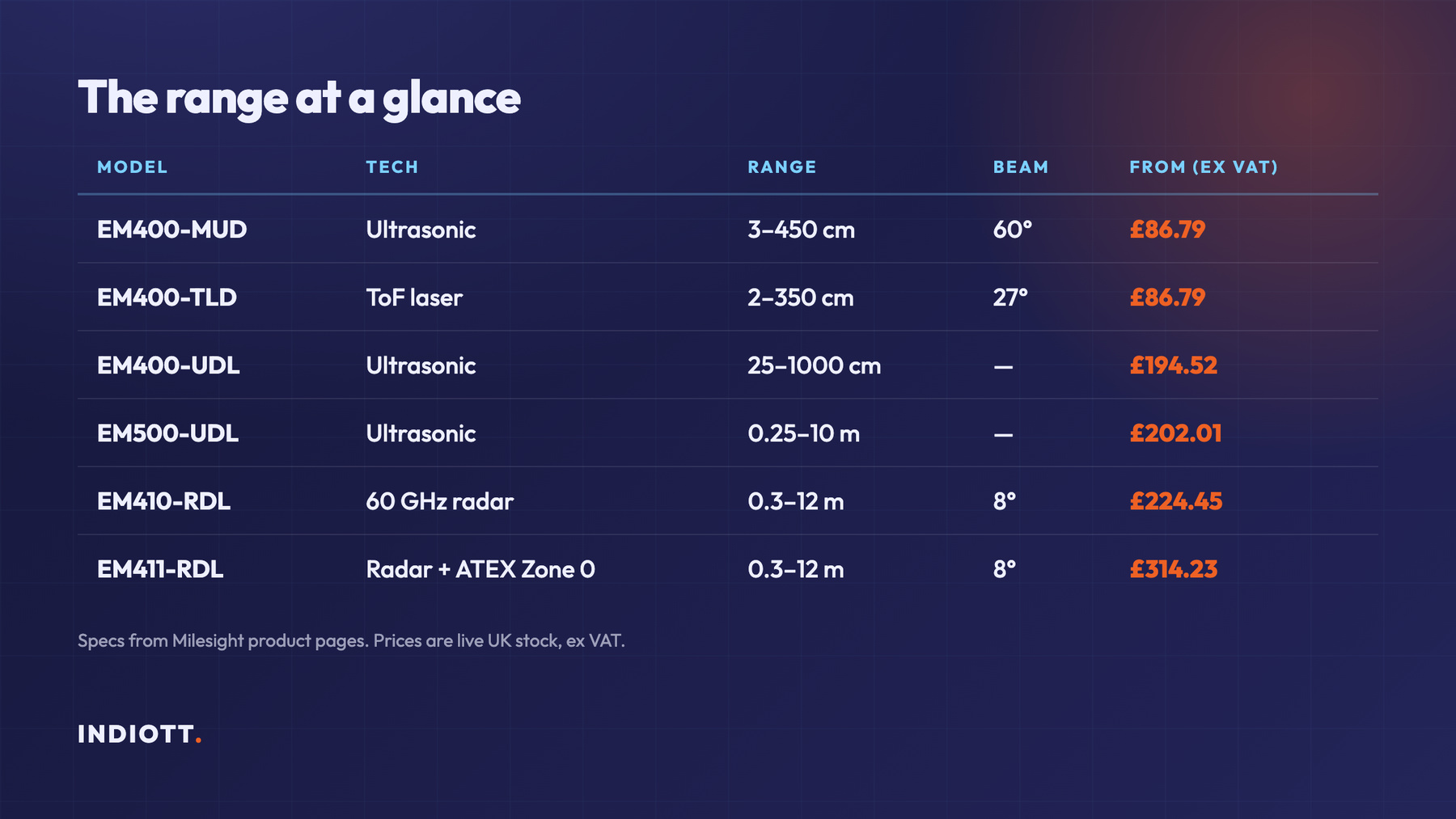
The six current models split into three price tiers. Under £110 you get the compact EM400 family with a 3.5 m to 4.5 m reach. Around £200 you get longer ultrasonic reach and tighter accuracy. Above £220 you are buying 60 GHz radar and the environmental immunity that comes with it.
Specifications below are taken from Milesight’s published product pages, and prices are live UK stock, ex VAT, at the time of writing.
- EM400-MUD — ultrasonic, 3–450 cm, 60° beam, IP67, two 9000 mAh cells, over 10 years, −30°C to +70°C, with built-in tilt and temperature sensing. From £86.79.
- EM400-TLD — ToF laser, 2–350 cm, 27° field of view, ±2 cm, IP67, around 10 years, −30°C to +70°C. From £86.79.
- EM400-UDL — ultrasonic, 25–500 cm or 25–1000 cm standard, 30–500 cm or 50–1000 cm Pro at ±1% full scale, IP67, over 10 years. From £194.52.
- EM500-UDL — ultrasonic, 0.25–5 m or 0.5–10 m depending on variant, IP67 with UV resistance, one 19000 mAh cell, 10 years. From £202.01.
- EM410-RDL — 60 GHz radar, 0.3–12 m, 8° beam, up to ±2 mm on smooth surfaces, IP68 rated to 1 m for 48 hours, around 7 years, −40°C to +70°C. From £224.45.
- EM411-RDL — identical radar performance to the EM410-RDL, plus intrinsically safe ATEX Zone 0 certification. From £314.23.
Two things in that list are worth pausing on. The EM400-MUD and EM400-TLD cost the same, so the choice between sound and light is a free decision made purely on the medium. And the EM411-RDL costs £89.78 more than the EM410-RDL for one difference: the ATEX certificate. If your chamber is not a classified hazardous area, that is £89.78 you do not need to spend.
Why beam angle matters more than range
A wide beam in a narrow chamber measures the wall, not the liquid. This is the specification that decides most failed installations, and it is the one buyers ignore. The beam spreads as a cone, so the width of the footprint at the surface is a function of depth and angle, and you can work it out with school trigonometry.
Take a 3 m drop from sensor to surface. The EM400-MUD’s 60° ultrasonic beam illuminates a circle roughly 3.5 m across at that depth. The EM400-TLD’s 27° laser field of view covers about 1.4 m. The EM410-RDL’s 8° radar beam covers about 0.4 m. In a 1 m diameter manhole 3 m deep, only the radar sees nothing but water. The ultrasonic head is looking at the shaft walls, the benching and every pipe entry, and it will lock onto whichever of those returns the strongest echo.
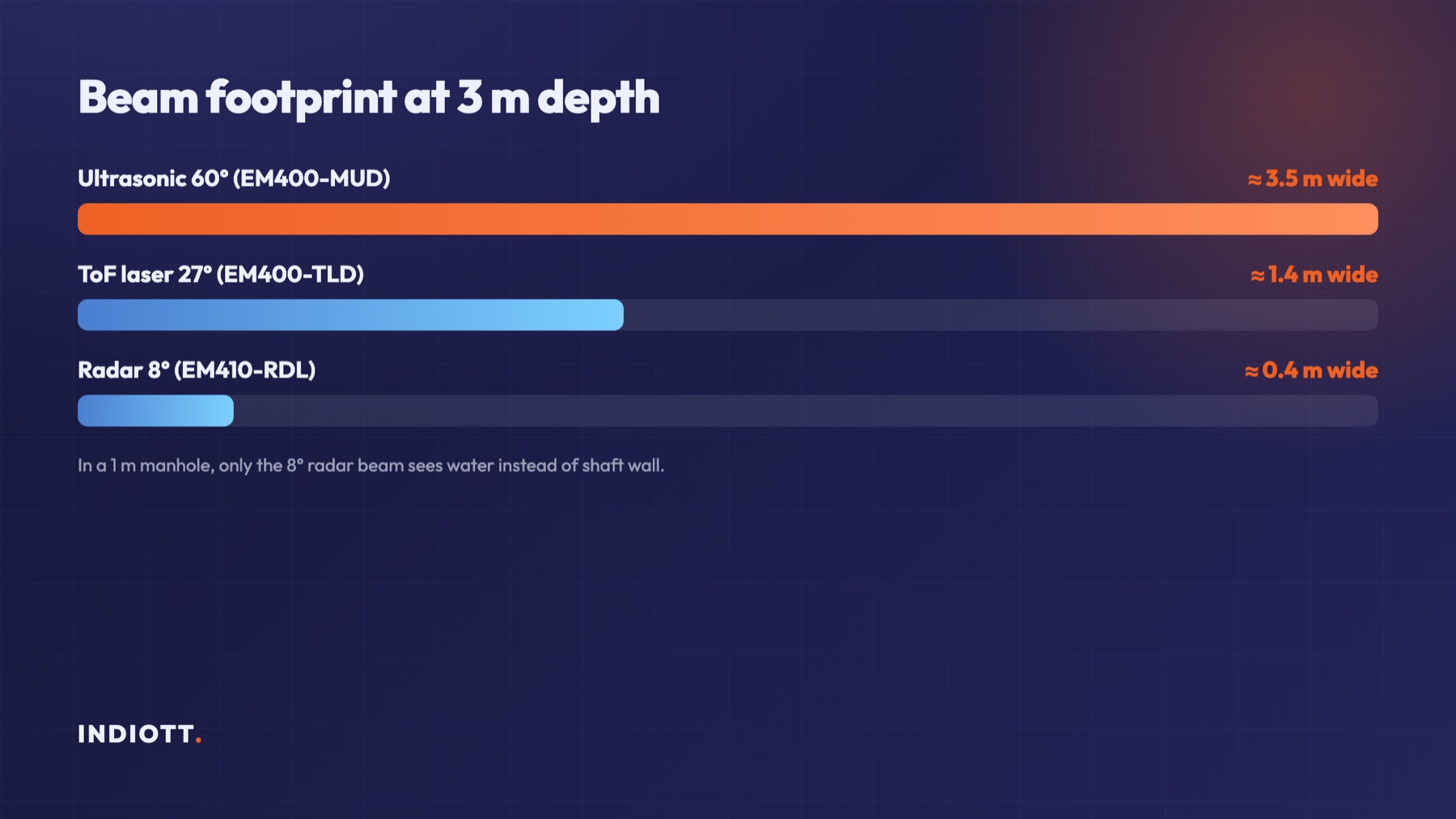
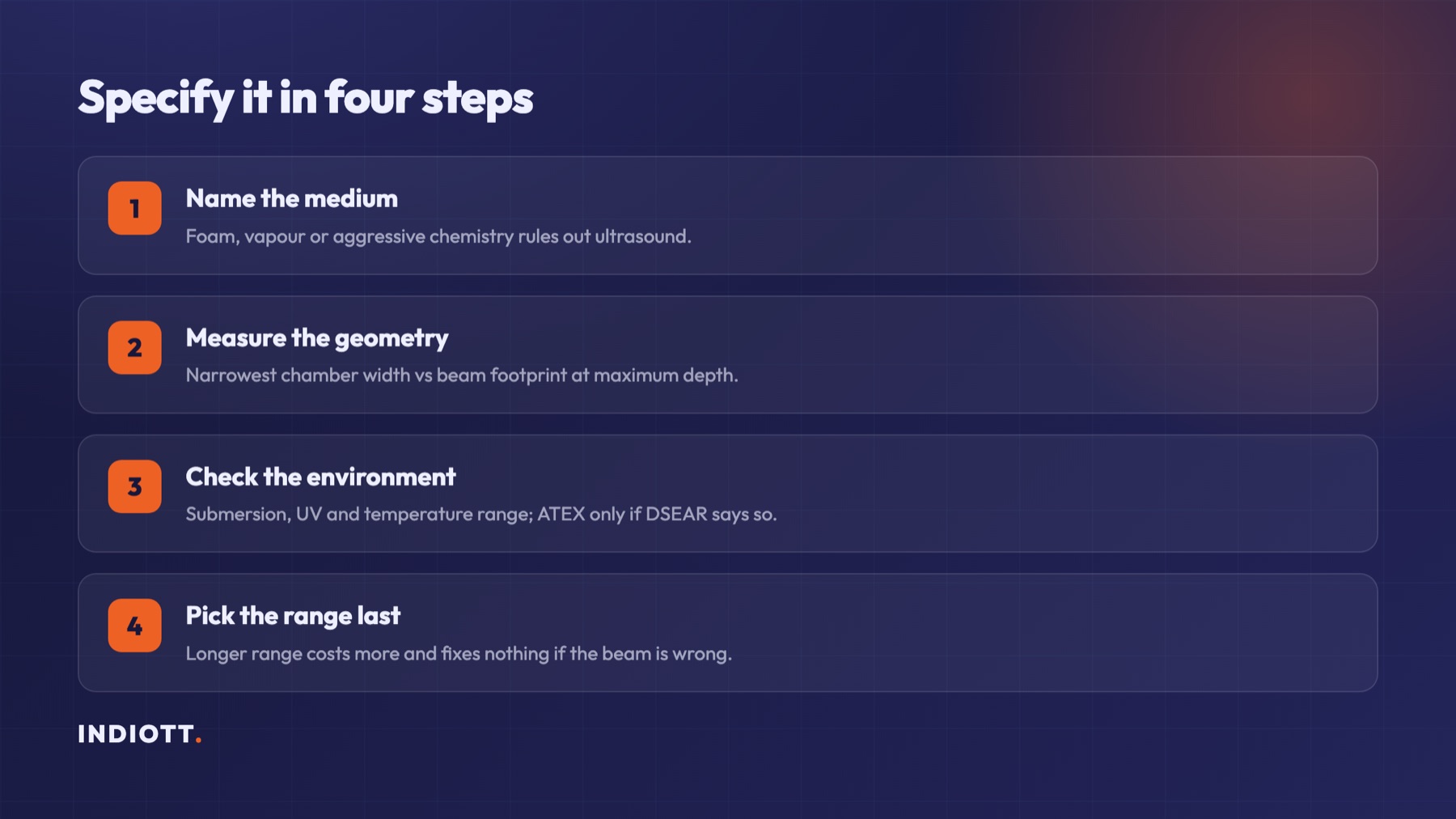
The practical test before you order: measure the narrowest dimension of the chamber, measure the deepest the level sensor will ever have to read, and check that the beam footprint at that depth still fits with clearance. If it does not, you need a tighter beam, not a longer range. This is why a £224.45 radar head is sometimes the cheap option, because the alternative is a £86.79 level sensor that produces numbers nobody trusts.
Which Milesight level sensor fits your job?
Match the level sensor to the awkward part of the site, not the easy part. These are the pairings that hold up in practice.
Waste bins and recycling containers. The EM400-MUD, in its Bin mode, with the tilt sensor doubling as a knocked-over or emptied signal. Wide beam is an advantage here because the surface is irregular and you want an average, not a point reading.
Sewers, wet wells and pumping stations. The EM410-RDL. Vapour, condensation and confined shafts are exactly the three conditions ultrasound handles worst, and the IP68 rating tolerates temporary submersion during a surcharge event. Our storm overflow monitoring guide covers the regulatory side of this application.
Fuel, oil and chemical tanks. The EM410-RDL for most, the EM411-RDL where the tank sits in an ATEX Zone 0 classified area. Both use a PVDF housing rated UL94 V0, which is the reason they tolerate aggressive vapours that would degrade a standard enclosure.
Water butts, salt stores and grain hoppers. The EM400-MUD or, if the store is deeper than 4.5 m, the longer-reach EM500-UDL level sensor. Dry bulk solids form a cone rather than a flat surface, so expect the reading to represent the peak of that cone.
Narrow standpipes and slim vessels. The EM400-TLD, whose 27° field of view fits where a 60° cone will not, provided the liquid is not foaming and the optical window stays clean.
For a broader treatment of monitoring strategy across a whole site, our tank level monitoring guide covers alarm thresholds, reporting intervals and the operational side.
What else do you need besides the sensor?
A level sensor on its own reports to nothing. You need a LoRaWAN gateway within radio range and a network server to decode the packets. For a single site the cheapest complete path is a gateway with an embedded network server, because it removes the platform subscription entirely.
That distinction matters when budgeting. The UG63 (£98.76) is a packet forwarder and expects an external network server. The UG65 (£279.82) and UG67 (£658.39) carry an embedded network server, so a small deployment can run with no recurring software cost at all. Our Milesight gateway buyer’s guide works through the choice in detail.
Budget realistically for the first site: one gateway, the level sensors, and a day of commissioning to set mounting heights and alarm thresholds. Level sensors are the cheap part.
Frequently asked questions
Which Milesight level sensor has the longest range?
The EM410-RDL and EM411-RDL, both rated 0.3 m to 12 m. Among the ultrasonic models the EM400-UDL and EM500-UDL reach 10 m in their long-range variants, while the EM400-MUD stops at 450 cm.
Can these sensors measure through a sealed tank lid?
Not reliably. Radar can pass through some plastics, but the manufacturer’s ranges assume a clear path to the surface. Fit the level sensor through a gland or on a bracket inside the vessel rather than assuming it will read through the roof.
What accuracy can I actually expect?
The radar models are quoted up to ±2 mm on smooth surfaces and ±5 mm on relatively smooth ones. Ultrasonic models are quoted as ±(1+0.3%×S) cm, so at 3 m that is roughly ±1.9 cm, or ±1% of full scale on the Pro and W variants. Real-world accuracy is usually limited by your mounting height measurement, not the level sensor.
How long do the batteries really last?
Milesight quotes 10 years for most models and around 7 years for the radar units, always at a stated reporting interval and 25°C. Reporting every 10 minutes instead of every hour, or operating near the temperature limits, will shorten that materially. Treat the headline figure as a best case.
Do I need ATEX certification?
Only if the level sensor will sit inside a classified hazardous area. That is a determination made by your site’s DSEAR risk assessment, not by the product catalogue. If no one has classified the area, ask before you spend the extra £89.78 on the EM411-RDL.
Will these work with my existing LoRaWAN network?
Yes. They are standard LoRaWAN Class A devices on EU868 in the UK and will join any compliant network server, including The Things Stack, ChirpStack and the servers embedded in Milesight’s own gateways.
The bottom line
Choose your level sensor on medium first, chamber geometry second, and range last. Ultrasound for open, dry, stable spaces; laser where the opening is narrow and the liquid is clean; radar wherever there is vapour, foam or a confined shaft. Only pay for ATEX when a risk assessment says you must. Prices above are live UK stock ex VAT — browse the Milesight sensor range, or send us the chamber dimensions and the medium and we will spec it and quote within one working day.
Next step
Get a priced kit list for your site
Answer three quick questions and tell us where to send it. An engineer replies within one working day with the parts, the prices and the lead time.
Rather talk it through? Call 023 9223 3611
Received. An engineer has it.
You will hear back within one working day with the parts, the prices and the lead time. A confirmation is on its way to your inbox.
If it is urgent, call 023 9223 3611.