BUILT IN-HOUSE / WORKPLACE SAFETY
IND-DUST Real-Time Dust Monitor
Real-time dust levels with an alarm on the floor
The short answer
What does a real-time dust monitor with an on-site alarm do?
It measures airborne dust continuously and sounds an alarm on the floor the moment levels climb, so work stops or extraction starts while it matters. Built by Indiott with PSI Technologies. It is an early-warning instrument, not gravimetric sampling, so it does not by itself evidence COSHH compliance.
A dust problem you only find out about from a quarterly survey is a dust problem you cannot act on. By the time a report comes back you cannot say which task, which shift or which hour caused it, and the extraction fan that failed last Tuesday has been failed ever since. We engineered the Dust Monitor for a site that needed to see the level climb and hear about it on the floor, while the shift was still running.
Talk through your site ● Answered within one working day
The difference
Dust monitor: what changes the day it goes live
A dust problem you only find out about from a quarterly survey is a dust problem you cannot act on. By the time a report comes back you cannot say which task, which shift or which hour caused it, and the extraction fan that failed last Tuesday has been failed ever since. We engineered the Dust Monitor for a site that needed to see the level climb and hear about it on the floor, while the shift was still running.
- Continuous ambient particulate readings where people actually work, sampled every few seconds rather than once a quarter
- Two configurable alarm thresholds that warn on the unit and raise a remote notification at the same moment
- A time-stamped trend per area and shift, so you can see which tasks and which hours actually generate dust instead of guessing
- A dashboard and export that tells your hygienist where and when to sample, rather than sampling blind on a calendar
What you get
- 01
Continuous ambient particulate readings where people actually work, sampled every few seconds rather than once a quarter
- 02
Two configurable alarm thresholds that warn on the unit and raise a remote notification at the same moment
- 03
A time-stamped trend per area and shift, so you can see which tasks and which hours actually generate dust instead of guessing
- 04
A dashboard and export that tells your hygienist where and when to sample, rather than sampling blind on a calendar
What this monitors, and what it is not
What this covers
Continuous ambient particulate monitoring with threshold alarms, so a failed extraction fan or a dusty process is caught the moment it happens rather than at the next survey.
What it does not
Respirable dust or workplace exposure limit compliance. These are ambient laser-scattering sensors rated 0–1000 µg/m³ with ±10 µg/m³ accuracy below 100 µg/m³. Nothing in their specification claims a respirable fraction, COSHH compliance or gravimetric equivalence.
Treat the output as trend and alarm data. If the number has to appear in a compliance report, that is a job for an occupational hygienist.
The full stack, applied here
One dust spike, from the floor to the alarm on it
Every Indiott build runs all five layers as one accountable system. Follow a single dust over limit from the sensor that catches it to the report that proves it.
The Indiott Dust Monitor reads particulate levels and air quality continuously where the work actually happens, the live picture occasional badge sampling cannot give.
Hands a live reading to CONNECT ↓
The unit reports over LoRaWAN or cellular from a sealed portable case, so a dusty workshop, a quarry weighbridge or a yard is covered without running mains or data cable to awkward spots.
Hands a signed reading to SECURE ↓
An encrypted uplink and device authentication keep the dust record tamper-evident wherever the unit joins a customer network.
Hands a trusted record to CONTROL ↓
Two configurable alarm thresholds drive the indicators on the unit and a remote notification the moment a level is approached, so the floor is warned while the shift is still running, not weeks later.
Hands an action and proof to MANAGE ↓
A dashboard logging every reading with trend per area and shift, exported so a hygienist can target formal sampling, or pushed to your platform over an API.
The loop is closed ✓
How teams start
From a single pilot to the whole portfolio
You do not boil the ocean. Nearly every rollout runs the same four moves, and you own a working, evidenced result at the end of the first one.
Scope & risk map
We walk the sites, list the assets and pin the one constraint that matters, then agree what a good result looks like before a single sensor is bought.
Pilot on one site
A focused set of sensors goes onto one site or asset group, live on our telemetry and dashboards, wired to the people who need the alert.
Validate & standardise
We tune thresholds, kill false positives, confirm the integration into your SCADA, BMS or CAFM, and write the standard design down so it repeats.
Scale the portfolio
The proven design rolls out across the estate, reusing the same hardware standards and data models so every site reads the same way.
Why Indiott
A specialist stack, not a box-shifter
Brand-agnostic by design
We pick the best of each brand for the layer and the environment, not one vendor catalogue. Milesight, AquaIoT, Atop, Browan, SpecSens and Urban.io, chosen on merit.
The whole stack, one supplier
Sensing, connectivity, OT security, control and the dashboard come from one accountable team, so there is no finger-pointing when something needs to talk to something else.
Specified and supported in Britain
UK-based engineers scope the site, quote the kit and stand behind it, with compliance mapped to the regimes your auditors actually cite.
Honest kit, honest pricing
Prices are shown where we can, quoted fast where we cannot, and you get a straight answer and a bill of materials within one working day.
 DEPLOYED IN THE FIELD
Compliance this answers to
| Standard | What it requires |
|---|---|
| COSHH Regulations 2002 | continuous ambient monitoring supports the duty to assess and control exposure by showing where and when dust is generated. It informs the assessment; it does not replace the personal sampling the assessment rests on. |
| Not a compliance instrument, deliberately | these are ambient laser-scattering sensors rated 0 to 1000 ug/m3. Nothing in the specification claims a respirable fraction or gravimetric equivalence, so the output is trend and alarm data, not a workplace exposure limit measurement. |
| Built with our partner PSI Technologies for a real site-safety duty | |
What it costs, roughly
The Dust Monitor is specified to the areas you need covered, the dust risks involved and the alarm configuration you want, so it is quoted to the application rather than sold from a price list. Tell us the site and the duty and a costed specification comes back within one working day.
Frequently asked questions
What do you set the alarm thresholds against?
The GB workplace exposure limits published in HSE EH40/2005 are the usual reference point, so a threshold is set below the relevant limit and the alarm fires while there is still time to act. That is a threshold choice, not a measurement claim: these are ambient particulate sensors, so what they report is trend and alarm data rather than a workplace exposure limit measurement.
Does continuous dust monitoring replace COSHH air sampling?
No, and we will not claim it does. Formal proof of compliance with a workplace exposure limit still needs gravimetric personal sampling on weighed filters, analysed to methods such as MDHS 14/4. Continuous optical monitoring sits alongside it: it shows which task, area and shift creates the peaks, drives control in real time, and gives evidence between sampling rounds.
How does the alarm reach people on the floor?
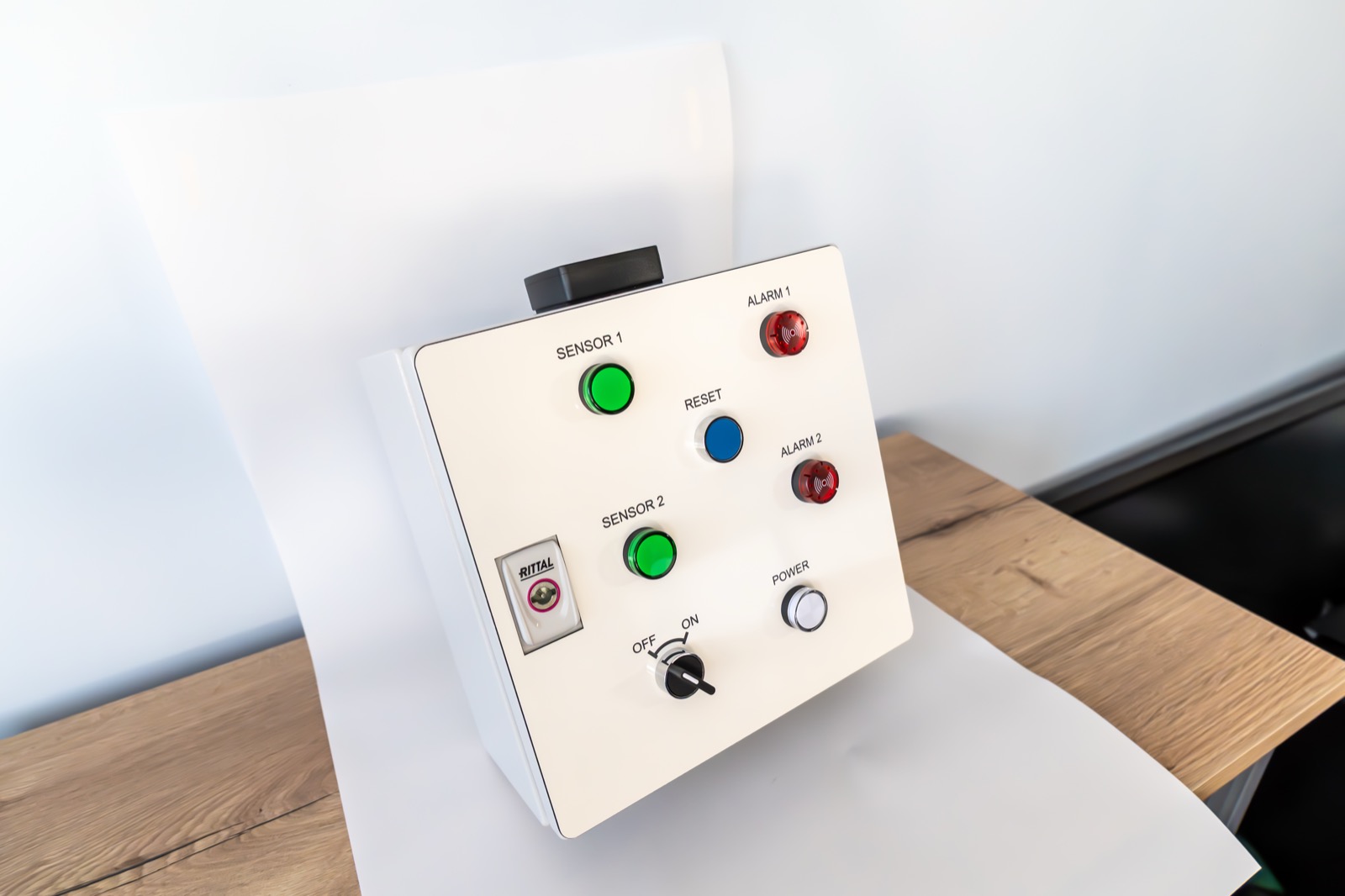
The panel raises a local audible and visual warning at the work area and pushes the alert to phones and the dashboard at the same moment. Two thresholds are configurable per area, so you can warn early and again at the level you want work to stop. If you need it wired to plant such as local exhaust ventilation, tell us and we scope that as part of the build rather than assume it.
How does data get out of a dusty workshop, quarry or yard?
Over LoRaWAN on the EU868 band, which carries several hundred metres inside a steel-framed building and a few kilometres across open ground back to one gateway, or over cellular where that suits the site better. Readings forward north over MQTT or HTTP, so the data can land in your own dashboard, BMS or SHE platform.
Could an off-the-shelf sensor do this instead?
Indoors, sometimes. A general indoor air-quality sensor measures PM2.5 and PM10 alongside CO2, TVOC, temperature and humidity, and suits offices, classrooms and clean workshops. What those units do not have is the on-unit alarm panel and the sealed, field-ready build, so for a site that needs the warning to happen where the work happens we build the Dust Monitor instead.
What does a Dust Monitor deployment cost and how long does it take?
Pricing is quoted per site because sensor count, enclosure and alarm configuration differ with the area being covered. Tell us the areas and the substance and you get a costed bill of materials within one working day. The stock hardware around it is typically dispatched within 14 working days. Most sites pilot one area first, then standardise.
Is this a respirable dust monitor for workplace exposure limits?
No. These are ambient particulate sensors rated 0–1000 µg/m³ with ±10 µg/m³ accuracy below 100 µg/m³. Nothing in the specification claims a respirable fraction, COSHH compliance or gravimetric equivalence. They are excellent at catching a failed extraction fan at 3am and reporting a trend; they are not the instrument for a compliance report.
Buying this in the UK
- IND-DUST is built to order by Indiott with PSI Technologies. Contact us for a price.
- Supplied by Indiott, a trading name of PSI Technologies Limited (Companies House 03689664, VAT GB 730 2340 83), Hampshire, United Kingdom.
- Every price is published ex VAT at indiott.com — no quote needed to see it.
- Typically dispatched within 14 working days from the UK, on a VAT invoice.
- Call 023 9223 3611 or request a quote.
Related solutions
Next step
Scope it with an engineer.
Tell us the site, the assets and the constraint. You get a bill of materials and a straight answer within one working day.
- A bill of materials sized to your site
- Priced ex VAT, UK entity, no login wall
Rather talk it through? Call 023 9223 3611
Received. An engineer has it.
You will hear back within one working day with the parts, the prices and the lead time. A confirmation is on its way to your inbox.
If it is urgent, call 023 9223 3611.