Milesight WS201 vs EM400-MUD vs EM400-TLD: which bin fill level sensor?
Short answer: The Milesight WS201 is for small indoor containers — its Time-of-Flight range is 1 to 55 cm, so it reads a paper or soap dispenser rather than a waste bin, and it is the cheapest of the three. The EM400-MUD is the ultrasonic one, 3 to 450 cm with a 60° beam, and it is the only model here that reaches the bottom of a deep commercial bin. The EM400-TLD covers 2 to 350 cm through a narrow 27° laser field of view, which is what you want when the container is deep but narrow. Both EM400 models are IP67 and rated -30 to 70 °C; the WS201 is IP30 and carries no water-ingress rating at all.
Which bin fill level sensor do I actually need?
Choose the WS201 if you are monitoring washroom consumables or small indoor containers — tissue, towel and soap dispensers in airports, hotels, shopping malls and visitor attractions. It mounts on a flat surface with 3M tape, weighs 24.7 g and is 12 mm thick, so it fits inside a dispenser lid, and it runs around 3.6 years on a single CR2450 at SF7 on EU868. Anything deeper than 55 cm is simply out of range.
Choose the EM400-MUD if the container is a real waste bin and you need depth. Its ultrasonic range runs to 450 cm, the longest of the three, and the LoRaWAN version ships with pre-set standard, bin and parking-lot modes. Accuracy is stated as ±(1 + 0.3% × S) cm, which works out at roughly ±1.3 cm at one metre. It is screw-mounted, IP67, and rated above ten years in bin mode at a 20-minute reporting interval.
Choose the EM400-TLD if the bin is deep but narrow, or the surface you are measuring is small. Its laser field of view is 27° against the MUD’s 60°, so the beam is far less likely to catch a bin wall on the way down and report full when it is not. Range is 2 to 350 cm, accuracy a flat ±2 cm, IP67, around ten years in standard mode at a 10-minute interval.
The EM400-MUD and EM400-TLD cost the same — what separates them?
Beam angle and range, and remarkably little else. The published specifications do not distinguish these two models on resolution (1 mm each), ingress protection (IP67 each), battery (2 × 9000 mAh ER26500 each), operating temperature (-30 to 70 °C each), tilt detection (3-axis accelerometer each), or the NTC temperature sensor both carry for a trash-burning alarm. They are within 3 mm and 30 g of one another. So decide on geometry alone: a wide 60° ultrasonic cone that fills a broad bin and reaches 450 cm, or a narrow 27° laser that stays off the walls of a tall, slim one but stops 100 cm shorter. Note the direction of that trade — the EM400-TLD is not the longer-range model, despite being the laser.
What else does a rollout need?
All three are LoRaWAN Class A devices supporting OTAA and ABP, and all three list EU868, the band the UK uses. The bill of materials is therefore one gateway for the site plus one sensor per bin or dispenser — not a gateway per bin. All three are configured over NFC from a phone app or by downlink once joined, so there is nothing to wire and no display to read. Be deliberate about placement: the WS201 is not a scaled-down EM400. It is IP30 with no water rating and an operating range of -10 to +60 °C, which keeps it indoors, while the two EM400s are IP67 and rated -30 to 70 °C.
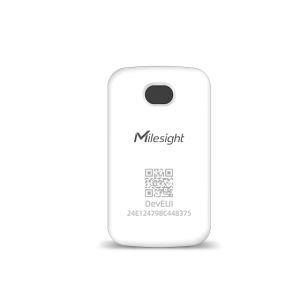
Milesight WS201 Smart Fill Level Monitoring Sensor
WS201-868M
£38.90 ex VAT (£46.68 inc. VAT)
Detection range (Time-of-Flight)1 - 55 cm
View the WS201-868MMilesight EM400-MUD Multifunctional Ultrasonic Distance/Level Sensor – LoRaWAN® Version
EM400-MUD-868M
£86.79 ex VAT (£104.15 inc. VAT)
View the EM400-MUD-868MMilesight EM400-TLD ToF Laser Distance Sensor – LoRaWAN
EM400-TLD-868M
£86.79 ex VAT (£104.15 inc. VAT)
View the EM400-TLD-868MSpecification comparison
| Specification | WS201-868M | EM400-MUD-868M | EM400-TLD-868M |
|---|---|---|---|
| Advanced features | Threshold alarm, hibernate mode | — | — |
| Approvals | CE, FCC; RoHS | — | — |
| Battery life | Around 3.6 years (SF7, EU868 & US915); around 2.3 years (SF10, EU868) at 60-min interval, 13 working hours a day, 25°C | — | — |
| Colour & material | White, ABS + PC (flame retardant) | — | — |
| Configuration | Mobile app via NFC, or Downlink | — | — |
| Detection accuracy | ± 1 cm | — | — |
| Detection range | 1 - 55 cm | — | — |
| Detection resolution | 1 mm | — | — |
| Dimensions | 66 × 38 × 12 mm | — | — |
| Frequency | CN470/IN865/RU864/EU868/US915/AU915/KR920/AS923-1&2&3&4 | — | — |
| Ingress protection | IP30 | — | — |
| Installation | On flat surfaces with 3M tape | — | — |
| Measurement technology | Time-of-Flight (ToF) | — | — |
| Operating temperature | -10°C ~ +60°C, 0-95% RH non-condensing | — | — |
| Power supply | 1 × 590 mAh CR2450 lithium battery | — | — |
| Protocol / mode | LoRaWAN®; OTAA/ABP Class A | — | — |
| ToF field of view | 25° (FoV accuracy ± 5°) | — | — |
| Tx power / sensitivity | 16 dBm (868 MHz) / 22 dBm (915 MHz) / 19 dBm (470 MHz); -132 dBm @300bps | — | — |
| Weight | 24.7 g (battery included) | — | — |
Specifications taken from the manufacturer datasheets. Rows where the models are identical are dimmed. Prices are ex VAT and read live from the catalogue.
Frequently asked questions
How deep a bin can each sensor measure?
The WS201 detects from 1 to 55 cm, so it suits dispensers and small containers only. The EM400-TLD covers 2 to 350 cm and the EM400-MUD covers 3 to 450 cm, making the MUD the deepest-reaching of the three.
Can the WS201 be used outdoors or in a wet bin store?
Its specification lists IP30 and an operating range of -10 to +60 °C, with no water-ingress rating. The EM400-MUD and EM400-TLD are both IP67 with an internal damp-proof coating and are rated -30 to 70 °C.
Which is more accurate, the EM400-MUD or the EM400-TLD?
Both resolve to 1 mm. The MUD is specified at ±(1 + 0.3% × S) cm, which is about ±1.3 cm at one metre, while the TLD is a flat ±2 cm across its range. The WS201 is ±1 cm over its much shorter 1-55 cm range.
Will these work on a UK LoRaWAN network?
Yes. All three list EU868 among their supported frequencies, which is the band used in the UK, and all three operate as LoRaWAN Class A devices with OTAA or ABP join. Configuration is by NFC from a mobile app, or by downlink.
How long do the batteries last?
The WS201 runs around 3.6 years on one 590 mAh CR2450 at SF7 on EU868 (about 2.3 years at SF10), based on a 60-minute interval, 13 working hours a day at 25 °C. Both EM400 models use 2 × 9000 mAh ER26500 cells: the MUD is rated over ten years in bin mode at a 20-minute interval, the TLD around ten years in standard mode at a 10-minute interval.
Can any of them detect a bin fire or a knocked-over bin?
The EM400-MUD and EM400-TLD both carry an NTC temperature sensor (-40 to 125 °C, 0.1 °C resolution) for a trash-burning alarm and a 3-axis accelerometer reporting normal or tilted status. The WS201 specification lists neither; its advanced features are threshold alarm and hibernate mode.