Milesight UF31 vs UF51: 5G dongle or outdoor 5G CPE?
Short answer: The UF31 is an indoor 5G modem that puts one wired device on a cellular connection. The UF51 is an outdoor 5G CPE built to be mounted on a pole or a wall and cabled back inside. They share a CPU and a modem generation, but almost nothing else about how they are installed is the same. The UF31 is a single price, £486.31 ex VAT; the UF51 is sold in two variants at £508.75 and £591.05 ex VAT, so it costs between about 5 and 22 per cent more depending on which one you need. Check the live range in the table below rather than assuming the headline figure.
The decision is usually made by where the signal is, not by the specification. If the 5G signal is good where the equipment lives, buy the UF31. If the signal is only good outside or up high, buy the UF51, because no amount of specification fixes a modem sitting in the wrong place.
Which one do I need?
Choose the UF31 for an indoor cabinet, a comms room or a desk, where you need one Gigabit Ethernet device online over 5G. It is 90 x 72 x 15 mm and takes 5-24 VDC or simply USB-C power, which makes it easy to hide in an existing enclosure, and it will DIN rail mount. It has four external SMA cellular connectors, so if the signal is marginal you can move the antennas to a window or run them outside on extensions while the unit stays indoors. Downlink is up to 2.5 Gbps, it is IP30 and rated -20°C to +50°C, so it must stay inside.
Choose the UF51 when the unit itself has to go outside. It is IP67 in a polycarbonate and cast-aluminium housing, rated -30°C to +60°C, and it is powered over 802.3at PoE on the LAN1 port, which means one Ethernet cable carries both power and data up the pole. Downlink is up to 4.67 Gbps using 2CC carrier aggregation. Its eight cellular antennas are internal, which is the trade: you cannot reposition them, but you have already solved the problem by mounting the whole unit where the signal is.
The UF51 is also a field gateway, and that is easy to miss
Beyond connectivity the UF51 carries an RS485 serial interface, one galvanically isolated digital input and one digital output, and a second Gigabit Ethernet port with the WAN port running at up to 2500 Mbps. On a remote site that turns one box into the cellular uplink, the local switch and the Modbus RTU connection to a panel or a meter. The UF31 has one Ethernet port and no serial or IO at all.
Optional Wi-Fi on the UF51 is 802.11ax 4×4 MIMO on both bands, up to 1200 Mbps at 2.4 GHz and 2400 Mbps at 5 GHz, which makes it a complete site solution for a compound or a car park. Note the power cost: typically 4.8 W without Wi-Fi and 9.9 W with it, against 3.9 W typical for the UF31.
Things that are the same
Both run a quad-core ARM Cortex-A55 at 2 GHz with 1 GB RAM and 1 GB flash. Both support 5G NR SA and NSA, 4G LTE and WCDMA on one Micro SIM. Both carry GNSS across GPS, GLONASS, Beidou, Galileo and QZSS. Both take a USB 3.0 Type-C connection for debugging. If you were choosing on processing or on network technology there would be nothing to choose between them, which is why the installation environment should decide it.
One constraint worth checking first
The UF51 accepts either 9-48 VDC through the power connector or 802.3at PoE, but the datasheet is explicit that it is one or the other, not both at once. If you were planning PoE with a DC supply as failover, that is not how this unit works, and the redundancy has to sit upstream in the PoE injector or switch instead.
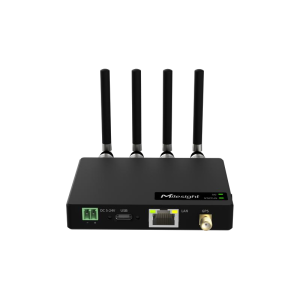
Milesight 5G Dongle
UF31
£486.31 ex VAT (£583.57 inc. VAT)
Cellular network and peak download speed5G NR SA & NSA / 4G LTE / WCDMA, up to 2.5 Gbps download
View the UF31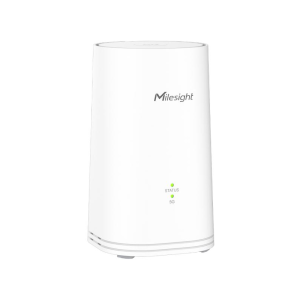
Milesight UF51 5G CPE
UF51
Price range: £508.75 through £591.05 ex VAT (£610.50 – £709.26 inc. VAT)
5G downlink speedUp to 4.67 Gbps (2CC carrier aggregation, 5G Sub-6 GHz)
View the UF51Specification comparison
| Specification | UF31 | UF51 |
|---|---|---|
| Dimensions | 90 × 72 × 15 mm | ф105 × 110 × 187 mm (ф105 × 110 × 218 mm with waterproof connector) |
| GNSS | GPS/GLONASS/Beidou/Galileo/QZSS | GPS/GLONASS/Beidou/Galileo/QZSS, 2 m CEP (open air) |
| Ingress protection | IP30 | IP67 |
| Installation | Desktop, wall mounting, DIN rail mounting | Desktop, pole mounting, wall mounting, bottom screw mounting |
| Memory | 1 GB LPDDR4X RAM and 1 GB NAND Flash | 1 GB LDDR4x RAM, 1 GB NAND Flash |
| Operating temperature | -20°C to +50°C | -30°C to +60°C (-22°F to +140°F) |
| Power consumption | Typical 3.9 W | Without Wi-Fi typical 4.8 W / max 6.5 W; with Wi-Fi typical 9.9 W / max 14.4 W |
| Power input | 5-24 VDC (2-pin 3.5 mm terminal block, surge and reverse-polarity protected); or 5 V / 3 A by USB Type-C | 9-48 VDC by power connector, or 802.3at PoE PD (not both at once) |
| SIM slot | 1 (Micro SIM-3FF) | 1 × Micro SIM (3FF), 1.8V/3V |
| USB | 1 × USB 3.0 (Type-C) for power supply, network supply and debug | 1 × USB 3.0 Type-C for network supply and debugging |
| 5G Sub-6 bands | N1/N3/N5/N7/N8/N20/N28/N38/N40/N41/N77/N78/N79 | — |
| 5G frequency (Sub-6) | — | N1/N3/N5/N7/N8/N20/N28/N38/N40/N41/N77/N78 |
| Antenna connectors | 4 × 50 Ω SMA (cellular) + 1 × 50 Ω SMA (GNSS) | — |
| Approvals | — | CE; RoHS |
| Cellular antennas | — | 8 × internal antennas |
| DI/DO | — | 1 × DI + 1 × DO, galvanic isolation; DO wet contact max 0.3A@30VDC |
| Ethernet | 1 × 10/100/1000 Mbps LAN port | — |
| Ethernet ports | — | 1 × 10/100/1000 Mbps (LAN2); 1 × 10/100/1000/2500 Mbps (LAN1/WAN) |
| Housing | Metal, black | — |
| LTE bands | FDD: B1/B3/B5/B7/B8/B18/B19/B20/B28/B32; TDD: B38/B40/B41/B42/B43/B46 | — |
| LTE frequency | — | FDD B1/B3/B5/B7/B8/B20/B28/B32; TDD B38/B40/B41/B42/B43 |
| Management | Web, CLI, DeviceHub | — |
| Max downlink speed | — | Up to 4.67 Gbps (2CC CA, 5G Sub-6 GHz) |
| PoE | — | 1 × 802.3at PoE PD on LAN1/WAN port |
| Relative humidity | 0% to 95% (non-condensing) at 25°C | — |
| Security | Access control, port mapping, DMZ, SYN-Flood protection, filtering (IP & MAC & domain) | — |
| Serial interface | — | 1 × RS485 (RS232 hardware optional), 300 bps to 230400 bps |
| Storage temperature | -40°C to +85°C | — |
| VPN | IPsec, OpenVPN | — |
| Weight | — | 957.3 g |
| Wi-Fi (optional) | — | 802.11b/g/n/ax 4×4 MIMO 2.4 GHz; 802.11a/n/ac/ax 4×4 MIMO 5 GHz; 4 × internal antennas |
| Wi-Fi max bit rate | — | 2.4 GHz: 1200 Mbps; 5 GHz: 2400 Mbps |
| CPU | Quad-core ARM Cortex-A55, 2 GHz | Quad-core ARM Cortex-A55, 2 GHz |
| Cellular network | 5G NR SA & NSA / 4G LTE / WCDMA | 5G NR SA & NSA / 4G LTE / WCDMA |
Specifications taken from the manufacturer datasheets. Rows where the models are identical are dimmed. Prices are ex VAT and read live from the catalogue.
Frequently asked questions
Can the UF31 be mounted outdoors?
No. The UF31 is IP30 and rated -20 degC to +50 degC, which is an indoor specification. It has four external SMA cellular antenna connectors, so the usual approach is to keep the unit indoors and run the antennas to where the signal is. If the unit itself has to be outside, that is the UF51 at IP67 and -30 degC to +60 degC.
Which is faster, the UF31 or the UF51?
The UF51, on paper. It is quoted at up to 4.67 Gbps downlink using 2CC carrier aggregation on 5G Sub-6, against up to 2.5 Gbps for the UF31. In practice the limit on most UK sites is signal quality and the operator's network rather than the modem, which is why mounting position usually matters more than the headline figure.
Does the UF51 need a separate power supply?
Not if you use PoE. It accepts 802.3at PoE PD on the LAN1/WAN port, so one Ethernet cable carries power and data. It can alternatively take 9-48 VDC through the power connector. The datasheet states these are alternatives and cannot both be connected at the same time, so PoE plus DC as a failover pair is not supported.
Can I connect Modbus equipment to either unit?
Only to the UF51. It carries one RS485 interface running from 300 bps to 230400 bps, plus one digital input and one digital output with galvanic isolation. The UF31 has a single Gigabit Ethernet port and no serial or IO interfaces, so Modbus RTU equipment would need a separate gateway alongside it.
Do both take the same SIM?
Yes, both take one Micro SIM in the 3FF format and both support 5G NR SA and NSA, 4G LTE and WCDMA. The band lists differ slightly: the UF31 adds N79 and LTE B46 and B19, which the UF51 band list does not include. For UK networks both are comprehensively covered.