GS301 vs GS601: odour detection or vape detection?
Short answer: These are not two versions of the same product. The GS301 measures ammonia and hydrogen sulphide, which is washroom odour, and it exists to trigger cleaning and ventilation. The GS601 measures a vape index from particulates plus TVOC, and it exists to catch people vaping. Both mount in a washroom, and that is roughly where the similarity ends.
Which one do I need?
Choose the GS301 for facilities management: demand-led cleaning, ventilation control and washroom service levels. It measures NH3 from 0 to 10 ppm and H2S from 0 to 5 ppm electrochemically, plus temperature and humidity, and it supports Milesight D2D so a threshold can start a fan directly with no cloud round trip. It runs on four replaceable 4000 mAh cells for around three years, which means no power needs to be brought to the ceiling of a washroom.
Choose the GS601 for schools, colleges and any site with a vaping problem. It reports a Vape Index from 0 to 100 with accuracy of plus or minus 10, alongside TVOC, PM1.0, PM2.5, PM10, temperature and humidity, and it raises a 70 dB buzzer and an LED locally when the threshold is crossed. It also carries a vibration sensor for tamper and vandalism alarms, which in a school setting is not optional.
The power supply is the constraint nobody checks first
The GS301 is battery powered for around three years. The GS601 is not battery powered at all: it needs 5 V 1 A over USB Type-C, or an optional PoE splitter.
That is a cabling job in every location, and in a school washroom ceiling it is usually the largest single cost of the deployment. It follows from the device class: the GS601 is Class C, listening continuously, which is what makes its alarm immediate. Price the containment and the power before you price the sensors.
Two environmental limits worth checking
The GS601 is rated -5°C to +45°C. That is narrow, and it rules out unheated outbuildings, sports pavilions and external toilet blocks that freeze in winter, which are exactly the places vaping tends to happen. The GS301 is far wider at -40°C to +55°C.
Both are IP30, so neither is suitable for a wash-down area or anywhere subject to direct spray. The GS301 wall mounts; the GS601 is a 128 mm ceiling disc.
On what these detect, honestly
Neither is a camera and neither identifies a person. The GS601 reports that vaping-like particulates and TVOC were detected in a space at a time, to plus or minus 10 on a 0 to 100 index. That is evidence a space needs attention, not evidence about an individual, and it is worth being clear about that with staff and pupils before installation rather than afterwards. The GS301 similarly reports gas concentrations, not who caused them.
The GS301’s gas sensor has a stated life of more than three years with under 1 per cent accuracy drift per month, so budget for sensor replacement as well as batteries over a long deployment.
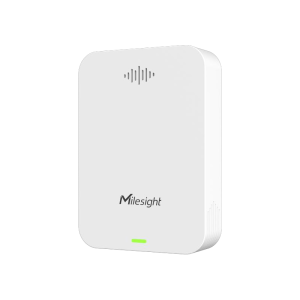
Milesight Bathroom Odor Detector
GS301
£351.64 ex VAT (£421.97 inc. VAT)
Gas detection ranges (NH3 / H2S)NH3 0 ~ 10 ppm; H2S 0 ~ 5 ppm
View the GS301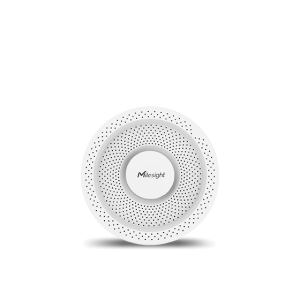
Milesight Vape Detector
GS601
£164.60 ex VAT (£197.52 inc. VAT)
Vape Index measuring range0 ~ 100 (accuracy ±10, resolution 1, laser scattering)
View the GS601Specification comparison
| Specification | GS301 | GS601 |
|---|---|---|
| Approvals | CE, FCC, EN62368; RoHS | CE, FCC; RoHS |
| Configuration | Mobile app via NFC | Mobile app via NFC or downlink |
| Dimensions / weight | 120 × 85 × 32.5 mm; 221.4 g (batteries included) | Ø 128 × 40 mm (Ø 5.04 × 1.57 in); 178.6 g |
| Frequency | CN470/IN865/RU864/EU868/US915/AU915/KR920/AS923-1&2&3&4 | RU864/IN865/EU868/US915/AU915/KR920/AS923-1&2&3&4 |
| Installation | Wall screw mounting | Ceiling mounting |
| LoRaWAN mode | OTAA/ABP Class A | OTAA/ABP Class C |
| Local alarm | 1 × status/alarm LED + 1 × buzzer, threshold alarm | 1 × status/alarm LED indicator + 1 × buzzer (70 dB @1 m) |
| Operating temperature | -40°C - 55°C | -5°C ~ 45°C |
| Power supply | 4 × 4000 mAh ER18505 Li-SOCl2 replaceable batteries | 5 V/1 A via USB Type-C port, or optional PoE splitter |
| Relative humidity | 0% - 95% (non-condensing) | 0 ~ 95% (non-condensing) |
| Sensitivity | -137 dBm | -137 dBm @300bps |
| Tx power | 16 dBm (868 MHz) / 19 dBm (470 MHz) / 22 dBm (915 MHz) | 16 dBm (868 MHz)/22 dBm (915 MHz) |
| Advanced features | — | Threshold alarm, tamper alarm, calibration, FUOTA |
| Ammonia (NH3) range | 0 ~ 10 ppm | — |
| Ammonia accuracy / resolution | ± 5% FS (-40 - 35°C) / 0.01 ppm | — |
| Battery life | Around 3 years (10 min interval, 25°C) | — |
| Gas detection principle | Solid polymer electrochemical | — |
| Gas sensor life | > 3 years | — |
| H2S accuracy / resolution | ± 5% FS (-40 - 35°C) / 0.001 ppm | — |
| Humidity | — | 0% ~ 100% RH, ±2% RH, resolution 0.5% RH |
| Humidity measurement | 0 - 100% RH, ± 2%, 0.5% RH resolution | — |
| Hydrogen sulfide (H2S) range | 0 ~ 5 ppm | — |
| Long-term stability | < 1% accuracy drift per month | — |
| PM1.0 & PM2.5 | — | Laser scattering, 0 ~ 1000 μg/m³, ±10 μg/m³ (0~100), ±10% of measured value (100~1000) |
| PM10 | — | 0 ~ 1000 μg/m³, ±25 μg/m³ (0~100), ±25% of measured value (100~1000) |
| TVOC | — | MOX (MEMS), 0 ~ 2000 μg/m³, accuracy 20 μg/m³ ±15% of readings (1~500 μg/m³), resolution 1 μg/m³ |
| Tamper detection | — | Vibration sensor for vandalism/tamper alarm |
| Temperature | — | -20°C ~ 60°C, ±0.2°C, resolution 0.1°C |
| Temperature measurement | -40 - 85°C, ± 0.2°C, 0.1°C resolution | — |
| Vape Index | — | Laser scattering, range 0 ~ 100, accuracy ±10, resolution 1 |
| Wireless protocol | LoRaWAN®, Milesight D2D | — |
| Wireless technology | — | LoRaWAN®, internal antenna |
| Ingress protection | IP30 | IP30 |
Specifications taken from the manufacturer datasheets. Rows where the models are identical are dimmed. Prices are ex VAT and read live from the catalogue.
Frequently asked questions
Does the GS601 need mains power?
Yes, in effect. It runs on 5 V 1 A over USB Type-C or an optional PoE splitter, and there is no battery option. That is a consequence of it being a LoRaWAN Class C device, listening continuously so its alarm is immediate. In practice the cabling and containment to each ceiling position is usually the biggest cost of a GS601 deployment, so price it before the sensors.
Can the GS301 detect vaping?
No. The GS301 measures ammonia from 0 to 10 ppm and hydrogen sulphide from 0 to 5 ppm using solid polymer electrochemical sensors, which is washroom odour, plus temperature and humidity. Vaping is detected through particulates and TVOC, which is what the GS601 measures as a Vape Index from 0 to 100.
Will the GS601 work in an unheated outdoor toilet block?
Probably not through a UK winter. The GS601 is rated -5 degC to +45 degC, so an unheated external block, sports pavilion or outbuilding that drops below freezing is outside its specification. The GS301 is rated -40 degC to +55 degC and is far more tolerant, but it detects odour rather than vaping.
Can these trigger ventilation automatically?
The GS301 can directly. It supports Milesight D2D, so crossing an ammonia or H2S threshold can command another Milesight device, such as a WS558 light and fan controller, without the message going through the gateway and network server. The GS601 datasheet lists LoRaWAN with threshold and tamper alarms but not D2D, so automation there goes through your platform.
Do they identify who was vaping?
No. The GS601 reports that vaping-like particulates and TVOC were detected in a space at a given time, as an index from 0 to 100 with plus or minus 10 accuracy. It has no camera and no means of identifying an individual. Treat the output as evidence that a space needs attention, and tell staff and pupils what is being measured before installation rather than after.