AM307 vs AM308L: which Milesight air quality sensor do you need?
Short answer: The AM308L is the one that measures particulates — PM2.5 and PM10, 0 to 1000 µg/m³ by laser scattering — but it has no display at all. The Milesight AM307 carries the 4.2-inch black-and-white E-Ink screen and no particulate sensor. Everything else is specified identically on both: temperature, humidity, NDIR CO2 at 400 to 5000 ppm, TVOC, light, barometric pressure and PIR occupancy. The catch in AM307 vs AM308L is battery life — around three years on the AM307 against around 1.3 years on the AM308L, same batteries, same 10-minute reporting interval.
AM307 vs AM308L: which one do I actually need?
Choose the AM307 if the room needs to see its own air. Anywhere a person makes a decision from the reading — a meeting room people walk out of, a classroom, a reception desk, a ward corridor — the 4.2-inch E-Ink screen and the traffic-light indicator do the job before anyone opens a dashboard. It is also the one to fit where a battery change is disruptive: three years at a 10-minute interval and 25°C, against around 1.3 years for the particulate model.
Choose the AM308L if the number that matters is dust and nobody is standing in front of the device. It adds PM2.5 and PM10 over the AM307’s sensor set and drops the screen, so it suits ceiling height, plant rooms, print and workshop areas, or a building-wide LoRaWAN estate where every reading lands in software anyway. Budget for shorter battery intervals or run it on the 5 V / 1 A USB-C supply, which both models accept.
Is the AM308L’s PM2.5 reading a dust-monitoring instrument?
No, and this is where most of the confusion sits. The AM308L is an indoor ambience sensor, not an occupational exposure instrument. Its particulate figures come from a laser-scattering cell rated 0 to 1000 µg/m³, with ±10 µg/m³ up to 100 µg/m³ and ±10% above that; the listed approvals are CE, CE (RED), FCC, ISED and RoHS. Nothing in the specification claims gravimetric equivalence or fitness for a COSHH assessment. Treat it as a trend and threshold device — it will tell you a workshop extraction fan failed at 3 a.m., and it will not stand up as the reading in a dust exposure report.
One more disambiguation: the AM307 is not a de-specified AM308L. It is the same 100.8 × 114 × 22 mm body with the screen fitted and the particulate cell absent. The AM308 — screen and particulates — is a third variant, listed here alongside the AM307.
Where the two are the same
On the shared sensors the datasheets do not distinguish them. CO2 is NDIR, 400 to 5000 ppm, ±(30 ppm + 3% of reading), 1 ppm resolution on both. Temperature is −20°C to 60°C at ±0.2°C above freezing (the AM308L sheet adds a ±0.3°C figure below 0°C), humidity 0 to 100% RH at ±2% RH, TVOC a 1.00 to 5.00 IAQ rating, pressure 260 to 1260 hPa at ±0.5 hPa, light 0 to 60000 Lux reported as six levels, and PIR occupancy 80° horizontal by 55° vertical to 5 m. Both are IP30 indoor units, both hold 18,000 records with retransmission, both configure by NFC or USB-C, and both are Class A LoRaWAN on EU868, the UK band. If your shortlist turned on CO2 accuracy or radio performance, the specification will not decide it for you — the screen, the particulates and the battery interval will.

Milesight AM307 / AM308 / AM319 Indoor Ambience Monitoring Sensor – AM307-868M
AM307-868M
£224.45 ex VAT (£269.34 inc. VAT)
View the AM307-868M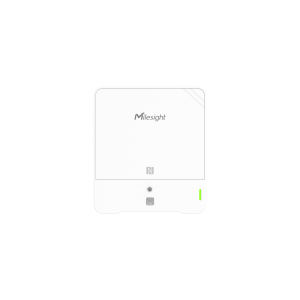
Milesight AM308L Indoor Ambience Monitoring Sensor
AM308L-868M
£239.41 ex VAT (£287.29 inc. VAT)
DisplayAM308L: Not Support (AM307 and AM308 use a 4.2-inch black & white E-Ink screen)
View the AM308L-868MSpecification comparison
| Specification | AM307-868M | AM308L-868M |
|---|---|---|
| Advanced Features | — | Calibration, threshold alarm, data storage (18,000 entries), data retrievability, data retransmission, button lock |
| Barometric Pressure | — | Piezoresistive absolute pressure sensor (MEMS); 260 - 1260 hPa; ±0.5 hPa; resolution 0.1 hPa |
| Battery Life (AM308(L) column) | — | Around 1.3 years (SF7, EU868 & US915), around 1.2 years (SF10, EU868), around 1 year (SF10, US915) at a 10 min interval, 25°C |
| Carbon Dioxide (CO2) | — | NDIR; 400 ~ 5000 ppm; ±(30 ppm + 3% of reading) at 0°C~50°C, 0% to 85% RH; resolution 1 ppm |
| Configuration | — | Mobile app via NFC; PC software via NFC or USB Type-C port; downlink |
| Dimensions & Weight | — | 100.8 × 114 × 22 mm (3.97 × 4.49 × 0.87 in); 222.6 g with batteries (AM308(L) column) |
| Display | — | Not supported on AM308L (AM307 & AM308: 4.2-inch black & white E-Ink screen) |
| Frequency & RF | — | CN470/RU864/IN865/EU868/US915/AU915/KR920/AS923-1&2&3&4; 16 dBm (868 MHz) / 22 dBm (915 MHz) / 19 dBm (470 MHz); sensitivity -137 dBm @300 bps |
| Housing, Installation & Approvals | — | ABS (UL94 HB), white; wall mounting via 3M tape or screws; CE, CE (RED), FCC, ISED, RoHS |
| Humidity | — | 0% ~ 100% RH; typ. ±2% RH (25°C); resolution 0.5% RH; digital CMOSens® (MEMS) |
| Indicators, Buttons & USB | — | 1 × traffic light status indicator + 1 × buzzer; 1 × power button + 1 × reset button; 1 × Type-C port for power supply, configuration or console |
| Light | — | Photodiode; 0-60000 Lux (determined as 6 levels, 0-5) |
| LoRaWAN | — | LoRaWAN®, internal antenna; OTAA/ABP Class A |
| Measured Parameters | — | Temperature, humidity, CO2, TVOC, light, barometric pressure, PM2.5, PM10 and motion |
| Motion | — | Passive infrared (PIR); 80° horizontal, 55° vertical, 5 m; reports Vacant/Occupied |
| Operating Environment | — | -20°C - 60°C; 10% - 90% RH (non-condensing); IP30 |
| PM2.5 & PM10 | — | Laser scattering; 0 ~ 1000 μg/m3; 0~100 (±10 μg/m3), 100~1000 (±10%) at -10°C~60°C; resolution 1 μg/m3 (not fitted on AM307) |
| Power Supply | — | 4 × 2700 mAh ER14505 Li-SOCl2 replaceable batteries, or 5V/1A via Type-C port |
| TVOC | — | MOX (MEMS); 1.00 ~ 5.00 IAQ rating; accuracy ±1; resolution 0.01 |
| Temperature | — | -20°C ~ 60°C; typ. ±0.3°C (-20°C ~ 0°C), ±0.2°C (0°C ~ 60°C); resolution 0.1°C; digital CMOSens® (MEMS) |
Specifications taken from the manufacturer datasheets. Rows where the models are identical are dimmed. Prices are ex VAT and read live from the catalogue.
Frequently asked questions
Does the Milesight AM307 measure PM2.5?
No. The AM307 has no particulate sensor. Its set is temperature, humidity, CO2, TVOC, light, barometric pressure and PIR motion. PM2.5 and PM10 are fitted on the AM308 and AM308L only, measured 0 to 1000 µg/m³ by laser scattering.
What does the L in AM308L mean?
On the AM308L the display is not supported. The AM307 and AM308 carry a 4.2-inch black-and-white E-Ink screen; the AM308L has none. It keeps the same traffic-light status indicator and buzzer as the other models, so local alarming still works without a screen.
How long do the batteries last on each model?
Both run on 4 × 2700 mAh ER14505 Li-SOCl2 replaceable cells, or 5 V / 1 A over USB Type-C. Milesight quotes around 3 years for the AM307 and around 1.3 years for the AM308(L) on EU868 at SF7, both at a 10-minute interval and 25°C.
Can I use either sensor for a COSHH or workplace dust exposure assessment?
The specifications do not support that use. The listed approvals are CE, CE (RED), FCC, ISED and RoHS, and the PM accuracy is ±10 µg/m³ up to 100 µg/m³ and ±10% above it. Treat the readings as trend and threshold data, not as instrument-grade exposure measurement.
Do the AM307 and AM308L work on UK LoRaWAN networks?
Yes. Both list EU868 among their bands, which is the UK LoRaWAN band, and both operate OTAA/ABP Class A at 16 dBm on 868 MHz with -137 dBm sensitivity at 300 bps. Both are IP30 indoor units rated -20°C to 60°C; the AM307's E-Ink screen is specified for 0°C to 40°C.