UG63 vs UG65 vs UG67: which Milesight LoRaWAN gateway do you need?
Short answer: for a single building or a small site, the UG63 is the cheapest way to get Milesight LoRaWAN sensors online. Choose the UG65 when you need more capacity and Ethernet or Wi-Fi backhaul as well as a built-in network server, and the UG67 only when the gateway itself has to live outdoors. All three run the EU868 band used in the UK.
Which Milesight gateway do I need?
Choose the UG63 if you are connecting a handful of sensors in one building and want the lowest entry cost. It is the gateway most often bought alongside a first sensor order — it plugs into a socket, and a PoE splitter variant is available if you would rather power it from the network.
Choose the UG65 if you are covering a whole site, need more simultaneous sensor traffic, or want the gateway to run its own network server rather than depend on a cloud one. It is the general-purpose choice for most commercial deployments.
Choose the UG67 if the gateway has to be mounted outside — on a pole, a rooftop or in a yard. It is the weatherproof member of the family, and you should not pay for it if the unit will sit in a plant room.
Do I need a gateway at all?
Yes, if you are buying LoRaWAN sensors. A LoRaWAN sensor does not talk to Wi-Fi or to a mobile network — it talks to a gateway, and the gateway carries the data onward over Ethernet, Wi-Fi or cellular. One gateway serves many sensors, so the gateway is a per-site cost rather than a per-sensor one. If your site already has a LoRaWAN gateway, or is inside the coverage of a public network, you may not need another.
Milesight UG63 Mini LoRaWAN® Gateway – External antenna-UG63-868M
UG63-868M
£98.76 ex VAT (£118.51 inc. VAT)
View the UG63-868M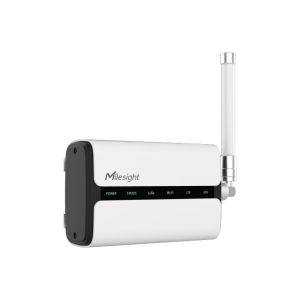
Milesight UG65 Semi-industrial LoRaWAN Gateway
UG65-868M
Price range: £279.82 through £338.17 ex VAT (£335.78 – £405.80 inc. VAT)
LoRa channels and device capacity8 half/full-duplex channels, around 2000 Class A/B/C devices (10 min uplink interval)
View the UG65-868MSpecification comparison
| Specification | UG63-868M | UG65-868M |
|---|---|---|
| Approvals | — | CE, CE (RED), Telec, JATE, RCM; RoHS |
| CPU / memory / flash | — | Quad-core 1.5 GHz 64-bit ARM Cortex-A53; 512 MB DDR4 RAM; 8 GB eMMC |
| Cellular (optional) | — | 4G LTE, 1 × mini SIM (2FF), internal antenna |
| Dimensions & weight | — | 180 × 110 × 55.5 mm; 548 g |
| Ethernet port | — | 1 × RJ45 WAN (PoE PD supported), 10/100/1000 Base-T, auto-sensing |
| Frequency band | — | CN470/IN865/EU868/RU864/US915/AU915/KR920/AS923-1&2&3&4 |
| Ingress protection | — | IP65 |
| Installation | — | Desktop, wall or pole mounting |
| Integration | — | MQTT(s), HTTP(s), BACnet/IP, BACnet/SC, Modbus TCP, Modbus RTU over TCP |
| LoRa antennas | — | 2 × internal antennas + 1 × 50 Ω N-Female external connector |
| LoRa channels | — | 8 (half/full-duplex), SX1302 chip |
| LoRaWAN protocol | — | V1.0 Class A/B/C and V1.0.2 Class A/B/C |
| Operating temperature | — | -40°C to +70°C (reduced cellular performance above 60°C) |
| Power consumption | — | Typical 2.9 W, max 4.2 W |
| Power input | — | DC 9-24 V via power connector, 802.3af PoE, or 5 V/1 A USB Type-C |
| Sensitivity / Tx power | — | -140 dBm @292bps; 27 dBm max |
| Supported devices | — | Around 2000 Class A/B/C devices (10 min uplink interval) |
| VPN tunnels | — | OpenVPN/IPsec/PPTP/L2TP/GRE/DMVPN/WireGuard |
| Wi-Fi | — | IEEE 802.11 b/g/n 2.4 GHz, AP or client mode |
Specifications taken from the manufacturer datasheets. Rows where the models are identical are dimmed. Prices are ex VAT and read live from the catalogue.