Milesight VS121 vs VS133: AI vision or ToF for people counting?
Short answer: Specify the Milesight VS133-P when the space must contain no lens at all — it senses depth with an invisible 940 nm time-of-flight beam, collects no images and works in complete darkness, quoting counting accuracy up to 99.8% over up to four counting lines. Specify the VS121 when you need to know how a whole area is used rather than how many people crossed a threshold: it is an AI sensor specified to count and measure area utilisation without collecting images, mounts at 2.3 m to 4 m and covers up to 6.8 × 18.8 m. Both list GDPR under approvals. The VS133-P costs roughly 1.8 times as much as the VS121.
Which one do I actually need, the VS121 or the VS133-P?
Choose the VS121 if the question you are trying to answer is “how is this space being used?” — an open-plan floor, a meeting suite, a study area. It covers 2.6 × 8.6 m at 2.3 m mounting height, 4.8 × 14.0 m at 3.0 m and 6.8 × 18.8 m at 4.0 m, with a 190° × 112° field of view. You can map up to 16 detection regions of up to 10 sides each with dwell time, plus people-flow analysis at up to four edges. One unit reports a zone, not a single seat.
Choose the VS133-P if the question is “how many people came through here?” — an entrance, a corridor, a gate line. Its detection range is 0.5 to 3.5 m, which caps installation height at 3.5 m, and its 98° × 80° field of view is deliberately tighter than the VS121’s: you want the doorway, not the room behind it. It gives up to four bi-directional counting lines, up to four detection areas, motion and dwell heat maps, ±3.5 cm distance measuring accuracy, and stores up to one million records locally with CSV export.
Is the VS121 a camera in the ceiling?
This is the objection that stalls occupancy projects, so answer it precisely. The VS133-P is not a camera. Its sensing element is a 940 nm infrared beam that is invisible to the eye and measures distance, which is why the datasheet can claim operation in complete darkness. There is no imaging path to discuss in a staff consultation.
The VS121 is not a CCTV camera either — it is specified to count people and measure area utilisation without collecting images, and it supports up to eight privacy masks. Both units carry GDPR alongside CE, FCC and RoHS. The honest distinction is that the VS121 is an optical AI sensor and the VS133-P is a depth sensor, so if your policy or your works council rules out lenses as a category, only the VS133-P removes the argument entirely. Note also that the specifications state darkness operation for the VS133-P only; they give no minimum light level for the VS121 either way.
What the datasheets catch people out on
- Ceiling height decides it before privacy does. The VS133-P caps at 3.5 m. Above that it is out, and the VS121 — rated to 4 m — is the only one of the two that fits.
- Neither is battery powered. The VS121 takes 5 V / 3 A over USB Type-C at 9.4 W, so it needs a supply at the mounting point. The VS133-P takes 802.3at PoE+ at 9.4 W typical and 23.8 W maximum, so it needs a PoE+ switch port instead.
- Both are indoor-only. IP30 for the VS121, IP40 for the VS133-P. Operating temperature is −20 °C to +60 °C and −20 °C to +50 °C respectively.
- They connect differently. The VS121 runs LoRaWAN Class C, OTAA or ABP, at −137 dBm sensitivity, on EU868 for the UK, and also lists Milesight D2D. The VS133-P has no radio: it reports over its Ethernet port using HTTP(S), MQTT(S) or BACnet/IP.
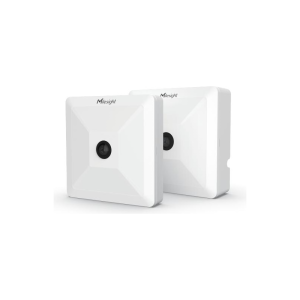
Milesight VS121 AI Workplace Occupancy Sensor
VS121
Price range: £276.82 through £284.30 ex VAT (£332.18 – £341.16 inc. VAT)
Installation height and detection range2.3 m to 4 m; 2.6 × 8.6 m at 2.3 m up to 6.8 × 18.8 m at 4 m
View the VS121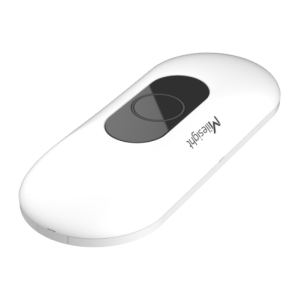
Milesight VS133-P AI ToF People Counting Sensor
VS133
£492.30 ex VAT (£590.76 inc. VAT)
Detection range (and maximum installation height)0.5 to 3.5 m; installation height ≤3.5 m
View the VS133Specification comparison
| Specification | VS121 | VS133 |
|---|---|---|
| Approvals | CE, FCC, SRRC, GDPR; RoHS | CE, FCC, GDPR; RoHS |
| Bi-directional people counting | Supported, with U-turn filtering | Up to 4 counting lines |
| Data retransmission | 1000 packets | 6 × 30000 packets |
| Detection range | 2.6 × 8.6 m at 2.3 m; 4.8 × 14.0 m at 3.0 m; 6.8 × 18.8 m at 4.0 m | 0.5 to 3.5 m |
| Ingress protection | IP30 | IP40 |
| Installation | Ceiling mounting | Ceiling, extended ceiling and lintel mounting (optional multifunctional bracket) |
| Installation height | 2.3 m to 4 m | ≤3.5 m |
| Operating temperature | -20°C ~ +60°C | -20°C ~ +50°C |
| Power consumption | 9.4 W | Typical 9.4 W, max 23.8 W |
| Power supply | 5 V / 3 A DC by Type-C port | 802.3at PoE+ |
| Regional counting & dwell time | Up to 16 areas (up to 10 sides each) | Up to 4 detection areas (up to 10 sides each) |
| Alarm I/O | — | 1 input, 1 output |
| Counting accuracy | — | Up to 99.8% |
| Dimensions | 85 × 85 × 20 mm | — |
| Dimensions / weight | — | 180 × 26 × 72 mm; 226 g |
| Distance measuring accuracy | — | ± 3.5 cm |
| Ethernet isolation | — | 1.5 kV RMS |
| Ethernet port | — | 1 × RJ45 10/100 Mbps (PoE PD) |
| Field of view | 190° horizontal, 112° vertical | — |
| Frequency | CN470/IN865/RU864/EU868/US915/AU915/KR920/AS923-1&2&3&4 | — |
| Heat map | — | Motion heat map, dwell heat map |
| Housing / colour / weight | PC + cast aluminium; white or black (optional); 130 g | — |
| LoRaWAN mode | OTAA/ABP Class C | — |
| Local storage | — | Up to one million data records, CSV export |
| Multi-device stitching | — | Up to 4 devices, automatic deflection angle detection |
| Network protocols | — | HTTP(s), MQTT(s), NTP, 802.1x, SSH, LLDP, BACnet/IP |
| People flow analysis | Traffic from different directions at up to 4 edges | — |
| Privacy mask | Up to 8 privacy masks | — |
| Recognition rate | Up to 98% (line-crossing detection within recommended range) | — |
| Sensitivity | -137 dBm @300bps | — |
| Serial interface | — | 1 × RS485 (under development) |
| ToF field of view | — | 98° horizontal, 80° vertical |
| ToF light beam | — | 940 nm (invisible) |
| Tx power | 16 dBm (868 MHz) / 20 dBm (915 MHz) / 19 dBm (470 MHz) | — |
| VPN | — | OpenVPN |
| Wi-Fi | IEEE 802.11 b/g/n, 2.4 GHz (AP mode for configuration) | — |
| Wireless protocol | LoRaWAN®, Milesight D2D | — |
| Relative humidity | 0 ~ 95% (non-condensing) | 0 ~ 95% (non-condensing) |
Specifications taken from the manufacturer datasheets. Rows where the models are identical are dimmed. Prices are ex VAT and read live from the catalogue.
Frequently asked questions
Does the Milesight VS121 record video or images?
No. The VS121 is specified to count people and measure area utilisation without collecting images, and it supports up to eight privacy masks. It carries GDPR alongside CE, FCC, SRRC and RoHS approvals. It is an optical AI sensor rather than a CCTV camera; if you need a device with no lens at all, that is the VS133-P, which senses with an invisible 940 nm time-of-flight beam.
Which is more accurate, the VS121 or the VS133-P?
The VS133-P quotes the higher figure: counting accuracy up to 99.8%, with distance measuring accuracy of ±3.5 cm. The VS121 quotes a recognition rate of up to 98% for line-crossing detection within its recommended range. The two are not measuring quite the same job, though — the VS133-P is a line counter at a threshold, while the VS121 also reports regional occupancy and dwell across up to 16 mapped areas.
How high can each sensor be mounted?
The VS121 mounts between 2.3 m and 4 m, and its coverage grows with height: 2.6 × 8.6 m at 2.3 m, 4.8 × 14.0 m at 3.0 m and 6.8 × 18.8 m at 4.0 m. The VS133-P has a detection range of 0.5 to 3.5 m, so its installation height is capped at 3.5 m. Above 3.5 m the VS133-P is not an option.
Do the VS121 and VS133-P work in the dark?
The VS133-P does — it uses a 940 nm time-of-flight beam that is invisible to the eye, and the datasheet states operation in complete darkness. The specifications do not state a minimum light level for the VS121 in either direction, so for an unlit space the VS133-P is the specified choice.
Are the VS121 and VS133-P battery powered, and how do they connect?
Neither is battery powered. The VS121 runs on 5 V / 3 A via USB Type-C at 9.4 W, supports the EU868 band used in the UK and runs LoRaWAN Class C in OTAA or ABP mode, with a 2.4 GHz Wi-Fi AP mode for configuration. The VS133-P takes 802.3at PoE+ at 9.4 W typical and 23.8 W maximum, and reports over Ethernet using HTTP(S), MQTT(S) or BACnet/IP.