Milesight VS370 vs VS373: presence detection or fall detection?
Short answer: The Milesight VS370 tells you whether a room is occupied; the VS373 tells you whether someone has fallen. The VS370 is a battery-powered 24 GHz radar-plus-PIR sensor that mounts on a wall and reports presence and a bright/dim light status. The VS373 is a mains-powered 60 GHz ceiling radar with lying alarm, dwell and breathing detection, an on-board buzzer, a digital output and an IP65 housing, and it lists at three times the VS370. If there is no permanent power at the mounting point, the VS370 is the only one of the two you can fit.
Which one do I actually need, VS370 or VS373?
Choose the VS370 if the question you are answering is “is anyone in there?” and nobody is going to run a cable to find out. It combines 24 GHz millimetre-wave radar with PIR, so a person sitting still at a desk or waiting in a washroom cubicle still registers, which is the single thing a PIR-only sensor gets wrong. Radar covers movement to 7.5 m and slight movement to 4.8 m across a 150 degree angle; it wall-mounts on a magnetic bracket with an extra 30 degrees of deflection and runs on two ER14505 cells with a quoted life of around 6.7 years at SF7 on EU868 with 50 triggers a day.
Choose the VS373 if the event you are paid to catch is a person on the floor: a care home bedroom, sheltered housing, a hospital ward, an assisted bathroom. It is a 60 GHz MIMO radar (24 transmitters, 22 receivers) that ceiling-mounts at 2.3 m to 3 m and covers 2 m x 2 m up to 4 m x 5 m depending on that height. It adds lying alarm, dwell detection, human in-place, multi-bed presence, breathing detection and 1,000 stored entries, plus a buzzer, a multi-colour LED and a 60 V / 1 A digital output so an alarm can sound locally even before the network sees it.
The VS370 is not a fall detector
This is where the money gets spent twice. Both are Milesight millimetre-wave radar sensors, both run LoRaWAN on EU868 (the UK band) and both support Milesight D2D, so they read as interchangeable. They are not. Lying alarm, dwell detection and breathing detection appear only in the VS373 specification. The VS370’s published outputs are presence and light status. A VS370 fitted in a care bathroom will report that someone is in the room; it will not tell you they are on the floor.
Two further negatives worth knowing before you order. The VS370 is IP30, which carries no water-ingress rating at all, so it is not the sensor for a shower zone; the VS373 is IP65. And neither device is a camera: the VS373 works from radar point-cloud data without capturing images, and no image sensor appears in either specification, which is why this class of sensor is accepted in bedrooms and bathrooms where a camera is not.
What each one needs at the mounting point
- VS370: wall mount, battery only, no cable, LoRaWAN Class A, operating range 0 to 30 degrees C. That narrow band rules out unheated plant rooms and outbuildings.
- VS373: ceiling mount at 2.3 to 3 m only, permanent 5 V / 3 A USB-C supply at up to 9.5 W, LoRaWAN Class C plus 2.4 GHz Wi-Fi with HTTP and MQTT, 0 to 50 degrees C.
One honest gap: Milesight quotes a recognition rate of up to 99% for the VS370 and publishes no equivalent accuracy figure for the VS373, so the datasheets do not let you compare their detection accuracy directly. Do not read the VS370’s number as a fall-detection figure. On radio the two are not distinguished either, both quoting -137 dBm sensitivity at 300 bps and the same frequency plans, so gateway range is not the deciding factor here.
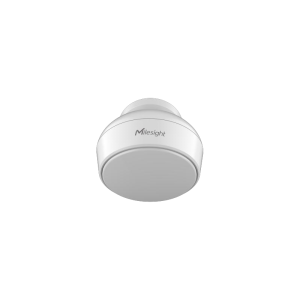
Milesight VS370 Radar Human Presence Sensor
VS370-868M
£74.82 ex VAT (£89.78 inc. VAT)
Radar detection distanceMovement 7.5 m, slight movement 4.8 m, across a 150° detection angle
View the VS370-868M
Milesight VS373 Radar Fall Detection Sensor
VS373-868M
£231.93 ex VAT (£278.32 inc. VAT)
Radar detection range2 m × 2 m to 4 m × 5 m (within the 2.3 m - 3 m installation height)
View the VS373-868MSpecification comparison
| Specification | VS370-868M | VS373-868M |
|---|---|---|
| Advanced features | Milesight D2D controller, hibernate time setting, sensitivity setting, FUOTA | Milesight D2D controller & agent, dwell detection, lying alarm, multi-bed presence detection, human in-place detection, breathing detection, data storage (1000 entries) |
| Dimensions & weight | Ф70 × 48.5 mm; body 89.6 g, magnetic bracket 38.2 g | 114 × 84 × 15 mm; 214.5 g |
| Ingress protection | IP30 | IP65 |
| Operating temperature | 0°C ~ 30°C, 0-95% RH non-condensing | 0°C ~ 50°C, 0-95% RH non-condensing |
| Power supply | 2 × 2700 mAh ER14505 Li-SOCl2 batteries | DC 5 V / 3 A by Type-C cable |
| Radar Tx power | 5 dBm | Max. 20 dBm |
| Technology | Millimetre wave radar & PIR | 60 GHz millimetre wave radar |
| Battery life | Around 6.7 years (SF7, EU868 & US915); around 5.3 years (SF10, EU868) at 50 triggers per day, 25°C | — |
| Configuration | Mobile app via NFC or Bluetooth, Downlink | — |
| Detection range | — | 2 m × 2 m ~ 4 m × 5 m (within the installation height) |
| Digital output | — | 1 × DO (60 V / 1 A) |
| Frequency | CN470/IN865/EU868/RU864/US915/AU915/KR920/AS923-1&2&3&4 | — |
| Housing | — | ABS (UL94 V1), white |
| Installation | Wall mounting via magnetic bracket (additional 30° deflection angle) | — |
| Installation height | — | 2.3 m ~ 3 m, ceiling mounting |
| Light status | Bright/Dim | — |
| LoRa Tx power / sensitivity | — | 16 dBm (868 MHz) / 22 dBm (915 MHz) / 19 dBm (470 MHz); -137 dBm @300bps |
| LoRa frequency | — | CN470/IN865/EU868/RU864/US915/AU915/KR920/AS923-1&2&3&4 |
| LoRa protocol / mode | — | LoRaWAN®, Milesight D2D; OTAA/ABP Class C |
| LoRaWAN mode | OTAA/ABP Class A | — |
| Local alarm | — | 1 × buzzer, 1 × multi-colour LED indicator |
| PIR detection area / distance | 110°; within 7 m | — |
| Power consumption | — | Max 9.5 W |
| Protocol | LoRaWAN®, Milesight D2D | — |
| Radar FoV | — | 70° horizontal, 140° vertical |
| Radar detection angle | 150° | — |
| Radar detection distance | Movement 7.5 m; slight movement 4.8 m | — |
| Radar frequency | 24 GHz | — |
| Radar transceiver | — | 24 transmitters & 22 receivers (MIMO array antenna) |
| Recognition rate | Up to 99% | — |
| Tx power / sensitivity | 16 dBm (868 MHz) / 20 dBm (915 MHz) / 19 dBm (470 MHz); -137 dBm @300bps | — |
| Wi-Fi | — | IEEE 802.11b/g/n 2.4 GHz, AP mode / client mode; HTTP and MQTT |
| Approvals | CE, FCC | CE, FCC |
Specifications taken from the manufacturer datasheets. Rows where the models are identical are dimmed. Prices are ex VAT and read live from the catalogue.
Frequently asked questions
Does the Milesight VS370 detect falls?
No. Lying alarm, dwell detection and breathing detection are listed only for the VS373. The VS370's published outputs are presence and a bright/dim light status, so it tells you a room is occupied, not that someone has fallen.
Can the VS373 run on batteries like the VS370?
No. The VS373 requires a permanent DC 5 V / 3 A supply over Type-C, drawing up to 9.5 W, and runs as LoRaWAN Class C. The VS370 is battery-powered on two ER14505 cells, with a quoted life of around 6.7 years at SF7 on EU868 at 50 triggers per day.
Which one can go in a wet room or shower area?
The VS373 is rated IP65. The VS370 is IP30, which carries no water-ingress protection, so it should be kept out of wet zones.
How high does the VS373 have to be mounted?
It is ceiling-mounted at 2.3 m to 3 m. Detection coverage within that height range runs from 2 m x 2 m to 4 m x 5 m, with a 70 degree horizontal and 140 degree vertical field of view.
Do both sensors work on UK LoRaWAN?
Yes. Both list EU868, the UK band, with OTAA/ABP operation and Milesight D2D support. The VS370 is Class A, the VS373 is Class C and additionally offers 2.4 GHz Wi-Fi with HTTP and MQTT.