Milesight LoRaWAN Thermostats Compared: WT101, WT102, WT201 and WT401
Five Milesight LoRaWAN thermostats matched to the plant they actually control, with the battery-free WT102 arithmetic, the WT201 wiring caveat UK buyers miss, and live prices.
Five Milesight LoRaWAN thermostats matched to the plant they actually control, with the battery-free WT102 arithmetic, the WT201 wiring caveat UK buyers miss, and live prices.
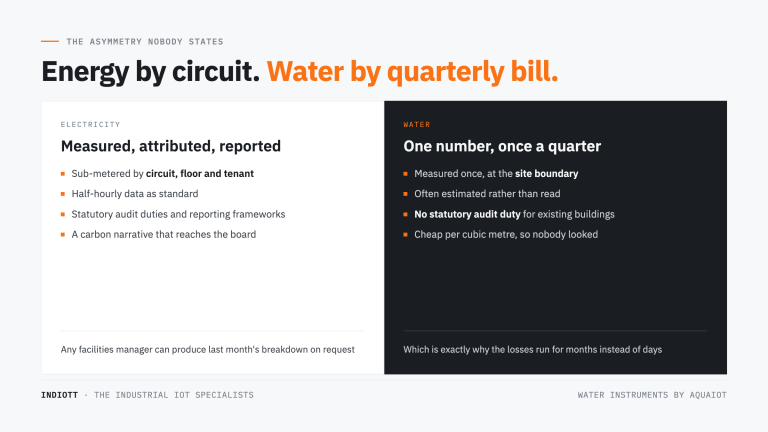
TL;DR: Most industrial and commercial estates know their energy consumption circuit by circuit and their water consumption as one number on a quarterly bill. Water sub-metering closes that gap, and it is not a compliance exercise, because no law requires it in an existing non-domestic building. It is a cost and risk argument. A single…
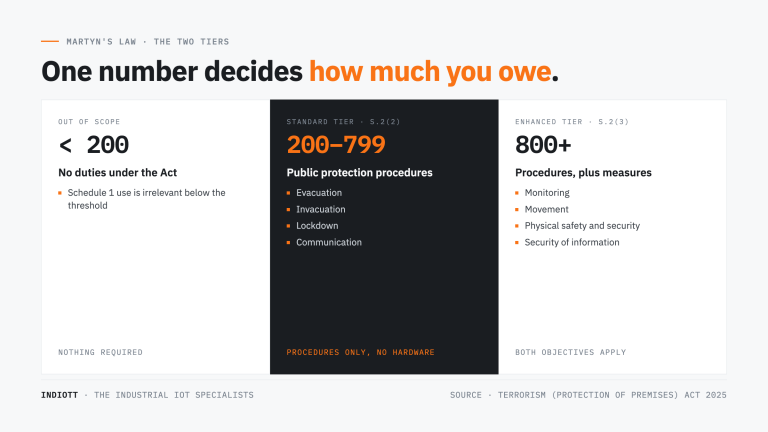
TL;DR: Martyn’s Law is expected to come into force in spring 2027, and it turns a headcount into a legal threshold. If you can reasonably expect 200 to 799 individuals at the same time you are standard tier, 800 or more and you are enhanced tier, and the figure must include your staff. The statutory…

TL;DR: Phase 2 of Awaab’s Law starts on 30 November 2026 and adds seven hazard categories to the fixed repair clock, including excess cold and excess heat. For a significant hazard the landlord has 10 working days to investigate, 3 to issue a written summary, and 5 to make the property safe. Emergency hazards run…
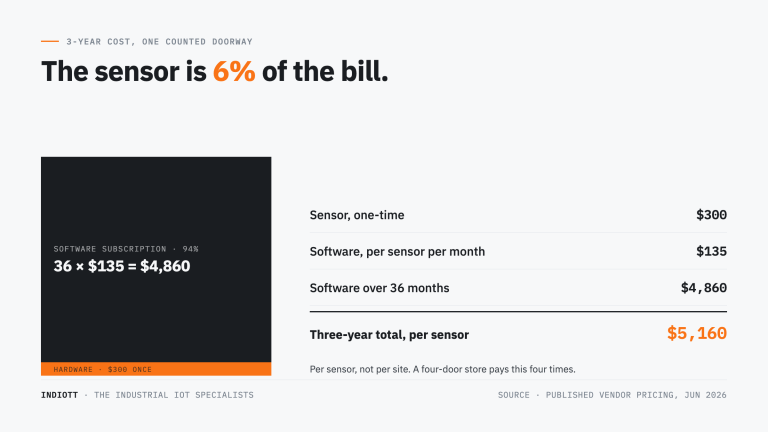
TL;DR: Most of a people counting system cost is not the sensor. Published subscription pricing runs to $135 per sensor per month billed annually on top of a $300 one-off unit, which is $5,160 over three years with 94% of it software. The alternative is buying the hardware outright: a passage counter from £74.82 ex…
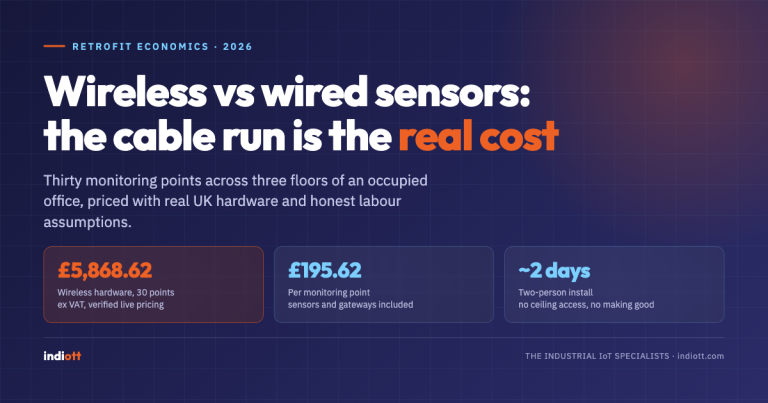
TL;DR: In a retrofit, the wireless vs wired sensors question is almost never about the sensor. It is about the cable run. Thirty wireless monitoring points across three floors of an occupied office cost £5,868.62 ex VAT in hardware and mount in roughly two team-days. The cabled equivalent needs thirty cable pulls, ceiling access, fire-stopping…
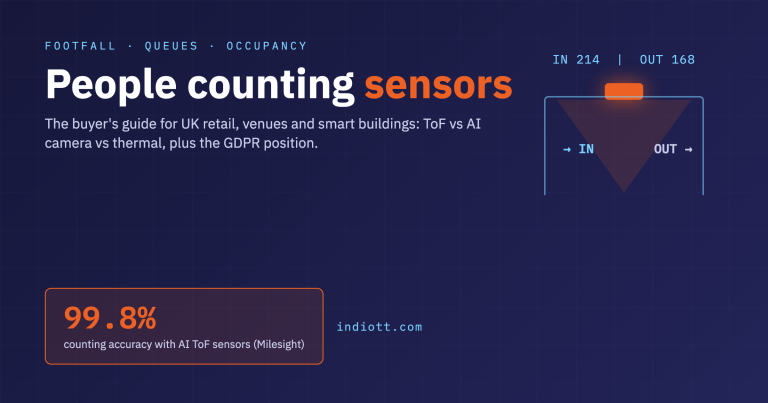
Last updated: 13 July 2026 TL;DR: People counting sensors measure how many people enter, leave or occupy a space, and they now reach up to 99.8% accuracy. UK retailers use them to calculate conversion rates, venues use them to hold fire-safety occupancy limits, and facilities teams use them for queue management and cleaning on demand….
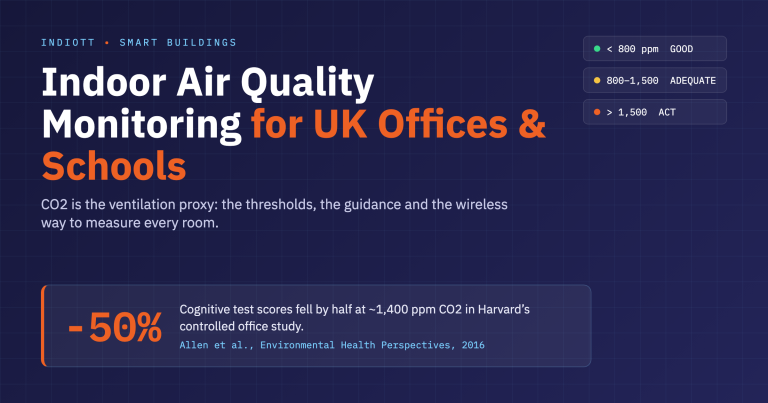
Last updated: 13 July 2026 TL;DR: CO2 is the cheapest reliable proxy for ventilation, so indoor air quality monitoring in UK workplaces starts with a CO2 reading in every occupied room. Keep spaces below 800 ppm where you can, investigate anything that sits above 1,000 ppm, and act when readings pass 1,500 ppm. Battery-powered LoRaWAN…
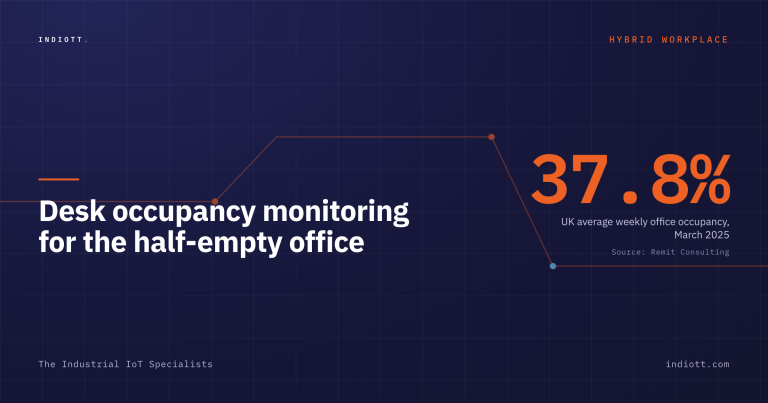
Desk occupancy monitoring uses anonymous IoT sensors to measure real utilisation, cut wasted floorspace and energy, and prove the hybrid office business case.
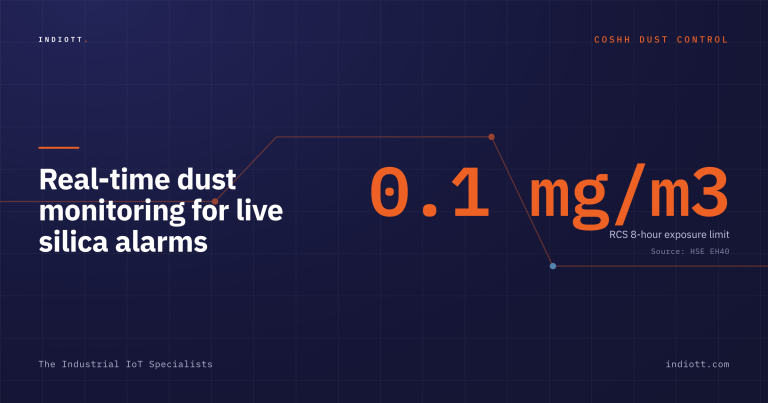
Real-time dust monitoring beats annual sampling: catch RCS spikes above the 0.1 mg/m3 EH40 limit, trigger alarms and extraction, and prove COSHH compliance.