Awaab’s Law Phase 2: Seven New Hazards From 30 November 2026
TL;DR: Phase 2 of Awaab’s Law starts on 30 November 2026 and adds seven hazard categories to the fixed repair clock, including excess cold and excess heat. For a significant hazard the landlord has 10 working days to investigate, 3 to issue a written summary, and 5 to make the property safe. Emergency hazards run to 24 hours throughout. Two of the seven new hazards are continuously measurable by a £38.90 sensor, and the clock starts on the day you become aware.
Last updated: 29 July 2026
On this page
Key takeaways
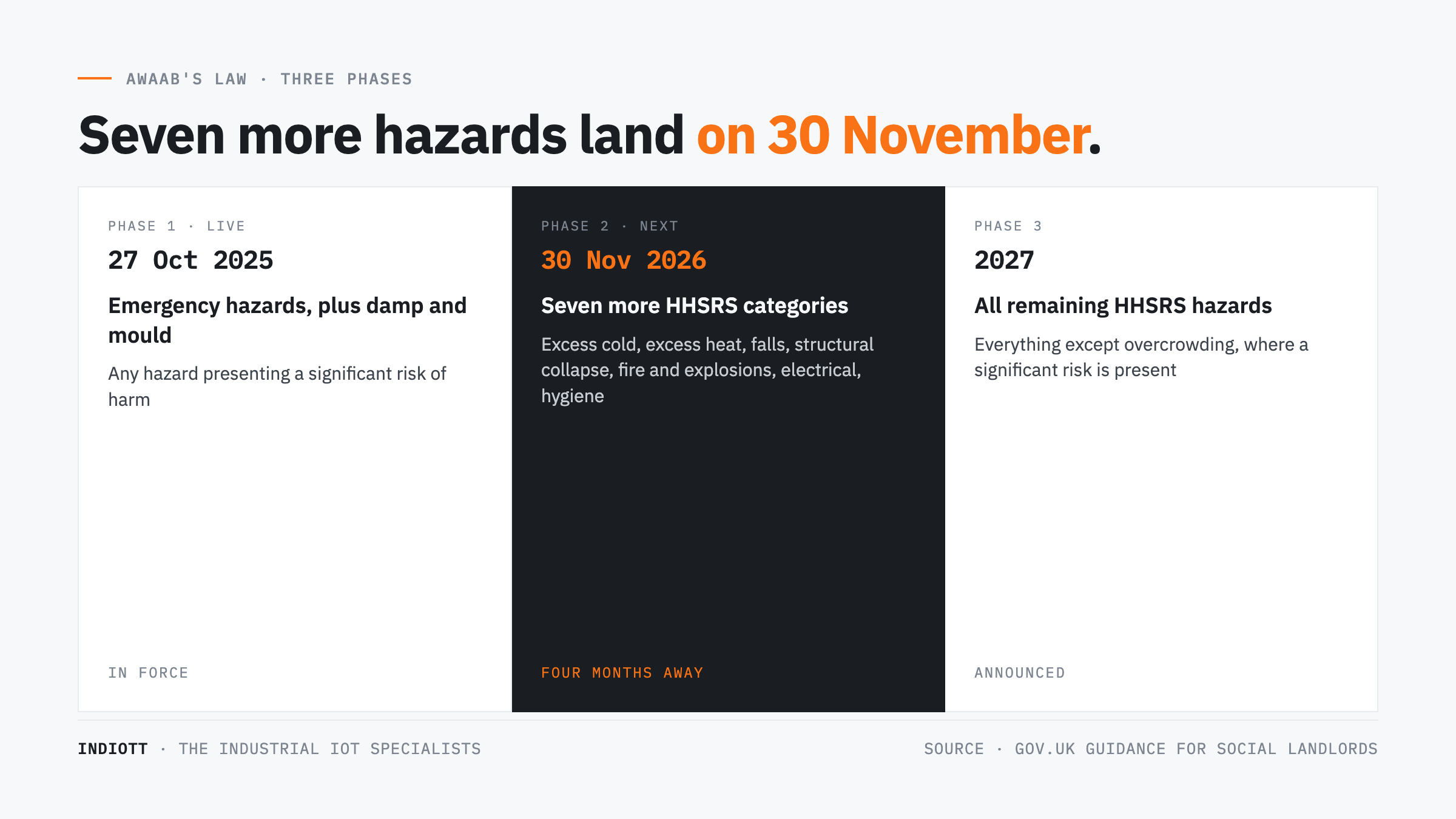
- Awaab’s Law phase 1 has applied since 27 October 2025, covering all emergency hazards plus damp and mould presenting a significant risk.
- Phase 2 of Awaab’s Law lands on 30 November 2026 and adds seven categories: excess cold, excess heat, falls, structural collapse and falling elements, fire and explosions, electrical hazards, and domestic and personal hygiene including pests.
- Timescales for a significant hazard: investigate in 10 working days, written summary within 3, make safe within 5, further works started or steps taken within 5 and physically started within 12 weeks.
- Emergency hazards keep a 24-hour investigate-and-make-safe duty.
- If the property cannot be made safe in time, the landlord must fund suitable alternative accommodation for the whole household.
What Awaab’s Law already requires
Awaab’s Law puts social landlords on a fixed statutory clock once they become aware of a hazard. Since 27 October 2025 it has covered all emergency hazards and damp and mould presenting a significant risk of harm. It applies to local authorities, housing associations and other registered providers of social housing, and sits alongside the wider regime overseen by the Housing Ombudsman.
A significant hazard is one posing a significant risk of harm to an occupier’s health or safety, where a reasonable landlord with the relevant knowledge would act as a matter of urgency. An emergency hazard is one presenting an imminent and significant risk, which a reasonable landlord would make safe within 24 hours. The GOV.UK guidance for social landlords gives examples including gas leaks, broken boilers, water loss and exposed wiring.
One line in that guidance is worth reading twice, because it removes an old defence. Landlords cannot assume damp and mould result from tenant lifestyle. Everyday moisture from cooking, bathing and laundry is unavoidable and does not justify declining to investigate.
The seven hazards added on 30 November 2026
Phase 2 of Awaab’s Law extends the same timescales to seven further HHSRS hazard categories. Phase 3 follows in 2027 with all remaining hazards except overcrowding.
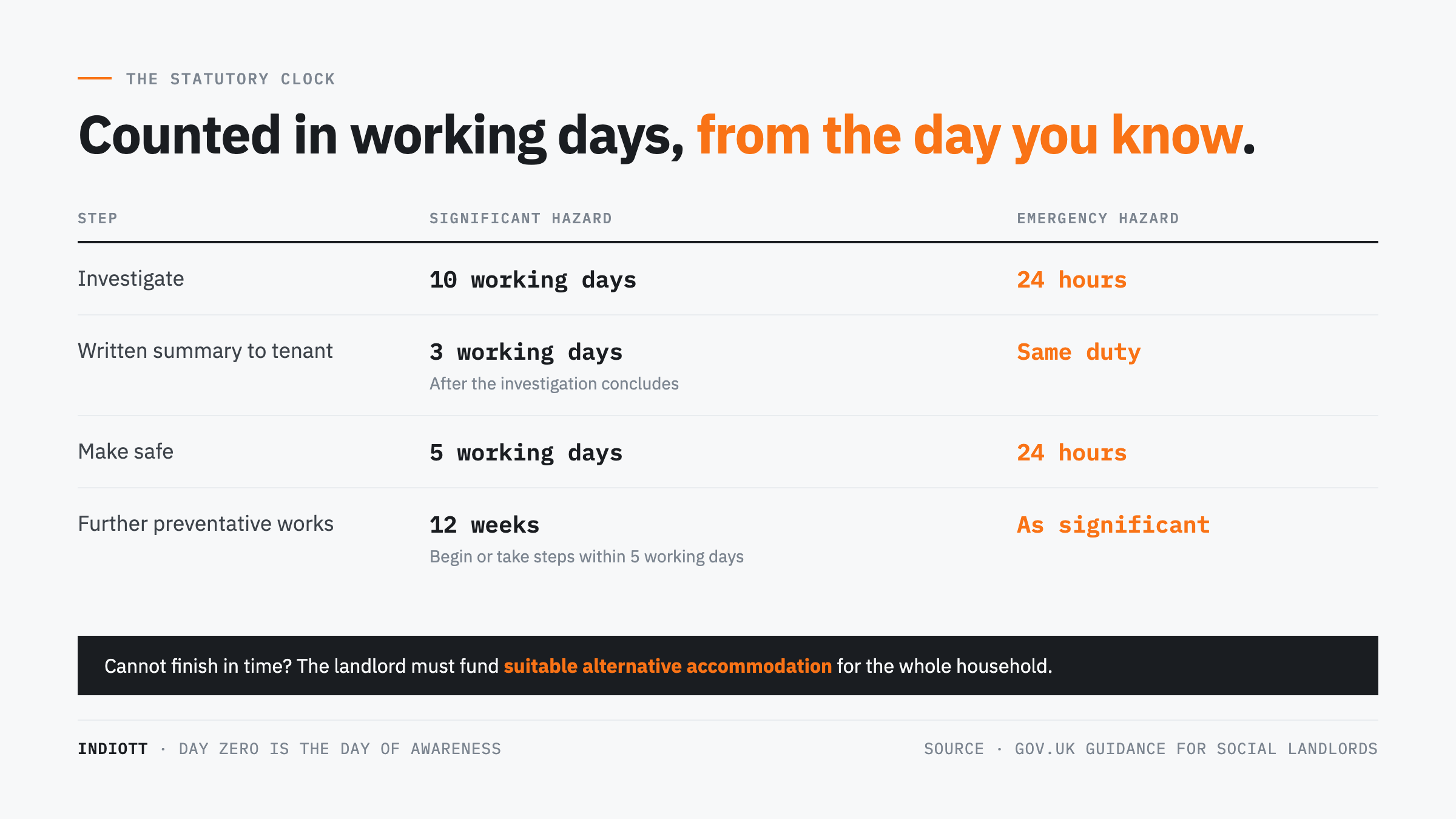
| Added from 30 November 2026 | Continuously measurable? |
|---|---|
| Excess cold | Yes, directly |
| Excess heat | Yes, directly |
| Falls, including baths, level surfaces, stairs and between levels | No |
| Structural collapse and falling elements | Partly, via movement and tilt |
| Fire and explosions | Via detection, already standard |
| Electrical hazards | Partly, via circuit monitoring |
| Domestic and personal hygiene, and food safety | Partly, via appliance temperature |
Most of the seven still depend on inspection. Two do not. Excess cold and excess heat are the only hazards on the list that a sensor can observe continuously, in every property, without anyone visiting. That asymmetry is the practical story of phase 2, and it is why Awaab’s Law is now a monitoring question and not only a repairs one.
The clock, in working days
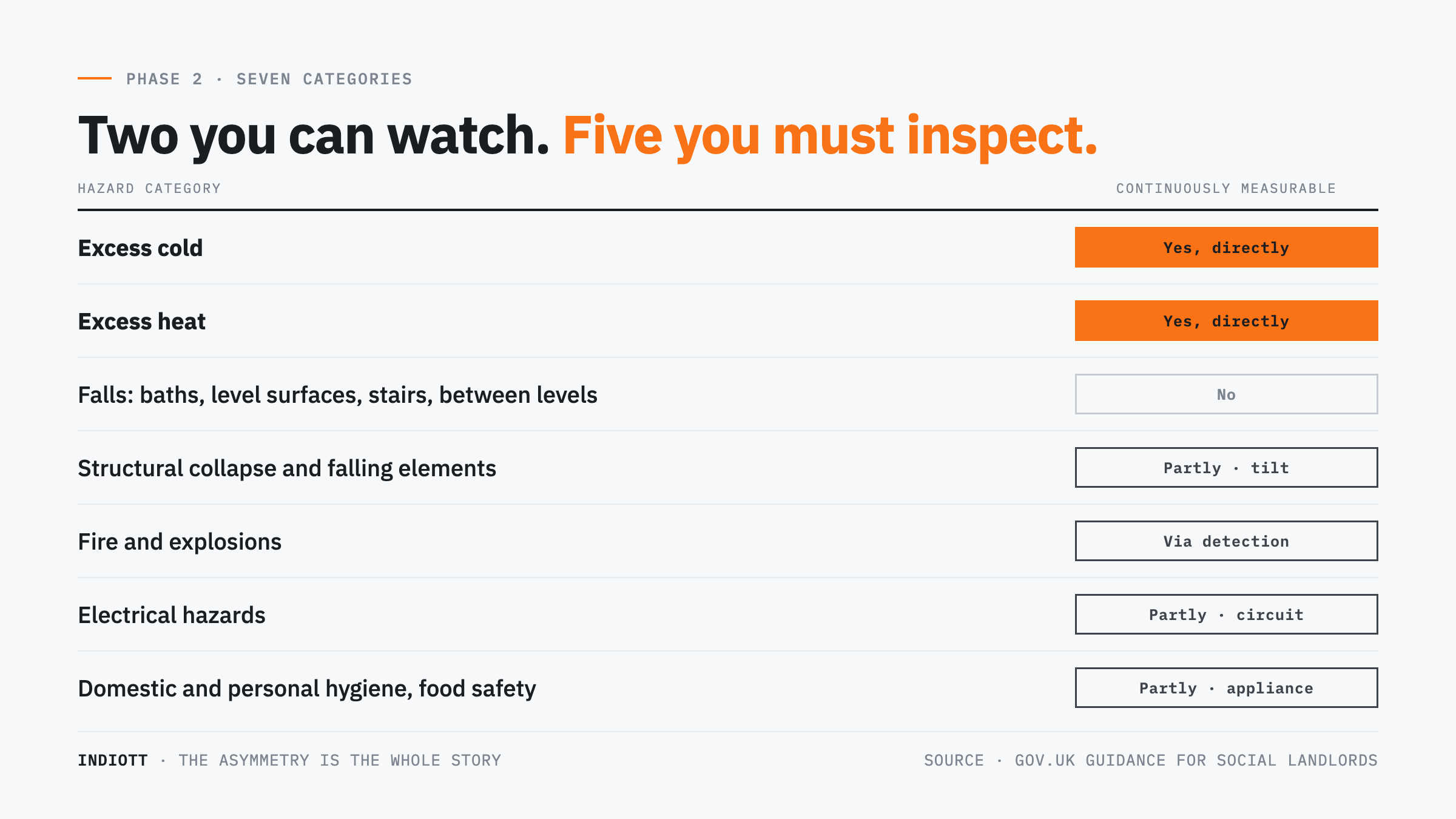
The Awaab’s Law timescales are precise, and they are counted in working days from the day the landlord becomes aware. Day zero is the day of awareness; day one is the next working day.
| Step | Significant hazard | Emergency hazard |
|---|---|---|
| Investigate | Within 10 working days | Within 24 hours |
| Written summary to the tenant | Within 3 working days of the investigation concluding | Same duty applies |
| Make safe | Within 5 working days of the investigation concluding | Within 24 hours |
| Further preventative works | Begin, or take steps to begin, within 5 working days; physically started within 12 weeks | As for significant |
If the work cannot be completed inside those periods, the landlord must secure suitable alternative accommodation at its own expense until it is done, for the whole household, considering space, proximity to schools and work, accessibility and pets. That is the provision that turns a slow response into a large bill.
Why excess cold and excess heat are different
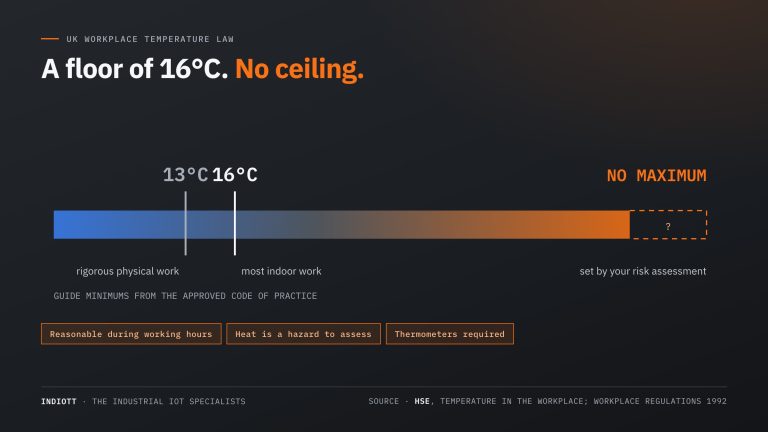
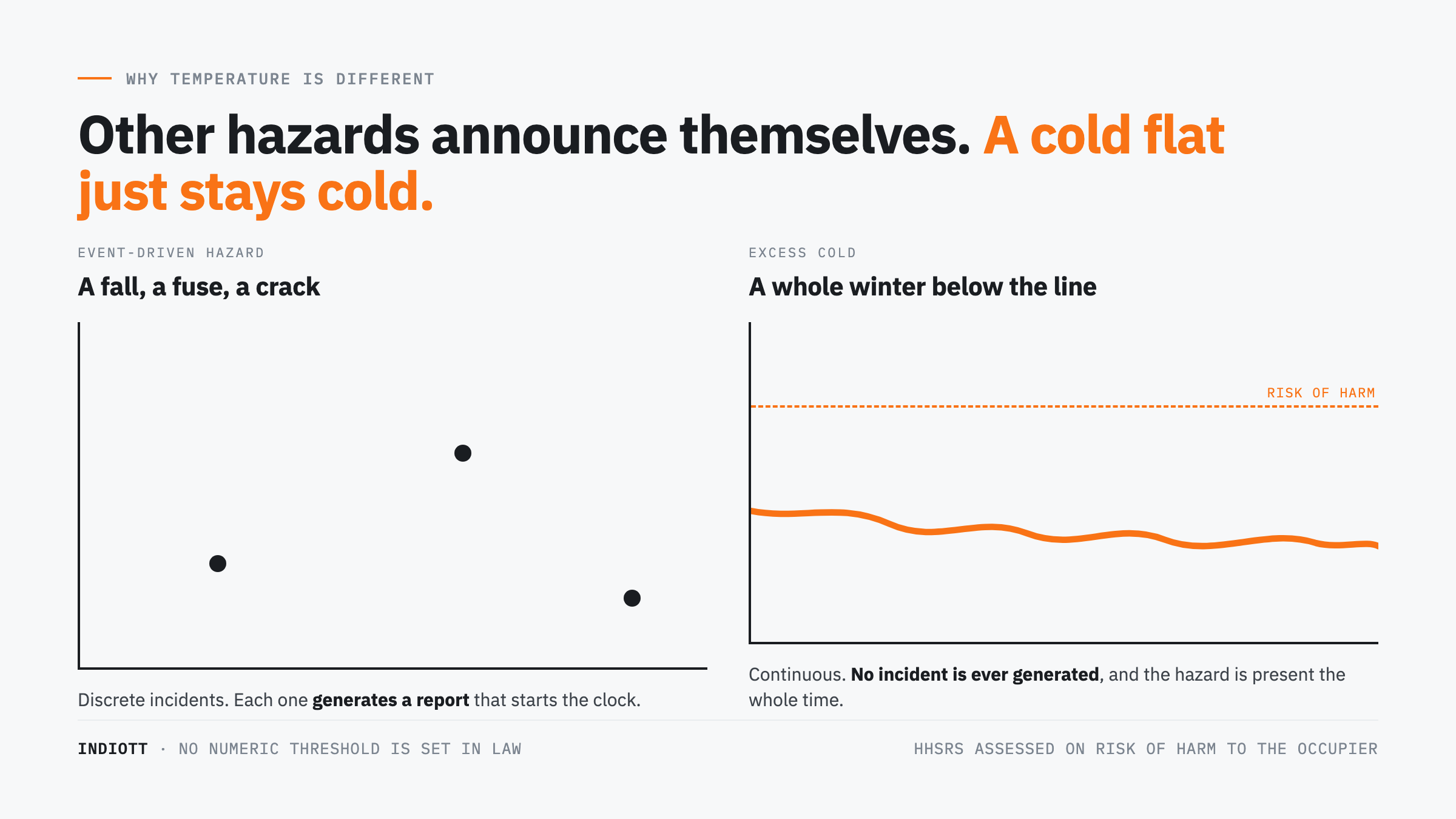
Every other hazard on the Awaab’s Law phase 2 list announces itself through an event or an inspection. A tenant falls. A fuse blows. A wall cracks. Temperature does none of that. A flat that sits at 14°C through February is a hazard the whole time and produces no incident to report, and a top-floor flat at 32°C in August is the same problem inverted.
Two consequences follow for anyone preparing for Awaab’s Law, and they pull in opposite directions. The bad one is that a temperature hazard can persist for months without triggering the clock, which is exactly the pattern that made damp and mould a scandal. The good one is that temperature is trivially cheap to measure continuously, which no other hazard on the list can claim.
There is a third consequence worth being honest about: once you monitor, you know. Awareness starts the clock, and a landlord holding a year of temperature data for a property has a harder time arguing it did not know. That is a real operational consideration, and it is also the point. The alternative is not knowing, and the alternative is what phase 2 exists to end.
What counts as becoming aware
Awareness is the trigger for everything in Awaab’s Law, so it is worth being clear about what starts it. It is not limited to a tenant reporting a problem. Information reaching the landlord through any route can count, including contractors, other agencies and the landlord’s own records.
The guidance is equally clear that record-keeping is the defence. Landlords should hold accurate information about residents and homes, plus clear records of engagement, investigations, access attempts and communications with tenants and contractors. There is a defence where a landlord took all reasonable steps and the obstacle was genuinely beyond its control, such as failure to gain access after reasonable attempts or unavailable specialist contractors, but it has to be evidenced.
Read those two paragraphs together and the practical conclusion is uncomfortable but simple. Continuous data cuts both ways: it establishes awareness, and it is also the only thing that proves what the property was actually doing on a given date. Under Awaab’s Law the second matters more, because the defence turns on evidence rather than intent.
What it costs to instrument
The hardware that answers the measurable half of Awaab’s Law is not expensive, which is the argument. Every price below is the current listed figure on indiott.com, excluding VAT, verified on 29 July 2026.
| Sensor | Covers | From, ex VAT |
|---|---|---|
| Milesight EM300-TH | Temperature and humidity, LoRaWAN | £38.90 |
| Milesight AM102L | Indoor ambience, temperature, humidity | £38.90 |
| Milesight WS203 | Motion plus temperature and humidity | £38.90 |
| Milesight EM320-TH | Temperature and humidity, outdoor rated | £41.90 |
| Milesight AM304L | Wider indoor ambience set | £71.82 |
| Milesight UG63 gateway | 8-channel, 2,000+ nodes, one per building | £98.76 |
Put that against the alternative. A single failure to meet the Awaab’s Law timescales can mean funding alternative accommodation for a household until the work is done. The comparison is not sensor cost against zero, it is sensor cost against one avoided decant.
Battery-powered LoRaWAN sensors matter here for a specific reason: social housing retrofit cannot rely on tenant wifi or on running cables through occupied homes. That trade-off is covered in wireless versus wired sensors, and the damp side of the same deployment in our damp and mould monitoring guide.
Five steps before November
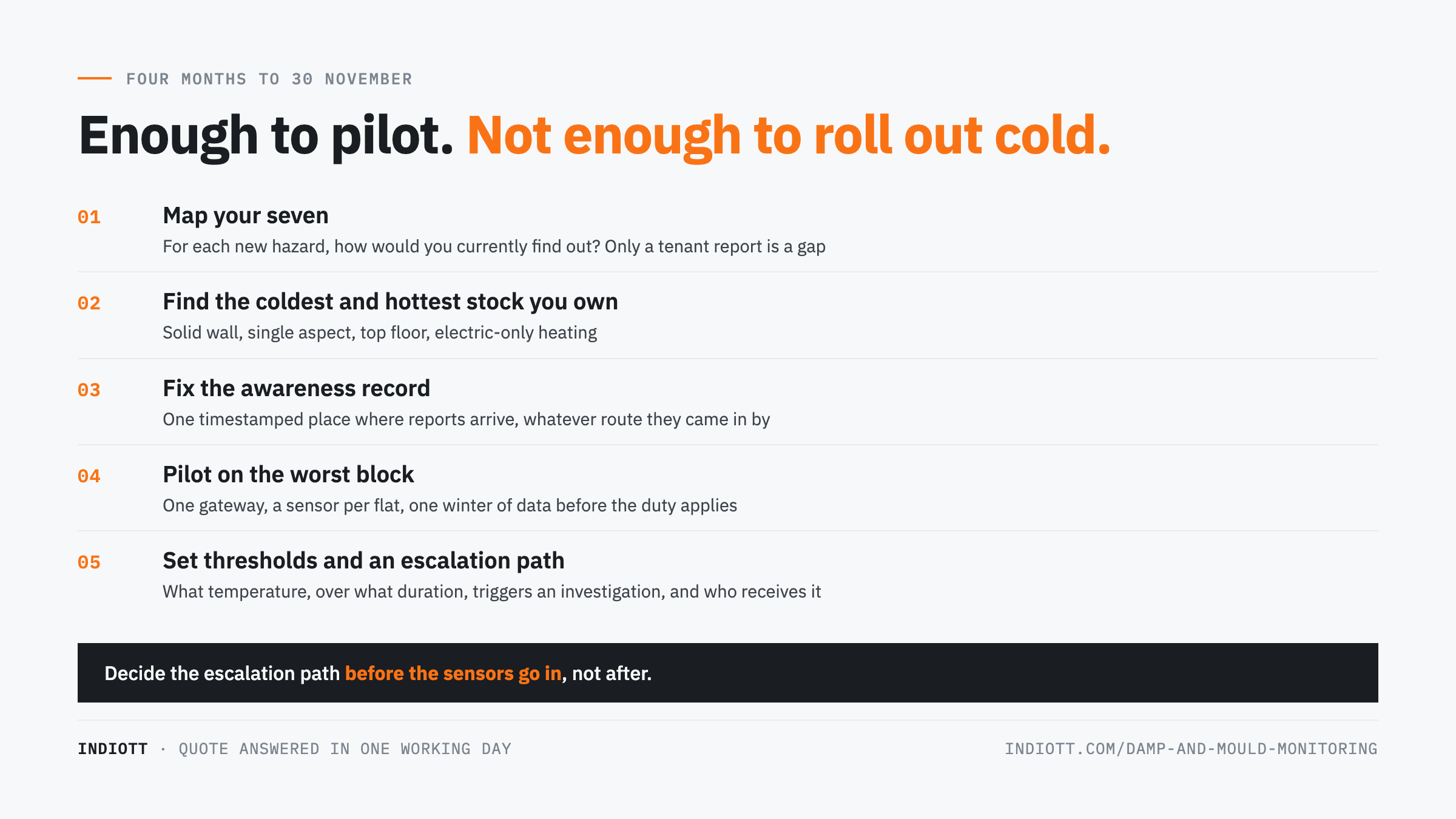
Four months is enough to prepare for Awaab’s Law phase 2 and not enough to procure, install and learn from scratch across a whole stock. Prioritise accordingly.
- Map your seven Awaab’s Law hazards. For each new hazard category, write down how you would currently find out. Any answer that is only a tenant report is a gap.
- Find the coldest and hottest stock you own. Solid wall, single aspect, top floor, electric-only heating. That is where excess cold and excess heat will bite first.
- Fix the awareness record. One place where reports arrive, timestamped, whatever route they came in by. The clock is unforgiving about dates.
- Pilot on the worst block. One gateway, a sensor per flat, one winter of data before the duty applies.
- Set thresholds and an escalation path. Decide now what temperature over what duration triggers an investigation, and who receives it.
Frequently asked questions
When does Awaab’s Law phase 2 start?
30 November 2026. Phase 1 has applied since 27 October 2025 for emergency hazards and damp and mould. Phase 3, covering all remaining HHSRS hazards except overcrowding, follows in 2027.
Who does Awaab’s Law apply to?
Social landlords: local authorities, housing associations and other registered providers of social housing. It does not currently extend the same statutory timescales to the private rented sector.
Does a sensor alert count as becoming aware?
Information reaching a landlord through any route can constitute awareness, not just a tenant report. A monitoring alert should therefore be treated as starting the clock, which is precisely why the escalation path and threshold need deciding before the sensors go in, not after.
What if we cannot get access to the property?
There is a defence where a landlord took all reasonable steps and the obstacle was genuinely beyond its control, and inability to gain access after reasonable attempts is a listed example. It has to be evidenced, which means recording every access attempt at the time.
What temperature counts as excess cold under Awaab’s Law?
Awaab’s Law does not set a numeric threshold. Excess cold and excess heat are HHSRS hazard categories assessed on risk of harm to the occupier, taking account of age, health and the condition of the property. That is why the useful output of monitoring is a duration-weighted record rather than a single reading.
Pilot one block before winter
A gateway and a sensor per flat on your worst-performing block gives you one heating season of data before the Awaab’s Law duty applies, which is the difference between preparing and reacting. Send us the block and we will price it inside one working day. Start with the damp and mould monitoring range, the LoRaWAN temperature sensors, or request a quote.
Next step
Get a priced kit list for your site
Answer three quick questions and tell us where to send it. An engineer replies within one working day with the parts, the prices and the lead time.
Rather talk it through? Call 023 9223 3611
Received. An engineer has it.
You will hear back within one working day with the parts, the prices and the lead time. A confirmation is on its way to your inbox.
If it is urgent, call 023 9223 3611.