Plant Room Monitoring: Boiler Faults, Lost Heat and Leaks in Buildings Without a BMS
TL;DR: A building without a building management system usually finds out its heating has failed when the radiators go cold. Plant room monitoring closes that gap with five checks: the boiler or pump panel’s fault contact, flow temperature, return temperature, the room itself and water on the floor. Wireless sensors report each one to a gateway and send alerts, so a lockout becomes a message instead of a complaint. Monitoring adds warnings; it does not control plant or replace servicing.
Last updated: 14 September 2026
On this page
Key takeaways
- Plant room monitoring gives a building without a BMS the alerts that matter most: plant faults, lost heat, frost risk and leaks.
- Where a boiler or pump panel has a volt-free fault output, a dry contact input turns a lockout into an alert.
- Flow and return temperatures show whether heat is leaving the plant. Nesta explains that a condensing boiler needs its return water below around 54°C to condense.
- Approved Document L says new or fully replaced wet heating systems should be sized to work at a maximum flow temperature of 55°C or lower.
- Monitoring does not control the plant, and it is not a gas or carbon monoxide alarm.
Why monitor a plant room without a BMS?
Plant room monitoring matters most where nothing else is watching. A building management system reads the plant continuously and raises alarms, but a building without one relies on someone noticing a problem. A boiler that locks out overnight is usually discovered in the morning, when the building is already cold.
Plant rooms are also visited rarely. A pressurisation unit weeping onto the floor, a pump that stopped, or a room that fell close to freezing during a cold snap can all go unseen between service visits.
Wireless plant room monitoring fills that gap without cabling through the building. Battery sensors report to a gateway, and the gateway sends alerts to a phone or an inbox.

What should plant room monitoring measure?
Plant room monitoring should cover five checks, each chosen because it shows a failure early.
- The fault contact. A change on the boiler or pump panel’s fault output is the plant telling you it has stopped.
- Flow temperature. If the flow pipe is not reaching its normal temperature, heat is not being made.
- Return temperature. The return shows how much heat the water gave up on its way round, and on a condensing boiler, whether it can condense.
- The room. Temperature and humidity in the plant room itself, for frost risk, overheating and damp.
- Water on the floor. A leak sensor at the lowest point, or under the unit most likely to leak.
Most of this can be read without touching the controls. The only wired connection is the fault input, and that uses terminals the manufacturer provides.
How does a boiler fault alert work?
A boiler fault alert works by reading a volt-free contact: a switch inside the boiler or panel that opens or closes when the appliance goes to fault, without carrying any voltage of its own. A dry contact input on a wireless sensor sees the switch change state and reports it to the gateway.
The Milesight EM300-DI has one dry contact input and works either as a pulse counter or as a digital input, so in digital input mode it reports the contact as open or closed. Its IP67 housing is rated from -30°C to 70°C, which suits a plant room.
Three rules keep this safe. Use only the fault or alarm terminals named in the manufacturer’s manual. Never connect the input to a powered or live signal. And have a competent engineer make the connection, so the appliance’s own safety controls and warranty are untouched.
Not every boiler has a fault output. Where it does not, the flow and return temperatures still show the symptom that matters: the plant stopped delivering heat.
What do flow and return temperatures tell you?
Flow and return temperatures tell you whether heat is leaving the plant and how much the water gives up on its way round. The heat delivered depends on the water flow rate and the temperature drop between flow and return, so a flow pipe that goes cold means no heat is being made, and a return almost as hot as the flow suggests the water is giving up little heat.
The return also decides whether a condensing boiler condenses. Nesta’s work on lowering boiler flow temperatures explains that the water returning to the boiler has to be below around 54°C for condensing to happen, and that most condensing boilers in use across the UK are set with flow temperatures of 70 to 80°C.
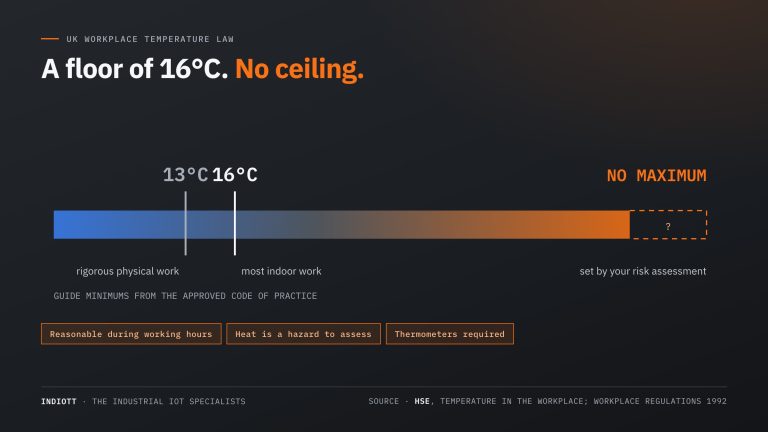
Regulations point the same way for new work. Approved Document L, Volume 2, for buildings other than dwellings, says a newly installed or fully replaced wet heating system should be sized to operate at a maximum flow temperature of 55°C or lower, and that designing to a lower temperature still is preferable.
A logged return temperature therefore shows two things plant room monitoring cares about: when heat stops, and whether the boiler spends its time above the point where it can condense.

Why watch the plant room itself?
Watching the plant room itself catches problems the plant cannot report. A room that falls towards freezing puts pipes, pumps and pressurisation units at risk, and a room that runs far hotter than usual can point to a ventilation problem. Humidity that stays high for hours suggests water somewhere it should not be.
A temperature and humidity sensor on the wall covers this. Set a low temperature alert that leaves time to act before anything freezes, and review the humidity trend weekly rather than alerting on every spike.
For leaks, a sensor on the floor at the lowest point, or under the pressurisation unit or a valve that has wept before, is the simplest check. The Milesight WS303 triggers once liquid reaches 0.5 mm and has a built-in buzzer for anyone nearby.
What are the limits of plant room monitoring?
Plant room monitoring warns; it does not act. Four limits are worth planning around.
- It does not control plant. It will not restart a boiler, change a setpoint or switch a pump. A BMS controls and monitors; a monitoring kit only reports.
- Pipe probes read the pipe surface. A probe strapped to a pipe under its insulation reads slightly below the water inside. Compare readings with each other and with their own history, not with the boiler display.
- It is not a safety device. It is not a gas detector, a carbon monoxide alarm or a substitute for servicing. Those stay exactly as they are.
- Radio has to reach. Basement and rooftop plant rooms can be hard to reach, so test the signal from the plant room before fixing sensors.

What does a plant room monitoring kit include?
A plant room monitoring kit needs a gateway and five sensors. Our plant room monitoring kit combines a UG63 gateway, an EM300-TH for the room, two TS201 probes for flow and return, an EM300-DI on the fault contact and a WS303 leak sensor, with live prices and one click to the basket.
The TS201 probe measures from -40°C to 125°C on a 1.5 m cable, so it covers heating pipes comfortably. If the plant has gas meters with pulse outputs, a second EM300-DI in pulse counter mode can count them; our guide to pulse counters explains how. For higher process temperatures, see PT100 temperature monitoring.

Frequently asked questions
Does plant room monitoring replace a BMS?
No. A BMS controls plant as well as monitoring it. Plant room monitoring gives a building without a BMS alerts for faults, lost heat, frost risk and leaks.
What if the boiler has no fault output?
Watch flow and return temperatures instead. When the boiler stops, the flow pipe cools, and that shows up in the readings even without a fault contact.
Where should flow and return probes go?
On bare pipe close to the boiler, one on the flow and one on the return, held with a clip or cable tie and covered again with the pipe insulation.
What flow temperature should a heating system run at?
Approved Document L says new or fully replaced wet heating systems in buildings other than dwellings should be sized for a maximum flow temperature of 55°C or lower. Nesta explains that condensing boilers need return water below around 54°C to condense.
Will a wireless sensor work in a basement plant room?
Often, but concrete and steel weaken radio. Test the signal from the plant room door first, and put the gateway inside or near the plant room if readings do not arrive.
Know the plant stopped before the building does
Plant room monitoring turns a room nobody visits into five alerts that matter: a fault, heat not leaving the plant, a return too hot to condense, a room near freezing and water on the floor.
See the plant room monitoring kit with live prices, or send us a photo of the plant room and an engineer will reply within one working day.
Next step
Get a priced kit list for your site
Answer three quick questions and tell us where to send it. An engineer replies within one working day with the parts, the prices and the lead time.
Rather talk it through? Call 023 9223 3611
Received. An engineer has it.
You will hear back within one working day with the parts, the prices and the lead time. A confirmation is on its way to your inbox.
If it is urgent, call 023 9223 3611.