Outdoor Cabinet Monitoring: Doors, Heat and Condensation in the Boxes That Run a Site
TL;DR: Outdoor cabinets hold the controllers, routers and power supplies that keep a site running, and they fail in three ways nobody sees: a door left open, heat building up in summer and condensation forming in winter. Cabinet monitoring watches all three with one sealed sensor per door that also reads temperature and humidity, reporting to an outdoor LoRaWAN gateway. A single isolated cabinet can use a cellular sensor that needs no gateway at all.
Last updated: 14 September 2026
On this page
Key takeaways
- Cabinet monitoring matters because outdoor enclosures hold the equipment a site depends on, and they are rarely looked inside.
- They fail in three hidden ways: a door left open, heat building up in summer, and condensation forming as air cools below its dew point.
- The Met Office confirmed a UK record air temperature of 40.3°C at Coningsby in the July 2022 heatwave, and a closed cabinet in the sun starts from that air.
- The EM300-MCS reports door state, temperature and humidity from one IP67 unit, rated from -30°C to 70°C.
- A single remote cabinet can use a TS601 cellular sensor, which detects the door opening by the change in light inside a dark enclosure.
What goes wrong inside outdoor cabinets?
Outdoor cabinets are exposed on every side, and three conditions do the damage without anyone seeing: rain and dust through a door left ajar, heat from the sun on a closed metal box, and water condensing on cold surfaces overnight. Cabinet monitoring exists to catch those three conditions early.
Without cabinet monitoring, most cabinets are visited on a schedule or when something has already stopped working. A traffic controller, a telemetry outstation, a site router or a CCTV power supply can spend weeks in poor conditions before the fault shows as a lost connection or a failed unit.

Why does an open cabinet door matter?
An open cabinet door matters twice. It is a security event, because someone has accessed the equipment, and it is an environmental one, because a cabinet’s weather protection only works with the door shut against its seal. Rain, dust and insects get in through a door left on the latch.
A door record also answers practical questions. Did the maintenance contractor actually attend? Was the cabinet left open after the visit? Which cabinet is opened far more often than the others? With cabinet monitoring, a magnetic contact on each door turns every opening into a time-stamped entry.
How hot do outdoor cabinets get?
Outdoor cabinets start from the outside air temperature and add the heat of the sun and the equipment inside. The Met Office’s verification of the UK record confirmed 40.3°C at Coningsby, Lincolnshire, in the July 2022 heatwave, when the previous UK record of 38.7°C was provisionally met or exceeded at 46 stations. That is an air temperature measured in the shade; a closed metal box in direct sun heats up from there.
Equipment ratings decide how much margin there is. The UG67 outdoor gateway, for example, is rated from -40°C to 70°C but notes reduced cellular performance above 60°C. Cabinet monitoring shows how close each enclosure runs to the limits of what it holds, and a rising trend in a cabinet that used to run cooler is often a failed fan or a blocked filter.

Why do cabinets suffer from condensation?
Cabinets suffer from condensation because their walls cool faster than the air inside them. Dew point is the temperature to which air must be cooled for its water vapour to condense, as Penn State’s meteorology course on dew point explains. When a metal wall cools overnight below the dew point of the air trapped inside, water forms on it.
A worked example shows how easily that happens. Air at 18°C and 70% relative humidity has a dew point of about 12.4°C, by the standard Magnus approximation. On a clear night, the cabinet’s steel skin can fall well below 12.4°C while the air inside is still humid, and water condenses on the inside of the door and runs onto terminals.
Temperature and humidity measured together give the dew point for every reading, so cabinet monitoring can show which enclosures spend their nights close to condensing. Those are the ones that need a heater, a breather or a better seal.

How does cabinet monitoring work?
Cabinet monitoring works with a sealed sensor on the door that also reads temperature and humidity, reporting to an outdoor gateway within radio range. For a group of cabinets on one site, that is one sensor per door and one gateway. For a single cabinet miles from anything, a cellular sensor with no gateway is simpler.
| Situation | What to fit |
|---|---|
| Several cabinets on one site or along a route | One EM300-MCS per door, one UG67 outdoor gateway with 4G |
| A single isolated cabinet | One TS601 cellular sensor, no gateway |
| Cabinets near an existing LoRaWAN gateway | One EM300-MCS per door, no new gateway |
The EM300-MCS carries a temperature and humidity sensor alongside its door contact, so one IP67 unit per door covers all three failures. The TS601 reports temperature and humidity over LTE and has a light sensor that its datasheet lists for cargo box opening detection, which works the same way in a dark cabinet. See the TS601 product page for its full specification.

What should cabinet alerts look like?
Cabinet monitoring alerts should separate the urgent from the trend. A door opening outside a maintenance window needs an alert now; a cabinet that runs a few degrees hotter each summer needs a line in a monthly report.
- Door opened outside planned visits: immediate alert.
- Internal temperature near the limit of the equipment inside: alert, with a check of fans and filters.
- Humidity staying near saturation overnight: weekly review, and a heater or breather where it repeats.
- No readings from a cabinet: alert, because a silent cabinet may mean a flat battery, a failed gateway or damage.
What are the limits?
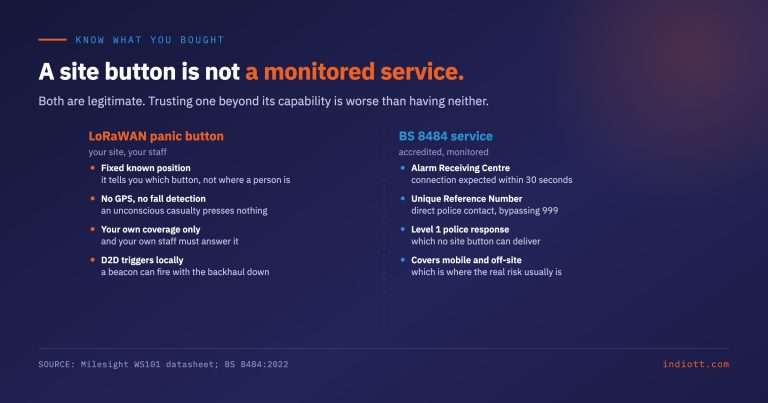
Cabinet monitoring watches the enclosure, not the equipment’s own health or the power feeding it. A door sensor will not tell you a power supply has failed or a router has crashed; those need the equipment’s own alarms or a controller input. It is also not an intruder alarm with a monitored response.
The biggest practical limit of cabinet monitoring is radio. Steel cabinets weaken signals, so check the reading from inside a closed cabinet before fitting a whole route. A cabinet that fails needs the gateway closer, a different sensor position, or the cellular option.
What does a cabinet monitoring kit include?
Our cabinet monitoring kit pairs a UG67 outdoor gateway, IP67 and with 4G built in, with six EM300-MCS door sensors, one per cabinet, each reporting door state, temperature and humidity. The kit page lists live prices and adds the kit to the basket in one click. If a cabinet’s telemetry or alarm still reports over a phone line, our post on the PSTN switch-off covers what stops working and how to move it.
Frequently asked questions
How do you stop condensation in an outdoor cabinet?
Keep the enclosure’s air above its dew point and limit moisture getting in: a small heater, a breather and a good door seal are the usual measures. Monitoring temperature and humidity shows which cabinets need them.
Can one sensor monitor a cabinet door and temperature?
Yes. The Milesight EM300-MCS combines a magnetic door contact with a temperature and humidity sensor in one IP67 unit rated from -30°C to 70°C.
How do you monitor a remote cabinet with no power or broadband?
Use a battery cellular sensor such as the TS601, which reports over LTE without a gateway where there is mobile coverage, and can detect the cabinet being opened by the change in light inside.
Will a wireless sensor work inside a steel cabinet?
Often, but steel weakens radio. Test the signal from inside a closed cabinet before fitting a full route, and move the gateway closer or use a cellular sensor where it fails.
What temperature is too hot for an outdoor cabinet?
It depends on the equipment inside. Check each device’s rated operating range; the UG67 gateway, for example, is rated to 70°C with reduced cellular performance above 60°C.
Open the cabinet without driving to it
Cabinet monitoring turns sealed boxes into a daily record of access, heat and moisture, so maintenance goes to the enclosures that need it before the equipment inside fails.
See the cabinet monitoring kit with live prices, or send us the route and cabinet count and an engineer will plan the gateways within one working day.
Next step
Get a priced kit list for your site
Answer three quick questions and tell us where to send it. An engineer replies within one working day with the parts, the prices and the lead time.
Rather talk it through? Call 023 9223 3611
Received. An engineer has it.
You will hear back within one working day with the parts, the prices and the lead time. A confirmation is on its way to your inbox.
If it is urgent, call 023 9223 3611.