IoT Weather Station: Wind Data That Stops the Crane Argument
Last updated: 4 September 2026
In short: A site weather station replaces “the forecast said it was fine” with a timestamped record of what the wind actually did, at your location, at the height that matters. For lifting operations that record is the difference between a defensible decision to continue and an argument after the event.

The nearest official weather station is probably an airport twelve miles away, on flat ground, at a standard ten metres. Your site is in a valley, or between two towers that channel wind, or on a ridge. Those are different places meteorologically, and only one of them is where the crane is.
This guide covers what a site weather station should measure, where it has to be mounted to mean anything, and the specific limits that make wind data a legal matter rather than a convenience.
Why does a site need its own weather station?
Because wind is intensely local, and a shared regional weather station cannot resolve it. Tower crane operations run to a hard number, and that number is close enough to everyday British weather that guessing is not viable.
UK industry practice sets the recommended maximum in-service wind speed for tower cranes at 38 mph, which is 16.5 m/s, established by the CPA Tower Crane Interest Group, sitting below the manufacturer design limit of 45 mph or 20 m/s under EN 14439 to leave time for a safe shutdown.
The responsibility is personal and statutory. The Appointed Person is legally responsible under LOLER Regulation 8 for establishing wind limits for every lift and has the authority to stop work, with BS 7121-1:2016 Clause 19 and Annex D providing the wind assessment guidance.
A weather station does not make that decision. It gives the Appointed Person a number from the actual site instead of a number from an airport, and it keeps the record afterwards.
Mounting height is the whole measurement
Mounting height is the point that invalidates more weather station installations than any equipment fault. Wind speed increases with height above ground, substantially and predictably.
A unit bolted to the site cabin at three metres, surrounded by hoardings and material stacks, is measuring a sheltered pocket. The jib is forty metres up in clean air, and the difference between those two figures is not a rounding error.

Two workable approaches. Mount an anemometer on the crane itself at or near jib height, which is what most modern cranes already have, and use the site weather station for the wider environmental record. Or mount the station on the highest clear structure available and be explicit in the lift plan about what its reading represents.
What does not work is mounting it wherever the cable reaches and then treating the number as though it were the wind at the hook. Document the mounting height and exposure alongside the data, because a reading without a height is uninterpretable.
Gust, not average, is what stops the job
A weather station reporting a ten minute mean of 12 m/s sounds comfortable. If it contains gusts touching 18 m/s, the job is already outside the in-service limit for part of that period.
Configure the weather station to report maximum gust within each interval alongside the average, and set alerts on the gust. Reporting only a mean smooths away exactly the events the limit exists to protect against.
Wind direction matters as much as speed for some operations, because a crane’s capacity and a load’s behaviour depend on orientation, and a large panel is a sail. Direction also tells you whether dust or noise is heading for the neighbours today.
Ultrasonic against cup and vane
The traditional weather station anemometer spins. A cup rotor for speed, a vane for direction, both on bearings, and both with a start-up threshold below which they simply do not turn.
An ultrasonic sensor times sound pulses between fixed transducers and infers the wind from the difference. No moving parts, no bearings, no start-up threshold and nothing to seize in freezing weather.
The Milesight WTS506 datasheet specifies ultrasonic operating principle for both wind speed and direction, with speed measured across 0 to 60 m/s at ±0.3 m/s or ±3%, whichever is greater, and direction across 0 to 360° at ±3°.
Read that tolerance against your threshold. At the 16.5 m/s in-service limit, ±3% is about ±0.5 m/s, so a reading of 16.3 could genuinely be 16.8. That is not a reason to distrust the instrument. It is a reason not to operate right on the line and call it compliance.
The 0 to 60 m/s range is comfortably beyond anything a UK site will experience, which matters because a sensor that saturates during the event you most needed to record is worse than no sensor.
What else is worth measuring
Wind is the headline, but the same weather station usually carries the sensors that answer other site questions.
- Temperature, on a thermistor across -40 to 85°C at ±0.3°C. Concrete pours, frost protection and cold working decisions all hang on it, and an on-site figure beats a regional forecast.
- Humidity, capacitive across 0 to 100% RH at ±3%. Combined with temperature it gives you dew point, which governs condensation on surfaces due to be painted or coated.
- Rainfall, where the station supports it, for excavation and earthworks decisions and for evidencing why a programme slipped.
The value compounds because one weather station gives one timestamped record. A dispute about a delayed pour is much simpler to settle when temperature, humidity and wind for that morning all came from the same weather station on the same site.

Power, mounting and getting the data off site
A weather station has to sit in clean air, which is usually the one place with no power. The WTS506 addresses this with high power solar and rechargeable battery backup, in a waterproof, UV-proof and salt spray resistant enclosure.
Salt spray resistance is not a marketing line on coastal and estuarine sites, where a standard enclosure degrades within a season.
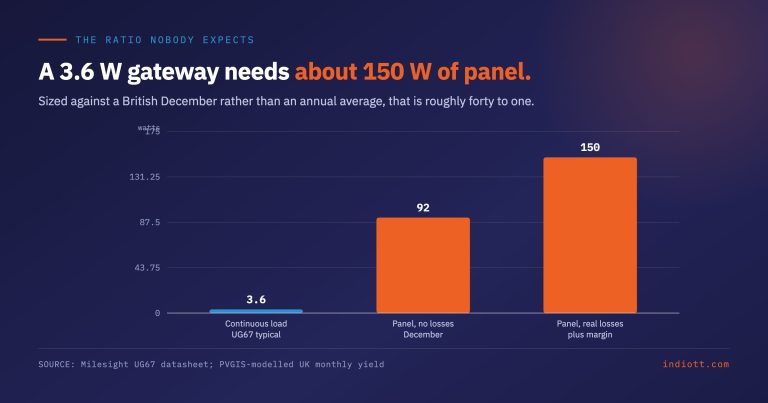
Check the solar sizing against midwinter rather than the annual average, and keep the mounting accessible enough that the panel can actually be wiped clean when it needs it.
For data, the unit stores more than 19,000 historical records locally with retransmission, and quotes line of sight range up to 15 km in rural areas. Local storage matters more than range on a construction site, because the gateway will lose power or move as the build progresses, and a station that buffers through that keeps the record continuous.
Long range with local buffering is the right combination for a site whose layout changes monthly. If the site has no mains at all, our guide to off-grid monitoring power budgets covers sizing the rest of the system around it.
Setting thresholds that people will actually respect
A weather station generates alerts, and alerts get ignored when they fire too often. Getting the threshold structure right at commissioning is what keeps the system credible six months later.

Use three levels rather than one. An advisory well below the limit that tells a supervisor conditions are building, an action level at the point where specific operations stop, and an out-of-service level that triggers the shutdown procedure. One threshold produces either constant noise or no warning at all.
Set them on gust over a short window, and require the condition to persist for a defined period before the alert fires. A single anomalous sample from a passing vehicle or a slammed panel should not stop a site, and a five minute persistence rule removes almost all of that noise without hiding real weather.
Name who receives each level. An alert addressed to everyone is addressed to nobody, and the Appointed Person needs the action level directly rather than via a group inbox.
Finally, review the thresholds against what the weather station actually recorded after the first month. If the advisory fired forty times and nobody acted once, it is set wrong, and leaving it wrong teaches people to dismiss the next one.
Using the record after the event
The reason to keep the data is that questions arrive late. HSE guidance on luffing jib tower cranes warns that if cranes are left out of service with the slew brake engaged or the jib parked at too small a radius, the crane may not weathervane freely in high winds, with the possibility of very high loadings and collapse of the jib or the whole crane.
A continuous wind record does two things there. Before the event, it triggers the out-of-service procedure at the right time rather than at the end of the shift. After it, it evidences what conditions actually were.
Keep the raw data, not just the alerts. An alert log proves a threshold was crossed. The underlying series proves what happened in the hours either side, which is the question that actually gets asked.
Frequently asked questions
Can I just use a weather app or the Met Office forecast?
For planning, yes. For a decision to lift or stop, no. A forecast is a prediction for a region, not a measurement at your mounting height, and it is not a record of what occurred.
What wind speed stops a tower crane?
UK industry practice puts the recommended maximum in-service speed at 16.5 m/s, below the 20 m/s manufacturer design limit under EN 14439. The binding figure for any specific crane is the manufacturer’s, and the Appointed Person sets the limit for each lift.
Does a weather station need mains power?
Not usually. Solar with battery backup is the norm precisely because the best mounting positions have no supply. Check the panel is sized for midwinter rather than for the annual average.
Ultrasonic or mechanical anemometer?
Ultrasonic for anything unattended. No bearings to wear, no start-up threshold, and nothing that seizes in ice. Mechanical units are cheaper and still perfectly serviceable where someone maintains them.
Where should the weather station go on a construction site?
As high and as clear of obstruction as you can safely mount and maintain it, with the height recorded. If crane decisions depend on it, take the reading at jib height rather than extrapolating from ground level.
The short version
Buy the weather station for the record as much as for the reading. Mount it high and clear, document the height, report gusts rather than averages, and keep the raw series. The instrument tolerance is a few per cent; the error from mounting it on the site cabin is far larger than that.
For the other things a site should be measuring, our guides to real-time dust monitoring and COSHH and noise monitoring cover the neighbour-facing obligations that wind direction feeds directly into.
The Milesight WTS506 IoT weather station is priced and in stock. Add it to a quote and we will come back within one working day.
Next step
Get a priced kit list for your site
Answer three quick questions and tell us where to send it. An engineer replies within one working day with the parts, the prices and the lead time.
Rather talk it through? Call 023 9223 3611
Received. An engineer has it.
You will hear back within one working day with the parts, the prices and the lead time. A confirmation is on its way to your inbox.
If it is urgent, call 023 9223 3611.