Milesight IoT Controllers Compared: UC100, UC300, UC50x and UC51x
Last updated: 11 August 2026
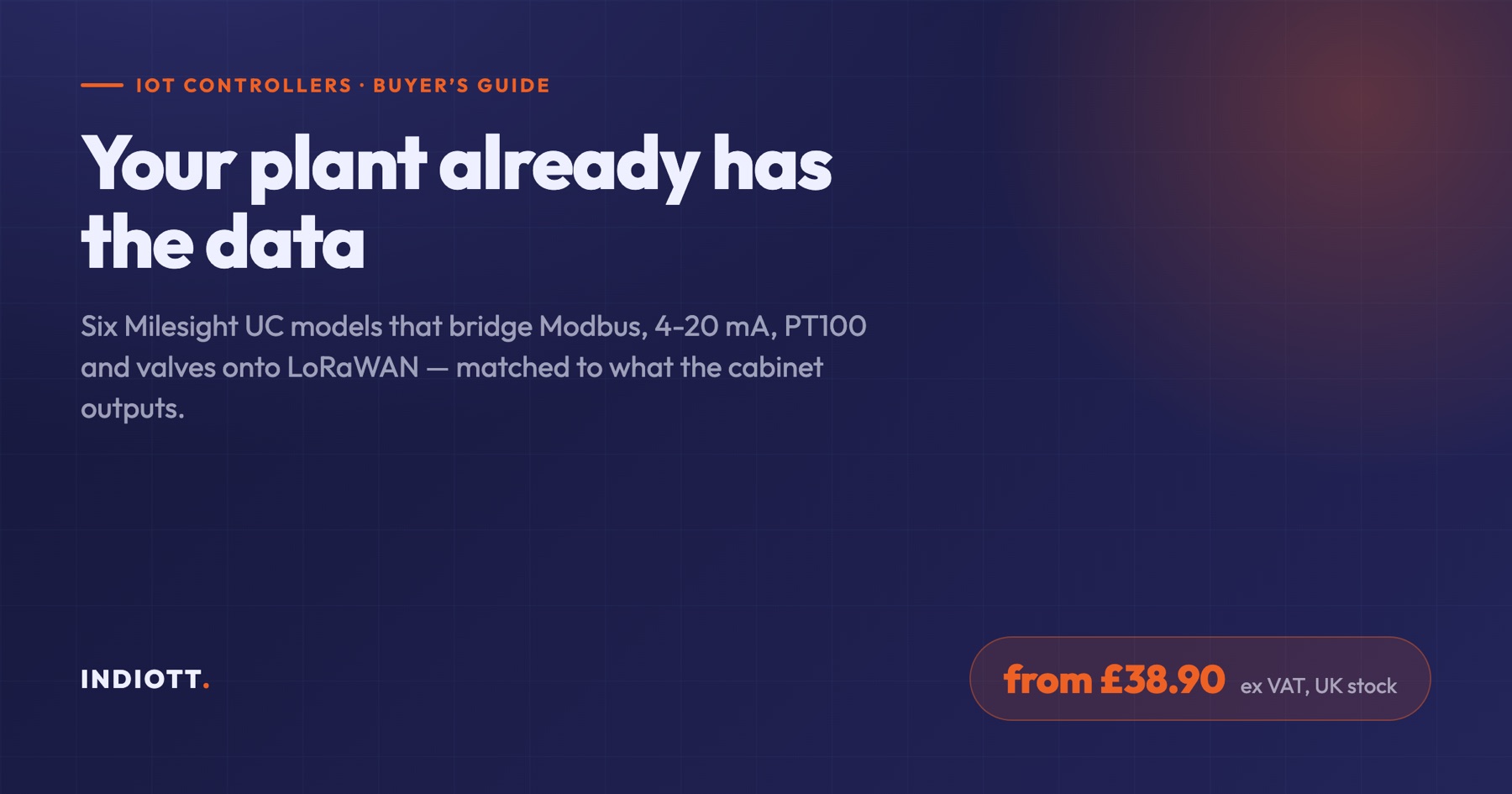
Short answer: if the plant already speaks Modbus RTU, the UC100 (£38.90 ex VAT) is the cheapest IoT controller that gets it onto LoRaWAN. If you need to read 4-20 mA, 0-10 V or PT100 signals and switch relays, use the UC300 (£104.74). For a wet, outdoor or buried location use the IP68 UC501 (£119.71) or UC502 (£122.70), and for irrigation valves the UC511 (£119.71) or UC512 (£127.19).
Most sites already have the measurement. The flow meter, the energy meter, the pump panel and the level transmitter are all producing numbers, and those numbers are stuck in a cabinet nobody visits. An IoT controller is the bridge, and the model you need depends entirely on what the existing kit outputs.
On this page:
- What does an IoT controller actually do?
- The six models compared
- UC100: when the plant already speaks Modbus
- UC300: analogue inputs, PT100 and relays
- UC501 vs UC502: what £2.99 actually buys
- Valve control: UC511 and UC512
- What does a controller retrofit cost?
- Which IoT controller do you need?
- Frequently asked questions
What does an IoT controller actually do?
It reads existing industrial signals and puts them on a LoRaWAN network, and in most cases it can switch something back. That is the whole job. An IoT controller is not a sensor and it is not a gateway; it sits between the plant and the radio.
This matters because the cheapest route to monitoring an asset is usually not a new sensor. A pump panel already has a run signal, a fault contact and often a Modbus interface. Replacing that with a wireless sensor duplicates measurement you already own; wiring an IoT controller to the existing signals costs less and tells you more.
All six models here report over LoRaWAN, so they need a gateway in range and a network server. Our LoRaWAN primer covers the radio, and the gateway buyer’s guide covers the receiving end. The specifications below are from Milesight’s published product pages, and prices are live UK stock ex VAT.
The six models compared
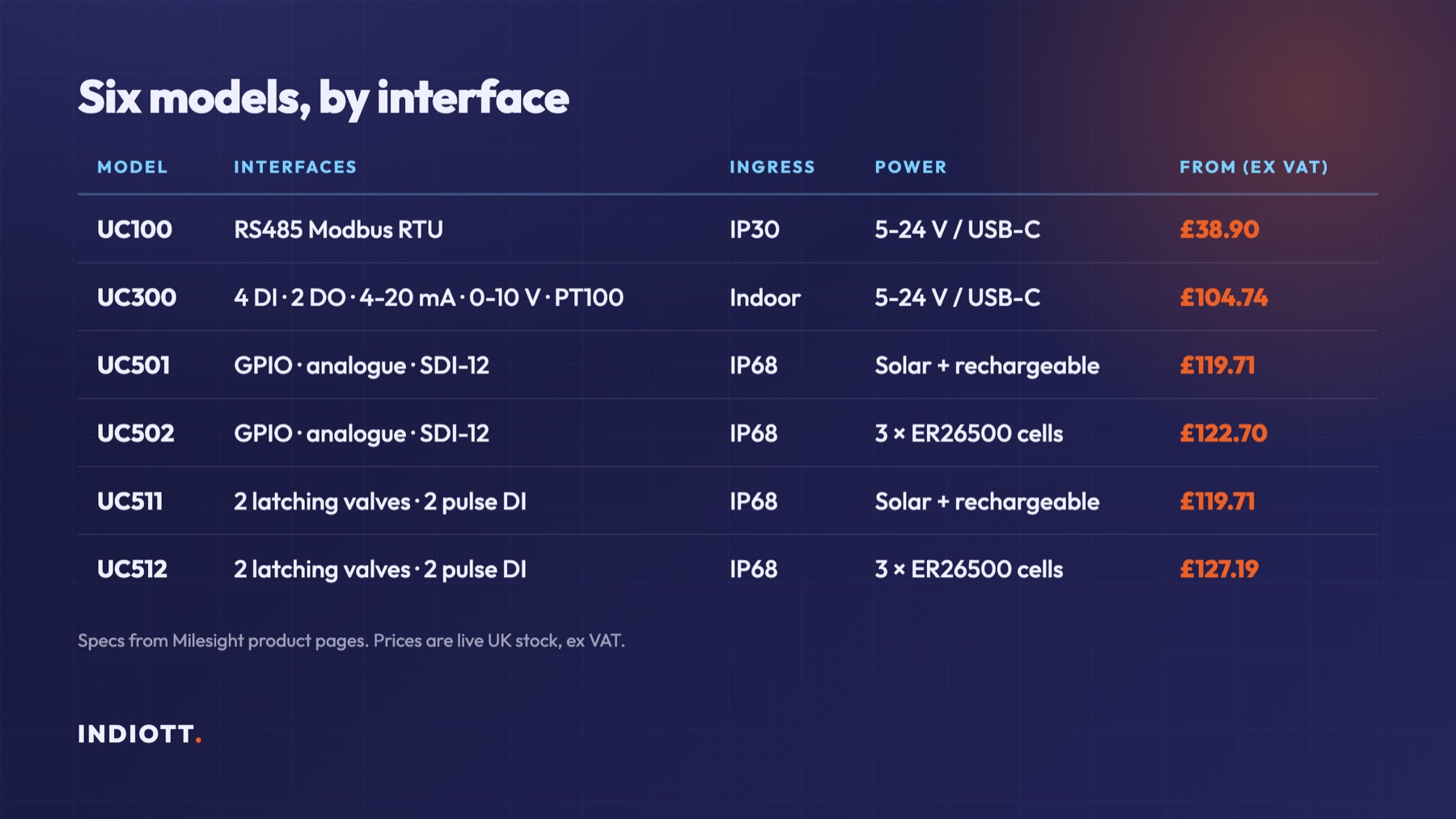
The IoT controller range splits into two families by environment. The UC100 and UC300 are indoor cabinet devices. The UC50x and UC51x are IP68 field devices rated for a metre of water for seven days.
- UC100 — Modbus RS485 to LoRaWAN converter, reads up to 64 registers across up to 32 Modbus RTU devices, under 0.5 W, DC 5-24 V or USB-C, −20°C to +60°C, IP30, 70 × 45 × 13 mm, 32 g. £38.90.
- UC300 — 4 DI + 2 DO with SPDT relays rated 3 A at 30 VDC or 250 VAC, 2 × 4-20 mA plus 2 × 0-10 V analogue inputs, 2 × PT100 RTD spanning −200°C to 800°C, RS232 and RS485, DC 5-24 V or USB-C, −20°C to +60°C, 93 × 70 × 22 mm. £104.74.
- UC501 — 2 GPIO, 2 analogue inputs switchable between 4-20 mA and 0-10 V, RS232 or RS485, SDI-12, IP68, powered by two 2550 mAh rechargeable cells with a 6 V 1.7 W solar panel, −20°C to +60°C. £119.71.
- UC502 — the same interfaces, powered instead by three replaceable 9000 mAh ER26500 lithium cells, −30°C to +70°C. £122.70.
- UC511 / UC512 — two solenoid interfaces for 12 V DC latching valves plus two dry-contact digital inputs for water meter pulses, IP68. £119.71 and £127.19.
UC100: when the plant already speaks Modbus
At £38.90 this is the highest-leverage device in the range. This IoT controller does one thing: it polls Modbus RTU registers over RS485 and sends the values over LoRaWAN. It reads up to 64 registers and addresses up to 32 Modbus devices on the bus.
Those two numbers are the specification that decides the job. Sixty-four registers is generous for a handful of meters reporting flow, volume, pressure and status, and thin if you intended to mirror an entire PLC register map. Count the registers you actually need before assuming one IoT controller covers the panel.
The power figure is the other quiet advantage: under 0.5 W, from either a 5-24 V terminal or a USB-C lead. That is low enough to run from almost any existing control supply in the cabinet without adding a PSU, which removes the electrical work that usually dominates retrofit cost. Our IoT energy monitoring guide covers the metering case in more depth.
The limitation to respect is IP30 and −20°C to +60°C. This is a cabinet device. Outdoors it needs an enclosure.
UC300: analogue inputs, PT100 and relays
Choose this IoT controller when the signals are electrical rather than digital. A 4-20 mA level transmitter, a 0-10 V damper position, a PT100 in a flow and return, a volt-free fault contact, and a relay to start or inhibit something: the UC300 covers all of it in one box.
The interface count is four digital inputs, two relay outputs, two 4-20 mA inputs, two 0-10 V inputs and two PT100 inputs, plus RS232 and RS485. The PT100 range of −200°C to 800°C is far wider than any building application needs and is aimed at process work.
Pay attention to the relay rating: SPDT at a maximum 3 A at 30 VDC or 250 VAC. That switches a contactor coil, a pilot valve or an indicator. It does not switch a motor directly, and treating this IoT controller as a starter is the mistake to avoid.
Like the UC100 it is an indoor device on a 5-24 V or USB-C supply. Between them, the UC100 and UC300 cover the great majority of cabinet retrofits, and the £65.84 difference is entirely about whether you need analogue and relay capability or just the serial bus.
UC501 vs UC502: what £2.99 actually buys
Almost nothing on the interface side, and a great deal on where you can put it. The two field models carry identical IoT controller I/O: two GPIO, two switchable 4-20 mA or 0-10 V analogue inputs, one software-switchable RS232 or RS485 port, and one SDI-12 port. Both are IP68 to one metre for seven days, on an M12 connector.
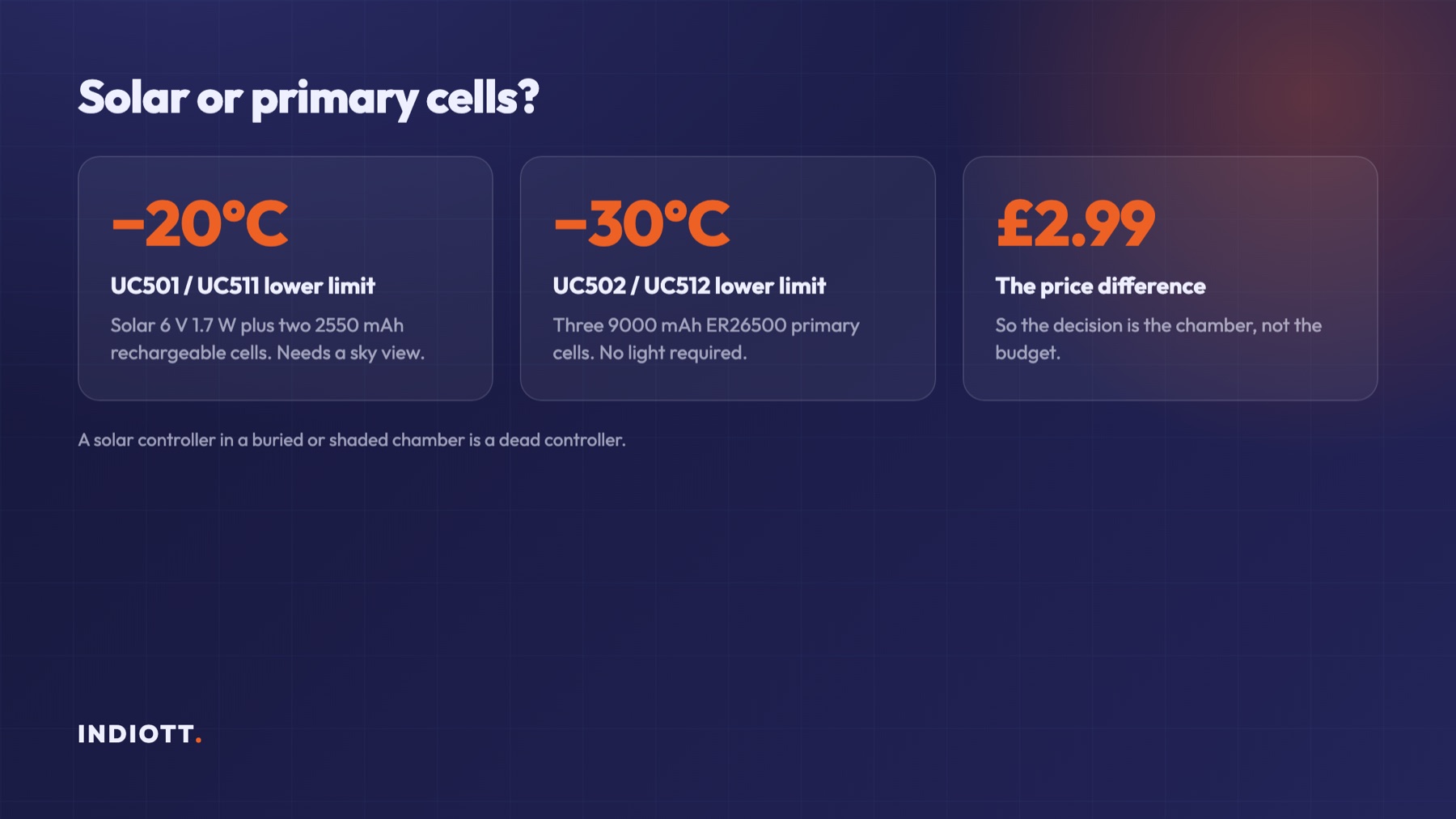
The difference is power and temperature. The UC501 runs on two 2550 mAh rechargeable cells with an integrated 6 V 1.7 W solar panel and is rated −20°C to +60°C. The UC502 runs on three replaceable 9000 mAh ER26500 primary cells and is rated −30°C to +70°C.
That makes the choice a site question, not a budget one. A chamber with a sky view takes the UC501 and never needs a battery visit. A buried chamber, a culvert, a north-facing shaft or anywhere a panel would be shaded, vandalised or buried under leaves takes the UC502, because a solar IoT controller with no light is a dead one. Cold sites also favour the UC502 by ten degrees at the bottom of the range.
The SDI-12 port on both is worth flagging, because it opens up the environmental sensor market: water quality sondes, soil probes and weather instruments that speak SDI-12 natively. Our tank level monitoring guide covers the level-measurement side of these applications.
Valve control: UC511 and UC512
The UC511 and UC512 repeat the same split for a different job. Each drives two 12 V DC latching solenoid valves over a 1.5 m lead and counts pulses from two dry-contact water meters, so a single IoT controller both opens the valve and measures what went through it.
Latching is the important word. A latching solenoid needs a pulse to change state, not a continuous hold current, which is what makes battery-powered valve control viable at all. Do not connect a conventional continuously-energised solenoid to these terminals.
The UC511 adds solar and Milesight D2D, which allows device-to-device triggering without a round trip through the network server. The UC512 gives up solar for three primary cells and the wider temperature range, with Milesight quoting over ten years of Class A operation. For remote irrigation, stock troughs and unpowered valve chambers, that is usually the right trade. Our older piece on web-enabled solenoid valves in the utilities sector covers the operational background.
What does a controller retrofit cost?
The device is rarely the expensive part. Ten Modbus panels across a site cost £389 in UC100 hardware, plus a gateway. On a UG65 at £279.82 with its embedded network server, that is £668.82 of hardware to bring ten previously invisible panels online, with no recurring software fee.
Compare that with replacing the same ten measurement points with new wireless sensors and the arithmetic is not close, because you would be buying instrumentation you already own. This is the argument for starting any retrofit with an IoT controller survey rather than a sensor catalogue.
What we deliberately do not quote is installation labour, because it swings enormously with panel access, isolation requirements and whether an electrician is needed to land the supply. Get that priced separately, and note that the low power draw of these devices often removes the need for a new PSU, which is where retrofit labour usually goes.
Which IoT controller do you need?
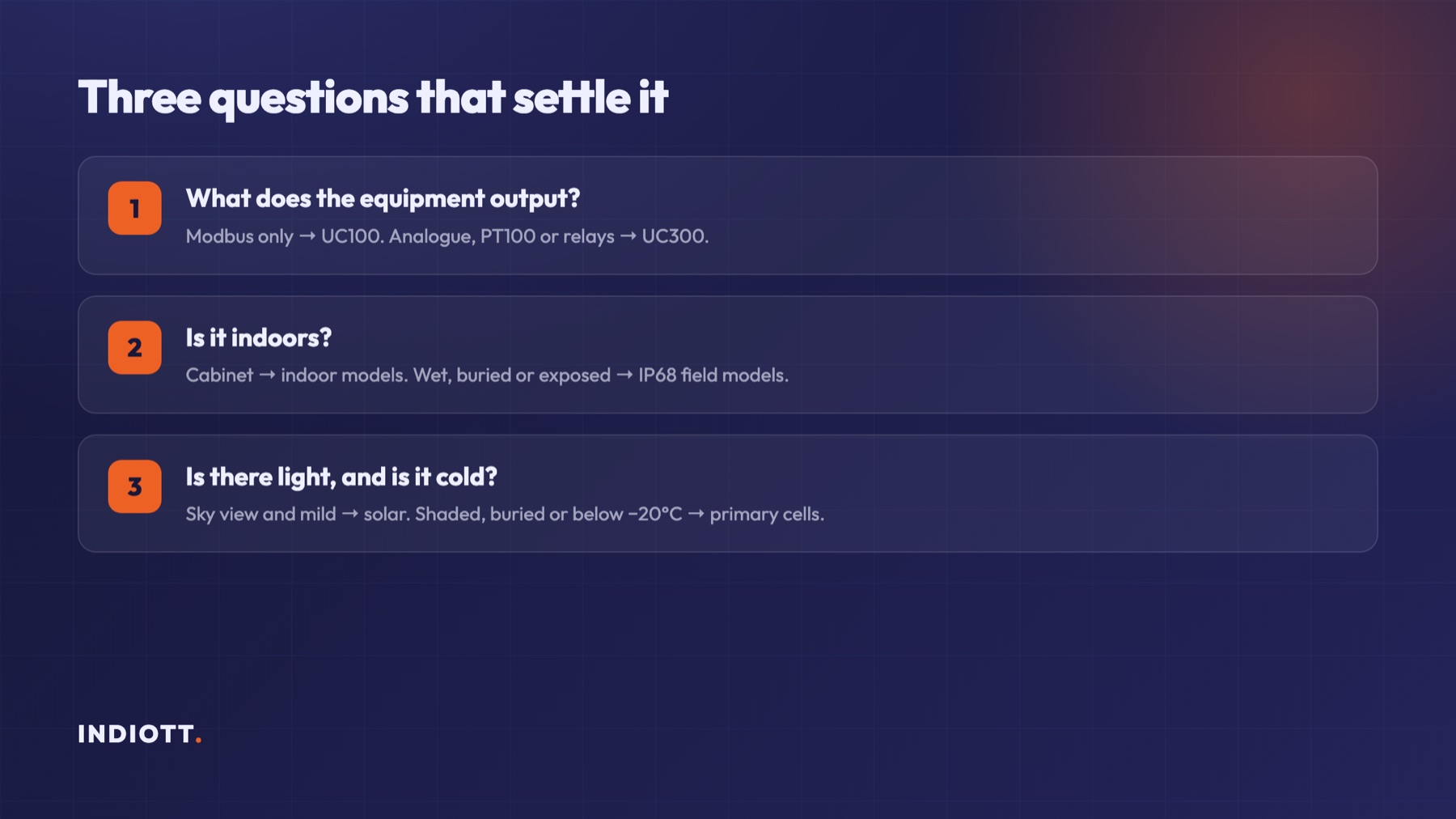
Three questions settle it.
What does the existing equipment output? Modbus RTU only, UC100. Analogue, PT100 or relays needed, UC300. Nothing but a valve to drive, UC511 or UC512.
Is it indoors? Cabinet, either indoor model. Wet, buried or exposed, you need the IP68 field devices.
Is there light and is it cold? Sky view and mild, the solar UC501 or UC511. Shaded, buried or below −20°C, the primary-cell UC502 or UC512. Our industrial IoT cost guide sets these against a whole-project budget.
Frequently asked questions
Can an IoT controller replace a PLC?
No, and it should not try. These devices poll, report and switch on simple rules. Interlocks, safety functions and fast control loops belong in a PLC. The right pattern is to leave the PLC doing its job and use an IoT controller to read from it and report remotely.
How many Modbus devices can the UC100 read?
Up to 32 Modbus RTU devices on the RS485 bus, reading up to 64 registers in total. If your register list is longer than that, you need either a second unit or a device with more capacity.
Does an IoT controller need a separate power supply?
Not usually for the indoor models. The UC100 draws under 0.5 W and both it and the UC300 accept 5-24 V DC or USB-C, so an existing control supply in the panel is normally enough. The IP68 field models are battery or solar powered by design.
What is SDI-12 and do I need it?
SDI-12 is a serial protocol used by environmental instruments such as water quality sondes, soil moisture probes and weather sensors. It is on the UC501 and UC502. If none of your instruments mention it, you do not need it.
Will an IoT controller work underwater?
The UC501, UC502, UC511 and UC512 are IP68 rated for one metre for seven days, which covers a flooded chamber rather than permanent submersion. The UC100 and UC300 are indoor devices and need an enclosure outdoors.
Can the UC300 switch a pump directly?
No. Its relays are SPDT rated at a maximum 3 A at 30 VDC or 250 VAC, which is a control-circuit rating. Switch a contactor with it and let the contactor switch the motor.
The bottom line
Start from what the plant already outputs, not from what you want to measure. A Modbus meter needs a £38.90 UC100, not a new sensor. Analogue and relay work needs the UC300. Wet or buried locations need the IP68 models, and the choice between solar and primary cells is decided by whether the chamber sees daylight. Prices above are live UK stock ex VAT — browse the range, or send us the panel schedule and signal list and we will spec it and quote within one working day.
Next step
Get a priced kit list for your site
Answer three quick questions and tell us where to send it. An engineer replies within one working day with the parts, the prices and the lead time.
Rather talk it through? Call 023 9223 3611
Received. An engineer has it.
You will hear back within one working day with the parts, the prices and the lead time. A confirmation is on its way to your inbox.
If it is urgent, call 023 9223 3611.