What is LoRaWAN? A plain-English guide for UK industrial buyers
Last updated: 2 July 2026
TL;DR: What is LoRaWAN? It is a low-power, long-range wireless standard that lets battery sensors send small readings several kilometres to a gateway, then on to a server and your dashboard. In the UK it runs on the licence-exempt 863 to 870 MHz band, needs no SIM or data plan, secures every message with AES-128, and lets one device run for years on a single battery. It suits level, environment, occupancy and leak monitoring across large or remote sites.
If you have ever priced up connecting hundreds of sensors across a water network, a factory or an estate, the sums get ugly fast. A SIM per device, a monthly data fee per device, and batteries that die in months. LoRaWAN was built to break that pattern. This guide explains it in plain English, with the real UK figures, so you can decide whether it fits your project.
What is LoRaWAN, in one sentence?
What is LoRaWAN? It is a networking protocol that carries tiny amounts of data over long distances using very little power, so that simple sensors can run for years without mains power, a SIM card or a monthly data contract. It is the open standard behind most industrial IoT sensor deployments.
The name splits into two parts. LoRa is the radio technique. LoRaWAN is the rulebook that turns lots of LoRa radios into a working, secure network. So when buyers ask what is LoRaWAN, the honest answer is: it is that rulebook, plus the radios and servers that follow it. Keep those two ideas separate and the rest of the technology makes sense.
LoRa vs LoRaWAN: what is the difference?
LoRa is the physical radio layer. The LoRa Alliance describes it as a modulation technique derived from Chirp Spread Spectrum, which encodes information on radio waves using chirp pulses (LoRa Alliance). Those chirps are what let a weak signal travel far and still be decoded.
LoRaWAN sits on top. The LoRa Alliance calls it a Media Access Control layer protocol built on top of LoRa modulation, a software layer that defines how devices use the LoRa hardware (LoRa Alliance). In short, LoRa gets the signal there. LoRaWAN handles addressing, security, and how the whole network behaves.
How does LoRaWAN actually work?
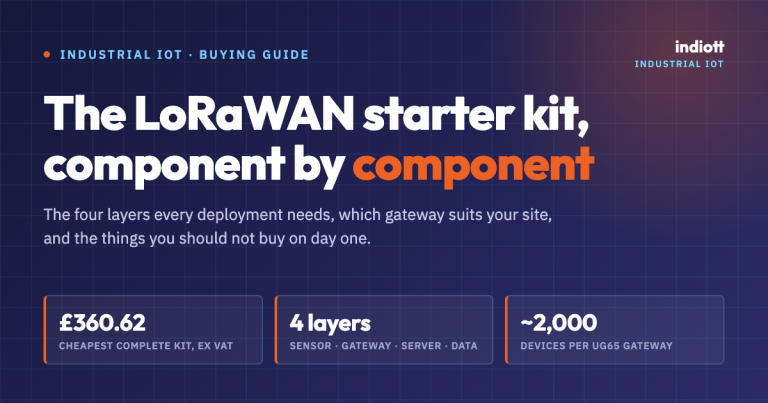
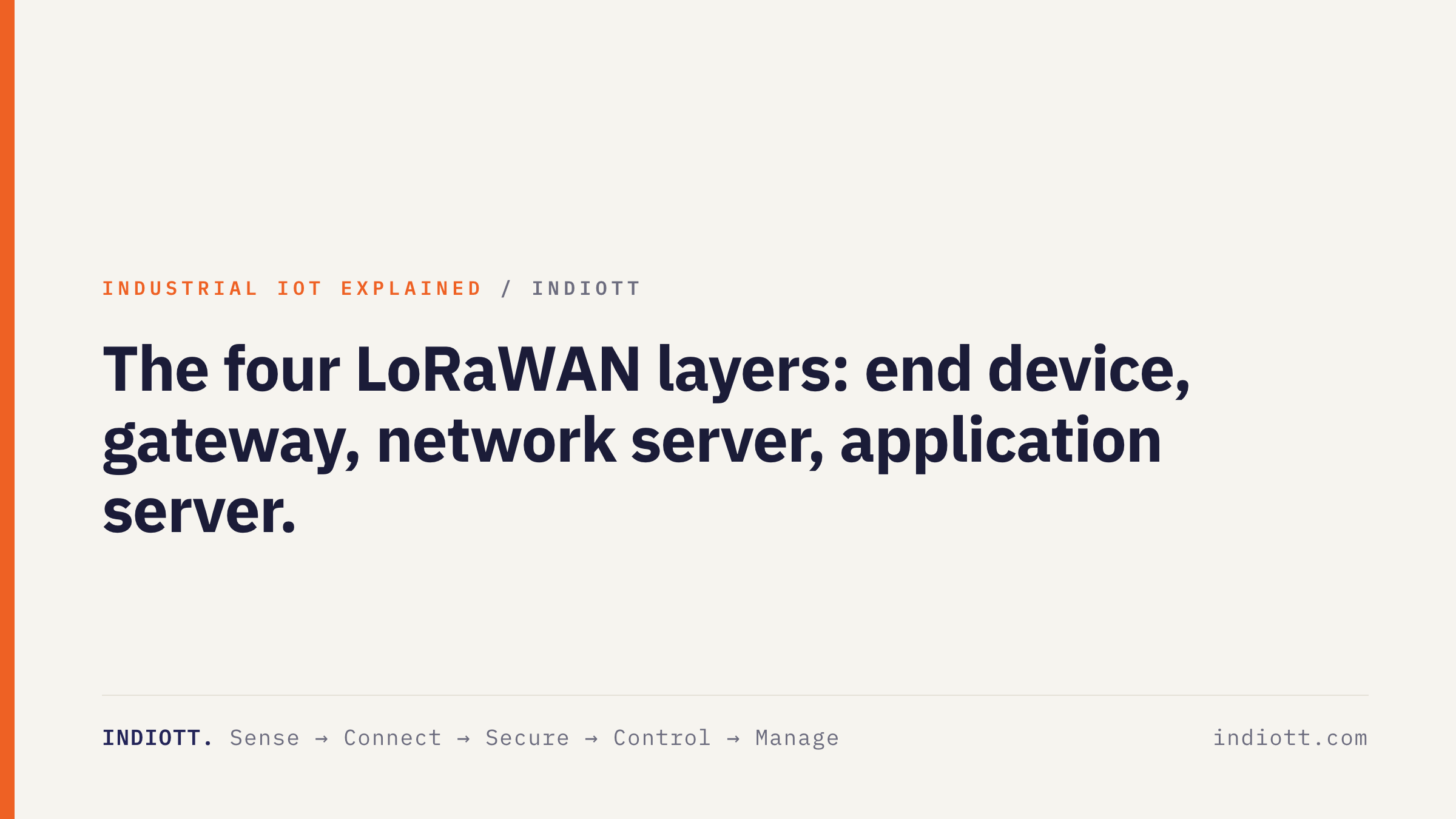
Understanding what is LoRaWAN at the technical level comes down to four stages: an end device sends a reading, a gateway hears it, a network server sorts and de-duplicates it, and an application server hands it to your dashboard. The device never pairs to one gateway. It simply broadcasts, and any gateway in range relays the message.
This is a star-of-stars topology, where gateways relay messages between end devices and a central network server (LoRa Alliance). Each layer has a clear job, which is why the standard scales so well.
- End device. The sensor. It measures a level, a temperature, an open door, or a leak, then sends a short LoRa message. It sleeps between readings, which is where the battery savings come from.
- Gateway. The bridge. The Things Industries defines it as a specialised device that receives messages from end devices and forwards them to the network server, and back again. One gateway can serve a wide area and many devices at once.
- Network server. The brain. It manages the whole network, removes duplicate copies of the same message picked up by different gateways, checks device authentication, and routes data on.
- Application server. The destination. It securely processes your data and passes it to a dashboard, a database, or another system that acts on the reading.
Because a message can be heard by several gateways, coverage is resilient. If one gateway fails, others still catch the same broadcast. You do not lose a sensor because a single link went down.
What is the EU868 band and why does it matter in the UK?
In the UK, LoRaWAN uses the EU868 frequency plan, which operates in the 863 to 870 MHz band. This is licence-exempt spectrum, so you do not buy a licence or a SIM to use it. That is the single biggest reason LoRaWAN is cheap to run at scale.
The band is regulated, not lawless. Ofcom sets the rules for short range devices in its Interface Requirement IR 2030, which permits licence-exempt use across much of 863 to 870 MHz at up to 25 mW e.r.p. for non-specific short-range devices (Ofcom). Equipment must also meet the ETSI EN 300 220 standard.
Two limits shape real deployments. Transmit power is capped, commonly at 25 mW, which is 14 dBm. And a duty cycle limit of around 1 percent on the main channels means each device may only transmit for a small fraction of the time. That is fine for sensors sending a reading every few minutes, and it is why LoRaWAN is not used for video or voice.
What range and battery life can I realistically expect?
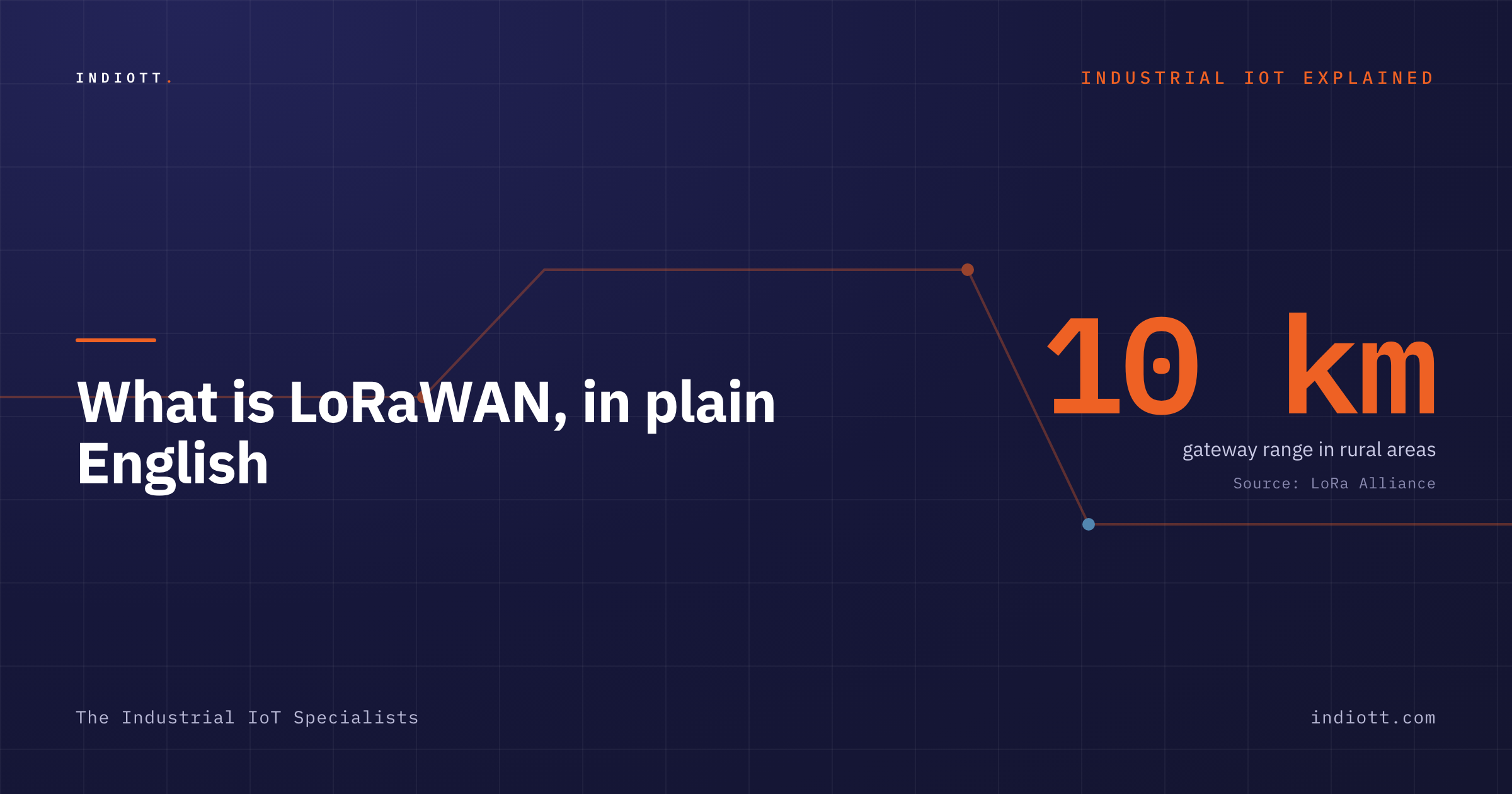
Realistic UK figures: LoRaWAN gateways transmit and receive over more than 10 kilometres in rural areas and up to 3 kilometres in dense urban areas (LoRa Alliance). End devices can last up to 10 years on a single coin cell battery (LoRa Alliance). Buildings, hills and clutter cut the range, so plan a site survey rather than trusting a headline number.
The long life comes from how LoRaWAN behaves. A sensor wakes, sends a short message, then sleeps. Semtech notes this asynchronous design means data is only sent when necessary, which extends battery life of sensor devices in the field by as much as 10 years (Semtech). Compared with a device that holds a constant cellular connection, the power saving is dramatic.
Range and battery are linked through the radio settings. Push for maximum distance and the device spends longer transmitting, which drains the battery faster and eats into your duty cycle. In practice you tune each device to the shortest reliable link, which is why gateway placement matters so much.
Is LoRaWAN secure?
Yes. LoRaWAN secures communication between the end device and the application server using AES-128 encryption (LoRa Alliance). Security is built into the standard, not bolted on, and it uses separate keys so the network operator and the application owner never see each other’s secrets.
Each device holds root keys that derive two session keys: one protects the network layer, the other protects your application payload end to end. That means even the party running the gateways and network server cannot read your sensor data. For regulated sectors such as water and critical infrastructure, that separation is a genuine advantage.
Security still needs discipline. Keys must be provisioned and stored properly, firmware kept current, and gateways placed on a segmented network. Encryption on the air interface does not excuse weak practice on the servers behind it. This is where a specialist integrator earns their fee.
Public vs private LoRaWAN networks: which should I use?
Two models exist. On a public network you connect your devices to gateways run by someone else, such as a community or commercial operator, and pay per device or per message. On a private network you own the gateways and the network server, so all data stays inside your organisation and there are no recurring connectivity fees.
Public networks are quick to start and need no infrastructure, but coverage depends on gateways you do not control, and costs climb as sensor counts grow. For a handful of devices in a well-covered area, they are convenient.
Private networks suit industrial buyers. You control coverage, security policy and data, and a single gateway can support up to 10,000 devices (Milesight), so the hardware pays for itself quickly at scale. For water utilities, manufacturing and estates handling sensitive readings, private is usually the right call. Indiott builds private LoRaWAN networks end to end, from sensors and gateways in the shop to the dashboard.
When should I choose LoRaWAN over cellular, NB-IoT or Wi-Fi?
Choose LoRaWAN for large fleets of low-power sensors sending small readings across a wide or hard-to-reach site, where battery life and no per-device fees matter most. Choose cellular, NB-IoT or Wi-Fi when you need high bandwidth, low latency, mobility, or deep single-building coverage instead. Knowing what is LoRaWAN good at, and what it is not, is the whole decision.
The power gap is real. Semtech measures a LoRaWAN radio at roughly 18 mA transmitting at 10 dBm, against about 220 mA for NB-IoT at 23 dBm, with NB-IoT holding a synchronous connection that keeps draining the battery (Semtech). LoRaWAN also uses unlicensed spectrum, while NB-IoT runs on licensed cellular bands that carry data-plan costs.
Use this quick test:
- LoRaWAN when you have many fixed sensors, small data, multi-year battery, and a wide site you can cover with your own gateways: level, environment, occupancy and leak monitoring.
- NB-IoT or cellular when devices are scattered with no gateway nearby, sit deep underground, or you would rather pay a data plan than run infrastructure. Our LoRaWAN vs NB-IoT comparison weighs this in detail.
- Wi-Fi or wired when devices need high bandwidth or live control inside one building with mains power and existing network coverage.
Semtech reports LoRaWAN can cover up to 30 miles per gateway in rural, open environments (Semtech), which is far beyond Wi-Fi and cheaper to blanket than cellular across a private site.
What can UK buyers actually do with LoRaWAN?
Four use cases cover most UK industrial projects: level, environment, occupancy and leak. Each uses cheap battery sensors reporting to a private gateway, and each replaces a manual round or a costly wired install.
- Level. Radar or pressure sensors track tank, reservoir and chamber levels across a water network, so crews stop driving out to dip a tank. See utilities and water networks.
- Environment. Temperature, humidity, CO2 and air-quality nodes watch stores, plant rooms and public spaces, feeding compliance and comfort dashboards.
- Occupancy. Desk, room and people-counting sensors reveal how buildings are really used, cutting wasted space and energy. See occupancy and space utilisation.
- Leak. Spot leak detectors under pipework and around plant flag water where it should not be, before it becomes a flood or a Legionella risk.
The market backs the direction of travel. Mordor Intelligence values the LoRa and LoRaWAN IoT connectivity market at 10.71 billion US dollars in 2025, rising to 44.76 billion by 2030 at a compound annual growth rate of 33.10 percent (Mordor Intelligence). This is a maturing, standardised technology, not a science project.
Scale is proven. As of March 2022, Semtech recorded 166 network operators offering LoRaWAN across 181 countries, with over 240 million end nodes and 3.2 million gateways in service (Semtech). Buyers are not betting on a niche.
Frequently asked questions
Is LoRaWAN free to use in the UK?
The radio spectrum is licence-exempt, so there is no spectrum fee and no SIM or data plan for private networks. You still buy the sensors, gateways and server, but there are no recurring per-device connectivity charges.
How far does a LoRaWAN signal travel?
Expect more than 10 kilometres in rural areas and up to 3 kilometres in dense urban areas, according to the LoRa Alliance. Buildings and terrain reduce this, so plan gateway placement with a site survey.
How long do LoRaWAN sensor batteries last?
Up to 10 years on a single battery for a device that sends occasional small readings, per the LoRa Alliance. Frequent transmissions and long-range settings shorten that, so reporting interval and radio tuning matter.
Is LoRaWAN better than 4G or 5G?
For low-power sensors sending small data across a wide site, yes, because it needs no SIM, no data plan and far less power. For video, live control or mobile high-bandwidth devices, cellular is the right choice.
Do I need to build my own network?
Not always. You can use a public network for a few devices, but industrial buyers usually run a private network for control, security and no per-device fees. An integrator such as Indiott can design and deploy the whole stack.
The bottom line
What is LoRaWAN, in a line? The cheapest, longest-lasting way to connect large fleets of simple sensors across a UK site, with no SIMs, no data plans and AES-128 security as standard. If your project is level, environment, occupancy or leak monitoring at scale, it is very likely the right layer of the stack.
Indiott specialises in exactly this: sourcing the right sensors and gateways, standing up a private network, and wiring it into dashboards that act on the data. Explore our industrial IoT solutions, or read the Milesight LoRaWAN gateway buyer’s guide to choose your first gateway.
Next step
Get a priced kit list for your site
Answer three quick questions and tell us where to send it. An engineer replies within one working day with the parts, the prices and the lead time.
Rather talk it through? Call 023 9223 3611
Received. An engineer has it.
You will hear back within one working day with the parts, the prices and the lead time. A confirmation is on its way to your inbox.
If it is urgent, call 023 9223 3611.