What to Buy First for an Industrial IoT Deployment: The LoRaWAN Starter Kit
TL;DR: A LoRaWAN starter kit is the fastest honest route into industrial IoT, but only if you buy all four layers: sensors, a gateway, a network server, and somewhere the data lands. Indiott kits run from £360.62 to £619.49 ex VAT. Below is the shopping list, the gateway decision rule, the arithmetic of kit versus piecemeal, and what you should not buy yet.
Last updated: 27 July 2026

On this page
- What do you actually need to buy for a first IoT deployment?
- What is in a LoRaWAN starter kit and what does it cost?
- Which gateway should you buy for your site?
- Which sensor answers the question you are asking?
- Is a LoRaWAN starter kit cheaper than buying the parts separately?
- Do you need to pay for an IoT platform on day one?
- What should you not buy for a first deployment?
- Your LoRaWAN starter kit procurement checklist
- Frequently asked questions
What do you actually need to buy for a first IoT deployment?
Four things, always: sensors that measure something, a gateway that hears them, a network server that decodes and authenticates the traffic, and a destination where readings become a chart, an alert or a database row. Buy three of the four and you own an expensive set of radios that talk to nobody.
Almost everyone gets this wrong the same way. They browse a catalogue, find a sensor measuring the thing they care about, buy six, then discover a LoRaWAN sensor is not a wifi device. It does not join your network. It transmits to a gateway, which hands the packet to a network server, which hands the decoded payload onward. No gateway, no data.
The good news is that layers two and three are often the same box. A Milesight gateway ships with an embedded network server, so one purchase covers the middle of the stack. That is the gap a LoRaWAN starter kit closes: it forces you to buy all four layers at once. For the radio theory, read what LoRaWAN is; this page assumes you have decided and need a shopping list.
What is in a LoRaWAN starter kit and what does it cost?
A LoRaWAN starter kit bundles a gateway with two to four sensors, so layers one, two and three arrive in one box, pre-matched on frequency band and known to work together. Indiott sells three, from £360.62 to £619.49 ex VAT. Each is priced at the exact sum of its parts.

The general-purpose LoRaWAN Starter Kit at £619.49 holds a UG65 gateway, an AM103 indoor ambience sensor, an EM500-CO2 sensor and a WS202 PIR and light sensor. You get temperature, humidity, CO2, motion and light across one building, which is enough breadth to learn what you actually want to measure long-term.
The Water & Leak Monitoring Kit at £360.62 is the cheapest complete route in: UG65 gateway, a WS201 fill-level sensor, a WS303 mini leak detector. Plant rooms, risers, tank stores. If your first question is “will I know before the ceiling comes down”, this is the LoRaWAN starter kit to order, and our flood monitoring guide covers the wider case.
The Smart Building Occupancy Kit at £531.21 pairs a VS321 AI occupancy sensor with an AM103 air-quality monitor and a UG65, for desk and room utilisation.
Which gateway should you buy for your site?
Match the gateway to where it physically lives, not to the size of your ambition. Indoor pilot in one building: UG65, which is why it anchors most LoRaWAN starter kit builds. Mounted outside: UG67. Nowhere to plug in: SG50. Data must reach a BMS: EG71. A throwaway bench test: UG63. Every rule is about environment, not sensor count.

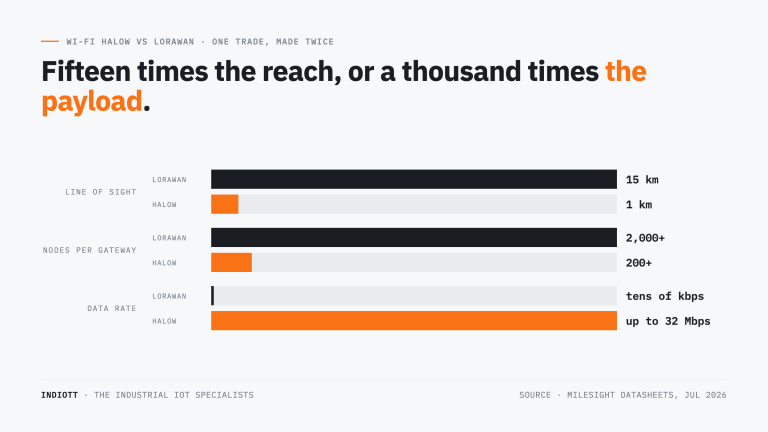
The UG65 from £279.82 is the default and sits inside all three kits. Milesight rates it for around 2,000 Class A/B/C devices at a ten-minute uplink interval and up to 2 km of signal penetration in an urban area, in an IP65 body with an embedded network server. On a first deployment that capacity is never the constraint. Your walls are.
The UG67 at £658.39 is the same idea in an IP67 enclosure rated -40°C to +70°C, with up to 15 km range in rural areas. Buy it when the gateway goes on a mast, roof or pole. Do not buy it for a plant room, where you are paying £378.57 for weatherproofing you will never use.
The SG50 at £683.83 runs on solar with internal batteries: the right answer for a reservoir, farm or remote pumping station where getting power to the mounting point costs more than the gateway. The EG71 at £1,047.44 adds BACnet, Modbus and MQTT, so readings land in a Siemens, Trane or Schneider system rather than a separate dashboard.
The UG63 from £98.76 is tempting and mostly a trap for a first buyer. It is a lightweight indoor packet forwarder with no embedded network server, so it only works if you have already stood up The Things Stack or ChirpStack. For the full head-to-head, our Milesight gateway buyer’s guide goes model by model.
Which sensor answers the question you are asking?
Start from the business question, not the product category. Write the sentence you want answered on a Monday morning, then buy the sensor that answers it. “Is the tank full”, “did the pump run”, “is there water on the floor” and “is this room stuffy” are four sentences with four SKUs and a fourfold spread in price.

How full is that tank or bin? The EM500-UDL ultrasonic sensor from £202.01 for clean liquids and open bins. For foam, vapour or anything that fouls an ultrasonic beam, the EM410-RDL radar sensor from £224.45 measures through the mess for £22 more. That £22 is the cheapest insurance in this article.
Is there water on the floor? The WS303 mini leak detector at £41.90, the highest-value part in the catalogue relative to what a burst pipe costs. Did the pump run, and how hard? The CT303/305/310 current transformer from £101.75 clamps around the supply and reports load without touching the machine, a pattern our energy monitoring guide covers in depth.
Is this room stuffy or over-occupied? The EM500-CO2 at £179.56 in plant areas, the AM103 at £127.19 for offices. Is that door or hatch open? The EM300-MCS contact switch at £52.37. Is pipe pressure holding? The EM500-PP at £197.52. All are battery-powered, with no cabling to run.
Is a LoRaWAN starter kit cheaper than buying the parts separately?
No, and any supplier claiming otherwise is hiding something. Every Indiott LoRaWAN starter kit is priced at the exact arithmetic sum of its components. The £619.49 kit is £279.82 for the UG65, plus £127.19 for the AM103, plus £179.56 for the EM500-CO2, plus £32.92 for the WS202. No bundle discount, no bundle markup.
So what does a LoRaWAN starter kit buy you? Compatibility. The frequency band matches the UK, the sensors are already supported by the gateway’s embedded network server, and nobody discovers mid-project that the level sensor they ordered is an AS923 unit that will never join an EU868 network. First time round, that beats a 5% discount.
Buy piecemeal once you know your answer. If the only question is leak detection across twelve plant rooms, one UG65 at £279.82 plus twelve WS303 detectors at £41.90 comes to £782.62 and covers the estate, a better use of £780 than two general-purpose kits. The rule: a LoRaWAN starter kit if you are exploring, parts if you are solving.
Do you need to pay for an IoT platform on day one?
No. This is where first-time budgets inflate by four figures for no return. A UG65 or UG67 carries an embedded network server, so layer three is already paid for inside your LoRaWAN starter kit. For layer four, The Things Stack Discovery plan is free for up to 10 devices and 10 gateways with no time limit.
One catch worth knowing before you commit: the free community sandbox enforces a fair use policy of 30 seconds of uplink airtime per day and 10 downlink messages per day, per node. At a fifteen-minute reporting interval on a small payload that is fine. At thirty-second GPS intervals it is not. Size your reporting frequency before you size your platform contract.
Buy a commercial platform when you have proven the data is worth acting on, need role-based access for facilities staff, or must integrate with an existing system. Until then a free network server and a spreadsheet export tells you what a £6,000 annual licence would. To have the platform layer specified properly later, ask us to scope it.
What should you not buy for a first deployment?
Four things, reliably. An outdoor gateway for an indoor pilot. A second gateway for redundancy before the first has proven coverage. Cellular backhaul on a site that already has wifi and Ethernet. A full platform contract before you have a single reading. Together these routinely double a first budget with nothing to show for it.
Redundancy is the expensive one. A UG65 handles roughly 2,000 devices, so a second gateway on a small site adds no capacity, only coverage somewhere the first cannot reach, and you do not know where that is until you test. If coverage genuinely worries you, the FT101 field tester at £441.42 answers it in an afternoon for less than a spare UG67.
Cellular backhaul deserves the same scrutiny. A UR35 industrial router from £149.63 is right for a remote site with no fixed line, and wrong for a warehouse with a patch panel. Buy connectivity you lack, not connectivity that sounds industrial. If cellular really is the answer, our LoRaWAN vs NB-IoT comparison is the next read.
One more: do not buy fifty sensors. A LoRaWAN starter kit gives you three or four. Get those reporting, then let the first month of real data tell you what the other forty-four should be. Requirements almost always change once you see the first chart.
Your LoRaWAN starter kit procurement checklist
Take this to whoever signs the purchase order. Nine lines, covering the failure modes that turn a £600 LoRaWAN starter kit into a £600 shelf ornament. Answer all nine and you are ready to order.
- Frequency band is EU868. The UK band. A US915 or AS923 unit will not join.
- Gateway matches the mounting location. Indoors UG65, outdoors UG67, off-grid SG50, BMS integration EG71.
- Network server is accounted for. Embedded in the gateway, or a free The Things Stack account. Never assumed.
- Backhaul exists at the gateway position. Ethernet, PoE or wifi, confirmed by someone who has stood there.
- Power exists at the gateway position, or you have specified the SG50.
- Each sensor maps to a written question. If you cannot write the sentence, do not buy the sensor.
- Reporting interval is agreed, because it drives battery life, airtime and platform tier.
- Destination for the data is named. A dashboard, a BMS, a webhook, a person. Not “we will decide later”.
- Prices are quoted ex VAT and cross-checked on the live product page the day you raise the order.
That is the whole method. Decide what question you are answering, buy the four layers, keep the pilot small, expand once the data has earned it. Order a LoRaWAN starter kit from the Indiott shop, browse the IoT buying guides, or if no kit fits your site, get a tailored kit spec built around it instead.
Frequently asked questions
How much does a LoRaWAN starter kit cost in the UK?
Indiott kits run from £360.62 ex VAT for the Water & Leak Monitoring Kit to £619.49 ex VAT for the general-purpose LoRaWAN starter kit, which pairs a UG65 gateway with three environmental sensors. Each kit is priced at the exact sum of its individual components.
How many sensors can one LoRaWAN gateway handle?
Milesight rates the UG65 and UG67 at around 2,000 Class A/B/C devices at a ten-minute uplink interval. In practice capacity depends on how often sensors report and how far they sit from the gateway. On a first deployment, coverage limits you long before capacity does, so no LoRaWAN starter kit will ever hit that ceiling.
Do I need a gateway if I only have one sensor?
Yes, unless you are inside the range of a public LoRaWAN network. A LoRaWAN sensor cannot reach the internet alone. It transmits to a gateway, which forwards to a network server. This is why buying sensors on their own is the most common first-purchase mistake, and why a LoRaWAN starter kit bundles both.
Can I start without paying for an IoT platform?
Yes. The Things Stack Discovery plan is free for up to 10 devices and 10 gateways with no time limit, and the Milesight UG65, UG67, SG50 and EG71 include an embedded network server. Add a commercial platform once you have proven the data is worth acting on, not before.
What is the cheapest way to try industrial IoT?
The Water & Leak Monitoring Kit at £360.62 ex VAT is the lowest-cost complete LoRaWAN starter kit, because it includes the gateway. A UG63 at £98.76 plus one WS303 leak detector at £41.90 is cheaper, but the UG63 has no embedded network server, so you must run The Things Stack or ChirpStack yourself.
Is a LoRaWAN starter kit enough for a whole building?
For coverage, usually yes. One UG65 typically covers a single building, and Milesight rates it at up to 2 km of urban signal penetration. For measurement, no. Three or four sensors tell you whether the approach works, not what happens in every room. Treat the LoRaWAN starter kit as the proof, then expand.
Next step
Get a priced kit list for your site
Answer three quick questions and tell us where to send it. An engineer replies within one working day with the parts, the prices and the lead time.
Rather talk it through? Call 023 9223 3611
Received. An engineer has it.
You will hear back within one working day with the parts, the prices and the lead time. A confirmation is on its way to your inbox.
If it is urgent, call 023 9223 3611.