7 Industrial IoT Trends 2026: A UK Buyer’s Guide to What Matters
Last updated: 1 July 2026
TL;DR: The biggest industrial IoT trends 2026 are agentic and edge AI, prescriptive maintenance, LoRaWAN and private connectivity, private 5G, hardened OT cybersecurity, UK and EU product-security regulation, and energy-aware hardware. Buyers should focus on devices that process data at the edge, ship with security by design, and connect over the right network for the job. Here is what to prioritise and what you can actually buy this year.

Industrial IoT is moving from pilot projects to standing infrastructure. This guide covers the seven trends shaping procurement decisions in 2026, written from the view of a UK supplier that sells and ships the hardware. Each section opens with a plain answer, then goes deeper.
- What is the difference between IoT and IIoT?
- Why is agentic and edge AI the top industrial IoT trend for 2026?
- How does prescriptive maintenance go beyond predictive?
- Are LoRaWAN and private connectivity still growing?
- Where does private 5G fit in industrial IoT?
- Why is OT cybersecurity now a hardware buying criterion?
- What UK and EU regulations affect IoT hardware in 2026?
- How is sustainability shaping industrial IoT hardware?
- What can you actually buy in 2026?
- Frequently asked questions
What is the difference between IoT and IIoT?
IoT is the broad category of connected devices, including consumer products like smart speakers and wearables. IIoT, industrial IoT, is the subset built for factories, utilities, water networks and infrastructure, where reliability, safety and long service life matter more than convenience. IIoT hardware tolerates harsh environments and speaks industrial protocols.
The distinction is commercial, not just technical. IIoT accounted for 24.3% of global IoT market revenue in 2023, according to N-iX, and that share reflects the higher value of sensors, gateways and routers that keep operations running. When you read about industrial IoT trends 2026, you are reading about equipment expected to survive a decade in the field, not a two-year consumer refresh cycle.
Why is agentic and edge AI the top industrial IoT trend for 2026?
Agentic AI, software that plans and acts rather than just answering, is the defining shift of the industrial IoT trends 2026. Vendors are moving intelligence onto the edge device so decisions happen locally, in milliseconds, without a round trip to the cloud. This cuts latency, reduces bandwidth cost and keeps sensitive process data on site.
The scale of the shift is visible at the industry’s flagship event. IoT Analytics counted 29 industrial agentic-AI solutions against just 7 non-agentic generative AI solutions at Hannover Messe 2026, a clear signal that agents are becoming the default architecture. The same research puts the industrial technology market at $176.9B in 2024 with a forecast compound annual growth rate of around 11%.
Demand is coming from the plant floor, not just the boardroom. Over 87% of surveyed manufacturers said devices should be more intelligent and process data at the edge, per N-iX. For buyers, this means favouring gateways and controllers with onboard compute, so analytics run where the data is generated.
How does prescriptive maintenance go beyond predictive?
Predictive maintenance tells you a bearing will fail soon. Prescriptive maintenance goes further, recommending the specific action, ordering the part and scheduling the work. In 2026 this is a headline outcome of edge AI, turning raw vibration, temperature and current data into a maintenance instruction rather than an alert an engineer must interpret.
The appetite for more sensing is real. Over 30% of manufacturers are ready to double their number of IoT devices, according to N-iX, which is exactly the density prescriptive models need to work well. More measurement points mean better inference, fewer false alarms and maintenance that is scheduled around production rather than against it. This trend rewards low-cost, long-battery-life LoRaWAN sensors that make wide coverage affordable.
Are LoRaWAN and private connectivity still growing?
Yes, strongly. LoRaWAN remains the workhorse for low-power, long-range sensing across sites, campuses and utility networks. It suits the many-sensors, small-data pattern of most industrial monitoring, and it lets an operator run a private network without a mobile subscription per device.
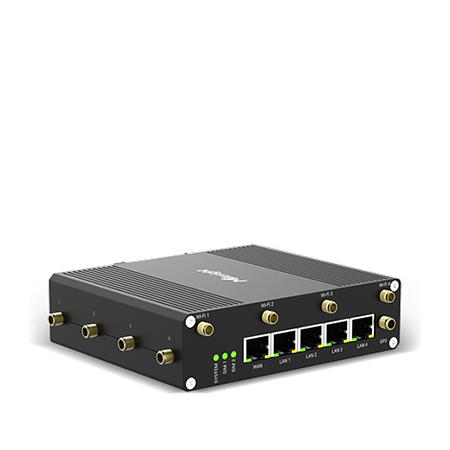
The numbers confirm the momentum. LoRaWAN passed 125 million deployed devices in November 2025 and is growing at roughly 25% a year, according to Semtech. That critical mass matters for buyers because it signals a mature supply chain and a deep catalogue of compatible sensors. The wider market is expanding around it too: GSMA Intelligence forecasts global IoT will reach 38.7 billion connections by 2030, with enterprise IoT rising to 63% of connections. Private LoRaWAN is one of the cheapest ways to claim your share of that. A compact indoor gateway is often the whole network a site needs.
Where does private 5G fit in industrial IoT?
Private 5G is for the high-bandwidth, low-latency, high-density cases LoRaWAN cannot serve: mobile robotics, machine vision, connected AGVs and video-heavy quality inspection. In 2026 it is a complement to LoRaWAN, not a replacement, and most serious sites will run both, matching each network to the traffic profile of the application.
The reason private cellular is rising is the enterprise skew in overall demand. With GSMA Intelligence projecting enterprise IoT to hit 63% of all connections by 2030, operators want cellular they control, with guaranteed coverage and no reliance on public network congestion. Industrial 4G and 5G routers bridge the gap today, giving resilient uplinks and failover while private 5G build-outs mature. For most buyers the practical 2026 move is a dual approach: LoRaWAN for sensing, cellular for the demanding edge.
Why is OT cybersecurity now a hardware buying criterion?
Because attackers have industrial systems firmly in their sights, and a breach now stops production, not just email. In 2026, security by design is a purchasing requirement rather than an add-on. Buyers are asking about secure boot, signed firmware, encrypted transport and vulnerability disclosure before they ask about price.
The threat data is stark. Dragos recorded 1,693 ransomware attacks against industrial organisations in 2024, an 87% year-on-year rise. The operational impact is landing too: the SANS 2025 survey found 22% of organisations reported an OT cybersecurity incident in the past year. Little wonder that 35% of businesses cite cybersecurity as a major challenge to implementing new IIoT, per N-iX. Our own view on hardening operational technology is set out on our OT cybersecurity page, and it starts with choosing devices that are defensible by design.
What UK and EU regulations affect IoT hardware in 2026?
Regulation is now a hard filter on which devices you can legally sell or deploy. In the UK, the Product Security and Telecommunications Infrastructure regime (PSTI) sets minimum security for connectable products. In the EU, the Cyber Resilience Act (CRA) and the NIS2 Directive raise the bar for manufacturers and operators of essential services alike. This is one of the most consequential industrial IoT trends 2026 for procurement teams.
The practical effect is that security debt is being pushed up the supply chain, onto the vendor. Given that Dragos logged an 87% jump in industrial ransomware in a single year, regulators are demanding provable baselines: no default passwords, a disclosure policy, and defined support periods. For buyers this simplifies diligence. Choose hardware from vendors who already meet these regimes and you inherit compliance rather than retrofitting it. It also protects long-life IIoT assets from being stranded by a rule change mid-service.
How is sustainability shaping industrial IoT hardware?
Sustainability has moved from marketing to specification. In 2026, energy-aware design shapes the whole IIoT stack: ultra-low-power LoRaWAN sensors that run years on a single cell, edge processing that avoids constant cloud transfer, and monitoring that directly cuts water, energy and emissions waste. The greenest device is often the one that reports a leak before it becomes a flood.
The edge-first direction reinforces this. With over 87% of manufacturers wanting devices to process data locally, according to N-iX, less data travels and less power is burned moving it. Low-power connectivity is central: LoRaWAN’s 125 million-plus deployed devices, reported by Semtech, exist largely because the radio sips power. For buyers with net-zero targets, IIoT is both the measurement layer and a way to shrink the footprint of measurement itself.
What can you actually buy in 2026?
Trends only matter if you can put them on a purchase order. Reflecting the industrial IoT trends 2026 above, the practical shopping list is short and available now: edge-capable LoRaWAN gateways, a broad range of LoRaWAN sensors, industrial 4G and 5G routers, and OT security appliances. The goal is a stack you can deploy this quarter, not a roadmap.
On the connectivity layer, a compact unit like the Mini LoRaWAN Gateway UG63 is enough to stand up a private network for a building or plant. Around it sit the sensors, routers and security hardware from the vendors on our brands page, curated for UK deployment and stocked for quick despatch. If you want the trends translated into a working system, our solutions pages map each use case, from flood telemetry to asset monitoring, onto specific hardware.
Ready to act on the industrial IoT trends 2026 rather than just read about them? Explore our solutions to see the hardware behind each use case, or request a quote and we will spec a system for your site. As UK industrial IoT specialists, we ship the sensors, gateways, routers and security appliances that turn these trends into running infrastructure.
Frequently asked questions
What is the difference between IoT and IIoT?
IoT covers all connected devices, including consumer products. IIoT, industrial IoT, is the subset engineered for factories, utilities and infrastructure, where ruggedness, long service life, industrial protocols and safety matter far more than in a consumer gadget. IIoT made up 24.3% of global IoT market revenue in 2023.
What is the future of industrial IoT?
The future is edge-first and enterprise-led. GSMA Intelligence forecasts 38.7 billion IoT connections by 2030, with enterprise IoT rising to 63% of them. Expect more on-device AI, wider LoRaWAN sensing, growing private 5G for demanding tasks, and security and regulation baked into every industrial device.
What are the biggest industrial IoT trends in 2026?
The biggest are agentic and edge AI, prescriptive maintenance, continued LoRaWAN and private-network growth, private 5G for high-bandwidth cases, hardened OT cybersecurity, UK and EU product-security regulation such as PSTI, CRA and NIS2, and energy-aware, sustainable hardware design.
How is AI changing industrial IoT?
AI is moving from cloud analytics to agentic edge software that decides and acts locally. IoT Analytics counted 29 agentic-AI industrial solutions against 7 non-agentic generative ones at Hannover Messe 2026. The result is prescriptive maintenance, lower latency, less bandwidth use and more resilient on-site decision-making.
Is LoRaWAN or 5G better for industrial IoT?
Neither is universally better; they solve different problems. LoRaWAN suits low-power, long-range, low-data sensing at scale and passed 125 million devices in 2025. Private 5G suits high-bandwidth, low-latency, high-density work like robotics and machine vision. Most industrial sites in 2026 run both, matched to each application.
Next step
Get a priced kit list for your site
Answer three quick questions and tell us where to send it. An engineer replies within one working day with the parts, the prices and the lead time.
Rather talk it through? Call 023 9223 3611
Received. An engineer has it.
You will hear back within one working day with the parts, the prices and the lead time. A confirmation is on its way to your inbox.
If it is urgent, call 023 9223 3611.