Industrial IoT Cost in the UK: 3 Real Budgets With Verified Prices
Last updated: 24 July 2026
TL;DR: A realistic industrial IoT cost in the UK is £1,159.68 of hardware for a 10-point pilot, or roughly £70 per monitored point per year across a five-year life. Sensors run from £32.92 to £371.09 ex VAT and gateways from £98.76. The costs that wreck budgets are not the sensors: they are platform subscriptions, installation labour and gateways nobody needed.
Ask about industrial IoT cost and every supplier in this market says “it depends, contact us”. That is not an answer, it is a lead form. So here are our list prices, three itemised worked budgets, and the arithmetic for the number your finance director will ask for: industrial IoT cost per monitored point per year. All prices are GBP ex VAT, verified on 20 July 2026.

What this guide covers
- What is the real industrial IoT cost in the UK?
- How much of industrial IoT cost is hardware?
- Which industrial IoT costs do buyers forget to budget?
- What do 10, 50 and 200-point deployments cost?
- What is the industrial IoT cost per point per year?
- Where is industrial IoT cost wasted?
- How do you calculate payback on industrial IoT cost?
- Frequently asked questions
What is the real industrial IoT cost in the UK?
Budget £2,200 for a 10-point pilot, £10,700 for a 50-point rollout and £35,600 for a 200-point estate, including hardware, mounting and installation. Over five years, the industrial IoT cost per monitored point per year lands between £43 and £75 depending on how you handle the network server.
Those figures assume battery-powered LoRaWAN sensors reporting to a gateway, the standard architecture for retrofitting monitoring into existing buildings. If LoRaWAN is new to you, our guide to what LoRaWAN is and how it works covers the radio side, and LoRaWAN vs NB-IoT covers when cellular makes more sense.
Nobody publishes these numbers because they are uncomfortable. Hardware is the smallest and most predictable part of industrial IoT cost, which makes the “how much are your sensors?” conversation almost irrelevant to whether your project succeeds. Cisco surveyed 1,845 IT and business decision-makers and found that only 26% had an IoT initiative they considered a complete success, while 60% stalled at the proof-of-concept stage. Projects rarely stall because a sensor was £40 too expensive.
How much of industrial IoT cost is hardware?
Hardware is about a third of five-year industrial IoT cost on the three budgets below. UK trade prices for LoRaWAN sensors run from £32.92 for a PIR and light sensor to £371.09 for a soil moisture, temperature and EC sensor, with most environmental and level sensors between £100 and £250. Gateways start at £98.76 and reach £1,047.44.
Here is the real price list, taken from our catalogue rather than from a range someone invented:
| Device | What it measures | Price (ex VAT) |
|---|---|---|
| WS202 | PIR and light | £32.92 |
| WS201 | Fill level | £38.90 |
| VS361 | Storefront footfall | £40.40 |
| WS303 | Mini leak detection | £41.90 |
| EM300-MCS | Door and contact | £52.37 |
| CT303 | Current, single phase | £101.75 |
| AM103L | Temperature, humidity, CO2 | £127.19 |
| EM500-CO2 | CO2, 4-in-1 outdoor | £179.56 |
| EM500-PP | Pipe pressure | £197.52 |
| EM500-UDL | Ultrasonic distance and level | £202.01 |
| EM500-SWL | Submersible water level | £251.38 |
| EM500-SMTC | Soil moisture, temp, EC | £371.09 |
| UG63 gateway | Mini indoor, 8 channel | £98.76 |
| UG65 gateway | Semi-industrial, IP65 | £279.82 |
| UG67 gateway | Outdoor, IP67 | £658.39 |
| EG71 gateway | Building controller | £1,047.44 |

The cheapest working LoRaWAN network you can buy is a UG63 mini gateway at £98.76 plus one WS202 sensor at £32.92. That is £131.68 for a functioning private radio network with a monitored point on it. Useful to know when someone quotes you five figures to “get started with IoT”.
Which industrial IoT costs do buyers forget to budget?
Six line items get missed: installation labour, the network server or platform subscription, mounting and enclosures, the site survey, backhaul, and battery replacement. Together these routinely exceed the hardware, and they are where industrial IoT cost estimates go wrong. On our 10-point pilot they add £1,050 to £1,159.68 of hardware.
Installation labour. A battery sensor takes 20 to 40 minutes to mount and commission, so budget eight to ten per engineer-day. A gateway takes about half a day. We will not publish a day rate we cannot source, so the examples below use £400 per engineer-day as a clearly-labelled planning midpoint of a £300 to £550 band. Substitute your own contractor rate.
Platform and network server. This is the one that quietly compounds. Published platform pricing exists: Datacake lists its first five devices free, then €25 per month up to 25 devices, €159 up to 50, €399 up to 200 and €659 up to 1,000. Read those tiers carefully, because the per-device cost does not fall smoothly.
Mounting and enclosures. Brackets, pole mounts, IP-rated boxes and gland kits. Budget £15 per point, more for outdoor or hazardous areas.
Batteries. A smaller line than most people fear. Milesight rates the EM500-UDL at 10 years on its 19,000 mAh Li-SOCl2 cell at a 10-minute reporting interval. At that life, batteries fall outside a five-year TCO window entirely. Report every 60 seconds instead and you will be changing cells inside three years, so reporting interval is a budget decision.
What do 10, 50 and 200-point deployments cost?
A 10-point pilot costs £2,209.68 to install and £255 a year to run. A 50-point, three-site rollout costs £10,708.75 to install and £1,621.80 a year. A 200-point estate costs £35,634.32 to install and £4,069.80 a year. All three use the same sensor mix so the comparison isolates scale.
The mix per ten points is four AM103L ambience sensors, three WS303 leak detectors, two WS202 PIR sensors and one EM500-CO2. Platform costs use the published Datacake tier for the device count, converted at €1 = £0.85, an assumption to re-check on the day.
| Line | A: 10 points | B: 50 points | C: 200 points |
|---|---|---|---|
| Gateways | £279.82 (1) | £1,218.03 (3) | £2,995.70 (8) |
| Sensors | £879.86 | £4,399.30 | £17,597.20 |
| Field tester (FT101) | not needed | £441.42 | £441.42 |
| Hardware total | £1,159.68 | £6,058.75 | £21,034.32 |
| Mounting at £15/point | £150.00 | £750.00 | £3,000.00 |
| Install (estimate) | £900.00 (2.2d) | £3,900.00 (9.8d) | £11,600.00 (29d) |
| Total to install | £2,209.68 | £10,708.75 | £35,634.32 |
| Platform per year | £255.00 | £1,621.80 | £4,069.80 |
| Five-year total | £3,484.68 | £18,817.75 | £55,983.32 |

Note the field tester. At 50 points and above, an FT101 field tester at £441.42 pays for itself the first time it stops you mounting a sensor in a radio dead spot.
What is the industrial IoT cost per point per year?
Across five years the pilot runs at £69.69, the 50-point rollout at £75.27 and the 200-point estate at £55.98. The mid-size rollout carries the worst industrial IoT cost per point, the opposite of what everyone assumes about scale, and the cause is the platform tier, not the hardware.
Look at what the published tiers do per device. At 25 devices you pay about €1.00 per device per month. At 50 devices you pay €159, which is €3.18 per device per month. At 200 devices you pay €399, which is €2.00. The 50-device tier is more than three times the per-device cost of the 25-device tier, and 60% worse than the 200-device tier. Cross that boundary without noticing and your industrial IoT cost per point goes up while your order gets bigger.
There is a straightforward fix, and it is already in your budget. Milesight gateways run an embedded LoRaWAN network server supporting around 2,000 Class A/B/C devices at a 10-minute uplink interval. Terminating your devices on the gateway you have already bought, and paying only for the dashboard layer, takes the 50-point rollout from £75.27 to £42.84 per point per year. That is a 43% reduction achieved by reading a spec sheet.

Where is industrial IoT cost wasted?
Three places, in order of damage: over-specified gateways, platform subscriptions you do not need, and cellular connectivity where LoRaWAN would have worked. Each inflates industrial IoT cost through a specification error rather than a price problem, so negotiating discount on the hardware will not recover the money.
Over-specified gateways. A UG65 handles around 2,000 devices, so a quote offering one gateway per 30 sensors is selling capacity you already had. Gateways are a coverage decision driven by buildings, walls and distance. Specifying an EG71 at £1,047.44 for an indoor pilot a £98.76 UG63 would cover is a 10.6 times overspend on the most over-sold item in the category. Our Milesight gateway buyer’s guide works through which unit actually fits.
Platform you do not need. If you monitor 30 leak sensors and want an alert when one gets wet, an enterprise platform with a data lake buys you nothing. You need the embedded network server and somewhere to send an email. Buy analytics when you have a question that needs analytics.
Cellular where LoRaWAN would do. A cellular sensor needs a SIM and a data plan, per device, forever. A LoRaWAN sensor needs a gateway once, then runs for years on a battery. Cellular earns its keep for single remote assets with no gateway nearby. For 40 points inside one building it is a recurring bill you chose to create.
How do you calculate payback on industrial IoT cost?
Divide year-one industrial IoT cost by the unit value of whatever you are saving. UK non-domestic electricity averaged 24.14 pence per kWh including the Climate Change Levy in Q1 2026, so every £1,000 of project cost needs 4,143 kWh avoided to break even. That is arithmetic, not a sales claim.
Worked through: a 10-circuit energy monitoring install using one UG65 and ten CT310 current transformers is £2,748.82 of hardware, plus £150 mounting, plus roughly £900 of installation, plus £255 of platform in year one. Call it £4,053.82. At the government’s published 24.14p per kWh, that install breaks even if it helps you avoid 16,793 kWh in the first twelve months.
We will not tell you what percentage you will save, because we do not know your building and neither does anyone quoting you a figure. We can tell you the threshold. Compare 16,793 kWh against your own consumption and you will know within a minute whether submetering justifies the spend. Our guide to IoT energy monitoring for commercial buildings covers where the savings usually hide.
Do starter kits reduce industrial IoT cost?
No, and we would rather say so. Our kits are priced as the exact arithmetic sum of their components, so a kit and the same parts bought separately cost the same to the penny. A kit removes the specification risk of choosing a gateway and sensors that work together, not money from your industrial IoT cost.
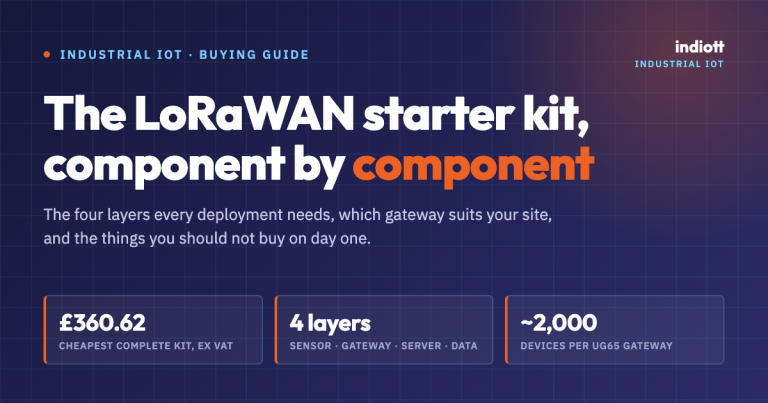
The LoRaWAN Starter Kit at £619.49 is a UG65 (£279.82), an AM103L (£127.19), an EM500-CO2 (£179.56) and a WS202 (£32.92). Those add to £619.49 exactly. The Water and Leak Monitoring Kit at £360.62 works the same way. Buy the kit for a fixed, known industrial IoT cost, or build your own basket from the full catalogue.
Frequently asked questions
How much does one IoT sensor cost in the UK?
Between £32.92 and £371.09 ex VAT depending on what it measures. A PIR and light sensor is £32.92, a leak detector £41.90, an ambience monitor £127.19, an ultrasonic level sensor £202.01, and a soil moisture and EC sensor £371.09. Most monitoring points land between £100 and £250.
How many sensors can one LoRaWAN gateway support?
A Milesight UG65 supports around 2,000 Class A/B/C devices at a 10-minute uplink interval. In practice you add gateways for radio coverage across buildings and distance, not because you ran out of device capacity. Being quoted one gateway per 30 sensors is a warning sign.
What is the ongoing annual industrial IoT cost after installation?
Mainly the platform or network server subscription, plus any SIM costs and support. On our worked examples that is £255 a year for 10 points and £4,069.80 for 200. Batteries typically fall outside a five-year window if sensors report every 10 minutes rather than every minute.
Is LoRaWAN cheaper than cellular IoT?
For clustered points, yes, because you pay for one gateway once instead of a SIM and data plan per device forever. For a handful of isolated remote assets with no gateway nearby, cellular usually wins. The crossover is typically a few devices per site.
Why does industrial IoT cost per point not always fall with scale?
Fixed costs like the gateway and site survey do spread over more points, but platform tier boundaries pull the other way. On our figures a 50-point rollout costs more per point than a 10-point pilot. Model your device count against the published tiers before ordering.
Do these prices include VAT?
No. Every figure here is GBP ex VAT, verified against our live catalogue on 20 July 2026. UK VAT at 20% applies on top. Prices move, so treat this page as a planning baseline rather than a quotation.
What to do next
If you have a site and a rough point count, get a costed quote at indiott.com/quote and we will itemise your industrial IoT cost the way this page does, hardware line by line, with the platform assumption written down rather than buried. If you would rather test the technology first, start from a fixed-price starter kit and scale from there. Either way, insist that whoever quotes you shows the cost per monitored point per year. It is the only number that compares one proposal to another.
Next step
Get a priced kit list for your site
Answer three quick questions and tell us where to send it. An engineer replies within one working day with the parts, the prices and the lead time.
Rather talk it through? Call 023 9223 3611
Received. An engineer has it.
You will hear back within one working day with the parts, the prices and the lead time. A confirmation is on its way to your inbox.
If it is urgent, call 023 9223 3611.