PSTN Switch-Off: The Telemetry, Alarms and Lift Lines Nobody Put on the List
TL;DR: The PSTN switch-off completes in January 2027, when the analogue telephone network that has carried voice, alarms and dial-up data for decades is retired. The government’s own list of affected equipment names alarms, lifts, payment terminals and intercoms. On industrial and estates sites the risk hides in things nobody calls a phone: alarm diallers on pumps and tanks, dial-up telemetry outstations and old meter modems. Find them now, and move each to IP or cellular before the line goes quiet.
Last updated: 11 September 2026
On this page
Key takeaways
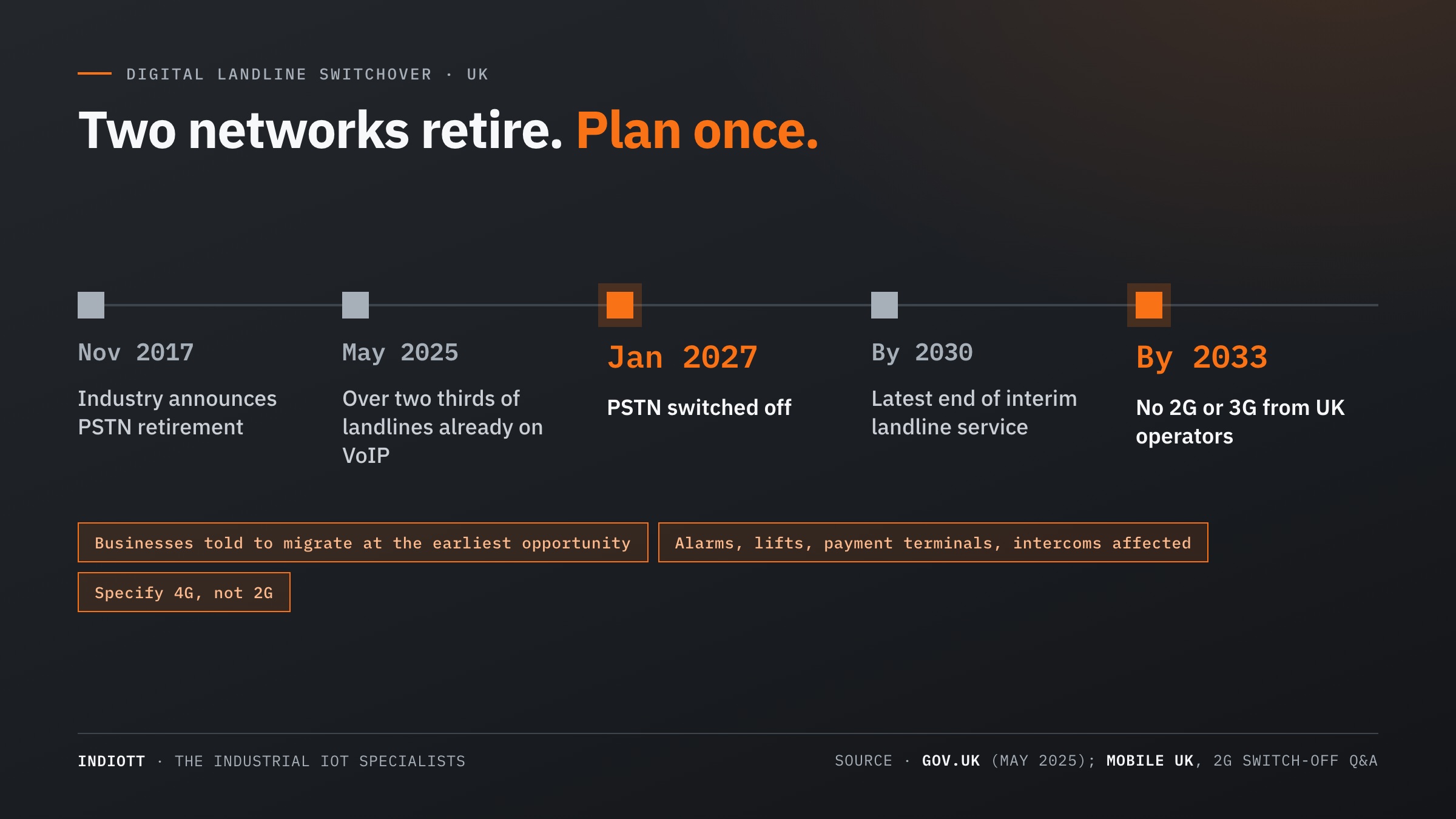
- The analogue Public Switched Telephone Network is being switched off by the telecoms industry by January 2027, and the government says over two thirds of UK landlines have already moved to VoIP.
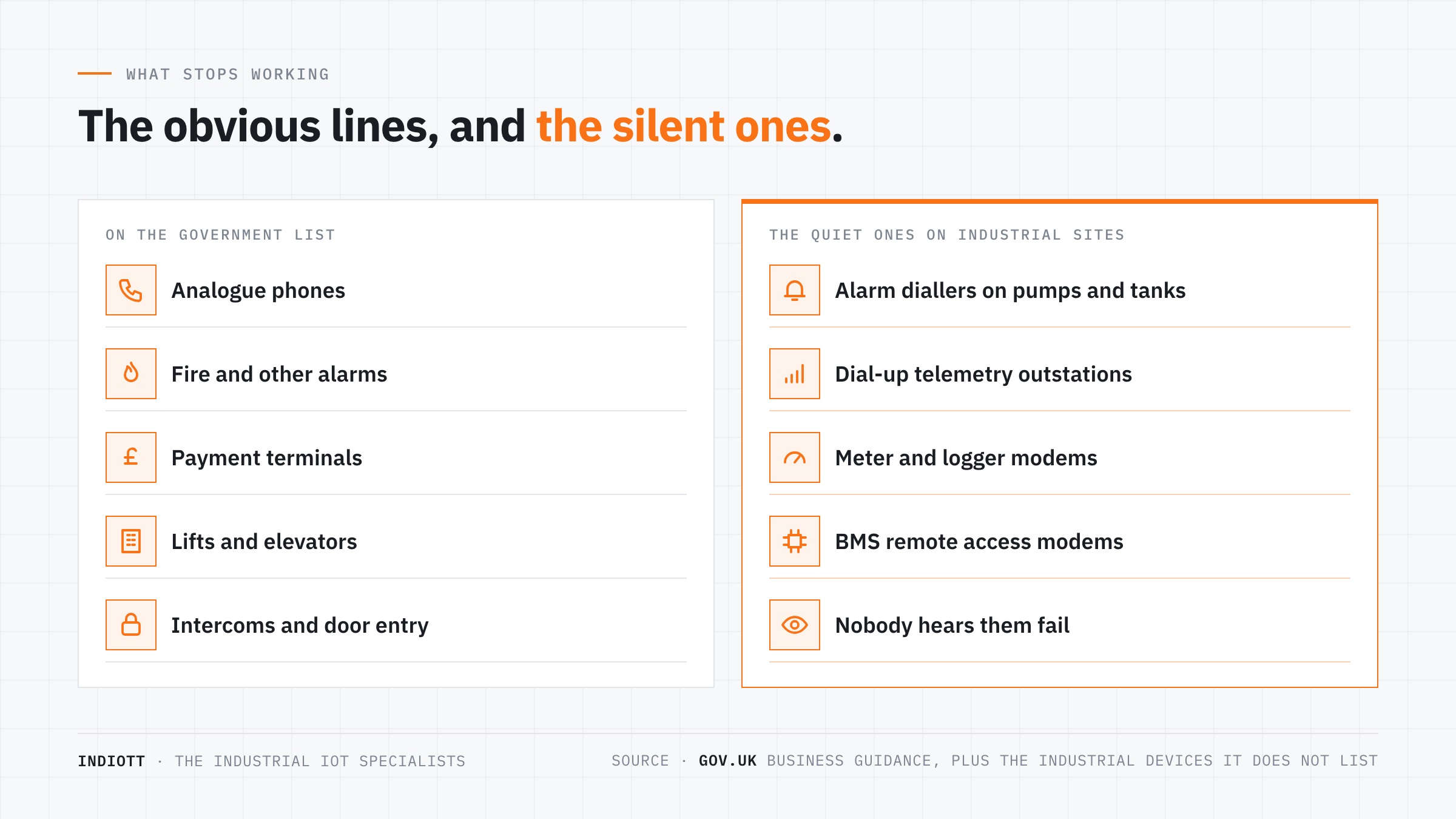
- Government guidance lists analogue phones, fire and other alarms, payment terminals, lifts, intercoms and broadband among the business systems affected.
- Industrial sites carry extra exposure: alarm diallers, dial-up telemetry and modems that were installed once and never looked at again.
- A plug-in adapter on a digital line is not a reliable home for an analogue modem. Move data devices to IP or cellular rather than hoping the tones survive.
- Do not swap one retiring network for another. UK operators do not plan to offer 2G and 3G beyond 2033, so specify 4G for anything you buy now.
What is the PSTN switch-off?
The PSTN switch-off is the retirement of the UK’s analogue telephone network, the Public Switched Telephone Network, which the telecoms industry is completing by January 2027. Landlines and every device that relies on the PSTN must move to digital technology, such as Voice over IP, Digital Voice or all-IP services. The industry announced the plan in November 2017.
The government’s guidance on moving landlines to digital technologies, published by the government in May 2025, says over two thirds of UK landlines have already been upgraded. For most households the change is a phone plugged into a router instead of a wall socket. For businesses the guidance is blunter: communications providers are advising all business customers to migrate at the earliest opportunity.
The same guidance says some customers without broadband may be offered an interim dedicated landline service until a digital solution is available, or 2030 if that comes sooner. That is a safety net for vulnerable households, not a plan for a pumping station.
What stops working after the PSTN switch-off?
Anything that sends its signal as an analogue tone down a copper phone line. The government names analogue phones, fire and other types of alarm, payment terminals, lifts and elevators, intercom systems and broadband services among the business systems affected. After the PSTN switch-off, each needs either a digital replacement or a route over IP or mobile.
That PSTN switch-off list is written for a typical business. An industrial site, a campus or an estates portfolio usually has a second list that nobody wrote down, because the devices were installed by a contractor years ago and have worked silently ever since:
- Alarm diallers on pumps, tanks, boilers and plant rooms that ring a phone number when a float switch or fault contact trips.
- Dial-up telemetry outstations that a control room polls over a modem.
- Meter and logger modems that report readings overnight over a phone line.
- Building management system modems used for remote access by a maintenance contractor.
- Lift emergency lines and door entry panels in plant and service areas.
- Intruder and fire alarm signalling to an alarm receiving centre.
In a PSTN switch-off the first four are the dangerous ones, because nobody receives a call from them in normal operation. When the line dies, they fail silently, and the first sign is an overflowing tank or a plant room alarm that never arrives.
Will an analogue modem work on a digital line?
Sometimes, and that is the problem. A digital phone service can present a traditional phone socket through an adapter in the router, and a simple voice call will usually work. Analogue modems, alarm diallers and fax style devices send data as tones, and tones do not always survive the conversion to packets and back. A device that works on test day can fail intermittently later.
That is why the guidance tells businesses to contact the equipment supplier or manufacturer to check whether a device will remain functional on a digital phone line, and why buyers of any new alarm or device should check compatibility before they buy. For data devices the better answer after the PSTN switch-off is to stop pretending they are phones: give them an IP connection, over the site network or over 4G.
For safety critical lines, lift emergency phones, fire and intruder alarm signalling, use a solution approved for that purpose and speak to the lift or alarm maintainer. Those systems have their own standards and insurance implications, and they are not a job for a general purpose router.
How do you move telemetry off the phone line?
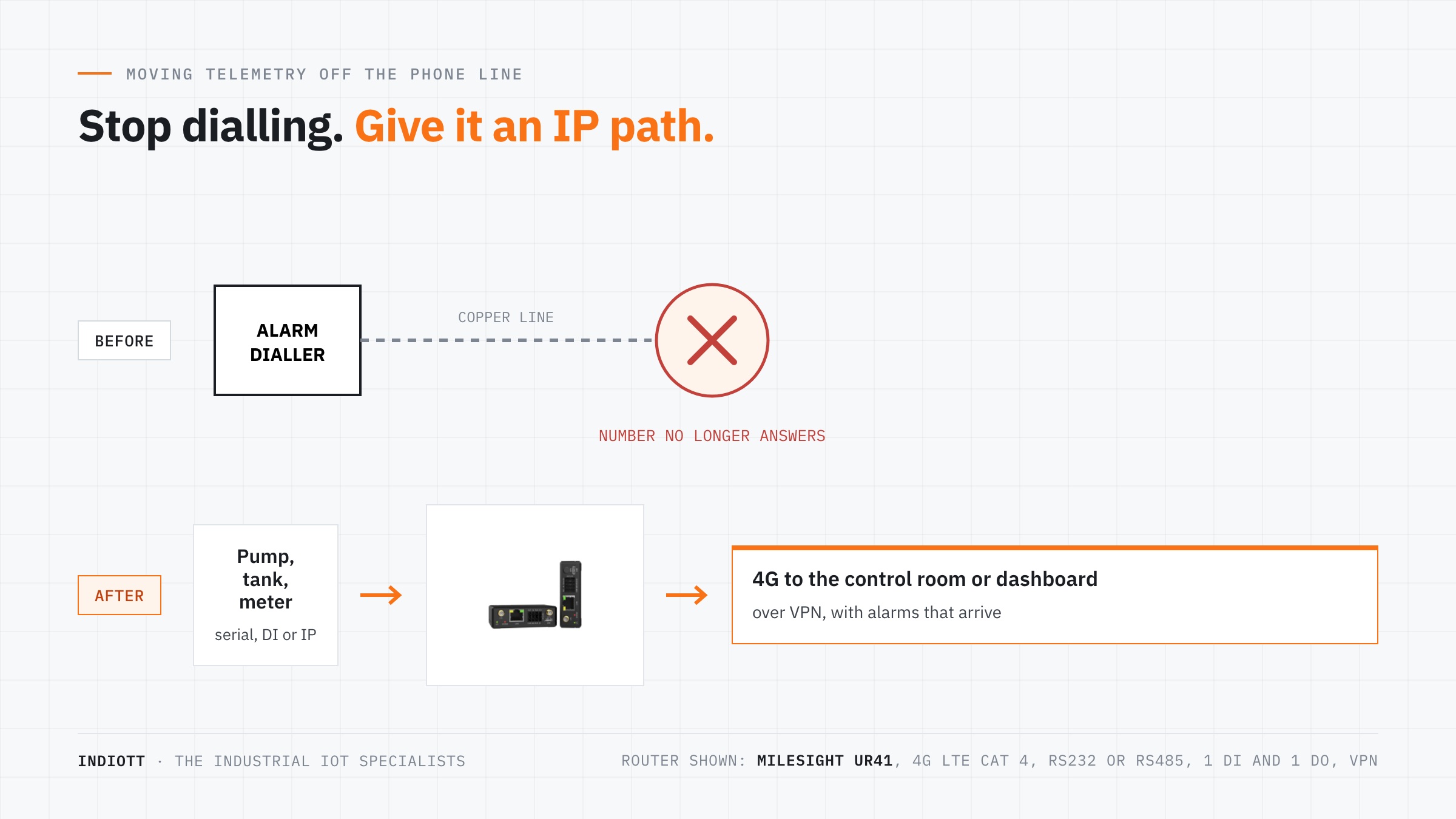
The PSTN switch-off answer for telemetry is to replace the phone line with an IP path, then choose the cheapest way to reach it. Where there is site network, use it. Where there is none, a 4G router gives the device its own connection. And where the device only speaks serial, a router or device server with a serial port carries that data over IP without changing the equipment at either end.
The Milesight UR41 is a 4G LTE Cat 4 router measuring 70 by 55 mm, with one Ethernet port, one serial port switchable between RS232 and RS485, one digital input and one digital output, and VPN support including IPsec, OpenVPN and WireGuard. It runs serial data transparently over TCP or UDP and acts as a Modbus RTU to TCP gateway, and it is listed at £86.04. For a cabinet with more equipment, the Milesight UR35 adds dual SIM slots, five Ethernet ports and optional PoE, and is listed at £149.63.
For a legacy RS232 or RS485 device that must keep talking to an existing control system, a cellular serial device server such as the ATOP SE5201B-C1 presents the serial port over the network, including a virtual COM port for software that expects one. It is quote only. Our guide to Modbus gateways for SCADA covers the protocol side in more depth.
Alarm diallers are the easiest win of all. Instead of ringing a number, a cellular sensor can report the reading itself. The Milesight TS601 carries its own nano SIM and raises threshold alarms without a gateway or a phone line.
What about 2G and 3G?
Plan for them in the same PSTN switch-off project, or you will migrate twice. The mobile operators have confirmed to the government that they do not plan to offer 2G and 3G services beyond 2033, according to Mobile UK, the operators’ trade body. The 3G switch-off is already well advanced, and each operator sets its own 2G timeline within that limit.
Mobile UK is explicit that some older IoT and machine to machine devices rely on 2G to send small amounts of data or as a backup connection, and that it is up to the owners of that infrastructure to decide how and when to upgrade. If a telemetry unit, lift line or alarm panel on your site has a 2G module, treat it as part of the PSTN switch-off project, not a separate one.
For anything you buy now, specify 4G. The UR41 and UR35 are LTE Cat 4 routers, and the TS601 uses LTE Cat.1, which is designed for low data IoT traffic on 4G networks.
How do you run the audit?
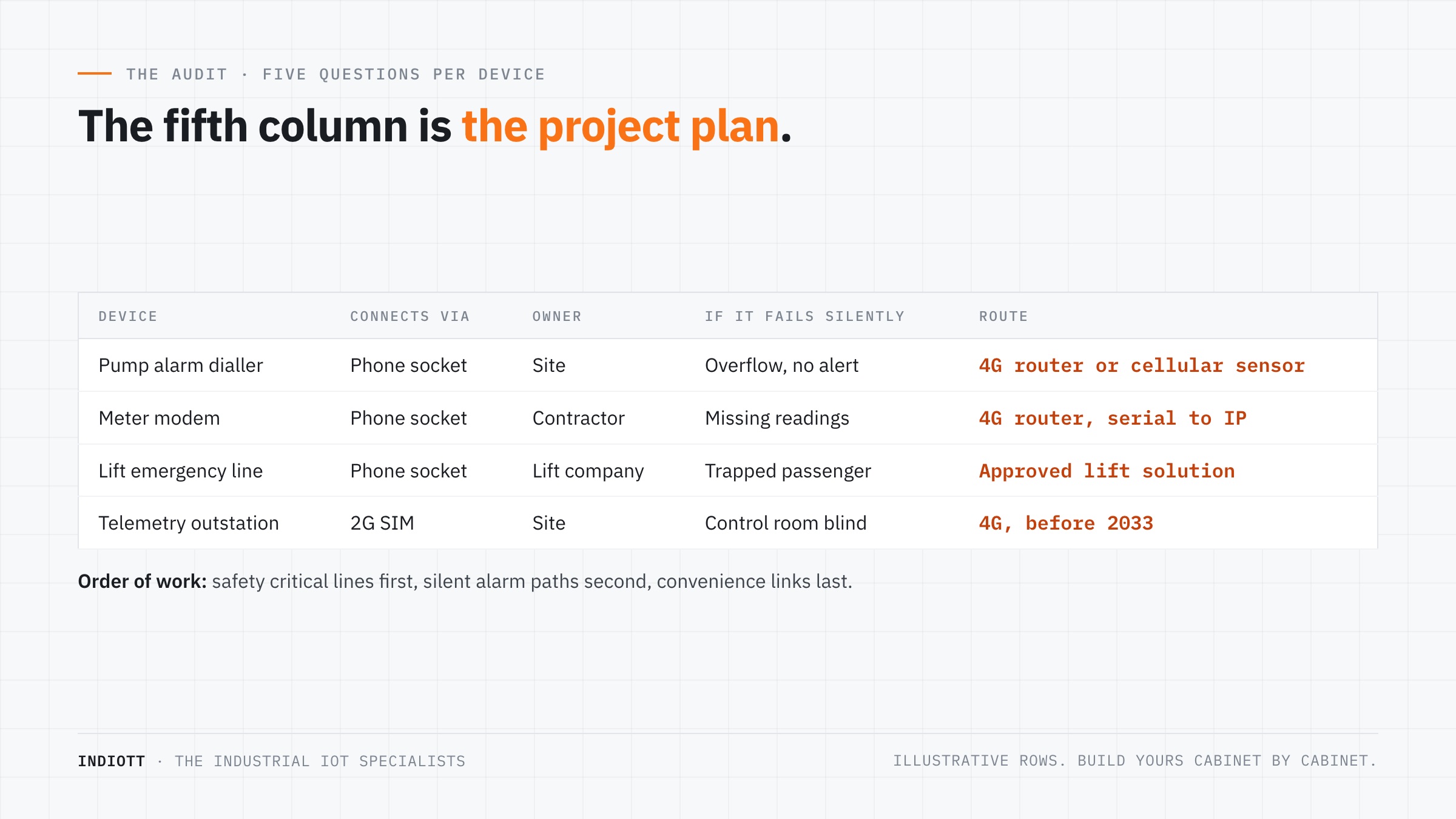
For a PSTN switch-off audit, walk the site with a simple question for every cabinet, panel and plant room: does anything here plug into a phone socket, contain a SIM, or dial a number? Then record five facts for each device and decide its route before the line is switched.
- What it is and what it does, in plain words: pump alarm dialler, meter modem, lift line.
- What it connects to: a phone socket, a 2G or 3G SIM, or the network.
- Who owns it: you, a contractor, a lift or alarm company, or the utility.
- What happens if it fails silently, which sets its priority.
- Its replacement route: site network, 4G router, cellular sensor, or an approved safety solution.
Do the safety critical lines first, the silent alarm paths second, and the convenience links last. And write down every phone number your devices call, because after the PSTN switch-off some of them will be ringing a number that no longer answers.
Frequently asked questions
When is the PSTN switch-off?
The telecoms industry is switching off the analogue PSTN by January 2027, according to government guidance. Over two thirds of UK landlines had already been upgraded to VoIP when that guidance was published in May 2025.
Will my alarm work after the PSTN switch-off?
It depends on how it signals. Government guidance lists alarms among the devices that need upgrading and advises contacting the equipment supplier or manufacturer to confirm compatibility with a digital line. For monitored fire and intruder alarms, speak to your alarm company about an approved signalling route.
Can a 4G router replace a phone line?
For data, yes. A 4G industrial router gives telemetry, meters and controllers an IP connection, and a router with a serial port can carry RS232 or RS485 data. It does not replace an approved analogue voice line for lift emergency phones or alarm signalling.
Is 2G a safe alternative to the PSTN?
No. The UK mobile operators do not plan to offer 2G and 3G beyond 2033, so a 2G device bought today has a limited life. Specify 4G for new telemetry.
Who is responsible for the PSTN switch-off on business lines?
The business. Communications providers are advising business customers to review their infrastructure, identify anything relying on the PSTN or ISDN, and migrate at the earliest opportunity.
Where to start
Start your PSTN switch-off plan with the devices that fail silently. A lift line or an intercom tends to be noticed quickly when it stops. An alarm dialler on a remote tank is noticed when the tank overflows.
Our industrial 4G and 5G routers page compares the cellular options for remote sites, and the Kit Builder will price a router, sensors and a gateway for a specific job. If you have a list of devices and are not sure which route suits each one, request a quote with the list and we will map it for you.
Next step
Get a priced kit list for your site
Answer three quick questions and tell us where to send it. An engineer replies within one working day with the parts, the prices and the lead time.
Rather talk it through? Call 023 9223 3611
Received. An engineer has it.
You will hear back within one working day with the parts, the prices and the lead time. A confirmation is on its way to your inbox.
If it is urgent, call 023 9223 3611.