Legionella Flushing: The Tap Nobody Uses Is the One That Matters
TL;DR: HSG274 does not ask you to run a tap for a fixed number of minutes. It asks you to flush until the temperature at the outlet stabilises and is comparable to supply water. That means the legionella flushing test is, literally, a temperature measurement. It is also the one control almost every estate records as a signature on a sheet, with no evidence the tap ever ran.
Last updated: 14 September 2026
On this page
Key takeaways
- HSE defines infrequently used equipment as anything not used for a period equal to or greater than seven days. That equipment must be on the legionella flushing regime.
- The instruction is to flush until the temperature stabilises and is comparable to supply water, then purge to drain. There is no fixed duration.
- The guidance also says to “sustain and log this procedure”. The log is the control, and on most estates the log is a signature.
- Hot water should be stored at 60°C and reach outlets at 50°C within one minute, or 55°C in healthcare premises.
- Cold sentinel outlets should be below 20°C within two minutes, and HSE asks you to watch the reading during the flush, not just at the end.
- Every one of those tests is a temperature over time at a tap. A sensor at the outlet records the whole curve without anyone writing anything down.
What counts as an infrequently used outlet?
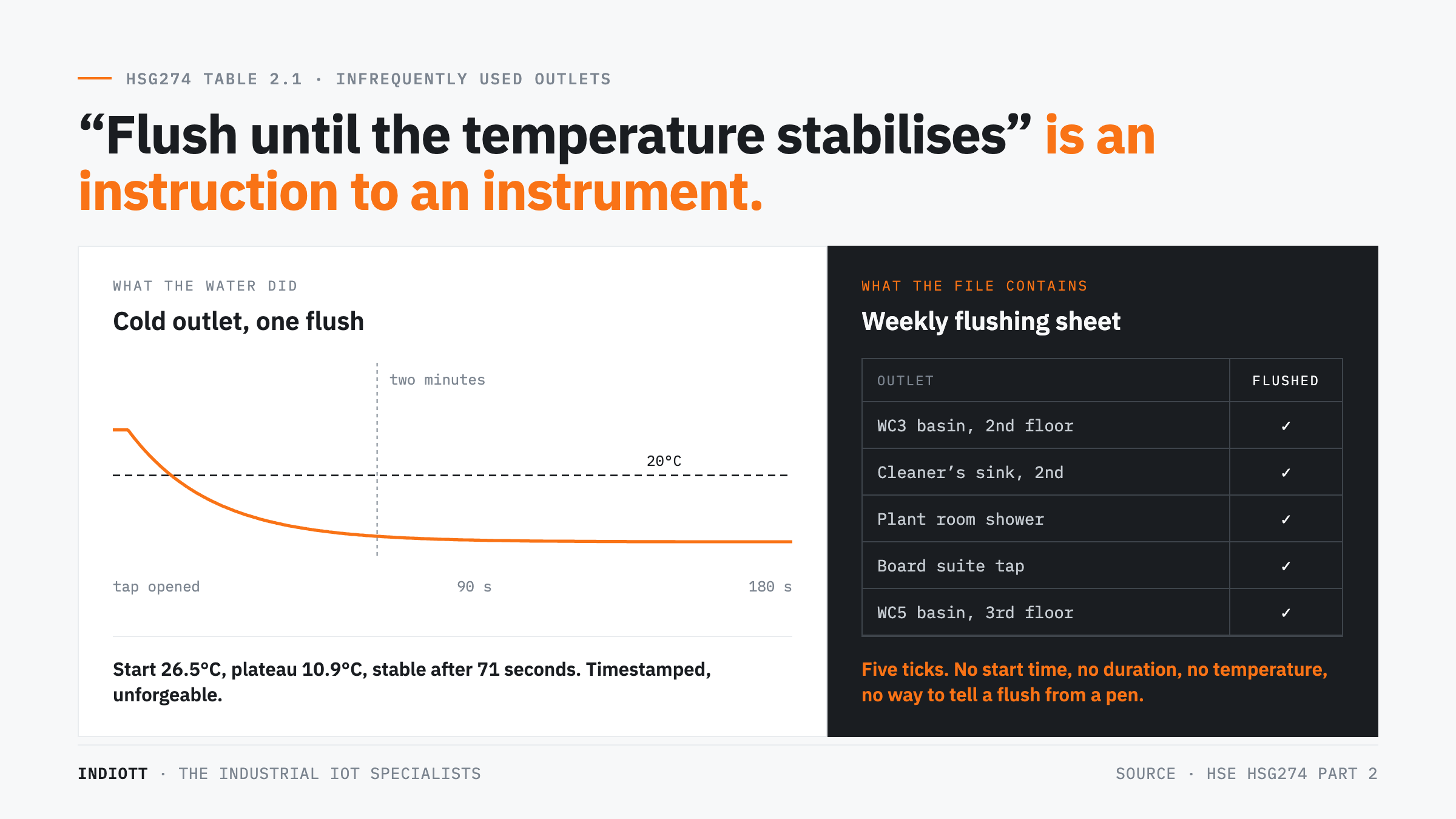
Seven days of disuse. HSE’s guidance is specific: infrequently used equipment within a water system, meaning equipment “not used for a period equal to or greater than seven days”, should be included on the legionella flushing regime. That threshold catches far more of a building than most risk assessments admit.
The duty behind it is short and worth reading in the original. HSE’s summary of what duty holders must do asks you to “identify and assess sources of risk”, “manage any risks”, “prevent or control any risks” and “keep and maintain the correct records”. Three of those four are judgement. The fourth is a filing problem, and it is the one that fails at audit.
Think about what actually goes a week without running in a real estate. The end cubicle in a rarely used toilet block. The cleaner’s sink on a floor that has been half empty since hybrid working. The shower in a plant room nobody has needed since the last confined-space job. A tap in a meeting suite that is only booked for quarterly board meetings. The outlets that get used every day are the ones that were never the hazard.
The guidance is blunt about the better fix first. It says consideration should be given to removing infrequently used showers, taps and associated equipment altogether, and that if removed, redundant pipework should be cut back as far as possible to a common supply, preferably by removing the feeding tee. A dead leg that is physically gone needs no legionella flushing at all, and no log entry for the next twenty years.
Where removal is impractical, the outlet joins the legionella flushing regime. And the moment it joins the regime, it becomes a recurring labour cost and a recurring evidence problem, every week, forever.
What HSG274 actually asks you to do
Three things, and the wording matters. Table 2.1 of the guidance sets out the legionella flushing action for infrequently used outlets as: flush the outlets until the temperature at the outlets stabilises and is comparable to supply water, purge to drain, and regularly use the outlets to minimise microbial growth in the peripheral parts of the system, sustaining and logging the procedure.
Notice what is absent. There is no “run for two minutes”. The endpoint of a legionella flushing operation is defined by a physical condition, not a stopwatch, because the point is to replace the stagnant water sitting in the branch with fresh water from the supply. How long that takes depends on the length of the dead leg, its diameter and how warm the surrounding riser is. Two minutes might be generous on one outlet and useless on another.
The temperature regime it sits inside is equally specific. Where temperature is the control, hot water should be stored at a minimum of 60°C and distributed so it reaches a minimum of 50°C, or 55°C in healthcare premises, within one minute at outlets. Cold water should be below 20°C, and pipe branches to individual outlets should deliver cold water as close to the incoming water temperature as possible within two minutes of running.
Why the legionella flushing log is the weakest evidence in the file
Because a legionella flushing log records an intention, not an event. A signature in a legionella flushing log asserts that a named person went to a named outlet on a named day and ran it. Nothing in the record distinguishes that from a sheet completed in the van at the end of a round, and everybody in the industry knows it.
This matters in exactly one circumstance, which is the circumstance that ruins people. If a case is linked to your building, the water safety file is the first thing requested, and the flushing log is the part of it that carries the least weight, because it is the part with no independent corroboration. Every other control leaves a trace. Chlorination leaves dosing records and residual measurements. Temperature control leaves calorifier readings. Legionella flushing leaves a tick.
There is a second, quieter cost. Because the log cannot distinguish a real flush from a recorded one, it also cannot tell you which outlets are genuinely problematic. An outlet that never reaches supply temperature no matter how long it runs is telling you something important about the pipework behind it. On a clipboard, that outlet looks identical to every other outlet on the round.
The legionella flushing test is a temperature test
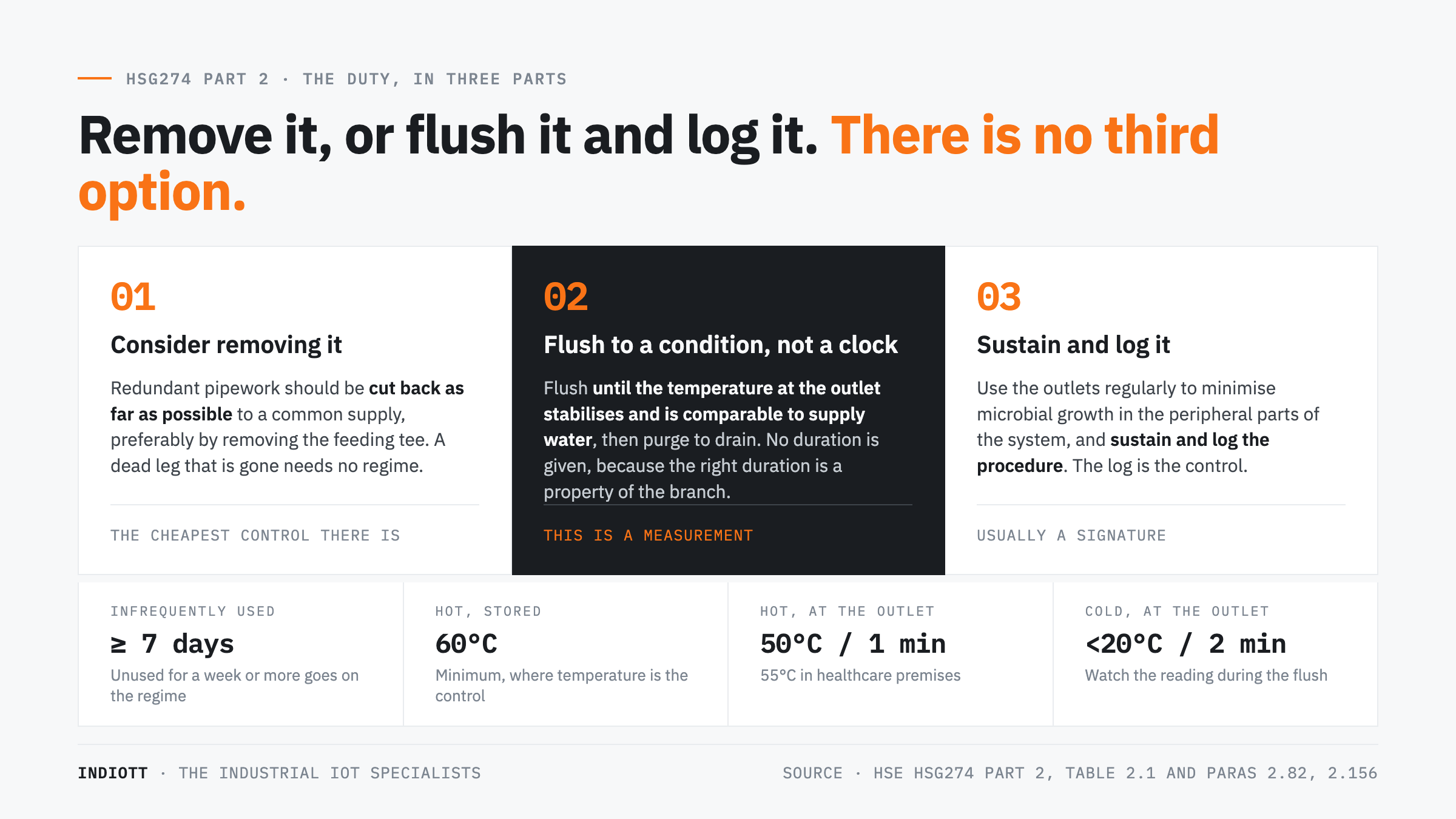
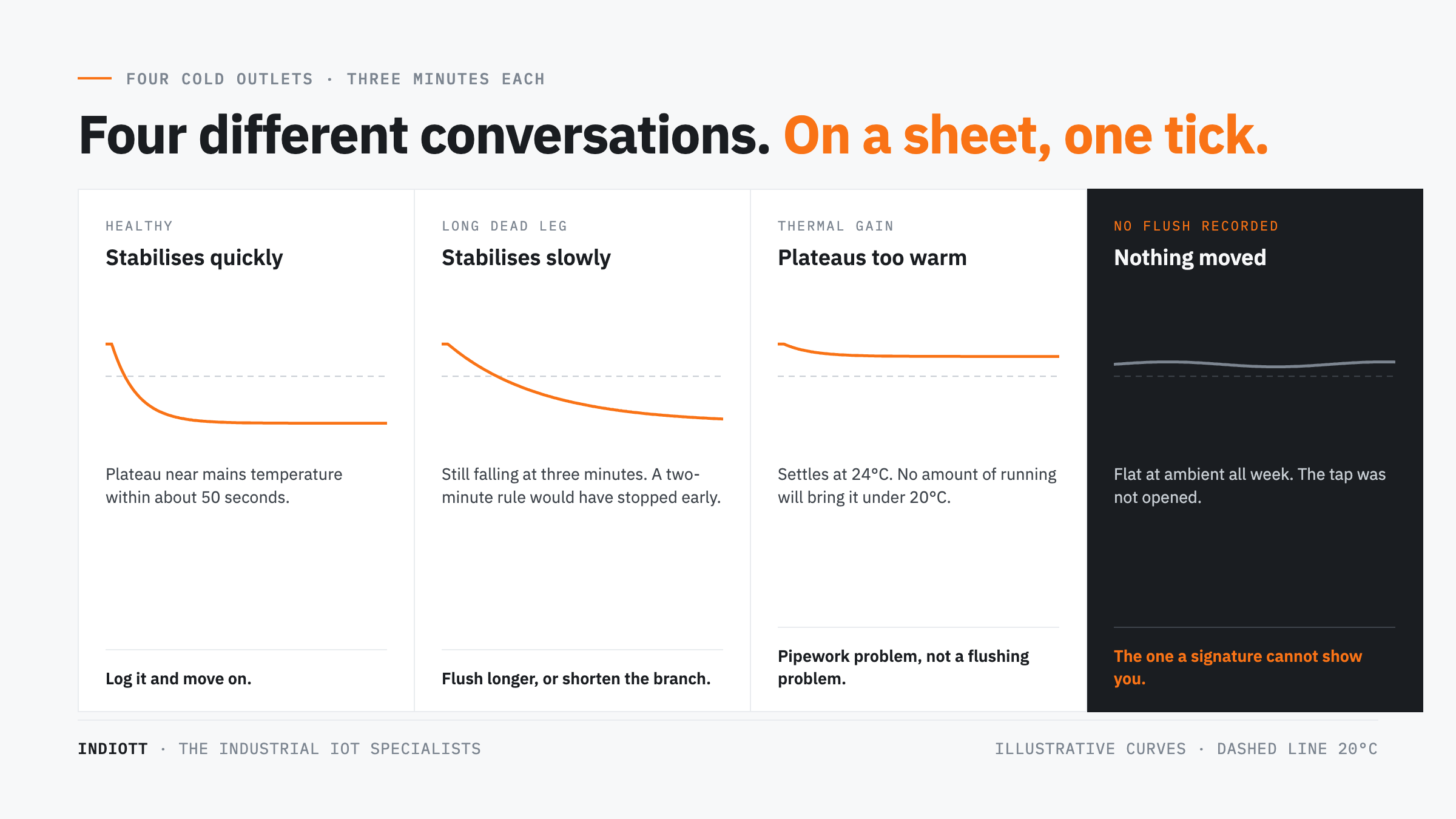
Read the requirement again and the instrument specifies itself. “Flush until the temperature at the outlets stabilises and is comparable to supply water” describes a curve: a starting temperature, a change while stagnant water is displaced, and a plateau when fresh supply water arrives. A temperature sensor at the outlet records the whole legionella flushing curve automatically, with a timestamp, whether or not anyone remembered to write it down.
What that record gives you goes beyond compliance paperwork. The shape of the curve is diagnostic. A branch that takes ninety seconds to stabilise has a long dead leg. A cold outlet that plateaus at 24°C instead of near mains temperature has thermal gain from something running next to it, which is precisely the “local heat gain” HSE tells inspectors to look for by watching the thermometer during the flush rather than reading it once at the end.
It also converts an assertion into a defensible dataset. Instead of fifty-two signatures a year per outlet, you have fifty-two curves, each with a start time, a duration and an end temperature. That is the difference between saying legionella flushing was carried out and being able to show what the water did while it happened.
One caveat worth stating plainly: a temperature sensor sees water moving and warming or cooling. It does not see whether the operative purged to drain properly or whether an aerosol-generating outlet was run safely. Those remain human tasks, and the record supports them rather than replacing them.
Sentinel outlets and the rest of the system
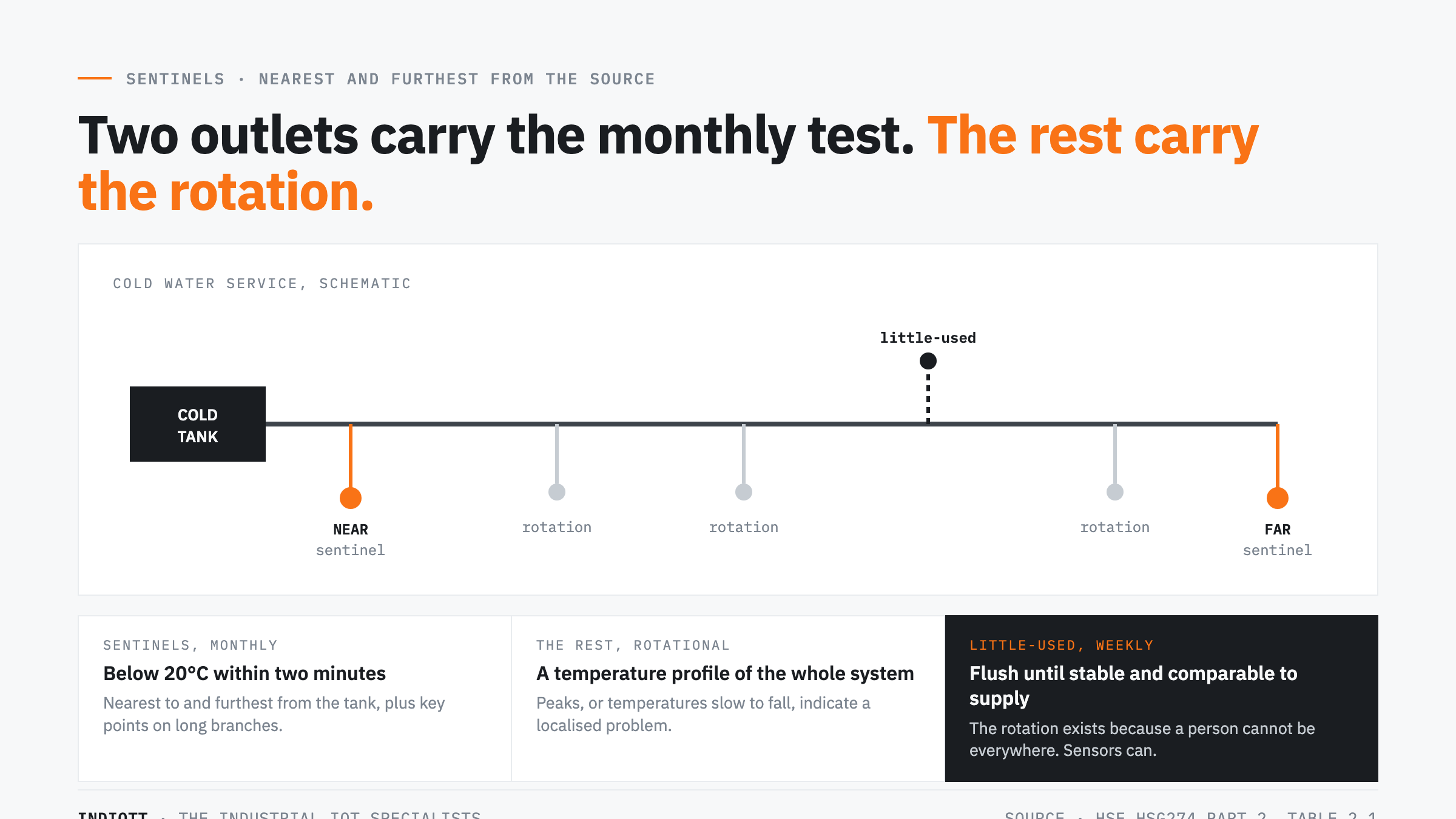
Sentinels are the outlets nearest to and furthest from the source, and HSE’s monthly check for cold water services is that they should be below 20°C within two minutes of running the tap. The guidance adds the detail almost everyone skips: to identify any local heat gain that might not be apparent after one minute, observe the thermometer reading during flushing.
Beyond the sentinels, the guidance asks for temperatures at a representative selection of other points, on a rotational basis, to build a temperature profile of the whole system over a defined time period. Peak temperatures, or temperatures that are slow to fall, are flagged as indicators of a localised problem.
That rotational profiling is the part continuous monitoring genuinely transforms. Rotation exists because you cannot be everywhere with a thermometer. Fixed sensors are everywhere, all the time, so the profile stops being a slow sample of the estate and becomes a live map of it. Our water management and legionella solution is built around exactly that shift, and it pairs naturally with the automated temperature work described in our legionella temperature monitoring guide.
What to instrument, and what it costs
Start with the outlets that are hardest to reach and easiest to forget, because that is where the labour saving and the evidence gap are both largest. All prices below are ex VAT.
- Milesight TS201, £44.89. A single-point LoRaWAN temperature sensor. The workhorse for an individual outlet, a sentinel tap or a return leg.
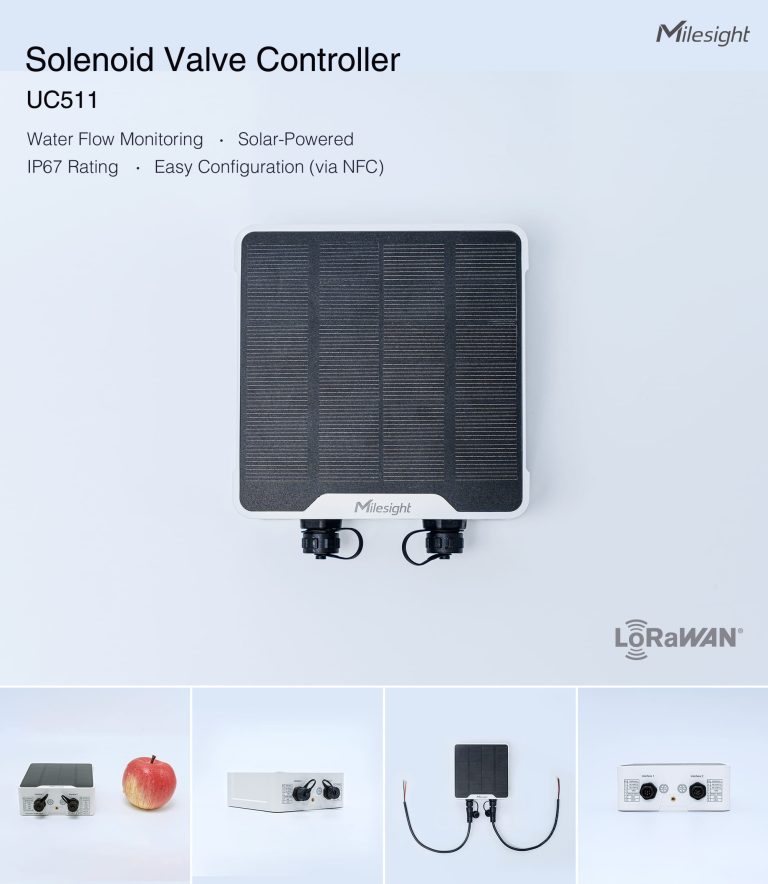
- Milesight TS302, from £64.34. Two probes on one radio, which suits a mixer position where you want the hot and the cold side of the same fitting on one record.
- Milesight TS101, from £74.82. An insertion probe for pipework rather than surfaces, which is what you want on a flow and return at the calorifier.
- Gateway. One indoor LoRaWAN gateway typically covers a building, and every sensor added afterwards shares it. That is why the second hundred sensors cost far less per point than the first ten.
The arithmetic that decides these projects is labour, not hardware. A weekly legionella flushing round of eighty outlets, at a few minutes each including travel between them inside a large building, is a standing commitment of several hours every week for as long as the building exists. Instrumenting the outlets does not remove that round. It tells you which outlets on it are actually being used by occupants, and therefore no longer meet the seven-day test at all.

What a sensor will not do
It will not run the tap. This is the single most important thing to be clear about before anyone signs a purchase order, because a monitoring system sold as a substitute for the legionella flushing round is being mis-sold. The water still has to move, and unless you fit automated flushing valves, a person still has to move it.
It will not remove your risk assessment or your written scheme, and it will not make you compliant on its own. ACoP L8 and HSG274 place duties on the duty holder, and a dataset is evidence in support of those duties rather than a discharge of them. Any supplier implying otherwise is selling you a liability, not a control.
It will not detect legionella. Temperature is a proxy for the conditions the organism likes, which is why the guidance is built around it, but no temperature sensor is a microbiological sample. Where your scheme calls for sampling, you still sample.
And it will not fix a system whose design is the problem. If a branch cannot deliver cold water near mains temperature within two minutes because it runs three metres alongside a hot riser, the sensor will prove that beautifully, every week, until somebody re-routes the pipe.
Frequently asked questions
How long should legionella flushing take at a little-used outlet?
Until the temperature at the outlet stabilises and is comparable to supply water, then purge to drain. HSE deliberately does not give a duration, because the correct duration depends on the volume of stagnant water in the branch. A sensor tells you what that duration actually is for each outlet, which lets you stop guessing in both directions.
How often does an infrequently used outlet need flushing?
The seven-day threshold in the guidance defines what goes on the regime, which is why most estates settle on a weekly round. Your written scheme sets the actual frequency based on your risk assessment, and higher-risk settings often go further.
Can sensors replace our legionella flushing records?
They can become the records, which is stronger than replacing them. The requirement is to sustain and log the procedure. A timestamped legionella flushing curve per outlet per week is a log, and it is one nobody can complete in the van afterwards.
What temperature should a cold outlet reach?
Below 20°C within two minutes of running, and as close to the incoming supply temperature as the branch can manage. Anything that plateaus well above mains temperature is telling you about heat gain into that branch.
Do we need a sensor on every outlet?
No, and we would not quote it that way. Sentinels first, then the infrequently used outlets that are hardest to reach, then a rotating selection of the rest to build the system profile the guidance asks for. That gets most of the value for a fraction of the point count.
Where this leaves you
The legionella flushing regime is the only major water safety control whose evidence is a signature. It is also, by HSE’s own wording, defined in terms of a temperature reaching a plateau, which is to say it is already a measurement waiting for an instrument. Closing that gap is unusually cheap, because the outlets that most need it are the ones nobody visits.
Send us the outlet schedule from your written scheme, or just the number of sentinels and infrequently used outlets and the building type, and we will come back with a point-by-point specification and price within one working day. Start from our water management and legionella solution, or read the 4-20mA guide if your building already has instrumentation you would rather keep.
Next step
Get a priced kit list for your site
Answer three quick questions and tell us where to send it. An engineer replies within one working day with the parts, the prices and the lead time.
Rather talk it through? Call 023 9223 3611
Received. An engineer has it.
You will hear back within one working day with the parts, the prices and the lead time. A confirmation is on its way to your inbox.
If it is urgent, call 023 9223 3611.