Non-Revenue Water: An IoT Guide to Cutting Leakage on UK Water Networks
Last updated: 2 July 2026
TL;DR: Non-revenue water is treated water that is put into supply but never billed, split into real losses (physical leakage), apparent losses (metering error and theft) and unbilled authorised use. England and Wales still lose 2,617 megalitres a day, nearly 19% of everything put into supply (Environment Agency). Acoustic loggers, pressure and flow sensors and district metered area monitoring over LoRaWAN find and cut those losses on ageing pipes, helping companies hit Ofwat’s 50% reduction target by 2050.
Every water utility in the UK pays to abstract, treat and pump water that a fifth of the time never reaches a paying customer. That gap between water produced and water billed is the single biggest efficiency problem on the network. This guide explains what those losses are, how large they are, what the regulator now demands, and the specific IoT hardware that turns a leaking network into a monitored one.

What is non-revenue water and what are its components?
Non-revenue water is the volume of treated water that a utility puts into its distribution system but receives no payment for. It is the difference between water supplied and water billed, and it is the standard measure used to size a loss-reduction programme. The International Water Association water balance breaks it into three parts.
Real losses are physical leakage: water escaping from transmission mains, storage facilities, distribution mains and service connections (International Water Association). This is the largest component on most UK networks and the one that ageing cast iron pipe makes worse every year.
Apparent losses are commercial losses. They include water theft, unauthorised connections and metering inaccuracy, where a meter under-reads and the utility bills for less than was actually used (International Water Association). The water reaches a customer, but the revenue does not.
Unbilled authorised consumption is water that is legitimately used but never charged for, such as mains flushing, firefighting and network operations (International Water Association). It is real usage, just off the ledger.
Reducing these losses means attacking all three, but real losses dominate the volume, and that is where sensing technology earns its keep. The World Bank puts the cost of non-revenue water to utilities worldwide at US$14 billion a year, which shows the scale of the prize.
How much water does the UK actually lose to leakage?
The UK loses a lot, and progress is slow. In 2024-25, water companies in England and Wales leaked 2,617 megalitres a day, which is 18.77%, or nearly one in five litres, of the 13,946 megalitres a day put into distribution (Environment Agency). That is treated, pumped, chlorinated water lost before it reaches a tap.
To picture the volume, 2,617 megalitres is 2.6 billion litres every single day, roughly a thousand Olympic swimming pools drained into the ground before breakfast. The National Audit Office framed the same problem earlier, describing around a fifth of supply lost to leakage (National Audit Office).

Per capita consumption is not helping the maths. Average use sat at 136.5 litres per person per day in 2024-25 (Environment Agency), and demand is rising even as supply tightens. The National Audit Office warned that England faces a shortfall of nearly 5 billion litres a day by 2050 against current usage, out of roughly 14 billion litres used daily now (National Audit Office).
Leakage is the fastest way to close part of that gap without building a reservoir. Water saved from a fixed leak is water that needs no new abstraction, no new treatment and no new pumping cost.
What are Ofwat’s leakage-reduction targets and PR24 commitments?
The regulator has set a clear long-term line: the water industry has committed to halving leakage by 2050, measured against a 2017-18 baseline. Progress so far is only about a 10% reduction, so the pace has to accelerate sharply through the next regulatory periods.
The 2017-18 baseline itself was 2,987 megalitres a day (Environment Agency), so the 2050 target implies cutting daily losses to under 1,500 megalitres. That is a huge distance from today’s 2,617 megalitres a day, and it will not close on manual leak surveys alone.
For the current five-year period, Ofwat’s 2024 Price Review, known as PR24 or AMP8, has challenged companies to deliver a further reduction in leakage from 2024-25 levels of around 17% to 20%. To pay for it, over £700 million has been allowed for pressure management, repairs and pipe replacement (Ofwat, via Depotnet).
Smart metering is funded alongside it. Ofwat has allowed over £1.7 billion for the delivery of 10.4 million smart meters between 2025 and 2030, partly because continuous overnight flow at a property is a reliable signal of a supply-pipe leak (Ofwat). Metering and network sensing are two halves of the same loss-reduction strategy.
How do acoustic loggers, pressure and flow sensors find leaks?
They listen, measure and compare. A modern leakage programme layers three sensing techniques over a network: acoustic loggers that hear leaks, pressure sensors that catch bursts and fatigue, and flow meters that quantify how much water is disappearing inside a defined zone.
Acoustic loggers clamp to valves, hydrants and fittings and listen for the steady broadband noise a pressurised leak makes underground. Deployed across a street and left in place, they correlate the sound between nodes to pinpoint a leak to within a metre or two, so a crew digs once in the right spot rather than trial-trenching a whole road.
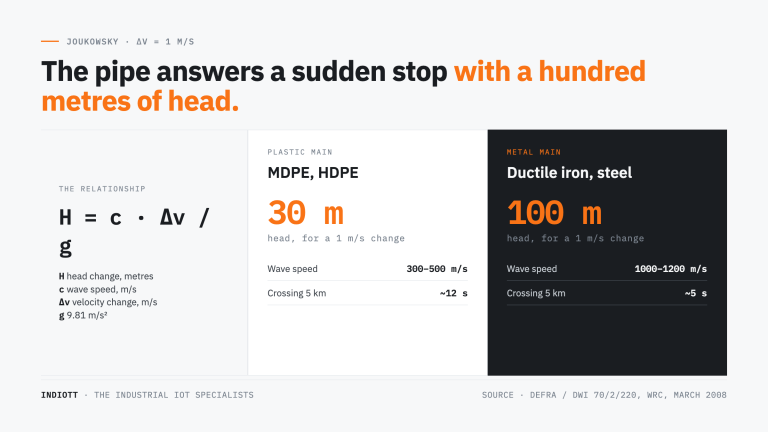
Pressure sensors watch pipe pressure continuously and flag the transient waves that signal a burst or a weakening main. The Milesight EM500-PP LoRaWAN pipe pressure sensor measures 0 to 1,600 kilopascals at plus or minus 0.5% accuracy, runs up to 10 years on a single battery and reports over LoRaWAN at ranges of up to 15 kilometres in rural areas (Milesight). One device, buried in a chamber, watches a pressure point for a decade.

Flow meters at zone boundaries turn noise into numbers. Electromagnetic and clamp-on ultrasonic meters record inflow to a district metered area with accuracy around plus or minus 0.5%, which is the basis for measuring leakage rather than just detecting it.
How does district metered area (DMA) monitoring cut non-revenue water?
DMA monitoring converts a sprawling, opaque network into small, measurable zones. A district metered area is a hydraulically isolated section of the network, typically a few thousand properties, with a metered inflow. By comparing water flowing in against water legitimately used, an operator can calculate the losses inside that zone and rank which areas leak worst.
The most powerful signal is minimum night flow. Between about 2am and 4am, legitimate demand collapses, so whatever water is still moving into a DMA is largely leakage. A rising night-flow baseline is an early, quantified warning that a new leak has started, often days before a customer notices low pressure.
Because each zone is small, a utility can target crews at the DMAs losing the most water first, instead of surveying the whole network blind. Pressure management follows: trimming excess pressure in a zone using a controlled valve both reduces the leak rate on existing leaks and slows the rate at which new bursts appear. This is exactly where Ofwat’s £700 million pressure-management allowance is aimed.
Indiott builds this monitoring layer for water companies on the utilities and water networks solution, pairing DMA flow metering with pressure logging and level telemetry across the zone.
Why is LoRaWAN the right network for water telemetry?
LoRaWAN fits water infrastructure because the assets are fixed, remote, battery-powered and buried. It is a long-range, low-power radio protocol built for exactly this: a sensor sending a few small readings an hour from a valve chamber, a borehole or a reservoir where mains power and cellular coverage are both absent.
The economics come from battery life. A LoRaWAN sensor such as the Milesight EM500-SWL submersible level sensor runs roughly 10 years on one 19,000 mAh battery and reads levels to plus or minus 0.5% across ranges up to 200 metres, with an IP68 probe rated for full submersion (Milesight). No power cabling, no annual battery swap, no truck roll for a decade.
Range covers the geography. A single LoRaWAN gateway reaches sensors up to about 15 kilometres away in rural terrain (Milesight), so one gateway can gather pressure, flow and level data from an entire catchment of loggers. For choosing between the two dominant low-power options, our LoRaWAN versus NB-IoT guide compares coverage, cost and battery life for utility deployments.
Level and valve telemetry complete the picture. Submersible and radar level sensors watch service reservoirs, boreholes and tanks so a utility knows storage state in real time, while valve-status telemetry confirms that a pressure-reducing valve is actually holding the setpoint that is keeping losses down.
What is the ROI of an IoT leakage programme?
The return comes from three stacked savings: the water no longer lost, the treatment and pumping energy no longer wasted, and the regulatory penalties avoided. Every megalitre of leakage fixed is a megalitre that never needed abstracting, chlorinating or pumping, so the marginal cost saving is real cash, not a paper figure.
The regulatory driver sharpens it. Under PR24, missing a leakage performance commitment triggers financial penalties, while beating it earns outperformance payments, so a monitored network protects revenue directly. With a 17% to 20% cut demanded this period and 50% by 2050, companies that instrument early avoid a scramble later.

The regulatory framework and figures behind these targets are published openly by the Environment Agency water resources report and by Ofwat’s PR24 price review, both of which set the baseline any leakage programme is measured against.
The hardware side is deliberately cheap to run. Ten-year battery life and multi-kilometre range mean the recurring cost of a LoRaWAN monitoring layer is dominated by the one-off install, not by maintenance. A pressure logger that finds one burst before it becomes a mains failure has often paid for itself in avoided emergency repair and lost water alone. Utilities can source the sensors, gateways and level loggers from the Indiott shop or scope a full deployment through the solutions hub.
Frequently asked questions
What is the difference between non-revenue water and leakage?
Leakage is only one part of non-revenue water. Non-revenue water is all treated water that is not billed, which also includes apparent losses like metering error and theft, plus unbilled authorised use such as mains flushing. Physical leakage is usually the largest share.
How much water does the UK lose to leakage?
In 2024-25, England and Wales lost 2,617 megalitres a day, about 18.77% of the water put into supply (Environment Agency). That is roughly 2.6 billion litres of treated water lost every day before it reaches customers.
What is Ofwat’s leakage target?
The industry has committed to halving leakage by 2050 against a 2017-18 baseline of 2,987 megalitres a day (Environment Agency). For 2025 to 2030, Ofwat’s PR24 sets a further reduction of around 17% to 20% from 2024-25 levels, backed by over £700 million of funding (Ofwat).
How do acoustic loggers detect leaks?
Acoustic loggers clamp to pipe fittings and listen for the continuous noise a pressurised leak makes underground. By correlating that sound between two loggers on the same pipe, they locate a leak to within a metre or two, so crews excavate once in the right place.
Why use LoRaWAN instead of cellular for water sensors?
Water assets are buried, remote and battery-powered. LoRaWAN gives 10-year battery life and up to 15 kilometres of range from one gateway (Milesight), which suits valve chambers and boreholes where mains power and reliable cellular coverage are both missing.
Conclusion
Cutting non-revenue water is the clearest efficiency win in the UK water sector: nearly a fifth of everything treated is still lost, the regulator wants half of leakage gone by 2050, and the sensing technology to find and cut those losses is now cheap, long-lived and proven. Acoustic loggers, pressure and flow sensors and DMA monitoring over LoRaWAN turn a leaking, unmeasured network into one that reports its own losses in real time.
To scope a leakage-reduction deployment on your network, explore the utilities and water networks solution or, for source and reservoir quality alongside loss control, our water quality monitoring solution.
Next step
Get a priced kit list for your site
Answer three quick questions and tell us where to send it. An engineer replies within one working day with the parts, the prices and the lead time.
Rather talk it through? Call 023 9223 3611
Received. An engineer has it.
You will hear back within one working day with the parts, the prices and the lead time. A confirmation is on its way to your inbox.
If it is urgent, call 023 9223 3611.