Pub Cellar Monitoring: Temperature, CO2 and the Alarm a Sensor Cannot Replace
TL;DR: Cellar monitoring for a pub or bar watches five things: cellar temperature, the cooler, CO2 at low level, humidity and the hatch. Cask ale is served at cellar temperature, and most brewers recommend 11 to 13°C. CO2 matters for safety as well as beer, because HSE warns it is heavier than air and has caused deaths in cellars. A monitoring sensor logs slow build-ups and cooling failures, but its range stops at the long-term exposure limit, so it works alongside a fixed CO2 gas alarm, never instead of one.
Last updated: 14 September 2026
On this page
Key takeaways
- Cellar monitoring protects two things at once: the quality of the beer and the safety of anyone who goes down the steps.
- Cask Marque reports that most brewers recommend a cask ale dispense temperature of 11 to 13°C, and it audits to a range of 10 to 14°C.
- HSE warns that CO2 is heavier than air and that deaths from asphyxiation have occurred when it has entered confined spaces such as cellars.
- HSE’s workplace exposure limits for CO2 are 5,000 ppm over 8 hours and 15,000 ppm over 15 minutes.
- Monitoring sensors such as the EM500-CO2 read up to 5,000 ppm, so they show slow build-ups but cannot replace a fixed CO2 gas alarm.
Why monitor a pub cellar?
Cellar monitoring catches the failures nobody sees until service: cooling that stopped overnight, a hatch left open on a hot afternoon, and CO2 slowly collecting at floor level. A cellar is visited briefly and irregularly, so continuous readings are the only record of what happened between visits.
The costs are direct. Beer kept too warm conditions too fast and has to be poured away, and a cooler failure on a Friday night can empty a weekend’s worth of stock. The safety risk is quieter. HSE’s page on the hazards of carbon dioxide points out that CO2 is colourless and odourless, so people cannot see or smell it at elevated concentrations.
A small LoRaWAN cellar monitoring kit covers both. It needs no cabling in a damp cellar, and it sends readings to a gateway upstairs so a manager can see the cellar from the bar or from home.

What temperature should a beer cellar be?
A cellar used for cask ale should be held at the temperature the beer is served at, because cask ale is dispensed at cellar temperature. Cask Marque’s guidance on beer temperature says most brewers recommend a dispense temperature of 11 to 13°C for cask ale, and that it audits to a range of 10 to 14°C to allow a little leeway.
The same guidance gives cooler serving temperatures for other products, which is why cellar monitoring should watch the cooling equipment as well as the room.
| Product | Temperature in Cask Marque’s guidance |
|---|---|
| Cask ale | 11 to 13°C recommended, audited 10 to 14°C |
| Standard lagers and keg | 5 to 8°C |
| Extra cold products | 0 to 5°C |
| Bottled products | 4 to 6°C |
A cellar that drifts above its range spoils cask ale gradually, and one that drops too low slows conditioning. Neither shows until the beer is poured, which is why a logged trend is worth more than a thermometer on the wall that someone reads once a day.

Why does CO2 matter in a cellar?
CO2 matters because cellars store it under pressure for dispense, and a leak collects where people stand. HSE explains that because CO2 is heavier than air, fatalities from asphyxiation have occurred when it has entered confined spaces such as tanks, sumps or cellars and displaced oxygen.
HSE sets two workplace exposure limits for CO2 in its guidance: a long-term limit of 5,000 ppm over an 8 hour reference period, and a short-term limit of 15,000 ppm over 15 minutes. As concentrations rise, HSE lists headaches, dizziness, confusion and loss of consciousness among the effects.
Two practical conclusions follow for cellar monitoring, and for anyone going into the cellar. Measure low, because that is where CO2 settles. And treat any steady rise over days as a sign of a slow leak or poor ventilation that the gas supplier should look at.
What can a CO2 monitoring sensor do, and what can it not?
A CO2 monitoring sensor can log the concentration in a cellar over days and weeks, show slow leaks and poor ventilation, and alert a manager when levels creep up. It cannot act as the gas safety alarm, because a monitoring sensor’s range and design are not those of a safety device.
The Milesight EM500-CO2, the sensor in our cellar kit, measures 400 to 5,000 ppm. That range stops exactly at HSE’s long-term exposure limit, and a serious leak can take concentrations well beyond anything the sensor can read. A cellar with CO2 cylinders needs a fixed CO2 gas detection alarm installed and maintained to the gas supplier’s guidance. The monitoring sensor sits alongside that alarm, adding a record and an early warning of the slow problems that never trip it.

What should cellar monitoring measure?
Effective cellar monitoring measures five readings, each at the point where its problem starts.
- Cellar air temperature. Against the cask range, with an overnight alert if cooling fails.
- Cooler or cold room temperature. A probe inside the cooling equipment, because the room can look fine while the cooler fails.
- CO2 at low level. Mounted low on the wall, where CO2 collects, logging the trend.
- Humidity. High humidity means condensation on walls and ceilings, which leads to mould and hygiene complaints.
- The hatch or cellar door. Open and closed, so a warm afternoon with the hatch propped open shows up in the record.
The EM500-CO2 reports temperature, humidity and air pressure alongside CO2, so one device covers readings three and four, and part of reading one.
How should the alerts be set?
Set cellar monitoring alerts for events a manager can act on, with delays that ignore normal activity. A delivery with the hatch open for twenty minutes is normal; a hatch open for two hours is not.
| Reading | Useful alert |
|---|---|
| Cellar temperature | Outside the range your brewer or pub company specifies, for longer than a set time |
| Cooler temperature | Above its setpoint overnight, when nobody would otherwise notice |
| CO2 trend | A steady rise over days, or readings well above normal for the cellar |
| Humidity | Staying high for many hours |
| Hatch or door | Open outside delivery times, or open for longer than a delivery takes |
What does a cellar monitoring kit include?
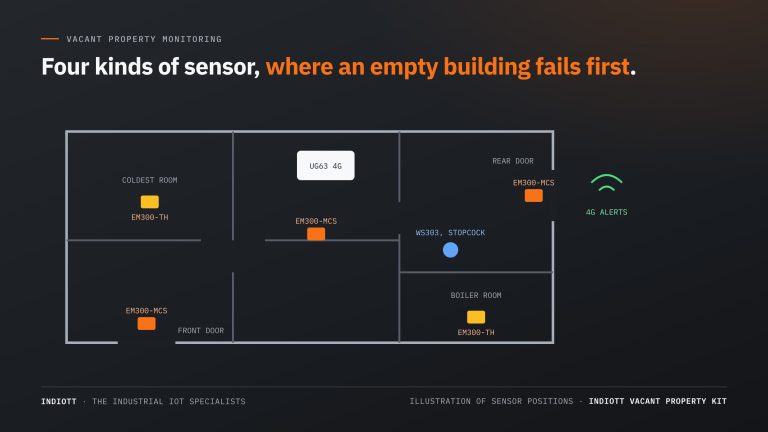
A cellar monitoring kit needs a gateway and four sensors. Our cellar monitoring kit pairs a UG63 gateway, placed upstairs near the cellar steps, with an EM500-CO2 low on the wall, a TS201 probe in the cooler and an IP67 EM300-MCS sensor on the hatch. The kit page shows the live price of every part and adds the whole kit to the basket in one click.
Cellars are below ground, so the gateway position matters: put it near the stairs or a floor hatch and test the signal before fixing the sensors. For the CO2 sensor itself, see the EM500-CO2, and for the wider range, our LoRaWAN CO2 sensors guide.

Frequently asked questions
What temperature should a pub cellar be?
For cask ale, most brewers recommend 11 to 13°C, the temperature it is served at, and Cask Marque audits to 10 to 14°C. Lagers, keg and bottled products are served colder from cooling equipment.
Is a CO2 monitor the same as a CO2 alarm?
No. A monitoring sensor logs concentrations for trends and alerts. A fixed CO2 gas alarm is a safety device installed to the gas supplier’s guidance. Cellars with CO2 cylinders need the alarm; monitoring adds to it.
Where should a CO2 sensor go in a cellar?
Low on the wall. HSE explains that CO2 is heavier than air, so it collects at low level in confined spaces such as cellars.
What are the workplace exposure limits for CO2?
HSE lists a long-term limit of 5,000 ppm over 8 hours and a short-term limit of 15,000 ppm over 15 minutes.
Will a wireless sensor work in a cellar?
Usually, if the gateway is near the cellar stairs or a hatch. Brick vaults and concrete floors weaken radio, so test the signal before fixing the sensors.
Watch the cellar between visits
Cellar monitoring turns a room visited for a few minutes a day into a continuous record of temperature, CO2, humidity and access. Keep the fixed CO2 alarm serviced, add monitoring for the slow problems, and let the alerts catch the cooling failure before the weekend’s beer is lost.
See the cellar monitoring kit with live prices, or read our guide to cold chain monitoring for HACCP for the kitchen side of the same job.
Next step
Get a priced kit list for your site
Answer three quick questions and tell us where to send it. An engineer replies within one working day with the parts, the prices and the lead time.
Rather talk it through? Call 023 9223 3611
Received. An engineer has it.
You will hear back within one working day with the parts, the prices and the lead time. A confirmation is on its way to your inbox.
If it is urgent, call 023 9223 3611.