BUYING GUIDE · AIR QUALITY
LoRaWAN CO2 Sensor Range: NDIR Accuracy, Battery Powered
CO2 is the one number that tells you whether ventilation works. NDIR sensing plus LoRaWAN means every room reports it for years on batteries — no wiring, no calibration rounds.
Why CO2, and why NDIR
A lorawan co2 sensor earns its place because CO2 is the honest proxy for ventilation: people exhale it at a known rate, so the concentration in a room tracks exactly how well fresh air replaces stale. HSE’s ventilation guidance leans on it for the same reason — one number, hard to argue with.
Every lorawan co2 sensor we stock uses NDIR (non-dispersive infrared) measurement — the reference-grade principle that stays stable for years with automatic baseline correction — rather than the cheap electrochemical estimates in consumer gadgets. Battery power plus LoRaWAN means a whole building instruments in an afternoon: no power sockets, no network drops, no ceiling contractors.
The LoRaWAN CO2 sensor line-up
From the per-room workhorse to the 8-in-1 flagship and the outdoor-rated unit. Pick by how many parameters each space deserves; they all share one gateway and dashboard.
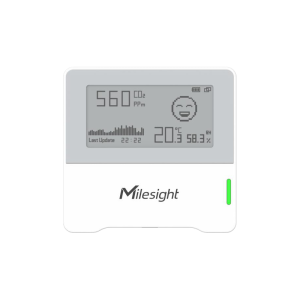 The per-room standardMilesight AM103 / AM103L Indoor Ambience Monitoring Sensor
CO2, temperature and humidity — the sensor most rooms need, at the price that covers every room.
From £127.19 ex VATView →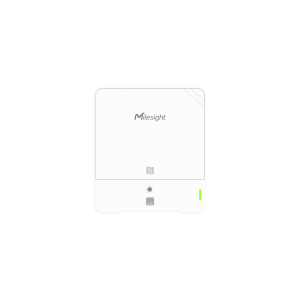 Rooms + occupancyMilesight AM305L Indoor Ambience Monitoring Sensor
Adds light and PIR presence: CO2 with the context of whether anyone is actually in there.
£172.08 ex VATView →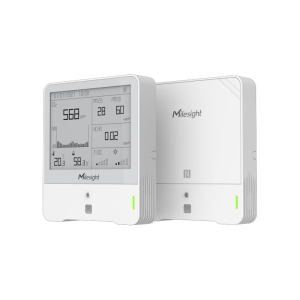 With displayMilesight AM307 / AM308 Indoor Ambience Monitoring Sensor
On-device screen and traffic-light state — occupants self-correct, estates still get the log.
From £224.45 ex VATView →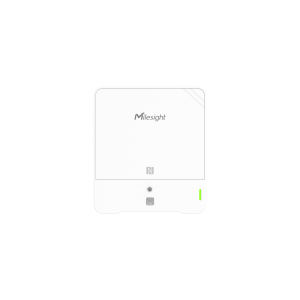 The 8-in-1 flagshipMilesight AM308L Indoor Ambience Monitoring Sensor
CO2 plus TVOC, pressure, light, PIR, temperature and humidity for labs and premium floors.
£239.41 ex VATView →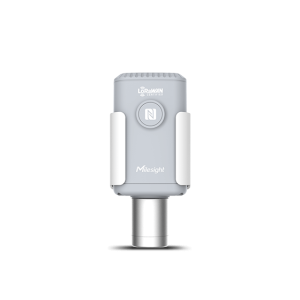 Outdoor & plantMilesight EM500-CO2 CO2 Sensor (4 in 1)
The outdoor-rated 4-in-1 CO2 unit for external baselines, plant rooms and agricultural spaces.
£179.56 ex VATView →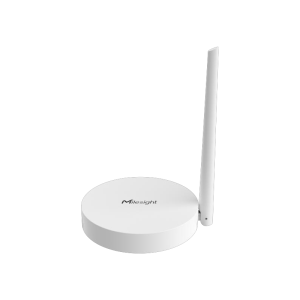 The gatewayMilesight UG63 Mini LoRaWAN® Gateway
Mini LoRaWAN gateway — carries every CO2 point in a typical building.
From £98.76 ex VATView →Compare models and prices
| Product | Best for | Connectivity | Price (ex VAT) |
|---|---|---|---|
| Milesight AM103 / AM103L Indoor Ambience Monitoring Sensor | Every occupied room | LoRaWAN® | From £127.19 |
| Milesight AM305L Indoor Ambience Monitoring Sensor | CO2 + presence context | LoRaWAN® | £172.08 |
| Milesight AM307 / AM308 Indoor Ambience Monitoring Sensor | Visible display spaces | LoRaWAN® | From £224.45 |
| Milesight AM308L Indoor Ambience Monitoring Sensor | Labs, premium floors | LoRaWAN® | £239.41 |
| Milesight EM500-CO2 CO2 Sensor (4 in 1) | Outdoor, plant rooms | LoRaWAN® | £179.56 |
| Milesight UG63 Mini LoRaWAN® Gateway | Site gateway | LoRaWAN® gateway | From £98.76 |
Thresholds, placement and the display question
The bands are settled science: outdoor air sits near 420 ppm, a well-ventilated room under 800, and complaints begin above 1000 — set your warning there and an action alert at 1500 ppm, the figure school guidance (BB101) also anchors on. Mount at breathing height, away from windows, doors and anyone’s direct exhalation path.
The display question divides deployments: units with screens change occupant behaviour immediately (people open windows when the light goes amber) but invite threshold debates; screenless units feed the estates dashboard without the theatre. Most estates mix them — displays in meeting rooms and classrooms, quiet loggers everywhere else. Either way a lorawan co2 sensor per enclosed occupied space, not per floor, is the coverage that finds the actual problem rooms.
- Warning at 1000 ppm, action at 1500 ppm — the defensible defaults
- NDIR with auto-baseline: no annual recalibration visits
- One per enclosed occupied room — CO2 varies wildly between adjacent spaces
- Displays drive behaviour; screenless units drive estates decisions
- Battery power = zero installation trades, minutes per room
- TVOC on the flagship catches fit-out off-gassing CO2 misses
From boxes to dashboards
One UG63 gateway covers a typical building; sensors adhesive-mount and join in minutes. Data lands in dashboards with per-room history and alert rules, and flows onward over APIs, MQTT or webhooks into BMS, CAFM or Teams — whatever your estates workflow already watches.
For the full use-case treatment see CO2 monitors for schools and office air quality monitoring — same hardware, sector-specific thresholds, rollout patterns and compliance context.
Why buy from Indiott
Indiott is the trading name of PSI Technologies Ltd, a UK industrial-communications specialist. Every device on this page is priced in GBP, held in UK stock and dispatched with UK-based support — no grey imports, no marketplace resellers, no guessing which regional frequency band you have been shipped.
Frequently asked questions
How often does an NDIR CO2 sensor need calibrating?
In practice, not on any schedule you manage: these units run automatic baseline correction, using the building’s unoccupied hours to re-anchor against outdoor-level CO2. That holds accuracy for years — the reason NDIR is worth insisting on over cheaper sensing principles.
Battery or mains for CO2 sensing?
Battery, almost always: a lorawan co2 sensor at a sensible reporting interval runs for years, installs anywhere in minutes and moves when the floor plan changes. Mains-powered points only make sense where a display should stay bright continuously.
Can one sensor cover an open-plan floor?
One sensor reads one air volume well — open plan needs a unit per zone (per AHU zone is a good rule), while every enclosed meeting room needs its own because doors make each one a separate experiment. Under-sensing is the most common deployment mistake.
What is TVOC and do I need it?
Total volatile organic compounds — the chemical soup from paints, furniture, cleaning and people. CO2 tracks ventilation against occupancy; TVOC catches contamination that ventilation dilutes slowly (fresh fit-outs, solvent use). Labs, new floors and wellness-certified buildings want both; standard offices are well served by CO2 alone.
Instrument every room that matters
Tell us room counts by type and we will spec the right lorawan co2 sensor mix with volume pricing — normally back within one working day.
Next step
Scope it with an engineer.
Tell us the site, the assets and the constraint. You get a bill of materials and a straight answer within one working day.
- A bill of materials sized to your site
- Priced ex VAT, UK entity, no login wall
Rather talk it through? Call 023 9223 3611
Received. An engineer has it.
You will hear back within one working day with the parts, the prices and the lead time. A confirmation is on its way to your inbox.
If it is urgent, call 023 9223 3611.
More buying guides