BUYING GUIDE · EDUCATION
CO2 Monitors for Schools and Classrooms
Stuffy classrooms are measurably worse places to learn. Networked CO2 sensors show every room's air quality live, flag the ones that need windows opened, and build the evidence estates teams need.
Ventilation you can see, room by room
CO2 monitors for schools turn an invisible problem into a number on a dashboard. CO2 itself is the tracer: high readings mean the room’s ventilation is not keeping up with occupancy, which correlates with drowsiness, poorer concentration and higher airborne-infection risk. The DfE’s Building Bulletin 101 sets the benchmarks for school ventilation performance.
Standalone traffic-light monitors were a good start, but nobody looks at forty separate screens. Networked CO2 monitors for schools report every classroom to one estates dashboard, alert when a room stays high, and log the history that shows whether the ventilation strategy actually works in winter.
The CO2 monitors for schools we recommend
All NDIR-based (the accurate, self-stable sensing technology), all battery or USB powered, all reporting over LoRaWAN so one gateway covers a whole school block. Prices are per classroom point.
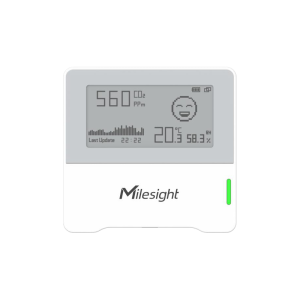 Standard classroomsMilesight AM103 / AM103L Indoor Ambience Monitoring Sensor
CO2, temperature and humidity in one compact unit — the workhorse classroom sensor at a per-room price that scales.
From £127.19 ex VATView →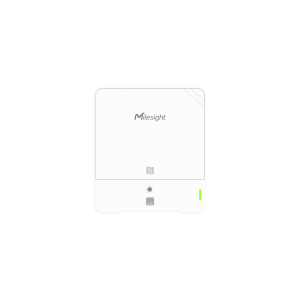 Classrooms + presenceMilesight AM305L Indoor Ambience Monitoring Sensor
Adds light and PIR occupancy: see CO2 in the context of whether the room is actually in use.
£172.08 ex VATView →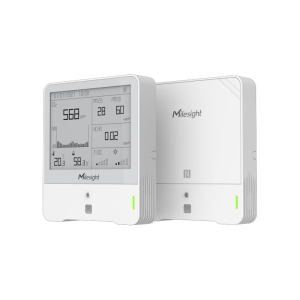 Display for the teacherMilesight AM307 / AM308 Indoor Ambience Monitoring Sensor
On-device screen with traffic-light state so staff can act immediately, while estates still get the data.
From £224.45 ex VATView → Science labs & hallsMilesight AM308L Indoor Ambience Monitoring Sensor
8-in-1 including TVOC and pressure — for labs, DT rooms and spaces where more than CO2 matters.
£239.41 ex VATView →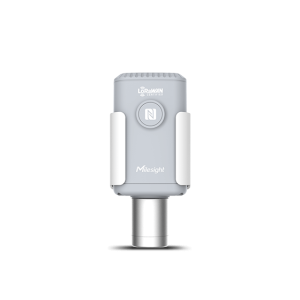 Outdoor baselineMilesight EM500-CO2 CO2 Sensor (4 in 1)
Outdoor-rated CO2 unit for a true outside-air reference and plant-room applications.
£179.56 ex VATView →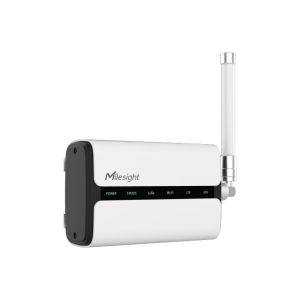 Whole-school gatewayMilesight UG65 Semi-industrial LoRaWAN Gateway
Semi-industrial LoRaWAN gateway — one unit typically covers a teaching block.
From £279.82 ex VATView →Compare classroom options
| Product | Best for | Connectivity | Price (ex VAT) |
|---|---|---|---|
| Milesight AM103 / AM103L Indoor Ambience Monitoring Sensor | Every classroom | LoRaWAN® | From £127.19 |
| Milesight AM305L Indoor Ambience Monitoring Sensor | Rooms + occupancy context | LoRaWAN® | £172.08 |
| Milesight AM307 / AM308 Indoor Ambience Monitoring Sensor | Visible display rooms | LoRaWAN® | From £224.45 |
| Milesight AM308L Indoor Ambience Monitoring Sensor | Labs, halls, DT rooms | LoRaWAN® | £239.41 |
| Milesight EM500-CO2 CO2 Sensor (4 in 1) | Outdoor reference | LoRaWAN® | £179.56 |
| Milesight UG65 Semi-industrial LoRaWAN Gateway | Site gateway | LoRaWAN® gateway | From £279.82 |
Thresholds and how many to buy
BB101’s headline figures for naturally ventilated teaching spaces: daily average CO2 should stay at or below 1500 ppm, with mechanically ventilated spaces held tighter (1000 ppm daily average). In practice, estates teams set a dashboard warning at 1000 ppm and an action alert at 1500 ppm — sustained breaches mean opening windows, adjusting AHU schedules, or flagging the room for remediation.
Buy one sensor per teaching space rather than sampling: the point of the exercise is finding the specific rooms that fail, and CO2 varies wildly between adjacent classrooms. Start with the known-stuffy block if budget is phased. HSE’s ventilation guidance uses the same CO2-as-proxy logic for workplaces, so the same estate dashboard covers staff rooms and offices too.
- ≤1500 ppm daily average — BB101 benchmark for naturally ventilated classrooms
- 800–1000 ppm — the ‘open a window’ warning band most schools configure
- NDIR sensing holds calibration for years — no annual recalibration round
- Battery power means no PAT testing, no sockets, no trailing leads
- History proves which rooms fail in winter when windows stay shut
- Same network extends to legionella, energy and occupancy sensing later
Rolling out across a school
Mount sensors at seated head height away from windows and door draughts, one per teaching room. A single UG65 gateway in a central corridor typically reaches a whole block; large or split sites add a second. No classroom wiring, no network drops — the deployment is an afternoon with adhesive pads.
Data lands in one dashboard for estates, with per-room alerts to the site team. Trusts roll every school into one view. Combine with vape detectors in toilets and energy monitoring in plant rooms on the same gateway — the network is already paid for.
Why buy from Indiott
We are engineers first and a shop second. Buy online in GBP from UK stock, or call us on 023 9223 3611 and we will sanity-check your device list before you spend a penny — the right frequency band (EU868), the right probe, the right gateway for the building.
Frequently asked questions
What CO2 level is acceptable in a classroom?
BB101 benchmarks naturally ventilated classrooms at a daily average of 1500 ppm or below, and mechanically ventilated ones at 1000 ppm. Fresh outdoor air is roughly 420 ppm. Most schools set a warning at 1000 ppm and treat sustained readings above 1500 ppm as an action trigger.
Are these accurate enough to rely on?
Yes — they use NDIR (non-dispersive infrared) sensing, the same measurement principle as reference instruments, with automatic baseline calibration. That is a different class of device from cheap electrochemical ‘air quality’ gadgets.
Why networked monitors instead of standalone traffic-light units?
Standalone units help the teacher in the room but give estates nothing: no history, no comparison, no evidence for remediation budgets. Networked CO2 monitors for schools put every room on one dashboard, so the estate team manages ventilation as a system rather than forty anecdotes.
What does a whole school cost?
A 30-classroom block is roughly thirty AM103 units plus one UG65 gateway, £4,544.32 ex VAT of hardware at the prices on this page, or £4,095.52 with the AM103L, which has no screen. Phased rollouts starting with the worst block are common; ask us for education pricing on volume.
Price up your school in one email
Send us a classroom count (or a block plan) and we will return exact hardware and volume pricing for CO2 monitors for schools — usually within one working day.
Next step
Scope it with an engineer.
Tell us the site, the assets and the constraint. You get a bill of materials and a straight answer within one working day.
- A bill of materials sized to your site
- Priced ex VAT, UK entity, no login wall
Rather talk it through? Call 023 9223 3611
Received. An engineer has it.
You will hear back within one working day with the parts, the prices and the lead time. A confirmation is on its way to your inbox.
If it is urgent, call 023 9223 3611.
More buying guides