LoRaWAN Tilt Sensor: What the Milesight EM320-TILT Detects, and Where ±1° Is Not Enough
TL;DR: The Milesight EM320-TILT is a battery LoRaWAN tilt sensor that measures its angle on three axes from -90° to +90°, to ±1°, and sends an alarm when the angle crosses a limit you set. It suits position and movement jobs: a barrier raised or lowered, a hatch left open, a pole knocked out of vertical, a tree bending towards a line. At ±1° it is not an instrument for precise structural monitoring, and at its default interval it reports state, not vibration.
Last updated: 14 September 2026
On this page
Key takeaways
- The EM320-TILT is a LoRaWAN tilt sensor with a MEMS accelerometer that measures angle on the X, Y and Z axes from -90° to +90°.
- Its datasheet gives ±1° accuracy and 0.01° resolution, in an IP67 housing rated from -30°C to 60°C.
- Milesight supports up to 36 customised trigger alarms on the three axes, and lets you set the installed position as zero.
- Battery life is around 4 years at SF7 and 3 years at SF10 at a 10 minute interval, on two replaceable lithium cells.
- It is listed at £62.85 ex VAT. It detects position and movement, not vibration, and ±1° is too coarse for precise structural monitoring.
What does a tilt sensor measure?
A tilt sensor measures the angle of whatever it is fixed to, relative to gravity. Fix one to a barrier arm, a hatch lid or a lamp column and it reports the angle of that object, so a change in angle tells you the object has moved: raised, opened, knocked or leaning.
The Milesight EM320-TILT does this with a MEMS accelerometer, which senses the direction of gravity on three axes and works out the angle from it. Milesight’s EM320-TILT product page lists the range as -90° to +90° on each axis, with ±1° accuracy and 0.01° resolution.
Because it reports over LoRaWAN, a tilt sensor like this can sit on equipment far from any power or network cabling, on a yard barrier, a roadside pole or a tree beside a railway, and still reach a gateway.

What can the EM320-TILT detect?
The EM320-TILT detects changes in position: something that should be at one angle now being at another. Milesight’s own applications include tree bending, barrier gates and the inclination of construction equipment, and the same principle covers six common jobs.
- Barrier gates and boom arms. Raised or lowered, and whether a barrier has been left up out of hours.
- Hatches, lids and covers. Roof hatches, chute flaps and container lids that should be closed.
- Poles and street furniture. Lighting columns, signs and camera poles pushed out of vertical by a vehicle strike or high wind.
- Trees beside assets. A tree that starts to lean towards a road, a railway or an overhead line.
- Construction equipment. Plant, masts and temporary structures that change angle when they should not.
- Mechanical positions. A damper flap or quarter-turn handle whose position shows open or closed, where the sensor can be fixed to the moving part.
For doors and windows, a magnetic contact is usually simpler and cheaper; our guide to wireless door sensors compares the options.

How do tilt alarms work?
Tilt alarms work by comparing the measured angle with limits you set on each axis, and reporting straight away when a limit is crossed instead of waiting for the next scheduled reading. Milesight describes support for up to 36 customised trigger alarms on the X, Y and Z axes.
The feature that makes this practical is the initial position. According to the EM320-TILT user guide, you can set the sensor’s current position as its starting point, so alarms are based on the change from how it was installed rather than on a perfectly level mounting. A sensor screwed to a slightly crooked pole still alarms correctly when the pole moves further.
Take a car park barrier. Mount the tilt sensor on the arm, set the lowered position as the initial position, and set an alarm for a change of more than, say, 30° on the axis the arm rotates around. Every raise and lower becomes an event, and a barrier left raised overnight shows up in the morning report.

Where is ±1° not enough?
±1° is plenty for telling whether a barrier is up or a hatch is open, and too coarse for measuring small movements in a structure. Precise structural monitoring of walls, retaining structures or bridges looks for changes far smaller than a degree, so it needs instruments built for that job.
The tilt sensor has four other limits worth planning around.
- It reports angle, not vibration. A MEMS tilt sensor reporting at minutes-long intervals will not measure vibration or shock. For rotating machinery, use a vibration sensor; our guide to vibration monitoring explains the difference.
- Mounting decides the reading. The sensor measures its own angle, so a loose bracket or a flexible fixing produces false movement. Fix it rigidly to the part that moves.
- Battery life depends on reporting. Milesight rates it at around 4 years at SF7 and 3 years at SF10 with a 10 minute interval. A longer interval with threshold alarms suits most position jobs.
- It is not a safety device. Use it for monitoring and alerts, not as a safety interlock on cranes, lifting equipment or machinery.

How do you install a tilt sensor?
Install a tilt sensor rigidly on the moving part, set its starting position once it is fixed, and test the alarm by moving the object through its normal range. The EM320-TILT mounts by wall screws or on a pole, and is configured from a phone over NFC.
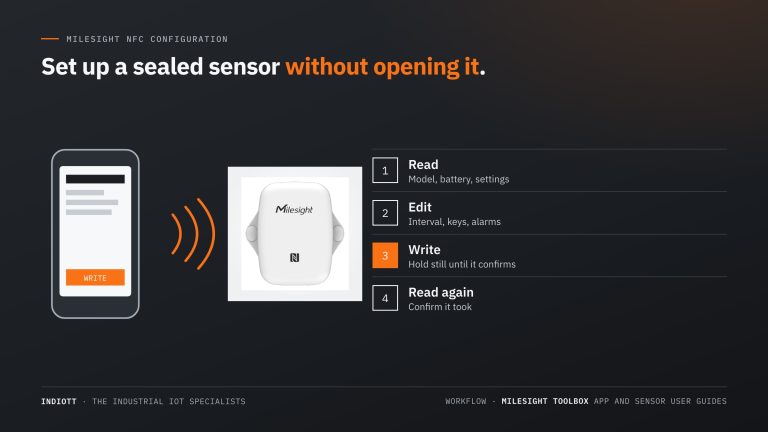
- Configure it first. Set the reporting interval and join settings over NFC before mounting. Our guide to Milesight NFC configuration walks through the app.
- Fix it rigidly. Screw it to the arm, lid or pole, not to a bracket that can flex.
- Set the initial position. With the object in its normal state, save the current angle as the starting point.
- Set the thresholds. Choose the axis that changes and the angle that means something has happened.
- Test through the full range. Raise, open or move the object and confirm the alarm arrives.
How much does the EM320-TILT cost?
The EM320-TILT tilt sensor is listed at £62.85 ex VAT on Indiott, typically dispatched within 14 working days with UK delivery at £14.25 ex VAT per order. It needs a LoRaWAN gateway within range; for outdoor jobs such as barriers and poles, an outdoor gateway on a building or mast usually covers a whole site.
See the EM320-TILT product page for live pricing.
Frequently asked questions
How accurate is the Milesight EM320-TILT?
The datasheet gives ±1° accuracy and 0.01° resolution across -90° to +90° on the X, Y and Z axes. That suits position and movement detection rather than precise structural monitoring.
Can a tilt sensor detect a barrier being raised?
Yes. Fixed to the barrier arm, with the lowered position set as its initial position, the EM320-TILT can alarm when the arm’s angle changes past a threshold you set.
Does the EM320-TILT send an alarm immediately?
Its threshold alarms upload when the angle crosses a limit you set, rather than waiting for the next scheduled report, according to Milesight’s user guide.
How long does the EM320-TILT battery last?
Milesight quotes around 4 years at SF7 and around 3 years at SF10 with a 10 minute reporting interval at 25°C, on two replaceable ER14505 lithium batteries.
Can the EM320-TILT be used outdoors?
Yes. It is rated IP67 and for -30°C to 60°C, and mounts by screws or on a pole.
Know what moved, and when
A tilt sensor turns the angle of a barrier, hatch, pole or tree into an alert the moment it changes. The EM320-TILT does that for a few pounds a point, provided the job is position and movement rather than precision or vibration.
Browse the EM320-TILT on Indiott, or read how position sensors fit into construction plant security. If you are unsure whether tilt or another sensor suits the job, send us a photo and an engineer will reply within one working day.
Next step
Get a priced kit list for your site
Answer three quick questions and tell us where to send it. An engineer replies within one working day with the parts, the prices and the lead time.
Rather talk it through? Call 023 9223 3611
Received. An engineer has it.
You will hear back within one working day with the parts, the prices and the lead time. A confirmation is on its way to your inbox.
If it is urgent, call 023 9223 3611.