Milesight WS558 Lighting Controller: Eight Lighting Circuits Switched and Metered Over LoRaWAN
TL;DR: The Milesight WS558 is a LoRaWAN lighting controller that switches up to eight lighting circuits from a DIN rail or wall-mounted unit, on a schedule, by remote command or from its own buttons. The LN version also measures voltage, current, power and energy, so you can see what each lighting circuit uses. It switches rather than dims, it limits LED and other capacitive loads to 5 A per output with a 16 A total, and it must be installed by a qualified electrician.
Last updated: 14 September 2026
On this page
Key takeaways
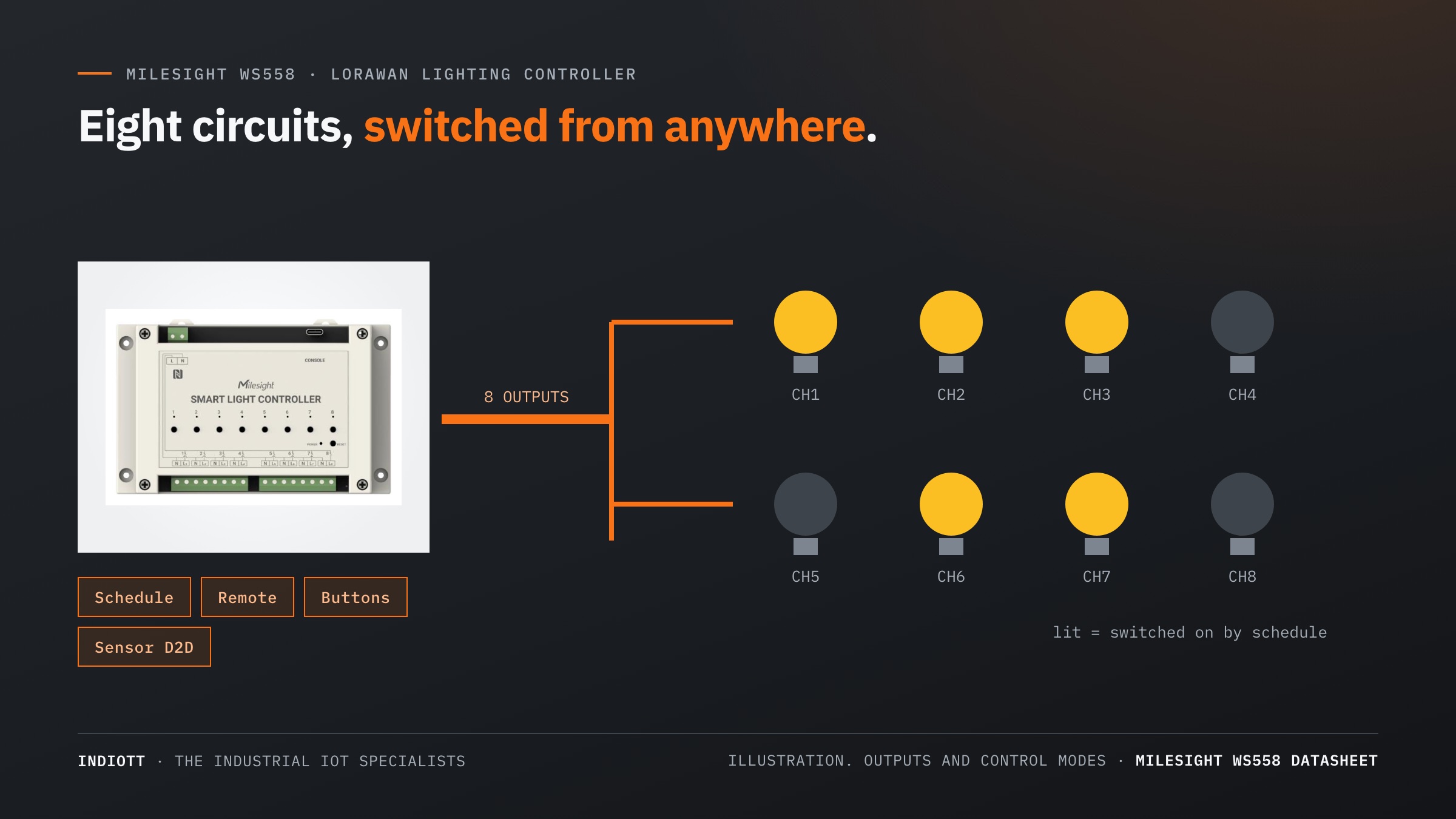
- The WS558 lighting controller switches 8 lighting circuits independently over LoRaWAN, from a schedule, a remote command, its own buttons or a sensor event.
- It comes in two versions: LN, with 8 active outputs and voltage, current, power and energy measurement, and Switch, with 8 passive outputs and no metering.
- On the LN version, each output carries up to 5 A for capacitive and inductive loads such as LED drivers, or 10 A resistive, with a 16 A total.
- It is a Class C device, so switching commands arrive without waiting for a scheduled report, and multicast switches a group of controllers at once.
- It switches but does not dim, it is listed at £104.74 ex VAT, and it belongs in a distribution board or enclosure fitted by an electrician.
What is the Milesight WS558?
The Milesight WS558 is a LoRaWAN lighting controller: a DIN rail or wall-mounted unit with eight switched outputs that turns lighting circuits on and off by schedule, remote command, local button or an event from another Milesight device. It brings lighting under central control without running new control cabling to each circuit.
Milesight’s WS558 product page describes it as a smart light controller for commercial buildings, controlling up to eight lighting circuits with scheduling, remote control and local operation. It is also listed in The Things Network’s device repository, so its payload decoder is ready for that network server.
Because it is mains powered, this lighting controller runs as a Class C device and keeps its receiver open. A command to switch a car park’s lights off reaches it as soon as the gateway can send it, rather than at the controller’s next check-in.
LN or Switch: which WS558 version do you need?
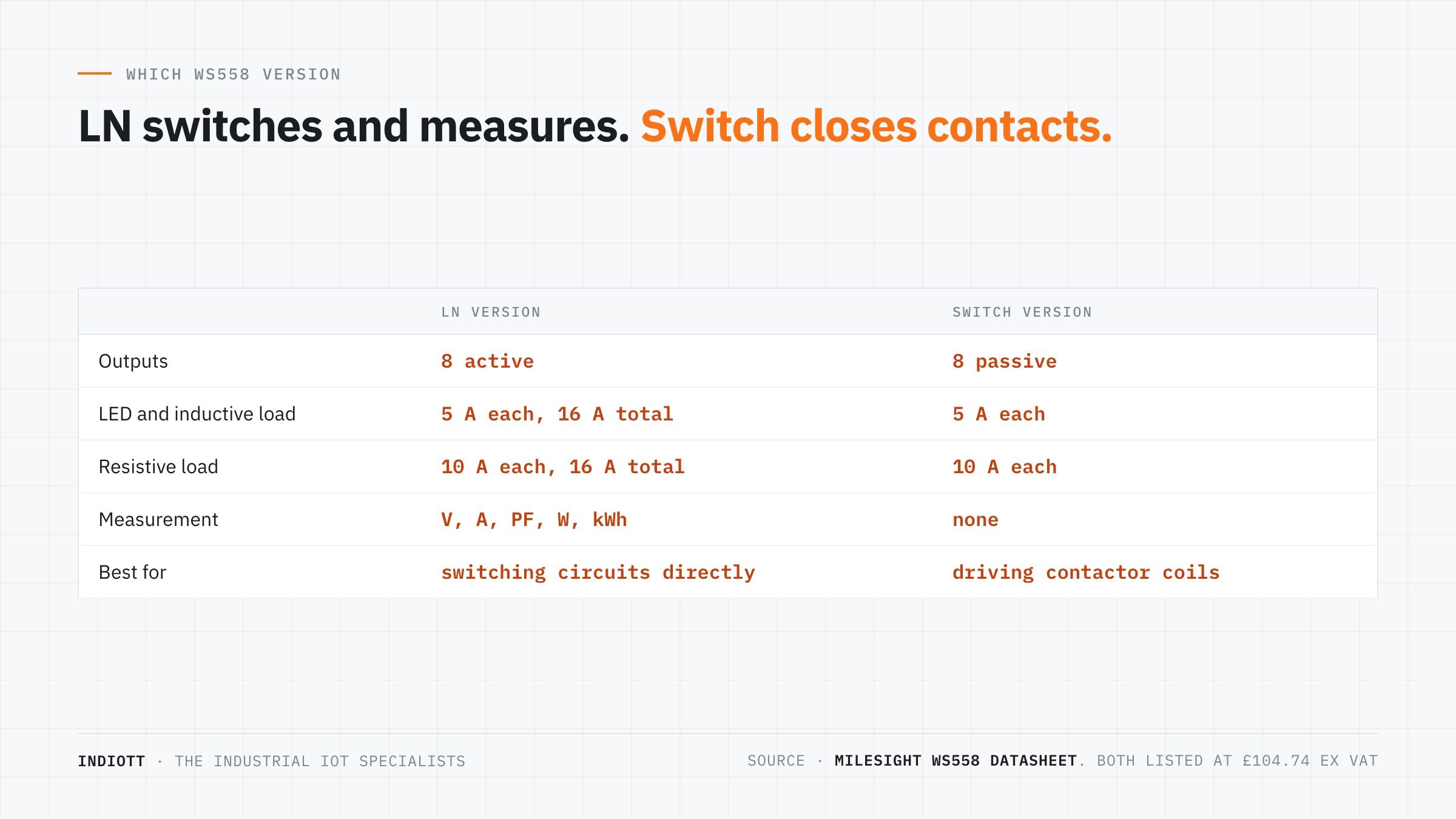
Choose the LN version when the lighting controller should switch mains to the circuits directly and measure what they use. Choose the Switch version when the lighting controller should close volt-free contacts, for example to drive contactor coils or signal another control system. Both are listed at the same price.
| WS558 LN version | WS558 Switch version | |
|---|---|---|
| Outputs | 8 active outputs | 8 passive switches |
| Capacitive and inductive load | 5 A per output, 16 A total | 5 A per switch |
| Resistive load | 10 A per output, 16 A total | 10 A per switch |
| Electrical measurement | Voltage, current, power factor, power, kWh | None |
| Supply | 100 to 240 V AC, 50 or 60 Hz | 100 to 240 V AC, 50 or 60 Hz |
The metering on the LN version is what turns a lighting controller into an energy tool. It shows which circuits burn power when a building should be dark, and proves the saving after a schedule change, without adding separate meters.
Where does a LoRaWAN lighting controller fit?
A LoRaWAN lighting controller fits wherever lighting circuits are left on longer than they need to be and nobody wants to rewire the controls. The radio link means the controller only needs a mains supply and a gateway in range, not a data cable back to a building management system.
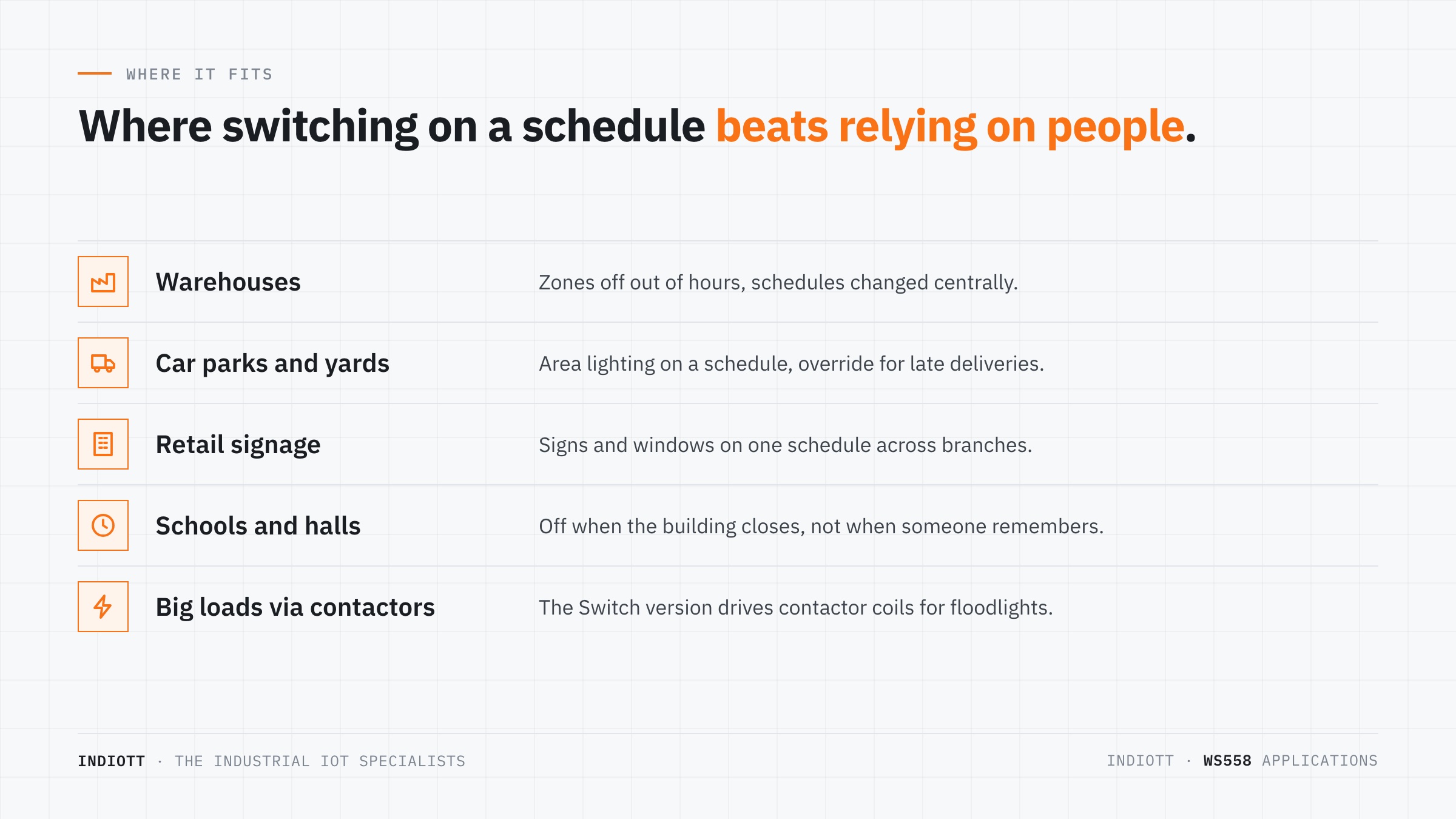
- Warehouses and logistics sheds. Zone lighting switched off out of hours, with the schedule changed centrally when shift patterns change.
- Car parks and yards. Security and area lighting switched by schedule, with remote override for events or late deliveries.
- Retail signage and windows. Sign and window lighting on the same schedule across many branches, sent as a multicast command.
- Schools and community buildings. Halls and corridors switched off when the building closes, rather than when the caretaker remembers.
- Large loads through contactors. The Switch version closes contacts that drive contactor coils, so floodlighting beyond the controller’s own rating can still be scheduled.
The lighting controller also works with Milesight’s own sensors through D2D, their device-to-device mode, so a motion or light sensor can trigger an output directly. Our guide to smart lighting control covers the sensors that pair with it.
What are the WS558’s limits?
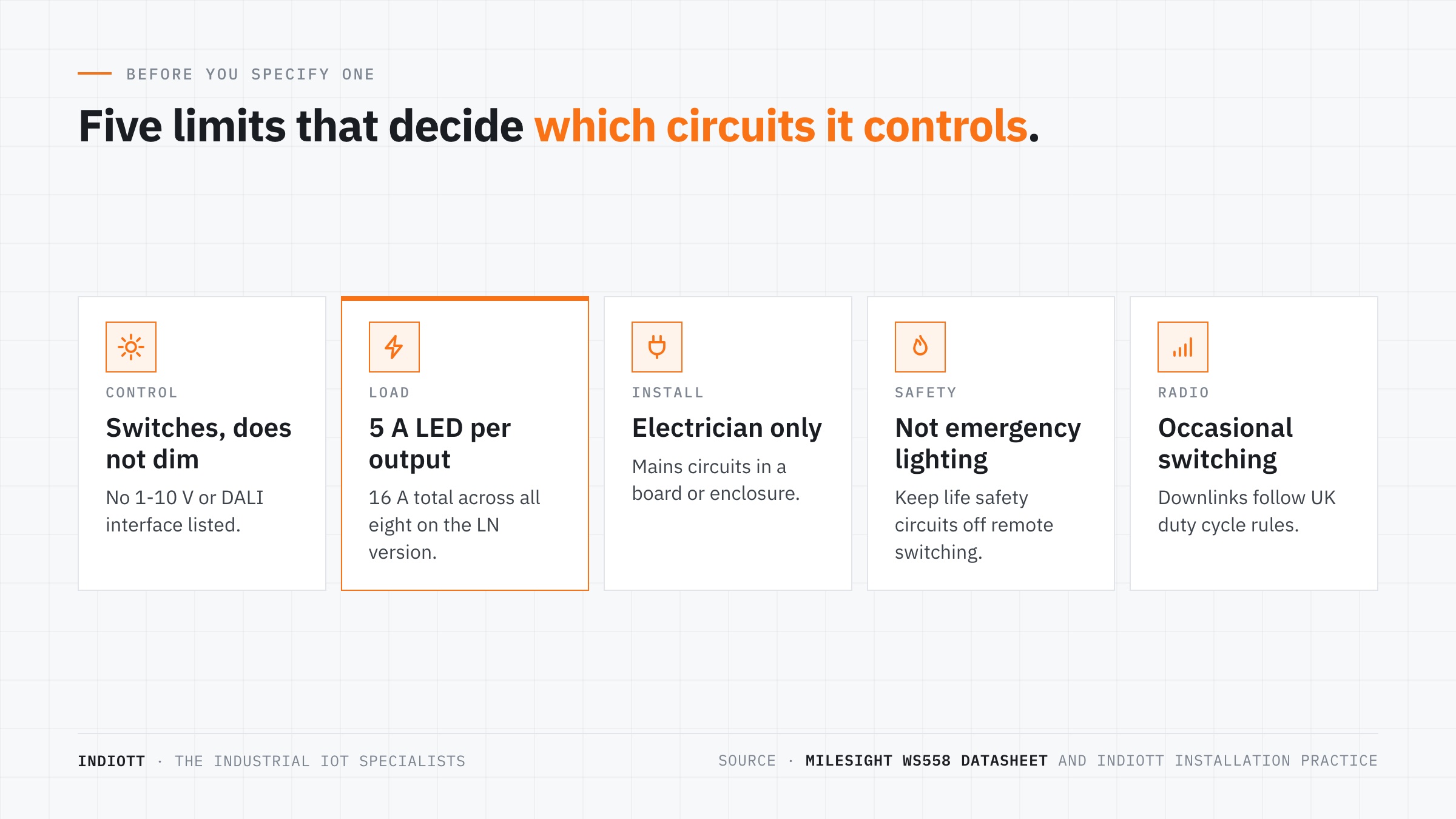
The WS558 lighting controller is a switching device installed in a live distribution board, so its limits are about loads, safety and what switching can achieve. Five matter before you specify one.
- It switches, it does not dim. The datasheet lists switched outputs and no dimming interface, so it cannot run 1-10 V or DALI dimming.
- LED drivers are capacitive loads. They draw a brief surge at switch-on, and the LN version rates capacitive and inductive loads at 5 A per output, with a 16 A total across all eight.
- It needs an electrician. It connects to mains lighting circuits in a board or enclosure, so it is a job for a qualified electrician.
- Some circuits must never be remotely switched. Keep emergency lighting and life safety supplies off any controller that can turn them off on a schedule.
- Commands depend on the radio. LoRaWAN downlinks from the gateway are limited by UK duty cycle rules, so the WS558 suits scheduled and occasional switching, not rapid repeated control. Our post on LoRaWAN duty cycle limits explains why.
The datasheet does not list an ingress protection rating, which is another reason it belongs inside a board or enclosure rather than on an exposed wall. It is rated from -20°C to 60°C and up to 95% humidity, non-condensing.
How does it compare with Milesight’s other switches?
The WS558 is the circuit-level lighting controller in Milesight’s switching range. The WS501 and WS513 are wall switch panels that replace a light switch, and the WS523 is a plug-in smart socket for individual appliances. For whole lighting circuits in a distribution board, the WS558 is the one to use.
All four are compared in our guide to WS501, WS513, WS523 and WS558. If the real job is a single appliance rather than a circuit, see our post on the WS523 smart socket.
How much does a WS558 cost?
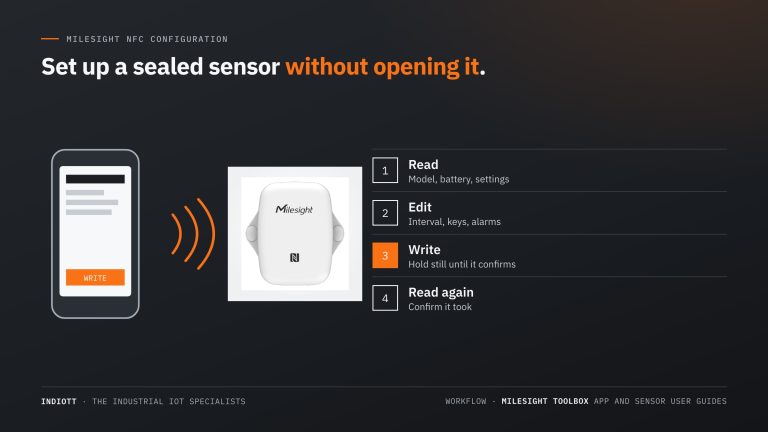
The WS558 lighting controller is listed at £104.74 ex VAT on Indiott in both the LN and Switch versions, typically dispatched within 14 working days with UK delivery at £14.25 ex VAT per order. Like any LoRaWAN lighting controller, it needs a gateway within range, and it is configured over NFC, USB-C or by downlink.
Frequently asked questions
Can the WS558 dim lights?
No. The WS558 has switched outputs only and the datasheet lists no 1-10 V or DALI dimming interface. It turns lighting circuits on and off.
What is the difference between the WS558 LN and Switch versions?
The LN version has 8 active outputs and measures voltage, current, power factor, power and energy. The Switch version has 8 passive switches with no measurement, suited to driving contactors or other control inputs.
How much load can each WS558 output carry?
On the LN version, up to 5 A per output for capacitive and inductive loads such as LED drivers, or 10 A resistive, with a 16 A total. On the Switch version, 5 A or 10 A per switch respectively.
Can the WS558 switch lights on a schedule?
Yes. Milesight describes scheduled control alongside remote commands, local buttons and device-to-device triggers from other Milesight sensors.
Does the WS558 need an electrician to install?
Yes. It connects to mains lighting circuits in a distribution board or enclosure, on DIN rail or by wall mounting, so it should be installed by a qualified electrician.
Control the circuits, not just the switches
The WS558 is the lighting controller for switching whole circuits on a schedule across a building or an estate, with metering on the LN version to prove what it saves. Keep emergency lighting off it, respect the 5 A LED rating, and let an electrician fit it.
See the WS558 on Indiott for live pricing, or send us the lighting layout and an engineer will confirm which version fits, within one working day.
Next step
Get a priced kit list for your site
Answer three quick questions and tell us where to send it. An engineer replies within one working day with the parts, the prices and the lead time.
Rather talk it through? Call 023 9223 3611
Received. An engineer has it.
You will hear back within one working day with the parts, the prices and the lead time. A confirmation is on its way to your inbox.
If it is urgent, call 023 9223 3611.