Which Milesight LoRaWAN Temperature Sensor Do I Need? EM300-TH vs EM320-TH vs TS101 vs TS201
Short answer: Choose the EM300-TH or the EM320-TH when you are measuring the air in a room, store or cold room — the EM320-TH is the more accurate of the two (typically ±0.2°C and ±2% RH) while the EM300-TH reads up to +70°C instead of +60°C and is the cheapest of the four. Choose the TS201 when the sensing point has to sit away from the radio: a 50 mm probe on a detachable 1.5 m cable, rated from -40°C to 125°C. Choose the TS101 only when you need to measure inside a mass rather than the air around it — its 400 mm stainless insertion probe is built to be pushed into a stack or pile, and it reports temperature only, with no humidity.
Which Milesight LoRaWAN temperature sensor do I need?
Choose the EM300-TH if you are monitoring ambient air and want the wider of the two ambient ranges. It measures -30°C to +70°C with humidity across 0% to 100% RH at ±3% typical, and its IP67 flame-retardant housing is rated for the same -30°C to +70°C it measures. It is the cheapest of the four, and it supports Milesight D2D, so it can trigger another Milesight device directly.
Choose the EM320-TH if the job is judged on accuracy. It is typically ±0.2°C between 0°C and 60°C and ±2% RH at 25°C — both tighter than the EM300-TH. The trade is the top of the range, which stops at +60°C. The enclosure is food-grade PC+ABS, it holds 3,000 records for retransmission after an outage, and a magnet-mount version exists.
Choose the TS201 if the thing you need to measure is not somewhere the radio can live. The device body is rated to 55°C, but the probe on the end of the 1.5 m cable reads -40°C to 125°C, so the probe can sit where the electronics could not. The probe unplugs at a 5-pin M12 A-coded connector and comes in a temperature-only DS18B20 version or a CMOSens version that also reports humidity.
Choose the TS101 if you are measuring inside a solid mass. Its probe is a Φ7 × 400 mm 316 stainless steel rod specified for insert installation and for phosphine corrosion resistance, reading -30°C to +70°C at ±0.5°C typical. It adds IK10 impact protection to the IP67 rating. It is the most expensive of the four and it does not measure humidity.
TS101 vs TS201: one is inserted, one is remote
The TS101 is not a long-probe version of the TS201, and the TS201 probe is not an accessory that fits a TS101. On the TS101 the 400 mm rod is part of the unit and the whole assembly is pushed into what it measures. On the TS201 a 50 mm probe hangs on a 1.5 m cable and unplugs at the M12 connector. They also differ in what they report: the TS101 is temperature only, while the TS201 is offered in a version that reports humidity as well.
Watch the range figures when you compare them. The TS201’s headline -40°C to 125°C is the probe measuring range, not an operating rating for the transmitter, which is specified at -30°C to 55°C. The TS101’s -30°C to +70°C applies to the sensor and to its operating environment alike.
Is the EM320-TH simply a newer EM300-TH?
No, and the specifications do not present either as a replacement for the other. The EM320-TH is tighter on both temperature and humidity accuracy and is the smaller unit at 85 × 58 × 18 mm against 88.5 × 85.3 × 27 mm. The EM300-TH covers 10°C more at the top of its range and lists Milesight D2D, which the EM320-TH datasheet does not. Both are IP67, both carry EN12830 approval, and both are quoted at ten years or more of battery life at a 10-minute reporting interval. All four sensors here are the -868M variants and use the EU868 band in the UK, running OTAA or ABP as Class A devices.
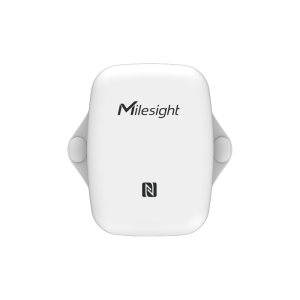
Milesight EM300-TH Temperature and Humidity Sensor
EM300-TH-868M
£38.90 ex VAT (£46.68 inc. VAT)
Temperature measuring range-30°C to +70°C
View the EM300-TH-868M
Milesight EM320-TH Temperature and Humidity Sensor – Standard Version
EM320-TH-868M
£41.90 ex VAT (£50.28 inc. VAT)
View the EM320-TH-868MMilesight TS101 Insertion Temperature Sensor – TS101 (1 Piece)
TS101-868M
£74.82 ex VAT (£89.78 inc. VAT)
View the TS101-868M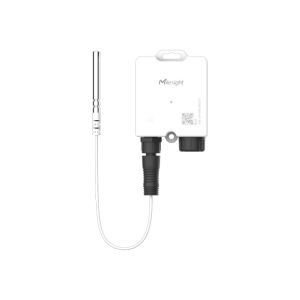
Milesight TS201 Temperature Sensor – TS201-868M (temperature probe)
TS201-868M
£44.89 ex VAT (£53.87 inc. VAT)
View the TS201-868MSpecification comparison
| Specification | EM300-TH-868M | EM320-TH-868M | TS101-868M | TS201-868M |
|---|---|---|---|---|
| Advanced features | Threshold alarm, Milesight D2D controller, data storage (2,800 entries), data retransmission, data retrievability | — | — | — |
| Antenna | Internal antenna | — | — | — |
| Approvals | CE, FCC, ISED, RCM, Telec, ICASA, EN12830; RoHS | — | — | — |
| Battery life | Over 10 years (SF7, EU868 & US915); around 5.8 years (SF10, EU868) at 10 min interval, 25°C | — | — | — |
| Configuration | NFC via mobile app, downlink | — | — | — |
| Dimensions | 88.5 × 85.3 × 27 mm (3.48 × 3.36 × 1.06 in) | — | — | — |
| Frequency | CN470/IN865/RU864/EU868/US915/AU915/KR920/AS923-1&2&3&4 | — | — | — |
| Housing & colour | ABS + PC (flame retardant), white | — | — | — |
| Humidity accuracy | Typ.: ±3% (10% ~ 90% RH @25°C), ±5% (0% ~ 10% RH and 90% ~ 100% RH @25°C) | — | — | — |
| Humidity range | 0% to 100% RH | — | — | — |
| Humidity resolution | 0.5% RH | — | — | — |
| Ingress protection | IP67 | — | — | — |
| Installation | Wall screw mounting, 3M tape mounting, cable-tie mounting | — | — | — |
| Mode | OTAA/ABP Class A | — | — | — |
| Operating temperature | -30°C to +70°C | — | — | — |
| Power supply | 1 × 4000 mAh ER18505 Li-SOCl2 battery (8000 mAh version optional) | — | — | — |
| Relative humidity | 0% to 100% (non-condensing) | — | — | — |
| Sensitivity | -137 dBm @300bps | — | — | — |
| Technology | LoRaWAN®, Milesight D2D | — | — | — |
| Temperature accuracy | Typ.: ±0.6°C (-30°C ~ 0°C), ±0.3°C (0°C ~ 70°C) | — | — | — |
| Temperature range | -30°C to +70°C | — | — | — |
| Temperature resolution | 0.1°C | — | — | — |
| Tx power | 16 dBm (868 MHz)/20 dBm (915 MHz)/19 dBm (470 MHz) | — | — | — |
| Weight | 95.6 g (with 1 battery) | — | — | — |
Specifications taken from the manufacturer datasheets. Rows where the models are identical are dimmed. Prices are ex VAT and read live from the catalogue.
Frequently asked questions
Which of these Milesight sensors measure humidity?
The EM300-TH and EM320-TH both measure humidity across 0% to 100% RH — the EM300-TH at ±3% typical (10-90% RH at 25°C) and the EM320-TH at ±2% typical at 25°C. The TS201 measures humidity only in its CMOSens (TH) probe version, at ±2% typical. The TS101 is a temperature-only sensor and reports no humidity.
What is the highest temperature these sensors can measure?
The TS201 probe is the highest at 125°C, though the transmitter body itself is only rated for operation up to 55°C, so the probe must be the part exposed to the heat. The EM300-TH and TS101 both measure to +70°C, and the EM320-TH to +60°C.
Do these work on UK LoRaWAN networks?
Yes. All four are supplied as -868M variants and their frequency plans include EU868, which is the band used for LoRaWAN in the UK. All four join as OTAA or ABP Class A devices, so they work with any standard LoRaWAN network server.
How are these sensors configured?
All four are configured over NFC using the Milesight mobile app. The EM300-TH and TS201 also accept configuration by LoRaWAN downlink, and the TS201 additionally supports FUOTA firmware updates over the air.
How long do the batteries last?
The EM300-TH is rated at over 10 years on its 4,000 mAh cell at SF7 on EU868, and around 5.8 years at SF10. The EM320-TH is quoted at 10 years or more on two 2,700 mAh cells at a 10-minute interval. The TS101 is up to 10 years at SF7 and around 4.8 years at SF10. The TS201 is the shortest, at roughly 8.2 to 9 years at SF7 depending on probe version. All use replaceable Li-SOCl2 batteries.