Milesight WS202 vs WS203 vs VS370: PIR vs mmWave occupancy sensors
Short answer: The WS202 and WS203 are PIR motion sensors; the VS370 pairs PIR with 24 GHz millimetre-wave radar and is the only one of the three whose datasheet quotes a slight-movement detection distance – 4.8 m, alongside 7.5 m for ordinary movement. That single line is the whole PIR vs mmWave decision. The WS202 adds a bright/dark light status; the WS203 adds temperature and humidity.
Which of these three should go in my room?
Choose the WS202 if the room empties and refills and you are driving lights. It has the longest PIR reach of the three, up to 8 m across 120 degrees horizontal by 100 degrees vertical, and reports a bright/dark status against a threshold you set anywhere in the 1-60,000 lux window. It is the cheapest and the smallest, at 50 x 50 x 23.8 mm.
Choose the WS203 if “is anyone in there” is only half the question and you also need the conditions. Same 120 x 100 degree PIR pattern but 6 m rather than 8 m, plus temperature (-20 to 60 degrees C, typically +/-0.2 degrees C over 0-60) and humidity (0-100% RH, typically +/-2%). It is the only one of the three that stores readings on board, 1,000 entries with data retransmission, for rooms at the edge of gateway coverage.
Choose the VS370 if people in the room sit still: desks, meeting rooms, waiting areas. Its 24 GHz radar covers 150 degrees and is specified to 7.5 m for movement and 4.8 m for slight movement, with a quoted recognition rate up to 99%, and a PIR element (110 degrees, within 7 m) alongside it. It costs roughly twice the WS202, and its operating window is 0-30 degrees C.
PIR vs mmWave: does a PIR sensor see someone sitting still?
A PIR element responds to infrared moving across its field, so it is a motion detector being used as an occupancy detector. Milesight’s own figures show where the line falls: the WS202 and WS203 each publish one detection distance, 8 m and 6 m, and no figure at all for slight movement, while the VS370 publishes two, because the radar covers the second case. If your space empties and refills – corridors, WCs, stores, classrooms – PIR is enough. If people sit and read, type or listen, a PIR-only sensor will keep declaring the room empty.
Two things the VS370 is not. It is not a camera and not a people counter: the radar returns presence and a bright/dim light status, never an image and never a headcount. And neither the WS202 nor the VS370 is a light meter – both report a bright/dark state against a threshold, not a lux reading you can log.
Where can each one physically go?
All three are rated IP30, so all three are dry indoor devices; none is specified for outdoor or washdown use. The VS370 narrows further, rated 0-30 degrees C against -20 to 60 degrees C for the WS202 and WS203, so it belongs in heated occupied space rather than a loading bay. On the network, the PIR vs mmWave choice changes nothing: EU868 for the UK, LoRaWAN Class A with OTAA or ABP, NFC setup from a phone, and Milesight D2D on all three to trigger another device directly.
The battery figures are not like for like – around 4.2 years for the WS202, 10.7 for the WS203 and 6.7 for the VS370, all at SF7 on EU868, but each is quoted at a different daily trigger count (30, 64 and 50). Read them as three separate claims, not a ranking.

Milesight WS202 PIR & Light Sensor
WS202-868M
£32.92 ex VAT (£39.50 inc. VAT)
PIR detection distanceMaximum 8 m, over a 120° horizontal / 100° vertical detection area
View the WS202-868M
Milesight WS203 Motion & TH Sensor
WS203-868M
£38.90 ex VAT (£46.68 inc. VAT)
PIR Detection DistanceMaximum 6 m (120° horizontal, 100° vertical)
View the WS203-868M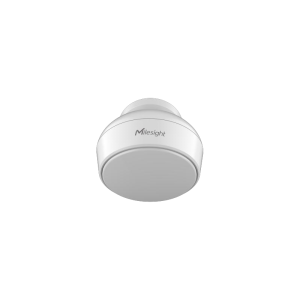
Milesight VS370 Radar Human Presence Sensor
VS370-868M
£74.82 ex VAT (£89.78 inc. VAT)
Radar detection distanceMovement 7.5 m, slight movement 4.8 m, across a 150° detection angle
View the VS370-868MSpecification comparison
| Specification | WS202-868M | WS203-868M | VS370-868M |
|---|---|---|---|
| Advanced features | Milesight D2D controller, threshold alarm | Milesight D2D controller, data storage (1,000 entries), data retransmission | Milesight D2D controller, hibernate time setting, sensitivity setting, FUOTA |
| Approvals | CE, FCC, RoHS, LoRaWAN® Certified; safety EN62368-1 | CE, FCC; RoHS | CE, FCC |
| Configuration | Mobile app via NFC | Mobile app via NFC, or downlink | Mobile app via NFC or Bluetooth, Downlink |
| Frequency | CN470/IN865/RU864/EU868/US915/AU915/KR920/AS923 | CN470/IN865/EU868/RU864/US915/AU915/KR920/AS923-1&2&3&4 | CN470/IN865/EU868/RU864/US915/AU915/KR920/AS923-1&2&3&4 |
| Installation | Flat surfaces with screws or 3M tape | 3M tape mounting, wall screw mounting | Wall mounting via magnetic bracket (additional 30° deflection angle) |
| Operating temperature | -20°C ~ 60°C, 0-90% RH non-condensing | -20°C to +60°C | 0°C ~ 30°C, 0-95% RH non-condensing |
| Power supply | 1 × 1650 mAh ER14335 Li-SOCl2 battery | 1 × 4000 mAh ER18505 Li-SOCl2 battery | 2 × 2700 mAh ER14505 Li-SOCl2 batteries |
| Battery life | Around 4.2 years (SF7, EU868); around 2.4 years (SF10, EU868) at 30-min interval plus 30 triggers per day, 25°C | — | Around 6.7 years (SF7, EU868 & US915); around 5.3 years (SF10, EU868) at 50 triggers per day, 25°C |
| Dimensions | 50 × 50 × 23.8 mm; lens Ф17.2 mm | 73 × 73 × 26 mm (2.87 × 2.87 × 1.02 in), without PIR cover | — |
| Light status | Bright/Dark (1-60000 lux set as bright or dark by custom threshold) | — | Bright/Dim |
| LoRaWAN mode | OTAA/ABP Class A | — | OTAA/ABP Class A |
| PIR detection area | 120° horizontal, 100° vertical | 120° horizontal, 100° vertical | — |
| PIR detection distance | Maximum 8 m | Maximum 6 m | — |
| Protocol | LoRaWAN®, Milesight D2D | — | LoRaWAN®, Milesight D2D |
| Technology | — | LoRaWAN®, Milesight D2D | Millimetre wave radar & PIR |
| Tx power / sensitivity | 16 dBm (868 MHz) / 22 dBm (915 MHz) / 19 dBm (470 MHz); -137 dBm @300bps | — | 16 dBm (868 MHz) / 20 dBm (915 MHz) / 19 dBm (470 MHz); -137 dBm @300bps |
| Weight | 40 g (battery included) | 89.6 g (battery included) | — |
| Antenna | — | Internal antenna | — |
| Battery Life (30 min report + 64 triggers/day, LED disabled, 25°C) | — | Around 10.7 years (SF7, EU868); around 5.4 years (SF10, EU868) | — |
| Colour & Material | — | White + Grey, PC + ABS (flame retardant, UL94 V0) | — |
| Dimensions & weight | — | — | Ф70 × 48.5 mm; body 89.6 g, magnetic bracket 38.2 g |
| Humidity Accuracy | — | Typ. ±2% RH (25°C) | — |
| Humidity Range | — | 0% ~ 100% RH | — |
| Humidity Resolution | — | 0.5% RH | — |
| Material & colour | Anti-flaming polycarbonate, white | — | — |
| Mode | — | OTAA/ABP Class A | — |
| PIR detection area / distance | — | — | 110°; within 7 m |
| Radar Tx power | — | — | 5 dBm |
| Radar detection angle | — | — | 150° |
| Radar detection distance | — | — | Movement 7.5 m; slight movement 4.8 m |
| Radar frequency | — | — | 24 GHz |
| Recognition rate | — | — | Up to 99% |
| Relative Humidity | — | 0 to 95% (Non-condensing) | — |
| Sensitivity | — | -137 dBm | — |
| Temperature Accuracy | — | Typ. ±0.3°C (-20°C ~ 0°C), ±0.2°C (0°C ~ 60°C) | — |
| Temperature Range | — | -20°C ~ 60°C | — |
| Temperature Resolution | — | 0.1°C | — |
| Tx Power | — | 16 dBm (868 MHz)/20 dBm (915 MHz)/19 dBm (470 MHz) | — |
| Ingress protection | IP30 | IP30 | IP30 |
Specifications taken from the manufacturer datasheets. Rows where the models are identical are dimmed. Prices are ex VAT and read live from the catalogue.
Frequently asked questions
Does a PIR sensor detect someone sitting still?
Not reliably. A PIR element responds to infrared moving across its field. Milesight quotes a single detection distance for the WS202 (maximum 8 m) and the WS203 (maximum 6 m) with no slight-movement figure at all. Only the VS370, which adds 24 GHz radar to its PIR, publishes one: 4.8 m for slight movement against 7.5 m for movement.
What is the difference between the Milesight WS202 and WS203?
The second sensor and the reach. Both use the same 120 degree horizontal by 100 degree vertical PIR pattern, but the WS202 reaches up to 8 m and reports a bright/dark light status against a threshold set anywhere from 1 to 60,000 lux. The WS203 reaches 6 m and reports temperature (-20 to 60 degrees C, typically +/-0.2 degrees C from 0-60) and humidity (0-100% RH, typically +/-2%), and it stores 1,000 entries on board with data retransmission.
How far does the Milesight VS370 detect?
The 24 GHz radar is specified to 7.5 m for movement and 4.8 m for slight movement across a 150 degree detection angle, with a separate PIR element covering 110 degrees within 7 m. Recognition rate is quoted up to 99%.
Can the WS202, WS203 or VS370 go outdoors or in a plant room?
No. All three are rated IP30, so all three are dry indoor devices with no outdoor or washdown rating. The VS370 is limited further by its 0-30 degrees C operating range, which rules out unheated space; the WS202 and WS203 are rated -20 to 60 degrees C, but IP30 still means indoors.
Do these sensors work on UK LoRaWAN networks?
Yes. The 868M variants operate on EU868, the band UK LoRaWAN networks use, in LoRaWAN Class A with OTAA or ABP joining. All three are configured from a phone over NFC, and all three can act as Milesight D2D controllers to trigger another Milesight device directly.