Milesight UG56 vs UG65: the indoor industrial gateway question
Short answer: The radios are effectively the same, but the UG56 costs less, so this is a decision about physical form and budget. Both run the SX1302 with 8 channels, around 2000 devices at a 10 minute uplink interval, -140 dBm sensitivity and 27 dBm maximum transmit power. The UG56 is a 186 g metal box for a cabinet or a DIN rail. The UG65 is an IP65 unit for a wall, a pole or somewhere damp, with gigabit Ethernet.
The UG56 costs less, and 4G widens the gap
Both are sold in two variants: base, and cellular with an external antenna. At base the UG56 is £173.58 ex VAT and the UG65 is £279.82, so the weather-resistant UG65 costs £106.24 more than the indoor UG56.
Adding 4G costs £40.40 on the UG56 and £58.35 on the UG65, which makes a cellular UG56 £124.19 cheaper than a cellular UG65 (£213.98 against £338.17). What the UG65 buys for the difference is the IP65 enclosure, gigabit Ethernet and wider power options. Live prices for every variant are in the table below.
Which one do I need?
Choose the UG56 when space or mounting decides it. At 110 x 75 x 24 mm and 186 g it fits inside an existing control cabinet, and it is the only one of the two that lists DIN rail mounting, on new hardware revisions. It draws typically 1.8 W, powered by 802.3af PoE or simply 5 V over USB Type-C. It is IP30 and rated -20°C to +60°C, so it needs a dry, temperate location. It also has an external SMA antenna connector, which lets you put the antenna somewhere better than the cabinet the gateway is hidden in.
Choose the UG65 for almost everything else. IP65 and -40°C to +70°C means eaves, a plant room, a loading bay or an unheated store are all fine. Its Ethernet port is 10/100/1000 against the UG56’s 10/100, it has two internal LoRa antennas plus an N-female external connector, and it will take 9-24 V DC, 802.3af PoE or USB-C. It is the more flexible unit on power, on mounting and on environment.
Where the UG56 is genuinely ahead
Two places. It lists a Micro SD slot for extendable storage, which the UG65 specification does not, and it lists Listen Before Talk support on the bands where it applies. It is also the lower-power unit at 1.8 W typical against 2.9 W, which matters if you are running from a small UPS or a solar supply.
Everything else is the same, and that is a lot
Both carry an embedded network server with the Milesight codec library, multicast and FUOTA, and both integrate over MQTT, HTTP, BACnet/IP, BACnet/SC, Modbus TCP and Modbus RTU over TCP. Both list the same LNS compatibility across The Things Stack, ChirpStack, Actility, AWS and the Milesight platforms, and both carry the same VPN set including WireGuard. Neither is limited by its network software, so choose on the enclosure, the mounting and the Ethernet speed.
If the gateway is going fully outdoors on a pole with no cover at all, neither of these is the answer and you want the IP67 UG67, or the SG50 if there is no mains supply either.
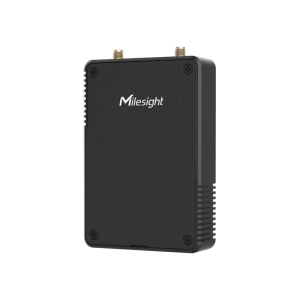
Milesight UG56 Industrial LoRaWAN Gateway
UG56
Price range: £173.58 through £213.98 ex VAT (£208.30 – £256.78 inc. VAT)
LoRaWAN channel count and device capacity8 half-duplex channels (SX1302), around 2000 Class A/B/C devices at a 10-minute uplink interval
View the UG56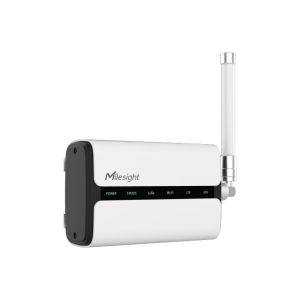
Milesight UG65 Semi-industrial LoRaWAN Gateway
UG65-868M
Price range: £279.82 through £338.17 ex VAT (£335.78 – £405.80 inc. VAT)
LoRa channels and device capacity8 half/full-duplex channels, around 2000 Class A/B/C devices (10 min uplink interval)
View the UG65-868MSpecification comparison
| Specification | UG56 | UG65-868M |
|---|---|---|
| Approvals | CE, CE (RED), RCM, FCC, ISED; RoHS | CE, CE (RED), Telec, JATE, RCM; RoHS |
| Cellular (optional) | 4G LTE, Class 3 (23 dBm ± 2 dB), 1 × Mini SIM (2FF) | 4G LTE, 1 × mini SIM (2FF), internal antenna |
| Dimensions / weight | 110 × 75 × 24 mm; 186 g | 180 × 110 × 55.5 mm; 548 g |
| Ingress protection | IP30 | IP65 |
| Installation | Desktop, wall mounting, DIN rail mounting (new hardware only) | Desktop, wall or pole mounting |
| Operating temperature | -20°C to +60°C | -40°C to +70°C (reduced cellular performance above 60°C) |
| Power consumption | Typical 1.8 W, max 6.9 W | Typical 2.9 W, max 4.2 W |
| Power input | 802.3af PoE, or 5 V / 2 A by Type-C port | DC 9-24 V via power connector, 802.3af PoE, or 5 V/1 A USB Type-C |
| Wi-Fi | IEEE 802.11 b/g/n, 2.4 GHz, internal antenna, AP or client mode | IEEE 802.11 b/g/n 2.4 GHz, AP or client mode |
| Antenna connector | 1 × 50 Ω SMA (centre pin SMA female) | — |
| CPU / memory | Quad-core 1.3 GHz 64-bit ARM Cortex-A35; 512 MB DDR3 RAM; 8 GB eMMC | — |
| CPU / memory / flash | — | Quad-core 1.5 GHz 64-bit ARM Cortex-A53; 512 MB DDR4 RAM; 8 GB eMMC |
| Coverage | Line of sight up to 15 km; about 2 km in urbanized environment | — |
| Ethernet | 1 × RJ45 WAN port (PoE PD supported), 10/100 Base-T, 1.5 kV RMS isolation | — |
| Ethernet port | — | 1 × RJ45 WAN (PoE PD supported), 10/100/1000 Base-T, auto-sensing |
| Extendable storage | 1 × Micro SD slot (internal) | — |
| Housing | Metal, black | — |
| LNS compatibility | The Things Stack, ChirpStack, Actility, AWS, DeviceHub LNS, Milesight Development Platform LNS, Milesight IoT Cloud | — |
| Listen Before Talk | Supported (not on AU915 or US915) | — |
| LoRa antennas | — | 2 × internal antennas + 1 × 50 Ω N-Female external connector |
| LoRa channels | — | 8 (half/full-duplex), SX1302 chip |
| LoRaWAN channels | 8 (half-duplex), SX1302 chip | — |
| Network server | Embedded, with Milesight codec library and custom codec setup; multicast and FUOTA supported | — |
| Relative humidity | 0% to 95% (non-condensing) at 25°C | — |
| Sensitivity | -140 dBm @292bps | — |
| Sensitivity / Tx power | — | -140 dBm @292bps; 27 dBm max |
| Tx power | 27 dBm max | — |
| VPN | OpenVPN, IPsec, PPTP, L2TP, GRE, DMVPN, WireGuard | — |
| VPN tunnels | — | OpenVPN/IPsec/PPTP/L2TP/GRE/DMVPN/WireGuard |
| Frequency band | CN470/IN865/EU868/RU864/US915/AU915/KR920/AS923-1&2&3&4 | CN470/IN865/EU868/RU864/US915/AU915/KR920/AS923-1&2&3&4 |
| Integration | MQTT(s), HTTP(s), BACnet/IP, BACnet/SC, Modbus TCP, Modbus RTU over TCP | MQTT(s), HTTP(s), BACnet/IP, BACnet/SC, Modbus TCP, Modbus RTU over TCP |
| LoRaWAN protocol | V1.0 Class A/B/C and V1.0.2 Class A/B/C | V1.0 Class A/B/C and V1.0.2 Class A/B/C |
| Supported devices | Around 2000 Class A/B/C devices (10 min uplink interval) | Around 2000 Class A/B/C devices (10 min uplink interval) |
Specifications taken from the manufacturer datasheets. Rows where the models are identical are dimmed. Prices are ex VAT and read live from the catalogue.
Frequently asked questions
Is the UG65 more expensive than the UG56?
Yes. The UG65 is 279.82 pounds ex VAT against 173.58 pounds for the UG56, a difference of 106.24 pounds. With 4G and an external antenna the UG65 is 338.17 pounds and the UG56 is 213.98 pounds, a difference of 124.19 pounds. For that the UG65 adds an IP65 enclosure, gigabit Ethernet and wider power options. Check the live variant prices in the comparison table.
Can the UG56 be DIN rail mounted?
Yes, on new hardware revisions. The UG56 datasheet lists desktop, wall and DIN rail mounting, noting DIN rail applies to new hardware only. The UG65 lists desktop, wall and pole mounting but not DIN rail, so for a control cabinet the UG56 is the natural fit.
Which has the better radio?
Neither, in any way that matters. Both use the SX1302 with 8 channels, quote -140 dBm sensitivity at 292 bps and 27 dBm maximum transmit power, support LoRaWAN V1.0 and V1.0.2 Class A/B/C, and are rated for around 2000 devices at a 10 minute uplink interval. The UG56 additionally lists Listen Before Talk support on the bands where it applies.
Can either be mounted outdoors?
The UG65 can go under cover, such as eaves, a canopy or a loading bay: it is IP65 and rated -40 degC to +70 degC. The UG56 is IP30 and -20 degC to +60 degC, so it must be indoors or inside a suitable enclosure. For fully exposed outdoor mounting neither is correct and you want the IP67 UG67, or the solar SG50 where there is no mains.
Do both work with The Things Stack and ChirpStack?
Yes. Both list compatibility with The Things Stack, ChirpStack, Actility, AWS, DeviceHub LNS, the Milesight Development Platform LNS and Milesight IoT Cloud, and both carry an embedded network server with the Milesight codec library, multicast and FUOTA if you would rather not run an external LNS at all.