UR35 vs UR41 vs UR75: Which Milesight Industrial Cellular Router Do I Need?
Short answer: Pick the Milesight UR41 industrial cellular router when a single device needs a 4G link inside a small enclosure — one LAN port, one switchable RS232/RS485 port, GNSS as standard, and it is the cheapest of the three. Pick the UR35 when a whole cabinet has to go online: five Ethernet ports, dual-SIM carrier failover, 2.4 GHz Wi-Fi, and RS232 plus RS485 running together. Pick the UR75 only if you genuinely need 5G — it is the only one of the three with 5G NR and Gigabit Ethernet, and it is the most expensive.
Which Milesight industrial cellular router do I need?
Choose the UR41 if you are putting one PLC, meter, RTU or vending controller online and space is tight. It is 70 x 55 x 22 mm and 103 g, powered from 5-24 VDC or 5 V USB Type-C, and it gives you exactly one 10/100 LAN port and one serial port that is software-switchable between RS232 and RS485. GNSS (GPS/GLONASS/Beidou/Galileo/QZSS, 2.5 m CEP) is on the standard specification, so it also fits vehicles and mobile skids.
Choose the UR35 if a site cabinet has several things that all need the same 4G connection. Five RJ45 ports (1 WAN + 4 LAN), two Mini-SIM slots for automatic carrier failover, 2.4 GHz Wi-Fi in AP or client mode for up to 15 connections, RS232 and RS485 available at the same time, a Micro SD slot, and an optional PoE variant that powers four 802.3af/at devices at up to 30 W each (60 W total, 48 V input required). It is rated -40°C to +70°C.
Choose the UR75 if the traffic itself justifies 5G. It runs 5G NR standalone and non-standalone on Sub-6 bands with 2CC carrier aggregation for up to 4.67 Gbps download, and backs that with five Gigabit ports, dual-band Wi-Fi 6 (600 Mbps at 2.4 GHz, 1200 Mbps at 5 GHz), a quad-core Cortex-A55 at 2 GHz and 1 GB of RAM. Think camera backhaul or a temporary site standing in for a fixed line.
Do I actually need 5G, or is the UR35 enough?
The UR75 is not a UR35 with a faster modem. The UR35 is LTE Cat 4 — a maximum of 150 Mbps down and 50 Mbps up — and its five Ethernet ports are 10/100, so anything wired to it is capped at 100 Mbps whatever the cellular link is doing. The UR75 changes the whole platform: Gigabit ports, Wi-Fi 6, and 1 GB of RAM and flash against the UR35’s 128 MB. If your traffic is Modbus polling, telemetry, alarms or SCADA, Cat 4 is already far more headroom than that needs.
Check the VPN list before assuming the 5G unit is a straight upgrade. The UR35 and UR41 specifications list OpenVPN, IPsec, GRE, L2TP, PPTP, DMVPN, WireGuard and ZeroTier; the UR75 specification lists OpenVPN, IPsec, L2TP client and PPTP client. If your remote-access design depends on WireGuard or ZeroTier, that matters more than the band.
What does the UR41 give up against the UR35?
Less than the size difference suggests on the radio side, and more than you might expect everywhere else. Both use LTE Cat 4 on the same 528 MHz Cortex-A7 with 128 MB of RAM and flash, so the cellular link is not the difference. What the UR41 does not have is a second SIM slot (one Nano SIM, so no dual-SIM failover — it offers multi-APN instead), a Wi-Fi radio anywhere in its published specification, more than one LAN port, simultaneous RS232 and RS485, PoE, or Micro SD. It is also rated -40°C to +60°C rather than +70°C. The UR41 is a compact wired-to-cellular gateway, not a 4G Wi-Fi hotspot.
All three are IP30 metal-housed and mount on DIN rail, wall or desktop, so enclosure choice does not separate them.
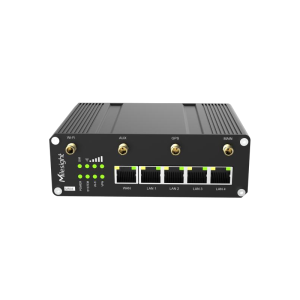
Milesight UR35 Industrial Cellular Router
UR35
Price range: £149.63 through £202.01 ex VAT (£179.56 – £242.41 inc. VAT)
Cellular network and peak throughput4G LTE Cat 4 — maximum 150 Mbps download, 50 Mbps upload
View the UR35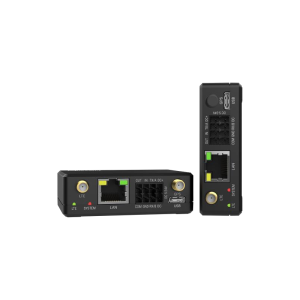
Milesight UR41 Mini Cellular Router
UR41
Price range: £86.04 through £115.97 ex VAT (£103.25 – £139.16 inc. VAT)
Cellular network4G LTE (CAT 4)/WCDMA/GSM (with GNSS and multi-APN)
View the UR41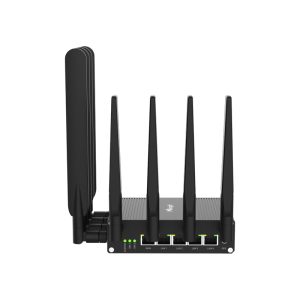
Milesight UR75 5G Cellular Router
UR75
Price range: £460.12 through £471.35 ex VAT (£552.14 – £565.62 inc. VAT)
Cellular network and peak download speed5G NR SA & NSA (Sub-6) with 2CC carrier aggregation, up to 4.67 Gbps download
View the UR75Specification comparison
| Specification | UR35 | UR41 | UR75 |
|---|---|---|---|
| Approvals | CE, CE (RED), FCC, RCM, JATE, Telec; EN62368-1; RoHS | CE, CE (RED), FCC; RoHS | CE, RCM; RoHS |
| Cellular network | 4G LTE (CAT 4) / WCDMA / GSM (differ as regions) | 4G LTE (CAT 4)/WCDMA/GSM | 5G NR SA & NSA / 4G LTE / WCDMA |
| Ethernet | 5 × RJ45 10/100 Mbps (1 × WAN + 4 × LAN), 1.5 kV RMS isolation | 1 × RJ45 10/100 Mbps LAN port, full or half duplex (auto-sensing), 1.5 kV RMS isolation | 5 × 10/100/1000 Mbps (1 × WAN + 4 × LAN) |
| Installation | Desktop, wall screw mounting, DIN rail mounting | Desktop, wall mounting, DIN rail mounting | Desktop, wall or DIN rail mounting |
| Operating temperature | -40°C to +70°C (reduced cellular performance above 60°C) | -40°C to +60°C (-40°F to +140°F) | -40°C to +70°C |
| Power consumption | Typical 3.9 W, max 4.6 W (non-PoE mode) | Standby 6.3 mA@12V; idle 78 mA@12V; data link 226 mA@12V | Without Wi-Fi: typical 2.8 W, max 5.5 W; with Wi-Fi: typical 7 W, max 13.7 W |
| Power input | 9-48 VDC (48 V needed for PoE) | 5-24 VDC by 2-pin 3.5 mm terminal block, or 5 V/1 A by USB Type-C | 9-48 VDC by power connector (48 V needed for PoE); or 5 V / 3 A by Type-C |
| Relative humidity | 0% to 95% (non-condensing) at 25°C | 0% to 95% (non-condensing) | 0% to 95% (non-condensing) at 25°C |
| VPN | OpenVPN, IPsec, GRE, L2TP, PPTP, DMVPN, WireGuard, ZeroTier | OpenVPN, IPsec, GRE, L2TP, PPTP, DMVPN, WireGuard, ZeroTier | OpenVPN, IPsec, L2TP client, PPTP client |
| CPU / memory | ARM Cortex-A7 528 MHz; 128 MB DDR3 RAM and 128 MB Flash | ARM Cortex-A7, 528 MHz; 128 MB DDR3 RAM and 128 MB Flash | — |
| Cellular Tx power | LTE Class 3 (23 dBm ± 2 dB) | LTE: Class 3 (23 dBm ± 2 dB) | — |
| Digital I/O | 1 × DI (dry contact) + 1 × DO (wet contact, max 0.3 A @ 30 VDC), galvanic isolation | — | 1 × DI (dry contact) + 1 × DO (wet contact, max 0.3 A @ 30 VDC), galvanic isolation |
| Dimensions / weight | 135 × 103 × 45 mm; 485 g | — | 135 × 115 × 36.4 mm; 567.2 g |
| GNSS | — | GPS/GLONASS/Beidou/Galileo/QZSS, positioning accuracy 2.5 m CEP (open air), 1 × 50 Ω SMA connector | GPS/GLONASS/BDS/Galileo/QZSS, 2 m CEP (open air) |
| PoE output (optional) | 4 × 802.3af/at PoE PSE on LAN ports, 30 W max per port, 60 W total max | — | 4 × 802.3af/at PoE PSE on LAN ports, 30 W max per port, 60 W total max |
| SIM slots | 2 × SIM slot (Mini SIM-2FF), 1.8V/3V | — | 2 (Mini SIM-2FF), 1.8V/3V |
| Serial modes | Transparent (TCP client/server, UDP server, MQTT client), Modbus server/client, Modbus RTU to Modbus TCP gateway, DLMS client | Transparent (TCP client/server, UDP server, MQTT client), Modbus TCP/RTU client, Modbus gateway (RTU to TCP), DLMS client | — |
| Serial ports | 1 × RS232 + 1 × RS485, 300 bps to 230400 bps, 3.5 mm terminal block | — | 1 × RS232 + 1 × RS485, 300 bps to 230400 bps, 3.5 mm terminal block |
| Wi-Fi | IEEE 802.11 b/g/n, 2.4 GHz, AP or client mode, up to 15 simultaneous connections | — | 802.11b/g/n/ax 2×2 MIMO 2.4 GHz; 802.11a/n/ac/ax 2×2 MIMO 5 GHz |
| 5G Sub-6 bands | — | — | N1/N3/N5/N7/N8/N20/N28/N38/N40/N41/N77/N78 |
| CPU | — | — | Quad-core ARM Cortex-A55, 2 GHz |
| Cellular Antenna Connector | — | 1 × 50 Ω SMA connector (centre pin: SMA female) | — |
| Cellular throughput | Maximum 150 Mbps download, 50 Mbps uplink | — | — |
| DI/DO | — | 1 × DI + 1 × DO, galvanic isolation; DI dry contact, DO wet contact max 0.3 A@30 VDC | — |
| Dimensions | — | 70 × 55 × 22 mm (2.76 × 2.17 × 0.87 in), antenna connector excluded | — |
| Extendable storage | 1 × Micro SD slot | — | — |
| GNSS (optional by region) | GPS/GLONASS/BDS/Galileo/QZSS, 2.5 m CEP (open air) | — | — |
| Housing | Metal, black | — | — |
| Housing & Colour | — | Metal, black | — |
| LTE bands | — | — | FDD: B1/B3/B5/B7/B8/B20/B28/B32; TDD: B38/B40/B41/B42/B43 |
| Management | — | Web, CLI (SSH/Telnet), SMS, SNMP v1/v2c/v3, TR069, DeviceHub, Milesight Development Platform | — |
| Memory | — | — | 1 GB LDDR4x RAM and 1 GB NAND Flash |
| Network Protocols | — | IPv4/IPv6, PPP, SNMP v1/v2c/v3, TCP, UDP, DHCP, RIPv1/v2, OSPF, DDNS, VRRP, HTTP, HTTPS, DNS, ARP, QoS, SNTP, Telnet, SSH, MQTT, MQTTS, TR069 | — |
| Routing | Static routing, priority based routing, RIP, OSPF | — | — |
| SIM Slot | — | 1 (Nano SIM-4FF) | — |
| Security | — | Access control, DMZ, port mapping, MAC binding, SPI firewalls, DoS & DDoS protection, IP & domain filtering; AAA (Radius, TACACS+, LDAP, local) | — |
| Serial Port | — | 1 × RS232 or 1 × RS485 (software switchable), 300 bps to 230400 bps, 3.5 mm terminal block | — |
| Weight | — | 103 g | — |
| Wi-Fi max bit rate | — | — | 2.4 GHz: 600 Mbps; 5 GHz: 1200 Mbps |
| Ingress protection | IP30 | IP30 | IP30 |
Specifications taken from the manufacturer datasheets. Rows where the models are identical are dimmed. Prices are ex VAT and read live from the catalogue.
Frequently asked questions
Do the UR35 and UR75 support dual-SIM failover?
Yes. Both have two Mini SIM (2FF) slots at 1.8 V/3 V for automatic carrier failover. The UR41 has a single Nano SIM (4FF) slot and offers multi-APN rather than dual-SIM failover.
Can the UR41 use RS232 and RS485 at the same time?
No. The UR41 has one serial port that is software-switchable between RS232 and RS485, at 300 bps to 230400 bps on a 3.5 mm terminal block. The UR35 and UR75 each have a separate RS232 and RS485 port, so both can run simultaneously.
Which of these industrial cellular routers can supply PoE?
PoE is an option on the UR35 and the UR75. Both offer four 802.3af/at PoE PSE ports on the LAN side at a maximum of 30 W per port and 60 W total, and both need a 48 V input for PoE to work. The UR41 has no PoE output.
How fast is the UR35's 4G connection?
The UR35 is LTE Cat 4, with a maximum of 150 Mbps download and 50 Mbps uplink. Note that its Ethernet ports are 10/100 Mbps, so wired clients are limited to 100 Mbps regardless of the cellular throughput.
What temperature range do these routers work in?
The UR35 and UR75 are rated -40°C to +70°C, with the UR35 datasheet noting reduced cellular performance above 60°C. The UR41 is rated -40°C to +60°C. All three are IP30, so they are intended for indoor or in-enclosure mounting.