AM304L vs AM305L vs AM308L: how much air quality sensing do you need?
Short answer: One family, three sensor loadouts, and a battery life penalty that most comparison tables leave out. The AM304L measures temperature, humidity, light and motion. The AM305L adds NDIR CO2. The AM308L adds TVOC, barometric pressure and laser-scattering PM2.5 and PM10 on top of that. Prices roughly triple across the range, and battery life falls from around 14 years to around 1.3.
The battery figure is the real decision
At a 10 minute reporting interval on EU868 at SF7, the datasheets quote around 14 years for the AM304L, around 11 years for the AM305L and around 1.3 years for the AM308L. That last number is not a typo and it is not a rounding of the others. Running a particulate sensor is expensive: the laser scattering measurement draws far more power than the NDIR and MEMS sensors alongside it.
Practically, an AM308L on batteries is an annual battery change on every unit. Across fifty rooms that is fifty visits a year, and at that point the labour outweighs the hardware difference. All three accept 5V 1A power over USB Type-C, so if you genuinely need particulate monitoring the honest answer is usually to power the AM308L permanently and treat the batteries as backup, which changes where you can site it.
The AM304L and AM305L are different in kind. At seven to fourteen years on a set of four ER14505 cells, they are fit and forget for the life of most fit-outs.
Which one do I need?
AM304L where the question is comfort and occupancy: is this room too warm, too humid, occupied, lit. It is the cheapest of the three by a wide margin and the longest lived. For desk-level comfort monitoring across a floor plate, this is usually the correct answer.
AM305L the moment CO2 matters, which in practice means ventilation. CO2 is the standard proxy for whether fresh air is reaching people, so this is the classroom, meeting room and office ventilation sensor. Range is 400 to 5000 ppm with accuracy of plus or minus 30 ppm plus 3 per cent of reading. If you are monitoring to demonstrate adequate ventilation, this is the entry point and the AM304L will not do it.
AM308L only when particulates or TVOC are genuinely part of the brief: a workshop, a laboratory, a site near a busy road, an air quality study. It is a substantially more capable instrument, measuring nine parameters, and it stores 18,000 entries against 4,320 on the other two. Buy it for a reason, not for completeness.
Two differences that catch people out
None of these three has a display. The 4.2-inch black and white E-Ink screen belongs to the AM307 and AM308, not to the L variants. If someone in the room needs to read the CO2 number off the wall, the L range cannot do it and you want the AM307 or AM308 instead. The L is, in effect, the screenless version.
The AM304L and AM305L support Milesight D2D; the AM307 and AM308 do not. D2D lets one Milesight device trigger another directly without going through the gateway and the network server, which is how you make a CO2 reading turn on a fan or light a panel with no cloud round trip. If that matters to the design, it narrows your options quickly.
The AM308L is also the one with the longer PIR reach, at 5 m against 3 m for the other two, and it reports Vacant or Occupied where they report Vacant or Trigger.
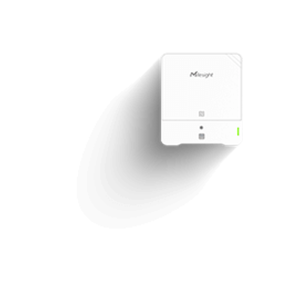
Milesight AM304L Indoor Ambience Monitoring Sensor
AM304L-868M
£71.82 ex VAT (£86.18 inc. VAT)
Measured parameters (sensor set, Ordering Information)Temperature, Humidity, Light, Motion — no CO2, TVOC, barometric pressure or PM2.5/PM10, and no E-Ink screen
View the AM304L-868M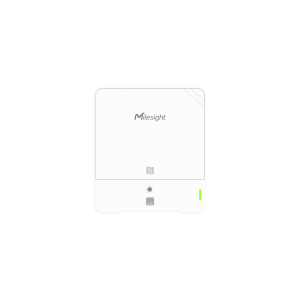
Milesight AM305L Indoor Ambience Monitoring Sensor
AM305L-868M
£172.08 ex VAT (£206.50 inc. VAT)
Sensor set (Ordering Information)Temperature, Humidity, Light, Motion, CO2 — with no E-ink display, and no TVOC, barometric pressure or PM2.5/PM10 sensors
View the AM305L-868M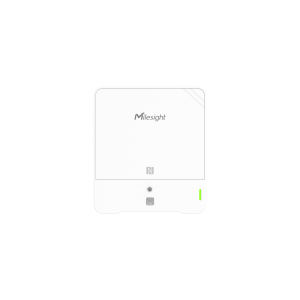
Milesight AM308L Indoor Ambience Monitoring Sensor
AM308L-868M
£239.41 ex VAT (£287.29 inc. VAT)
DisplayAM308L: Not Support (AM307 and AM308 use a 4.2-inch black & white E-Ink screen)
View the AM308L-868MSpecification comparison
| Specification | AM304L-868M | AM305L-868M | AM308L-868M |
|---|---|---|---|
| Advanced Features | Calibration, Threshold Alarm, Data Storage (4320 entries), Data Retrievability, Data Retransmission, Button Lock, D2D Data Transmission, D2D Controller | Calibration, Threshold Alarm, Data Storage (4320 entries), Data Retrievability, Data Retransmission, Button Lock, D2D Data Transmission, D2D Controller | Calibration, threshold alarm, data storage (18,000 entries), data retrievability, data retransmission, button lock |
| Display | Not supported (AM304L, AM305L and AM308L); the 4.2-inch black & white E-Ink screen is AM307 & AM308 only | Not Support (AM304L & AM305L & AM308L). The 4.2-inch Black & White E-Ink Screen is fitted to AM307 & AM308 only | Not supported on AM308L (AM307 & AM308: 4.2-inch black & white E-Ink screen) |
| Measured Parameters | Temperature, Humidity, Light, Motion | Temperature, Humidity, Light, Motion, CO2 | Temperature, humidity, CO2, TVOC, light, barometric pressure, PM2.5, PM10 and motion |
| Power Supply | 4 × 2700 mAh ER14505 Li-SOCl2 replaceable batteries, or 5V/1A by Type-C port | 1. 4 × 2700 mAh ER14505 Li-SOCl2 Replaceable Batteries; 2. 5V/1A by Type-C Port | 4 × 2700 mAh ER14505 Li-SOCl2 replaceable batteries, or 5V/1A via Type-C port |
| Battery Life (10 min interval, 25°C) | Around 14 years (SF7, EU868); around 7.5 years (SF10, EU868); around 12.5 years (SF7, US915); around 3.9 years (SF10, US915) | Around 11 Years (SF7, EU868 & US915); Around 6.3 Years (SF10, EU868); Around 3.7 Years (SF10, US915) | — |
| Configuration | Mobile App via NFC; Downlink | — | Mobile app via NFC; PC software via NFC or USB Type-C port; downlink |
| Dimensions / Weight | 100.8 × 114 × 22 mm (3.97 × 4.49 × 0.87 in); 181.25 g with batteries; wall mounting via 3M tape or screws | — | 100.8 × 114 × 22 mm (3.97 × 4.49 × 0.87 in); 222.6 g with batteries (AM308(L) column) |
| Frequency | CN470/RU864/IN865/EU868/US915/AU915/KR920/AS923-1&2&3&4 | CN470/RU864/IN865/EU868/US915/AU915/KR920/AS923-1&2&3&4 | — |
| Humidity | — | Range 0% ~ 100% RH; Typ. ±2% RH (25°C); Resolution 0.5% RH; Digital CMOSens® technology (MEMS) | 0% ~ 100% RH; typ. ±2% RH (25°C); resolution 0.5% RH; digital CMOSens® (MEMS) |
| Light | — | Photodiode; Range 0-60000 Lux | Photodiode; 0-60000 Lux (determined as 6 levels, 0-5) |
| Motion | — | Passive infrared (PIR); Detection Range 80° Horizontal, 55° Vertical, 3m; Status Vacant/Trigger | Passive infrared (PIR); 80° horizontal, 55° vertical, 5 m; reports Vacant/Occupied |
| Temperature | — | Range -20°C ~ 60°C; Typ. ±0.3°C (-20°C ~ 0°C), ±0.2°C (0°C ~ 60°C); Resolution 0.1°C; Digital CMOSens® technology (MEMS) | -20°C ~ 60°C; typ. ±0.3°C (-20°C ~ 0°C), ±0.2°C (0°C ~ 60°C); resolution 0.1°C; digital CMOSens® (MEMS) |
| Wireless Transmission Technology | LoRaWAN, Milesight D2D | LoRaWAN®, Milesight D2D (AM304L & AM305L only; AM307/AM308 are LoRaWAN® only) | — |
| Work Mode | OTAA/ABP Class A | OTAA/ABP Class A | — |
| Barometric Pressure | — | — | Piezoresistive absolute pressure sensor (MEMS); 260 - 1260 hPa; ±0.5 hPa; resolution 0.1 hPa |
| Battery Life (AM308(L) column) | — | — | Around 1.3 years (SF7, EU868 & US915), around 1.2 years (SF10, EU868), around 1 year (SF10, US915) at a 10 min interval, 25°C |
| Buzzer | — | Not fitted (AM307 & AM308: 1 × Buzzer) | — |
| CO2 Accuracy / Resolution | — | ± (30 ppm + 3 % of reading) (0°C ~ 50°C, 0% to 85% RH); Resolution 1 ppm | — |
| CO2 Operating Principle | — | Nondispersive Infrared (NDIR) | — |
| CO2 Range | — | 400 ~ 5000 ppm | — |
| Carbon Dioxide (CO2) | — | — | NDIR; 400 ~ 5000 ppm; ±(30 ppm + 3% of reading) at 0°C~50°C, 0% to 85% RH; resolution 1 ppm |
| Dimension / Housing | — | 100.8 × 114 × 22 mm (3.97 × 4.49 × 0.87 in); PC+ABS (V0), White; wall mounting via 3M tape or screws | — |
| Frequency & RF | — | — | CN470/RU864/IN865/EU868/US915/AU915/KR920/AS923-1&2&3&4; 16 dBm (868 MHz) / 22 dBm (915 MHz) / 19 dBm (470 MHz); sensitivity -137 dBm @300 bps |
| Housing, Installation & Approvals | — | — | ABS (UL94 HB), white; wall mounting via 3M tape or screws; CE, CE (RED), FCC, ISED, RoHS |
| Humidity Accuracy | Typ. ±2% RH (25°C); resolution 0.5% RH | — | — |
| Humidity Range | 0% ~ 100% RH | — | — |
| Indicators, Buttons & USB | — | — | 1 × traffic light status indicator + 1 × buzzer; 1 × power button + 1 × reset button; 1 × Type-C port for power supply, configuration or console |
| Ingress Protection | IP30; housing PC+ABS (V0), White | — | — |
| LED | — | 1 × Traffic Light Status Indicator | — |
| Light Range | 0-60000 Lux (photodiode), resolution 1 Lux, accuracy ±30% of reading | — | — |
| Light Report Mode | Illuminance Value or Illuminance Level (0-5) | — | — |
| LoRaWAN | — | — | LoRaWAN®, internal antenna; OTAA/ABP Class A |
| Motion Detection | Passive infrared (PIR), 80° horizontal, 55° vertical, 3 m; status Vacant/Trigger | — | — |
| Operating Environment | — | — | -20°C - 60°C; 10% - 90% RH (non-condensing); IP30 |
| Operating Temperature | -20°C - 60°C; relative humidity 10% - 90% (non-condensing) | — | — |
| Operating Temperature / Humidity / IP | — | -20°C - 60°C; 10% - 90% RH (non-condensing); IP30 | — |
| PM2.5 & PM10 | — | — | Laser scattering; 0 ~ 1000 μg/m3; 0~100 (±10 μg/m3), 100~1000 (±10%) at -10°C~60°C; resolution 1 μg/m3 (not fitted on AM307) |
| TVOC | — | — | MOX (MEMS); 1.00 ~ 5.00 IAQ rating; accuracy ±1; resolution 0.01 |
| Temperature Accuracy | Typ. ±0.3°C (-20°C ~ 0°C), ±0.2°C (0°C ~ 60°C); resolution 0.1°C | — | — |
| Temperature Range | -20°C ~ 60°C | — | — |
| Tx Power | — | 16dBm (868MHz) / 22dBm (915MHz) / 19dBm (470MHz) | — |
| Tx Power / Sensitivity | 16dBm (868MHz) / -137dBm @300bps | — | — |
Specifications taken from the manufacturer datasheets. Rows where the models are identical are dimmed. Prices are ex VAT and read live from the catalogue.
Frequently asked questions
Why is the AM308L battery life so much shorter?
The particulate sensor. At a 10 minute interval on EU868 at SF7 the datasheets quote around 14 years for the AM304L and around 11 years for the AM305L, but around 1.3 years for the AM308L. Laser-scattering PM2.5 and PM10 measurement draws far more power than the NDIR CO2 and MEMS sensors alongside it. All three can be powered permanently over 5V 1A USB Type-C, which is the usual answer for an AM308L deployment.
Do the AM304L, AM305L or AM308L have a screen?
No. All three datasheets state that display is not supported on the L variants. The 4.2-inch black and white E-Ink screen is fitted to the AM307 and AM308 only. If room occupants need to read the values on the wall, you need the AM307 or AM308 rather than any of the L models.
Which one do I need for classroom CO2 monitoring?
The AM305L is the entry point, because it is the cheapest of the three that carries a CO2 sensor: NDIR, 400 to 5000 ppm, accuracy plus or minus 30 ppm plus 3 per cent of reading. The AM304L has no CO2 sensor at all. If the classroom needs a visible readout for staff or pupils, look at the AM307 instead, which adds the E-Ink display.
What is Milesight D2D and which of these support it?
D2D lets one Milesight device trigger another directly, without the message travelling through the gateway and network server, so a CO2 threshold can switch a fan with no cloud round trip. The AM304L and AM305L support it. The AM307 and AM308 are LoRaWAN only and do not.
How many readings do they store if the gateway goes offline?
The AM304L and AM305L store 4,320 entries; the AM308L stores 18,000. All three support data retrievability and data retransmission, so buffered readings can be recovered once the link returns rather than being lost.