WT101 vs WT102 vs WT201 vs WT401: Which Milesight LoRaWAN Thermostat Do I Need?
Short answer: Milesight’s four LoRaWAN thermostat models split by what they physically control. Pick the WT101 or WT102 if the heat comes from a radiator — both replace the manual valve head, the WT101 on batteries and the WT102 self-powered from the water temperature. Pick the WT201 if you are replacing a wired wall thermostat in front of 24VAC HVAC plant, because it is the only one of the four with wiring terminals and relays. Pick the WT401 if you want a wall-mounted room interface with humidity and occupancy sensing that commands equipment elsewhere rather than switching it. All four operate on EU868, the UK LoRaWAN band.
Which Milesight LoRaWAN thermostat do I need?
Choose the WT101 if the room is heated by a radiator and you are retrofitting valve by valve. It latches onto an M30 × 1.5 mm valve in place of the manual head, runs on two replaceable AA lithium cells, and is the cheapest of the four.
Choose the WT102 if it is also a radiator, but returning to change batteries across an estate is the real cost. The WT102 is self-powered by temperature difference, generating its own power thermoelectrically once water temperature exceeds 45 °C, and accepts 5 V over USB Type-C as an alternative supply.
Choose the WT201 if there is already a wired thermostat on the wall with 24VAC equipment behind it — a furnace, air conditioner, heat pump, boiler or PTAC. It wires directly into that plant and switches it itself, and it reports humidity as well as temperature.
Choose the WT401 if you want a room interface rather than a switch: a 2.7-inch e-ink display, built-in temperature and humidity sensing, and a PIR occupancy sensor covering 120° horizontally to a maximum of 6 m. It is the most expensive of the four.
The WT401 is not a drop-in replacement for a wired thermostat
This is the mistake worth avoiding. The WT401 has no relays and no HVAC wiring terminals. Its specification controls PTAC (2H/1C), boilers, furnaces and heat pumps through Milesight UC7111 HVAC controllers, and radiators through the WT101 or WT102. If you take an existing thermostat off the wall expecting to land the same wires on a WT401, there is nowhere to land them — the WT201 is the model carrying the RC, RH, C, W1, W2/AUX, E, Y1, Y2/GL, G/GH and O/B terminal set.
The reverse catches people out too: the WT101 and WT102 are not room thermostats. They are motorised valve heads that latch onto the radiator, so the temperature they act on is the one at the radiator unless you use their external sensor mode. And a WT401 paired with WT101 or WT102 heads is a documented combination, not an either/or choice.
WT101 or WT102: what actually separates them?
Power, mainly. On the specification the two are close — same M30 × 1.5 mm default fitting, same NTC sensor rated −20 °C to 60 °C at ±0.5 °C, same 16 heating plans, same stepping-motor actuator, same IP30 rating. The WT101 quotes around 8 years at SF7 on EU868 (around 5 years at SF10) from two AA cells under its stated duty cycle. The WT102 removes that battery visit, but its stated harvesting condition is water above 45 °C, so on a low flow-temperature system that condition may not be met and the USB-C supply is the listed alternative. The WT102 also adds Class B operation, 1,000-entry data storage with retransmission and multicast, a direction-adjustable display and a wider adapter list including Markaryd and custom adapters. The WT101 specification lists a tamper alarm that the WT102’s does not.
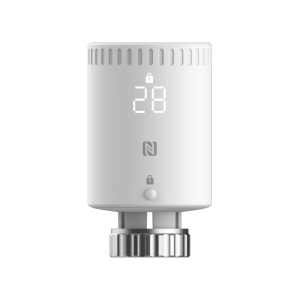
Milesight WT101 Smart Radiator Thermostat
WT101-868M
£59.85 ex VAT (£71.82 inc. VAT)
Valve fittingM30 × 1.5 mm default, with optional RA, RAV, RAVL, Giacomini and M28 (Comap, Herz, TA) adapters
View the WT101-868M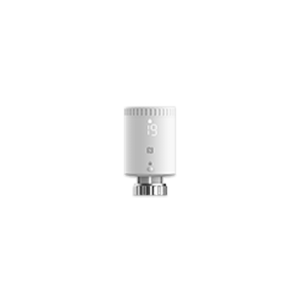
Milesight WT102 Smart Radiator Thermostat
WT102-868M
£97.26 ex VAT (£116.71 inc. VAT)
Power supplySelf-powered by temperature difference (thermoelectric when water temperature exceeds 45°C)
View the WT102-868M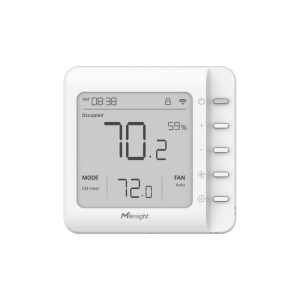
Milesight WT201 Smart Thermostat
WT201-868M
£97.26 ex VAT (£116.71 inc. VAT)
Wire relay rating24VAC (@ Typ. 150mA, Max. 1A)
View the WT201-868M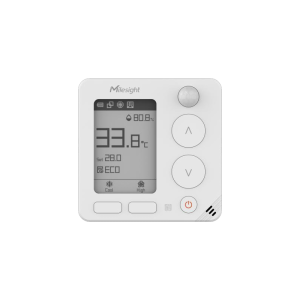
Milesight WT401 Smart Thermostat
WT401-868M
£112.23 ex VAT (£134.68 inc. VAT)
Battery life (Class A, EU868)5.2 years at SF7 / 3.3 years at SF10; Class C around 25 days
View the WT401-868MSpecification comparison
| Specification | WT101-868M | WT102-868M | WT201-868M | WT401-868M |
|---|---|---|---|---|
| Dimensions | Φ 52 × 90 mm (Φ 2.05 × 3.54 in) | 50 × 60 × 101.9 mm | 113 × 110 × 21 mm (4.45 × 4.33 × 0.83 in) | 86 × 86 × 24 mm |
| Display | LED display with white light | LED display with white light, direction-adjustable | 4.2-inch LCD segment code screen with white backlight | 2.7-inch black & white e-ink screen |
| Frequency | IN865/RU864/EU868 | IN865/RU864/EU868/US915/AU915/KR920/AS923-1&2&3&4 | IN865/RU864/EU868/US915/AU915/KR920/AS923-1&2&3&4 | IN865/RU864/EU868/US915/AU915/KR920/AS923-1&2&3&4 |
| Installation | Latching on the valve | Latching on the valve | Wall screws mounting | Wall screw mounting; 86 mm square or European 60 mm round box; 118/120 wall box via wall plate accessories |
| Material & colour | Stainless + ABS, white | PC + aluminium, white & silver | PC + ABS (UL94 V0), white | PC + ABS (UL94 V0), white |
| Operating temperature | -20°C ~ +60°C | -20°C ~ 60°C | -4°F ~ 140°F (-20°C ~ 60°C) | -20°C ~ 60°C (e-ink screen: 0°C ~ 40°C) |
| Relative humidity | 0% - 95% (non-condensing) | 0% - 95% (non-condensing) | 0% to 95% (non-condensing) | 0% to 95% (non-condensing) |
| Tx power | 16 dBm (868 MHz) | 16 dBm (868 MHz) / 22 dBm (915 MHz) | 16 dBm (868 MHz)/22 dBm (915 MHz) | 16 dBm (868 MHz) / 22 dBm (915 MHz) |
| Approvals | CE; RoHS | CE, FCC; RoHS | FCC, ISED | — |
| Configuration | NFC via mobile app or downlink | NFC via mobile app or downlink | — | Mobile app via NFC or Bluetooth® 5.0, downlink |
| Mode | OTAA/ABP Class A | OTAA/ABP, Class A / Class B | OTAA/ABP Class C | — |
| Power supply | 2 × 1.5V Li-FeS2 AA replaceable batteries (3000 mAh in total) | Self-powered by temperature difference; or 5V by USB Type-C port | — | 2 × 2700 mAh ER14505 Li-SOCl2 replaceable batteries, AC/DC 24V, DC 5V Type-C, or PowerBus DC 24V (not usable simultaneously) |
| Temperature accuracy | ± 0.5°C (0°C ~ 50°C) | — | ± 0.5°C (0°C ~ 60°C), ± 1°C (-20 ~ 0°C) | Typical ± 0.2°C, maximum ± 0.5°C |
| Temperature range | -20°C ~ 60°C | — | -4°F ~ 140°F (-20°C ~ 60°C) | -20°C ~ 60°C |
| Temperature resolution | 0.1°C | — | Report: 0.1°C, Display: 0.5°C (0.5°F) | 0.1°C |
| Actuator | Stepping motor | Stepping motor | — | — |
| Buttons | — | 1 × power/reset button, 2 × temperature/valve opening control buttons | — | 5 buttons (power, system on/off, temperature up/down, control mode, fan mode) |
| Control features | Automatic temperature control, valve opening control, heat plans, freeze protection, open-window detection, tamper alarm, effective stroke | Automatic temperature control, valve opening control, freeze protection, open-window detection, effective stroke | — | — |
| Default valve fitting | M30 × 1.5 mm | M30 × 1.5 mm | — | — |
| Fan modes | — | — | Auto, On, Circulate | Low, Medium, High, Auto, On, Circulate |
| HVAC compatibility | — | — | Most 24VAC HVAC systems, including furnaces and air conditioners (2H/2C), heat pumps (4H/2C or 3H/2C + 1 stage AUX heat), boilers and PTAC | PTAC (2H/1C), boilers, furnaces or heat pumps (2H/1C) via Milesight UC7111 HVAC controllers; radiators via Milesight WT101/WT102 |
| Humidity accuracy | — | — | ± 3% RH (40-85% RH), ± 5% RH (0-40% RH, 85-100% RH) | Typical ± 2% RH, maximum ± 5% RH |
| Humidity range | — | — | 0% - 100% RH | 0% - 100% RH |
| Protocol | LoRaWAN® | LoRaWAN® | — | — |
| Software features | Child lock, external sensor mode, FUOTA | Child lock, external sensor mode, data storage (1,000 entries), data retransmission, data retrievability, multicast, FUOTA | — | — |
| Temperature control modes | — | — | Heat, EM (emergency) heat, Cool, Auto | Heat, EM (Emergency) Heat, Cool, Auto |
| Weight | 170 g (with batteries) | — | 172 g | — |
| Advanced Features | — | — | — | Occupied detection, smart display, child lock, button customisation, external sensor mode, multicast, FUOTA |
| Battery Life (10 min report interval) | — | — | — | Class A: 5.2 years (SF7, EU868), 3.3 years (SF10, EU868); Class C: around 25 days |
| Battery life | Around 8 years (SF7, EU868); around 5 years (SF10, EU868) — 10 min interval + control once during a 5-month heating season, 25°C | — | — | — |
| Data storage | — | — | 1,000 entries, with data retransmission and retrievability | — |
| Digital input | — | — | 1 × DI (dry contact) for keycard switches, magnet switches etc. (physical switches or buttons only) | — |
| Heating plans | — | Up to 16 heating plans within one preset date period | — | — |
| Heating schedules | Up to 16 heating plans within 1 pre-set date period | — | — | — |
| Interfaces | — | — | — | 1 × USB Type-C (power or console); 1 × 2-pin power terminal connector (PowerBus) |
| LoRaWAN Mode | — | — | — | OTAA/ABP Class A / Class C |
| Optional adapters | RA, RAV, RAVL, Giacomini, M28 (Comap, Herz, TA) | — | — | — |
| PIR Detection Area | — | — | — | 120° horizontal, 90° vertical |
| PIR Detection Distance | — | — | — | Maximum 6 m |
| Power consumption | — | — | < 1.2W | — |
| Power supply (WT201) | — | — | 24VAC (±15%) (@ Typ. 150mA, Max. 1A) | — |
| Storage temperature | -40°C ~ +70°C (without batteries) | — | — | — |
| Supported metal adapters | — | RA, RAV, RAVL, Giacomini, M28 (Comap, Herz, TA, Markaryd), customizable | — | — |
| Technology | — | — | LoRaWAN®, Milesight D2D | — |
| Temperature sensor | — | NTC, range -20°C ~ 60°C, accuracy ±0.5°C (0°C ~ 50°C), resolution 0.1°C | — | — |
| Temperature sensor type | NTC | — | — | — |
| USB | — | 1 × Type-C for power supply, charging or external NTC sensor connection | — | — |
| Wire relays (WT201) | — | — | 24VAC (@ Typ. 150mA, Max. 1A) | — |
| Wire terminals | — | — | RC, RH, C, W1, W2/AUX, E, Y1, Y2/GL, G/GH, O/B, PEK, DI, GND | — |
| Wireless Technology | — | — | — | LoRaWAN® |
| Ingress protection | IP30 | IP30 | IP30 | IP30 |
| Sensitivity | -137 dBm | -137 dBm | -137 dBm | -137 dBm |
Specifications taken from the manufacturer datasheets. Rows where the models are identical are dimmed. Prices are ex VAT and read live from the catalogue.
Frequently asked questions
Do the WT101, WT102, WT201 and WT401 need a LoRaWAN gateway?
Yes. All four are LoRaWAN end devices that join a LoRaWAN network rather than Wi-Fi. The WT101 is Class A, the WT102 Class A or B, the WT201 Class C, and the WT401 Class A or C. All four support EU868, which is the band used in the UK.
Will a WT101 or WT102 fit my radiator valve?
Both fit M30 x 1.5 mm valves as standard. Adapters are available for Danfoss RA, RAV and RAVL, Giacomini, and M28 valves (Comap, Herz, TA). The WT102 additionally lists Markaryd and customisable adapters.
Does the WT102 really never need a battery change?
The WT102 is self-powered by temperature difference, generating power thermoelectrically once water temperature exceeds 45 degrees C. Where that condition is not met, the specification lists a 5 V USB Type-C port as the alternative supply.
How long do the batteries last on the WT101 and WT401?
The WT101 quotes around 8 years at SF7 on EU868 and around 5 years at SF10, from two 1.5 V Li-FeS2 AA cells, based on a 10-minute reporting interval with control once during a five-month heating season at 25 degrees C. The WT401 quotes 5.2 years at SF7 and 3.3 years at SF10 in Class A on EU868, but only around 25 days in Class C, so continuous-control installations should use one of its wired supply options.
Which of these thermostats measure humidity or detect occupancy?
The WT201 and WT401 both report relative humidity across 0-100% RH. Only the WT401 has a PIR occupancy sensor, covering 120 degrees horizontally and 90 degrees vertically to a maximum of 6 m. The WT101 and WT102 specifications list temperature sensing only.