Compressed Air Leaks: Finding the 30% You Are Paying For
Last updated: 27 August 2026
In short: Compressed air is roughly a tenth of UK industrial electricity, and an unmanaged system can lose 40 to 50% of what it generates through leaks. An annual leak survey finds them once a year. A permanently installed pressure sensor tells you what happened in the eleven months in between, for about £198.

Every factory engineer knows the compressed air system leaks. Almost none can say by how much this week, because the only measurement most sites have is an ultrasonic leak survey that happens once a year, if it happens at all.
This guide covers what compressed air actually costs you, what a permanently installed pressure sensor can and cannot resolve, and how to read pressure data so it tells you something a gauge on the wall does not.
Why is compressed air so expensive?
Because it is electricity converted into a gas, stored badly, and then leaked. The Carbon Trust puts compressed air at around 10% of UK industry’s electricity consumption.
The waste inside that figure is the part worth acting on. Reporting in the trade press attributes to the Carbon Trust a figure of over 10 TWh of electricity a year used by UK industry to compress air, with an estimated 30% loss.
The same reporting gives the British Compressed Air Society’s benchmark: aim for around 5 to 10% of air generated lost to leakage, while an unmanaged plant could be losing as much as 40 to 50%.
That range is the whole argument. The difference between a managed and an unmanaged compressed air system is roughly a third of the energy going into it.
Why an annual leak survey is not enough
An ultrasonic survey is genuinely good. A technician walks the site with a directional microphone, tags every audible leak, and hands you a list with estimated flow and cost per leak. It is the right way to find and fix individual compressed air leaks.
Its weakness is the calendar. Leaks are not a fixed population. A quick-release coupling fails, a hose gets dragged over a corner, a maintenance crew leaves an isolation valve cracked open on a Friday. By month four your surveyed system is not the system you are running.
Continuous pressure measurement does not locate leaks, and no honest supplier will tell you it does. What it does is tell you the aggregate has changed, which is the trigger to call the survey rather than waiting for the anniversary.

What does a pressure sensor actually resolve?
This is the specification that decides whether the data is useful, and it is the one most quotes skip. The Milesight EM500-PP datasheet gives a range of 0 to 1600 kPa, which is 16 bar, at an accuracy of ±0.5% of full scale, with a resolution of 1 kPa or 0.01 bar.
Read that tolerance carefully. It is 0.5% of full scale, not 0.5% of the reading. On a 16 bar device that is ±0.08 bar, and you carry that same ±0.08 bar whether the pipe is at 2 bar or at 14 bar.
A typical factory ring main runs at 6 to 7 bar. At 6.5 bar, ±0.08 bar is about 1.2% of the reading, which is fine for trend work. It is not fine if you were hoping to resolve a 0.05 bar pressure drop across a filter element, because that change is smaller than the instrument’s own uncertainty.
There is a second number that matters for year-on-year comparison. Long-term stability is quoted as ±0.3% of full scale per year, so roughly ±0.05 bar of drift annually. Compare this month to last month freely. Compare this December to last December with more caution.
Where to put sensors on a compressed air ring main
Three positions earn their place, and they answer different questions.
- At the compressor discharge or receiver. This is your generation reference. It tells you what the plant is producing and how hard it is working to hold setpoint.
- At the far end of the ring main. The difference between here and the receiver is your distribution loss. A widening gap over months means restriction, usually a blocked filter or a partly closed valve nobody logged.
- At a critical machine drop. Where a process actually fails if pressure sags. This is the one that turns compressed air data into a production conversation rather than an energy one.
Two compressed air sensors give you a differential and a trend. One sensor gives you a number that is hard to interpret, because you cannot tell generation problems from distribution problems.
The measurement that finds leaks without a survey
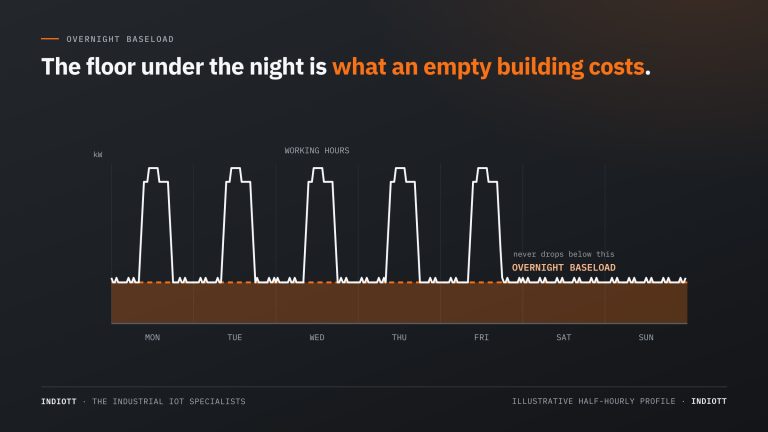
Watch the system when nothing is running. This is the single most useful thing continuous compressed air monitoring gives you, and it costs nothing extra once the sensor is in.
Shut the plant down on a Friday evening with the compressor isolated and the receiver full. Pressure should hold. The rate at which it falls overnight is your total leak rate, expressed as a pressure decay curve, and it needs no ultrasonic gear and no technician on site.
Repeat it every weekend automatically and you have a leak trend rather than a leak snapshot. A decay curve that steepens by 20% over six weeks is a compressed air system that has developed a new leak, and you now know that before the energy bill tells you.
The sensor supports this pattern directly. Battery life is quoted at 10 years at a ten minute reporting interval at 25°C, from a single 19000 mAh lithium thionyl chloride cell, and it stores 1,000 entries locally with data retransmission, so a gateway outage over a weekend does not lose the curve.

Reading a week of compressed air pressure data
Raw pressure is not the insight. The shape of the week is. Once a sensor has logged a few cycles you are looking for four patterns, and each one names a different fault.

A sawtooth that never rests. The compressor loads and unloads continuously through the night. Either something is genuinely running out of hours, or the compressed air system is leaking enough to keep the plant cycling against nothing.
A widening gap between receiver and ring end. Generation pressure holds but delivery falls. That is restriction, not leakage, and it points at filters, dryers or a valve rather than at pipework.
A daily sag at the same moment. A single high demand event is pulling the whole ring down. This is the case for a local receiver near that machine rather than for raising site pressure for everyone.
A slow month-on-month decline in overnight hold. The classic signature of accumulating leaks. No single day looks wrong, which is exactly why an annual survey misses it and continuous compressed air monitoring does not.
None of these require a specialist to interpret. They require a chart that covers more than one shift, which is the thing a dial gauge on the compressor house wall can never give you.
Installation details that catch people out
The process connection is G 1/2 inch male, so you need a matching port, tee or adapter. On an existing ring main that usually means a hot tap or a planned shutdown, which is a bigger job than the sensor itself and should be in the quote from the start.
Temperature ratings differ between the two halves of the device. The transceiver is rated -30 to 70°C but the pipe pressure sensor element is rated -10 to 70°C, and ingress protection is IP67 on the transceiver and IP65 on the sensor.
That matters for an unheated compressor house in a hard British winter, where -10°C is not hypothetical. Check the coldest recorded temperature at the actual mounting position before assuming an outdoor installation is fine.
The cable between the two is 1.5 m, which constrains how far the radio half can sit from the tapping point. Plan the mounting position and the radio path together, not one after the other.
Turning pressure into pounds
The rule of thumb worth knowing is that reducing system pressure saves energy roughly in proportion, so running compressed air at 7 bar when 6 would do is paying a premium for nothing.
Most sites over-pressurise for one reason: somebody once had a machine that starved, so the setpoint went up and never came back down. Continuous compressed air data lets you find whether that is still true, by showing whether the critical drop ever actually approaches its minimum.
If it never gets close, you have headroom to lower the setpoint and bank the saving. If it does get close, you have identified a genuine restriction to fix, which is a better outcome than permanently paying to compress against it.
The sensor is £197.52 excluding VAT. Delivery is a flat £14.25 across the UK and orders are typically dispatched within 14 working days.
Frequently asked questions
Can a pressure sensor find the location of a compressed air leak?
No. It tells you the total has changed, not where. Use continuous monitoring to decide when a survey is worth booking, and ultrasonic detection to find the individual leaks once you are on site.
What pressure should a factory ring main run at?
Whatever the highest genuinely necessary machine requires, plus a margin for distribution loss, and no more. Common practice sits at 6 to 7 bar, but the right figure is site specific and usually lower than the one currently set.
How many sensors does one compressed air system need?
Two as a minimum, at the receiver and at the far end of the ring, so you can separate generation from distribution. Add one per critical machine drop where a pressure sag stops production.
Does a weekend pressure decay test damage anything?
No, it is a standard technique, but coordinate it with production and with anyone relying on residual air for safety functions. Isolate deliberately rather than simply switching the compressor off.
Is compressed air monitoring worth it on a small site?
If your compressor is more than a few kilowatts and runs most of the day, the leak fraction alone usually justifies it. Below that, an annual survey and a disciplined shutdown routine may be enough.
The short version
You cannot manage a compressed air system you only measure once a year. A permanently installed pressure sensor will not find your leaks, but it will tell you when they have grown, let you run a free leak test every weekend, and show you whether your setpoint is higher than it needs to be.
For the wider energy picture, our guides to IoT energy monitoring and ESOS Phase 4 energy monitoring cover how this data feeds a compliance audit. If you are metering circuits as well as air, the current transformer guide covers sizing the clamps.
The Milesight EM500-PP pipe pressure sensor is priced and in stock. Add it to a quote and we will come back within one working day.
Next step
Get a priced kit list for your site
Answer three quick questions and tell us where to send it. An engineer replies within one working day with the parts, the prices and the lead time.
Rather talk it through? Call 023 9223 3611
Received. An engineer has it.
You will hear back within one working day with the parts, the prices and the lead time. A confirmation is on its way to your inbox.
If it is urgent, call 023 9223 3611.