ESOS Phase 4 readiness: qualification, deadline and the metering data that turns audits into savings
Last updated: 2 July 2026
TL;DR: ESOS Phase 4 applies to UK large undertakings, meaning any organisation with 250 or more employees, or a turnover above £44 million and a balance sheet above £38 million (gov.uk). The qualification date is 31 December 2026 and the compliance deadline is 5 December 2027. Your audit must cover 12 months of energy data spanning that qualification date, report total consumption in kWh, calculate energy intensity ratios and track action plan progress. Continuous IoT submetering makes that data audit-ready year-round.
Most large organisations treat the Energy Savings Opportunity Scheme as a four-yearly scramble. That is the wrong instinct. This guide sets out exactly who qualifies, the confirmed Phase 4 dates, what changed since Phase 3, and how live metering data converts a compliance chore into ongoing bill reduction.

Who qualifies for ESOS Phase 4?
You qualify for ESOS Phase 4 if your organisation is a “large undertaking” on the qualification date of 31 December 2026. Under gov.uk ESOS guidance a large undertaking is any UK organisation that either employs 250 or more people, or has an annual turnover above £44 million and an annual balance sheet total above £38 million. Meeting either limb is enough.
Group structure matters. If one company within a corporate group is a large undertaking, all of the group’s UK operations are pulled into the scheme, according to gov.uk. Highly energy-intensive small entities can therefore find themselves in scope purely because of a larger parent or sibling company.
The scheme is administered by the Environment Agency across the UK, and it captures a substantial slice of the economy. Almost 12,000 organisations are estimated to fall within ESOS, making it one of the widest-reaching energy audit obligations in the country.
One planned change that will not apply to Phase 4 is worth flagging. Government had proposed aligning ESOS qualification thresholds with Streamlined Energy and Carbon Reporting (SECR), but gov.uk confirms that this realignment will not go ahead for Phase 4. The familiar 250 employee and £44 million turnover tests still stand.
When is the ESOS Phase 4 qualification date and deadline?
The ESOS Phase 4 qualification date is 31 December 2026 and the ESOS Phase 4 compliance deadline is 5 December 2027, both confirmed by gov.uk. The full compliance period runs from 6 December 2023 to 5 December 2027, so the window is already open. Your assessment must be based on 12 months of verifiable energy data that includes the 31 December 2026 qualification date.
Those two dates do different jobs. The qualification date fixes whether you are in scope and anchors the 12 month reference period for your energy data. The compliance deadline is the last day to submit your notification of compliance to the Environment Agency.
There is a practical consequence that many organisations miss. Because the data year must cover 31 December 2026, an organisation with audits already complete could in theory notify compliance from the first working day of 2027, almost a full year before the 5 December 2027 deadline. Early filers avoid the late-year consultant bottleneck.

Leaving it late carries real risk. In previous phases the regulator extended deadlines only after widespread non-compliance, and Phase 4 tightens the rules rather than loosening them. Treating 5 December 2027 as a target rather than a backstop is the safer plan.
What changed in ESOS Phase 4 compared with Phase 3?
ESOS Phase 4 keeps the core audit obligation but hardens the data and reporting rules compared with Phase 3. Display Energy Certificates (DECs) and Green Deal Assessments (GDAs) are no longer accepted as compliance routes in ESOS Phase 4 (Elmhurst Energy). Participants must report total energy consumption in kilowatt hours and calculate energy intensity ratios, and action plan progress must now be evidenced rather than merely promised.
The energy intensity requirement is the change that most rewards good metering. Under gov.uk guidance you must calculate at least one ratio per activity area: building consumption in kWh divided by useful floor area in square metres, industrial consumption in kWh divided by output, and transport consumption in kWh per mile travelled. These ratios only mean anything if the underlying kWh figures are trustworthy.
Is net zero mandatory in ESOS Phase 4?
No. Government has postponed the introduction of mandatory net zero requirements until Phase 5, according to gov.uk. Organisations may still include a net zero assessment on a voluntary basis in Phase 4, following the process set out in the PAS 51215 standard, but it is not compulsory this time.
That postponement is a planning gift, not a reason to relax. The direction of travel is fixed, and gov.uk notes that net zero elements could add between £600 and £7,500 to the cost of an audit once they are required. Building the metering foundation now spreads that cost and de-risks Phase 5.
What are the action plan and record-keeping rules?
Action plans became a formal ESOS feature and Phase 4 expects evidence of delivery. Participants must report progress against action plan commitments, and where a commitment has not been met they must explain why (gov.uk). Vague intentions no longer suffice.
Record retention has also lengthened. Phase 4 requires records to be kept for two subsequent compliance periods, improving traceability and accountability (Elmhurst Energy). Continuous data logs make satisfying that requirement trivial rather than a document-hunting exercise.
Why does ESOS matter beyond compliance?
ESOS is designed to pay for itself. The scheme is estimated to deliver a net benefit of £1.6 billion to the UK, the majority felt directly by businesses through lower energy bills (gov.uk). Treating the audit as a cost centre misses the point of the whole exercise.
The measured energy savings are large. Across the ESOS population, the gov.uk Energy Security Bill factsheet attributes 1.65TWh of efficiency savings to buildings, 1.51TWh to industrial processes and 0.52TWh to transport fuel efficiency. The estimated total energy saving from the Phase 4 changes over the 2023 to 2037 appraisal period is 28TWh, more than the total net electricity the UK imported in 2021.

The problem is that a four-yearly audit captures a single snapshot. The consultant leaves, the recommendations sit in a report, and drift sets in. Without live data no one notices a chiller running out of hours or a compressor leaking until the next audit cycle four years later. That is exactly the gap that continuous monitoring closes.
How does IoT energy submetering turn ESOS audits into ongoing savings?
Continuous IoT submetering feeds your ESOS Phase 4 audit with granular, verified kWh data all year round, then keeps working after the assessor leaves. Instead of reconstructing 12 months of consumption from invoices, you export it. Instead of estimating energy intensity ratios, you calculate them from measured sub-loads. And instead of hoping action plan measures stuck, you watch the metered load fall.
Milesight LoRaWAN energy meters and clamp-on current sensors attach to distribution boards, individual machines and HVAC circuits without disrupting operations. They report over long-range, low-power LoRaWAN, so a single gateway can cover a large site or campus. That circuit-level visibility is precisely what a robust energy intensity calculation needs.
The benefits compound across the compliance lifecycle:
- Audit-ready data. Twelve months of continuous kWh logs covering the 31 December 2026 qualification date, exportable for the assessor with meter-level provenance.
- Real energy intensity. Per-building, per-line and per-process consumption measured directly, so kWh per square metre and kWh per unit output are calculated, not estimated.
- Action plan verification. When you implement a recommended measure, the submeter shows the before-and-after load, turning a paper commitment into proven savings.
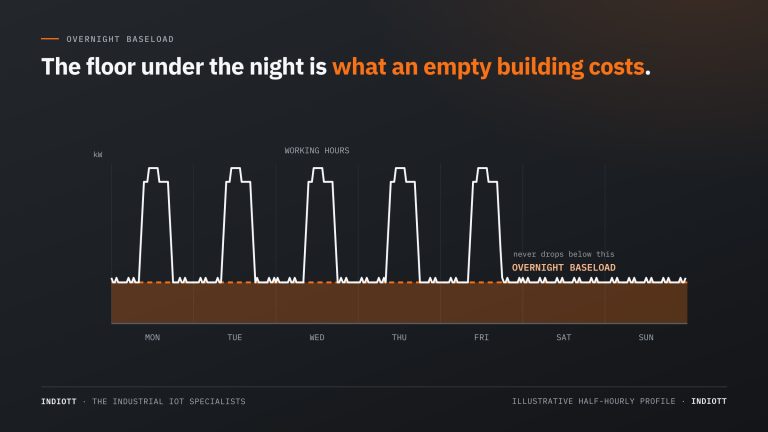
- Anomaly alerts. Out-of-hours consumption, failing plant and creeping baseloads surface in days, not at the next four-yearly audit.
Independent evidence supports the upside. The Carbon Trust reports that participating businesses typically identify cost savings of 5 to 10 per cent through low or no-cost measures. Live metering is what lets you find those measures continuously and prove they worked, rather than rediscovering the same 5 to 10 per cent every four years.

ESOS Phase 4 readiness checklist tied to metering data
Use this practical checklist to convert the ESOS Phase 4 obligation into a live energy programme rather than a one-off report.
- Confirm scope now. Check headcount, turnover and balance sheet against the large undertaking thresholds, and map the whole UK corporate group.
- Fix the data year. Ensure you will hold 12 months of energy data covering 31 December 2026 across electricity, gas, fuels and transport.
- Deploy submetering early. Install LoRaWAN meters on major buildings, production lines and HVAC before the reference year so the data is already flowing.
- Calculate intensity ratios from meters. Set up kWh per square metre, kWh per unit output and kWh per mile from measured sub-loads.
- Digitise the action plan. Track each recommended measure against its metered load so progress reporting is evidence-based.
- Aim to notify early in 2027. Avoid the late-year assessor bottleneck ahead of the 5 December 2027 deadline.
- Prepare for Phase 5. The metering estate that serves Phase 4 is the same foundation a voluntary or future mandatory net zero assessment needs.
The organisations that will find ESOS Phase 4 easy are the ones already measuring. If your energy data lives in a spreadsheet reconstructed from bills, the audit will hurt. If it lives in a metering platform, the audit is a report you export.
Frequently asked questions
What is the ESOS Phase 4 qualification date?
The ESOS Phase 4 qualification date is 31 December 2026 (gov.uk). Your organisation’s status as a large undertaking is assessed on that date, and your audit must use 12 months of energy data covering it.
When is the ESOS Phase 4 compliance deadline?
The compliance deadline is 5 December 2027 (gov.uk). The full compliance period runs from 6 December 2023 to 5 December 2027, and organisations with completed audits can notify from early 2027.
Who has to comply with ESOS Phase 4?
Any UK large undertaking, meaning an organisation with 250 or more employees, or a turnover above £44 million and a balance sheet above £38 million (gov.uk). If one group company qualifies, the whole UK group is in scope.
Is a net zero assessment required in ESOS Phase 4?
No. Mandatory net zero requirements have been postponed to Phase 5 (gov.uk). You may include a voluntary net zero assessment in Phase 4 under the PAS 51215 standard, but it is not compulsory.
Can IoT submetering be used for ESOS compliance data?
Yes. Continuous IoT submetering provides the verified kWh consumption and energy intensity data ESOS requires, with meter-level provenance, and keeps identifying savings between the four-yearly audit cycles.
Get Phase 4 ready with live energy data
ESOS Phase 4 rewards organisations that measure continuously instead of reconstructing consumption from invoices every four years. A LoRaWAN submetering layer gives you audit-ready kWh data, real energy intensity ratios and verified action plan progress, then keeps cutting your bills long after the assessor has gone.
Explore our energy metering and net zero solution to see how continuous submetering supports ESOS compliance, or read our guide to IoT energy monitoring for the technical detail on getting circuit-level visibility across your estate.
Next step
Get a priced kit list for your site
Answer three quick questions and tell us where to send it. An engineer replies within one working day with the parts, the prices and the lead time.
Rather talk it through? Call 023 9223 3611
Received. An engineer has it.
You will hear back within one working day with the parts, the prices and the lead time. A confirmation is on its way to your inbox.
If it is urgent, call 023 9223 3611.