LoRaWAN Current Transformers: Sizing CT Clamps for Circuit-Level Energy Monitoring
Last updated: 12 August 2026
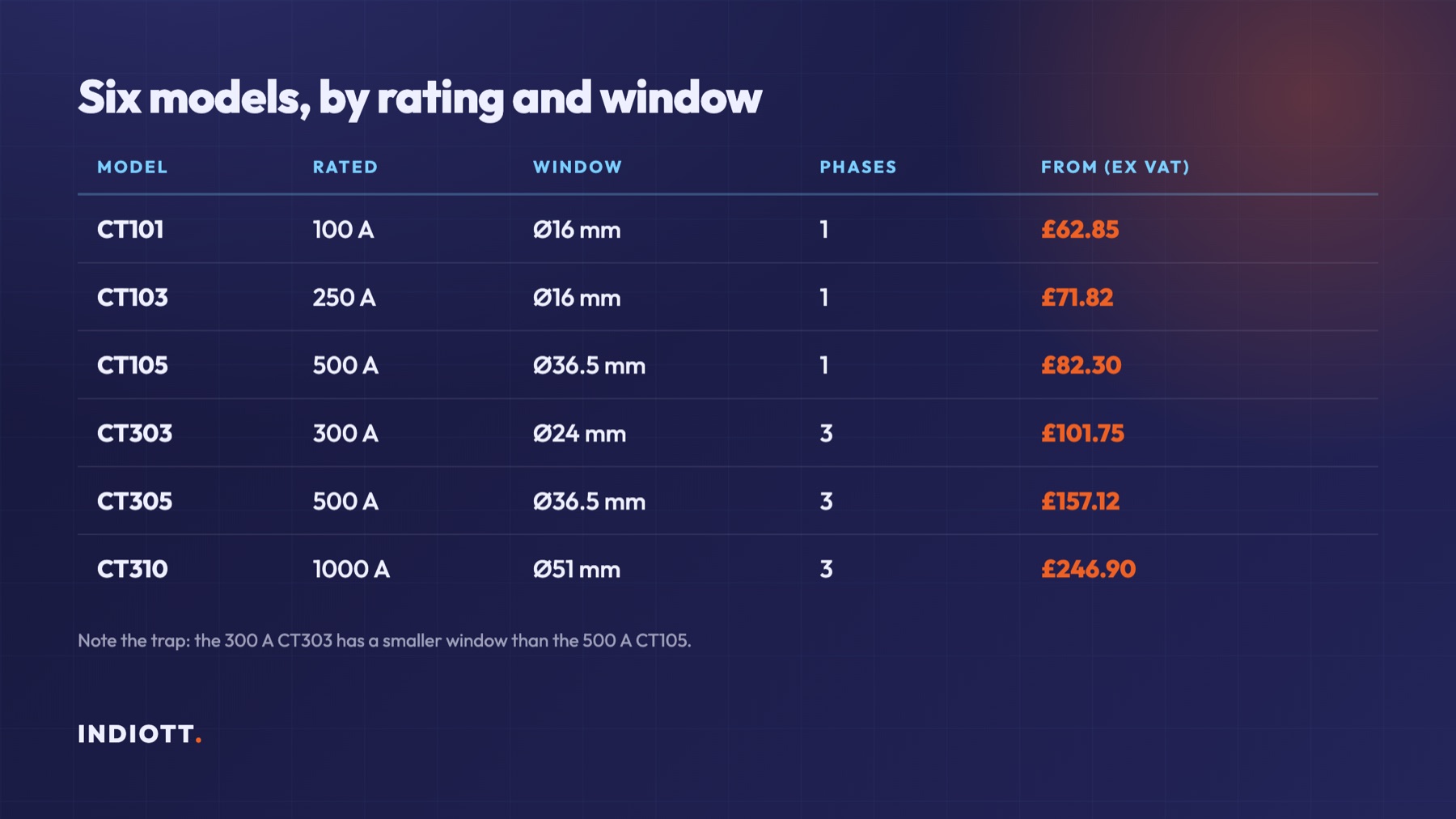
Short answer: size a current transformer on two numbers, the circuit’s amps and the cable’s diameter, and check both before ordering. Single-phase circuits take the CT101 at £62.85 ex VAT (100 A), CT103 at £71.82 (250 A) or CT105 at £82.30 (500 A). Three-phase circuits take the CT303 at £101.75 (300 A), CT305 at £157.12 (500 A) or CT310 at £246.90 (1000 A), each supplied as three clamps on one transceiver.
The trap is that amps and aperture do not rise together. The three-phase CT303 is rated 300 A but has a 24 mm window, while the single-phase CT105 is rated 500 A with a 36.5 mm window. A fat 300 A feeder can fail to fit a current transformer that is comfortably within its current rating.
On this page:
- What does a smart current transformer measure?
- The six models compared
- Sizing: amps first, then the window
- Three single-phase clamps or one three-phase set?
- Self-powered, and what that means on site
- The wire temperature sensor nobody mentions
- Which circuits should you monitor first?
- Which current transformer should you buy?
- Frequently asked questions

What does a smart current transformer measure?
It clamps around a live conductor and measures the current flowing through it, without breaking the circuit. A traditional current transformer feeds an analogue signal to a panel meter. These add a LoRaWAN radio, so the reading arrives on a dashboard rather than a panel display.
That distinction is what makes circuit-level monitoring affordable. A building’s incoming meter tells you the site total. Putting a current transformer on individual circuits tells you which of them is responsible, and that is the information an energy reduction programme actually needs. Our IoT energy monitoring guide covers the strategy, and ESOS Phase 4 readiness covers the compliance driver.
All six models sample at 3.3 kHz and report RMS current and accumulated current. All are IP30, so they belong inside a distribution board or panel, and all report over LoRaWAN to a gateway. Specifications below are from Milesight’s published pages, and prices are live UK stock ex VAT.
The six models compared
The current transformer range splits cleanly. The CT10x series is one clamp for one conductor. The CT3xx series is a one-to-three design: one transceiver with three clamps, intended for a three-phase circuit.
- CT101 — 100 Arms, Ø16 mm window, for lighting, office equipment and small HVAC. £62.85.
- CT103 — 250 Arms, Ø16 mm window, for commercial HVAC, compressors and mixed-load boards. £71.82.
- CT105 — 500 Arms, Ø36.5 mm window, for large motors, industrial feeders and chillers. £82.30.
- CT303 — 300 Arms, three clamps, Ø24 mm window. £101.75.
- CT305 — 500 Arms, three clamps, Ø36.5 mm window. £157.12.
- CT310 — 1000 Arms, three clamps, Ø51 mm window. £246.90.
Accuracy is ±1% across the CT3xx range. On the CT10x series it is ±1% above 5 Arms and ±3% at or below 5 Arms, which is worth knowing if you intend to monitor a lightly loaded circuit: at very low current the percentage error widens.
Sizing: amps first, then the window
Pick the smallest rating above your circuit’s design current, then confirm the cable fits the hole. The second step is the one that gets skipped, and it is the one that sends kit back.
The windows across the range are 16 mm on the CT101 and CT103, 24 mm on the CT303, 36.5 mm on the CT105 and CT305, and 51 mm on the CT310. A 16 mm window is comfortable on the sort of singles you find on a lighting or small power circuit. It is not going to accept a 185 mm² armoured feeder.
Measure the outside diameter of the conductor the clamp will actually go around, including insulation, and allow room to close the clamp without forcing it. If the cable is a multi-core armoured type, remember the clamp goes around a single core, not the whole cable, so the relevant measurement is taken after the gland.
The other sizing point is headroom. A circuit protected at 250 A does not necessarily run at 250 A, but sizing the current transformer to the protective device rather than the observed load is the safe default, because loads grow and a clamp that saturates reports nonsense.
Three single-phase clamps or one three-phase set?
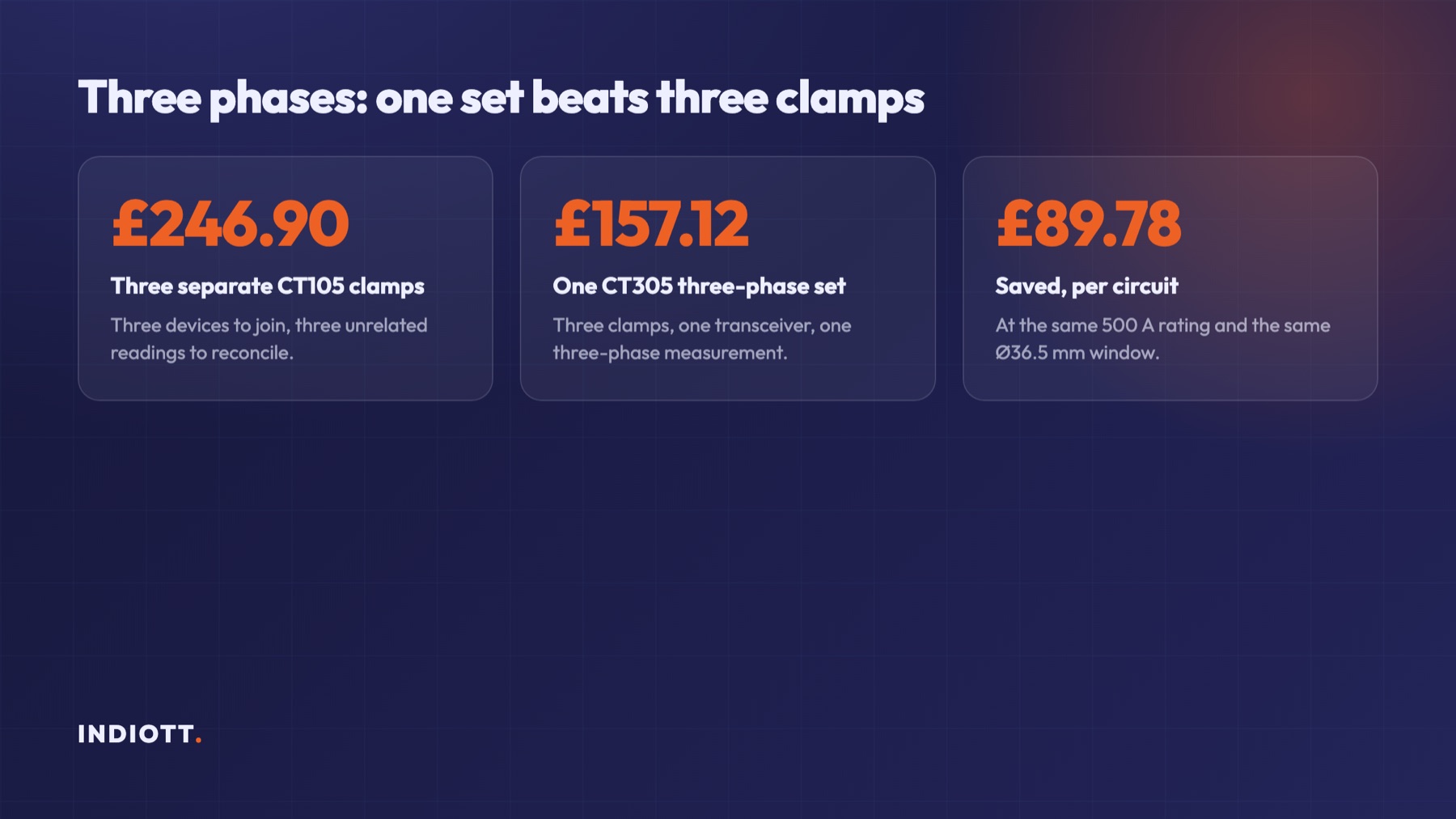
For a genuine three-phase circuit, the three-phase model is cheaper and simpler. Compare directly at 500 A: three separate CT105 units cost £246.90, while one CT305 covering the same three phases costs £157.12. That is £89.78 saved, plus two fewer devices to join to the network and keep track of.
It is also better data. Three clamps on one transceiver report as a single three-phase measurement, where three independent devices report three unrelated numbers that somebody then has to reconcile by name and timestamp.
Single-phase models still win where the circuits genuinely are independent single-phase loads, which describes most sub-circuit monitoring in offices, retail and light commercial. The rule is simple: one current transformer per conductor you care about, and a three-phase set only when the three conductors belong to the same load.
Self-powered, and what that means on site
A smart current transformer draws its power from the current it is measuring. Milesight lists induced current power supply, with a 5 V USB-C input as an alternative. There is no battery to replace and no spur to run into the panel, which removes most of the installation cost from a retrofit.
The CT10x series also holds up for up to 12 hours during a power interruption, so a short outage does not lose the device or its configuration. That is a modest but genuinely useful detail when a board is isolated for other work.
Self-powering has one consequence worth planning for. A circuit carrying no current supplies no power, so a current transformer on a standby or seasonal circuit will go quiet when the load does. That is normal behaviour, not a fault, and it is worth telling whoever monitors the dashboard before they raise a ticket.
The wire temperature sensor nobody mentions
Every CT3xx current transformer includes an NTC sensor for conductor temperature. It is listed as one NTC sensor at ±1% accuracy, alongside threshold and overrange current alarms.
This is more useful than it sounds. A loose or corroded termination heats up under load long before it fails, and thermal inspection of distribution boards is typically an annual exercise with a thermal camera. A current transformer that reports conductor temperature continuously turns that annual snapshot into a trend, and a rising temperature at constant current is a specific, actionable signal.
The clamp itself is rated −40°C to +55°C while the transceiver is rated −20°C to +70°C, so the temperature limits differ between the two halves of the product. In a hot switchroom, the transceiver’s 70°C ceiling is the one to check.
Which circuits should you monitor first?
Start with the circuits you could actually change, not the biggest ones. Monitoring the incomer tells you what you already know from the bill. A current transformer earns its cost when it sits on something you can switch off, reschedule or repair.
In a typical commercial building that means four groups: heating and cooling plant, which usually dominates and runs to a schedule somebody can edit; lighting circuits, where out-of-hours load is the classic finding; catering and hot water, which often run continuously without needing to; and any process or workshop load that should be idle overnight.
A practical starting set is six to eight circuits, which at CT101 and CT103 prices is roughly £400 to £550 of hardware plus a gateway. The point of that first tranche is not completeness, it is finding the one circuit drawing current at three in the morning that nobody could account for. That finding usually pays for the current transformer set several times over in the first winter.
Expand from evidence afterwards. Once a baseline exists, the next current transformer goes wherever the data says the uncertainty is, which is a far better guide than a schedule of everything in the building.
Which current transformer should you buy?
Four steps, in this order.
Count the conductors. One conductor per measurement means the CT10x series. Three conductors on one load means a CT3xx set.
Read the protective device. Size above it, not above today’s load. 100 A, CT101. Up to 250 A, CT103. Up to 500 A single-phase, CT105.
Measure the conductor. Under 16 mm gives you the cheapest options. Up to 24 mm on the CT303, up to 36.5 mm on the CT105 and CT305, up to 51 mm on the CT310.
Check the gateway. Panels are metal boxes and radio does not love them. Our gateway guide and LoRaWAN primer cover placement, and the cost guide puts it in a project budget.

Frequently asked questions
Do I need to isolate the board to fit a current transformer?
These are split-core clamps designed to fit around an existing conductor without breaking the circuit, which is the point of the non-invasive design. Whether the board is isolated for the work is a decision for the competent person doing it under your site’s electrical safety rules, not a product specification.
What accuracy can I expect at low load?
On the CT10x series, ±1% above 5 Arms and ±3% at or below 5 Arms. The CT3xx series is quoted at ±1%. If you are monitoring a very lightly loaded circuit, expect the percentage error to be larger in relative terms.
Can a current transformer measure energy in kWh?
These devices measure current, and report RMS and accumulated current. Deriving energy also needs voltage and power factor. For circuit-level attribution and load profiling, current is usually enough; for billing-grade kWh you need a meter.
Will one gateway cover every current transformer in a switchroom?
Usually, but metal panels attenuate the signal significantly. Mount devices with the antenna clear of the enclosure where possible, and plan on testing coverage rather than assuming it, particularly in basement switchrooms.
What is the difference between the CT303 and the CT105?
The CT303 is a three-phase set of three clamps rated 300 A with a 24 mm window at £101.75. The CT105 is one clamp rated 500 A with a 36.5 mm window at £82.30. Higher current rating does not mean a bigger hole, which is the sizing trap in this range.
Does a current transformer need mains power?
No. They are powered by the induced current in the conductor being measured, with a 5 V USB-C input available. A circuit carrying no current will not power its clamp.
The bottom line
Two measurements decide the order: the rating of the protective device and the outside diameter of the conductor. Get the second one wrong and the right current transformer will not close around the cable. Use the three-phase sets where the three conductors belong to one load, because they are both cheaper and cleaner than three separate clamps, and treat the CT3xx conductor temperature output as a free thermal-inspection upgrade. Prices above are live UK stock ex VAT — browse the range, or send us a distribution board schedule and we will spec it and quote within one working day.
Next step
Get a priced kit list for your site
Answer three quick questions and tell us where to send it. An engineer replies within one working day with the parts, the prices and the lead time.
Rather talk it through? Call 023 9223 3611
Received. An engineer has it.
You will hear back within one working day with the parts, the prices and the lead time. A confirmation is on its way to your inbox.
If it is urgent, call 023 9223 3611.