Vape Detectors for UK Schools: What They Detect, Where to Mount Them, and What They Cost
Last updated: 13 August 2026
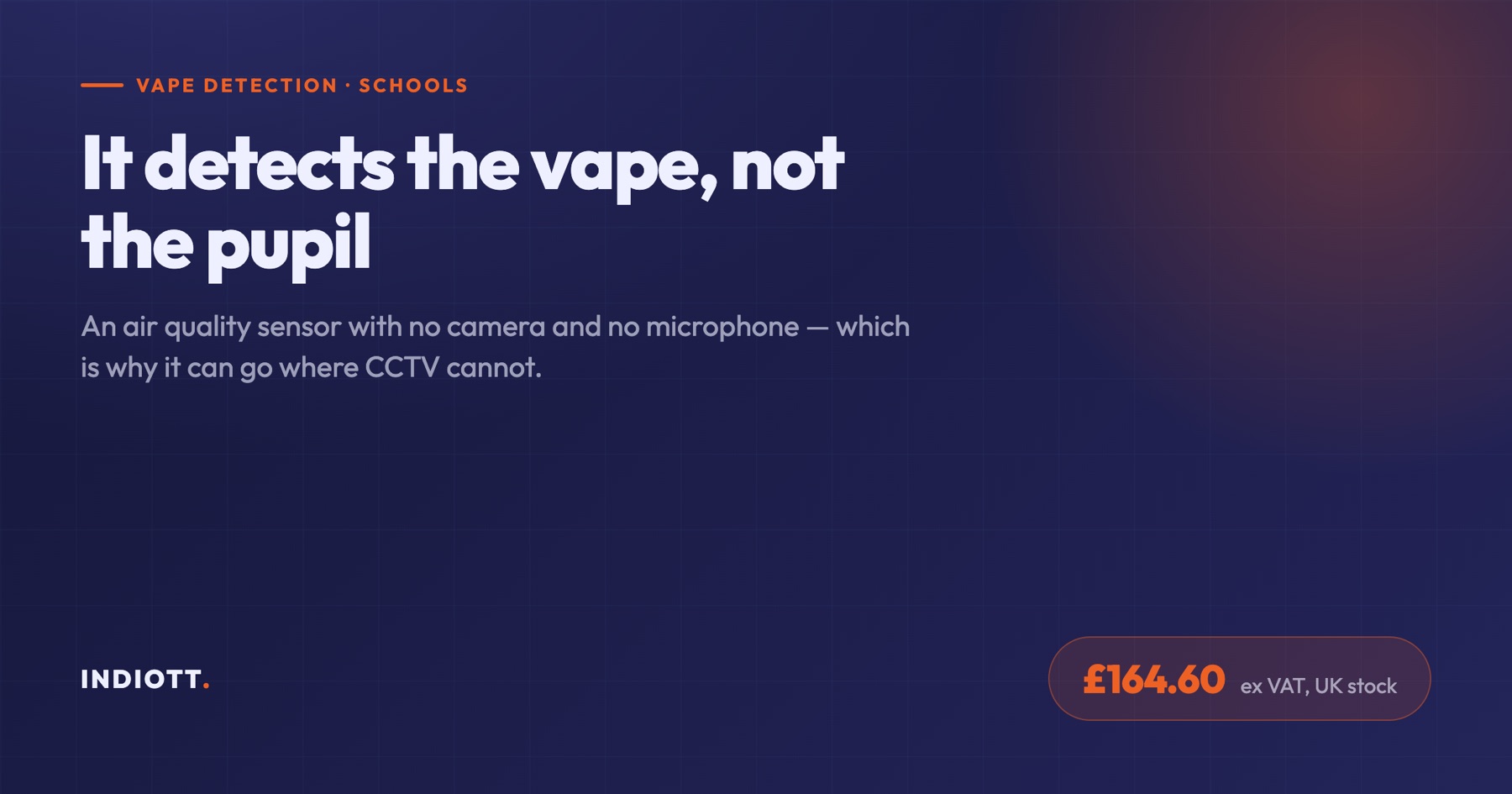
Short answer: a vape detector is an air quality sensor, not a camera. It watches for the particulate and TVOC signature of an exhaled vape and raises an alert, which is what lets you put one in a toilet block where a camera would be unlawful and unthinkable. The Milesight GS601 (£164.60 ex VAT) measures temperature, humidity, TVOC, PM1.0, PM2.5, PM10 and a vape index, and its specification lists no camera and no microphone.
Before spending anything, be clear about what the device does and does not deliver. A vape detector tells you that a vaping event happened, where, and when. It does not tell you who. Schools that expect an identification tool are disappointed; schools that use it to target supervision and evidence a pattern get value from it.
On this page:
- How big is the problem in UK schools?
- How does a vape detector actually work?
- What the GS601 measures
- Privacy: why this is not CCTV
- The install constraint nobody mentions
- Where to mount them, and how many
- Turning alerts into a policy that works
- Frequently asked questions
How big is the problem in UK schools?
Around one in fourteen 11 to 17 year olds currently vapes, and among 16 to 17 year olds it is closer to one in eight. Those are the headline findings of the 2025 ASH Smokefree GB Youth Survey, a YouGov survey of 3,044 young people with 2,746 respondents aged 11 to 17.
The detail matters more than the headline. ASH reports that 20% of 11 to 17 year olds have ever tried vaping, an estimated 1.1 million; 7% currently vape, an estimated 400,000; 4% vape more than once a week; and 3% vape daily, an estimated 160,000 children. Prevalence rises sharply with age: 5% of 11 to 15 year olds currently vape against 12% of 16 to 17 year olds.
Two further findings shape how a school should respond. Ever-smoking among young people rose from 14% in 2023 to 21% in 2025, so this is not simply displacing tobacco. And 63% of young people now believe vaping is as or more harmful than smoking, which means the awareness message has largely landed and the remaining behaviour is not driven by ignorance.
The legal backdrop changed too. Since 1 June 2025 it has been an offence to sell or supply single-use vapes in England under the Environmental Protection (Single-use Vapes) (England) Regulations 2024, with equivalent measures across the rest of the UK. Disposables have not disappeared from school bags, but the supply route has changed.
How does a vape detector actually work?
A vape detector watches the air for a specific combination of changes and decides that combination means vaping. An exhaled vape cloud is mostly propylene glycol and vegetable glycerine aerosol, which reads as a sudden spike in fine particulate, accompanied by a rise in total volatile organic compounds and usually a small bump in humidity.
None of those signals alone is conclusive. Aerosol deodorant spikes particulate. A cleaner’s product spikes TVOC. A hot shower spikes humidity. What a vape detector does is look at the pattern and its speed, which is why the GS601 exposes a dedicated vape index alongside the raw measurements rather than just reporting particulate.
The practical consequence is that no vape detector is infallible, and any procurement that assumes zero false positives is set up to fail. Treat an alert as a prompt to look, in the same way a fire alarm panel prompts an investigation rather than proving there is a fire.
What the GS601 measures
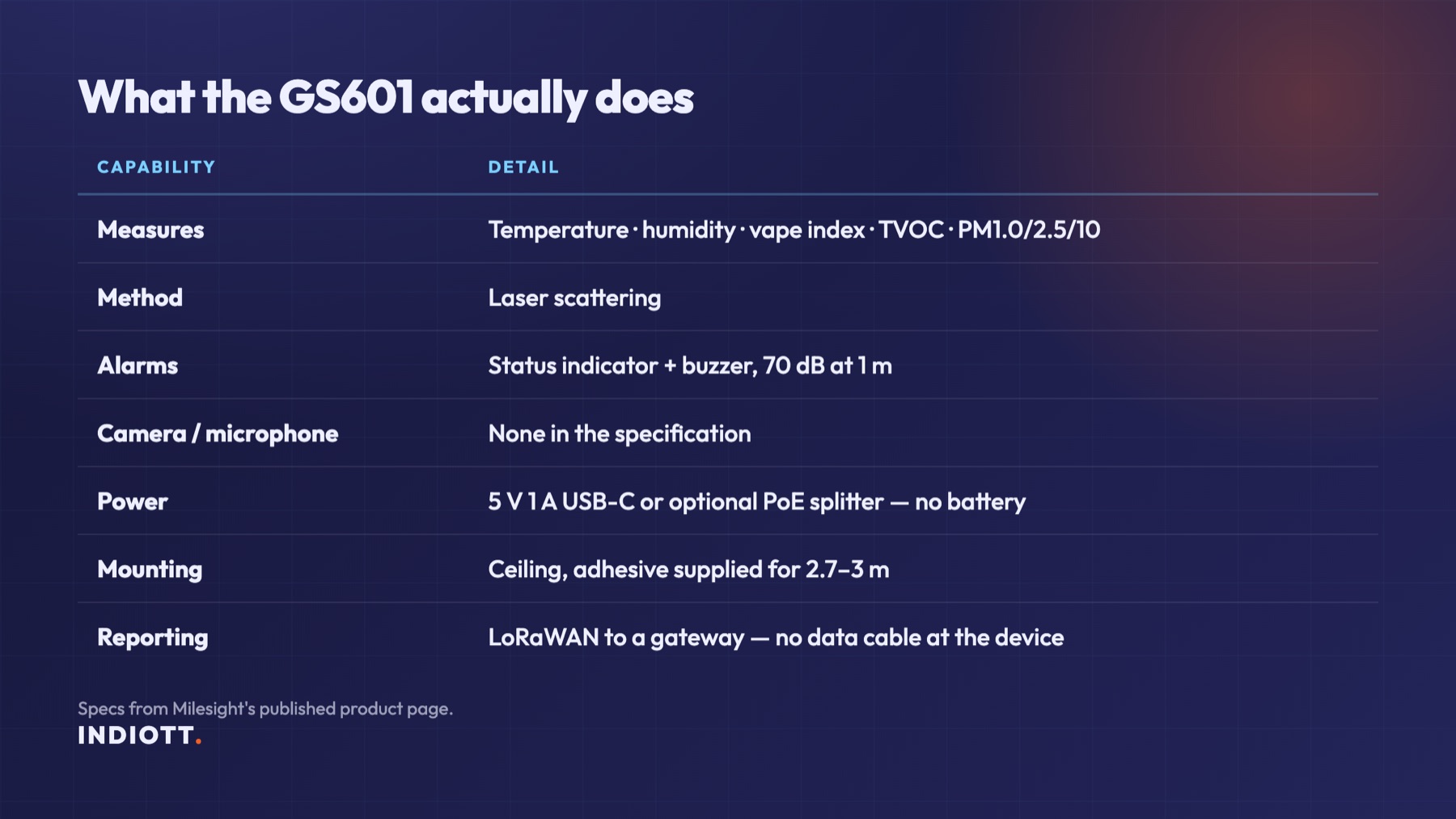
The GS601 is the vape detector we stock. Specifications are from Milesight’s published product page; the price is live UK stock ex VAT.
- Sensors — temperature, humidity, vape index, TVOC, and PM1.0, PM2.5 and PM10 particulate, using laser scattering detection.
- Alarms — one status and alarm indicator plus one buzzer rated 70 dB at 1 m.
- Power — 5 V 1 A over USB-C, or an optional PoE splitter. There is no battery option.
- Mounting — ceiling mount, with 3M adhesive supplied for 2.7 to 3 m ceilings.
- Size — Ø128 × 40 mm, with an internal antenna, reporting over LoRaWAN.
- Price — £164.60.
Because it reports over LoRaWAN, each vape detector needs a gateway within range rather than a network cable back to a switch. In a school that usually means one gateway serving a whole block. Our gateway buyer’s guide and LoRaWAN primer cover the receiving side.

Privacy: why this is not CCTV
The specification contains no camera and no microphone. That single fact is what makes a vape detector deployable in the one place the problem concentrates, which is the toilet block, and it is the first thing to put in front of governors, staff and parents.
A vape detector of this type produces environmental readings: particulate counts, TVOC levels, temperature, humidity and a derived vape index, each with a timestamp and a room name. It captures no image, no audio and nothing that identifies an individual. Compared with any camera-based approach, the data protection footprint is very small.
Small is not zero, and this is not legal advice. If an alert is used alongside other information, such as a supervision log, to reach a conclusion about a named pupil, your school is processing personal data and your data protection officer should have signed off the approach in advance. Write the retention period down, decide who can see the alerts, and put the detectors in your privacy notice before switching them on, not after a parent asks.
Be equally straightforward with pupils. Schools that announce where each vape detector is and what it records generally see the behaviour move or reduce; schools that install them quietly tend to face a trust problem when they are discovered, which costs more than the detection was worth.
The install constraint nobody mentions
This vape detector needs permanent power at ceiling level. It runs on 5 V USB-C or a PoE splitter, and there is no battery variant, which is a genuine constraint in a Victorian toilet block with a single light circuit and no data cabling.
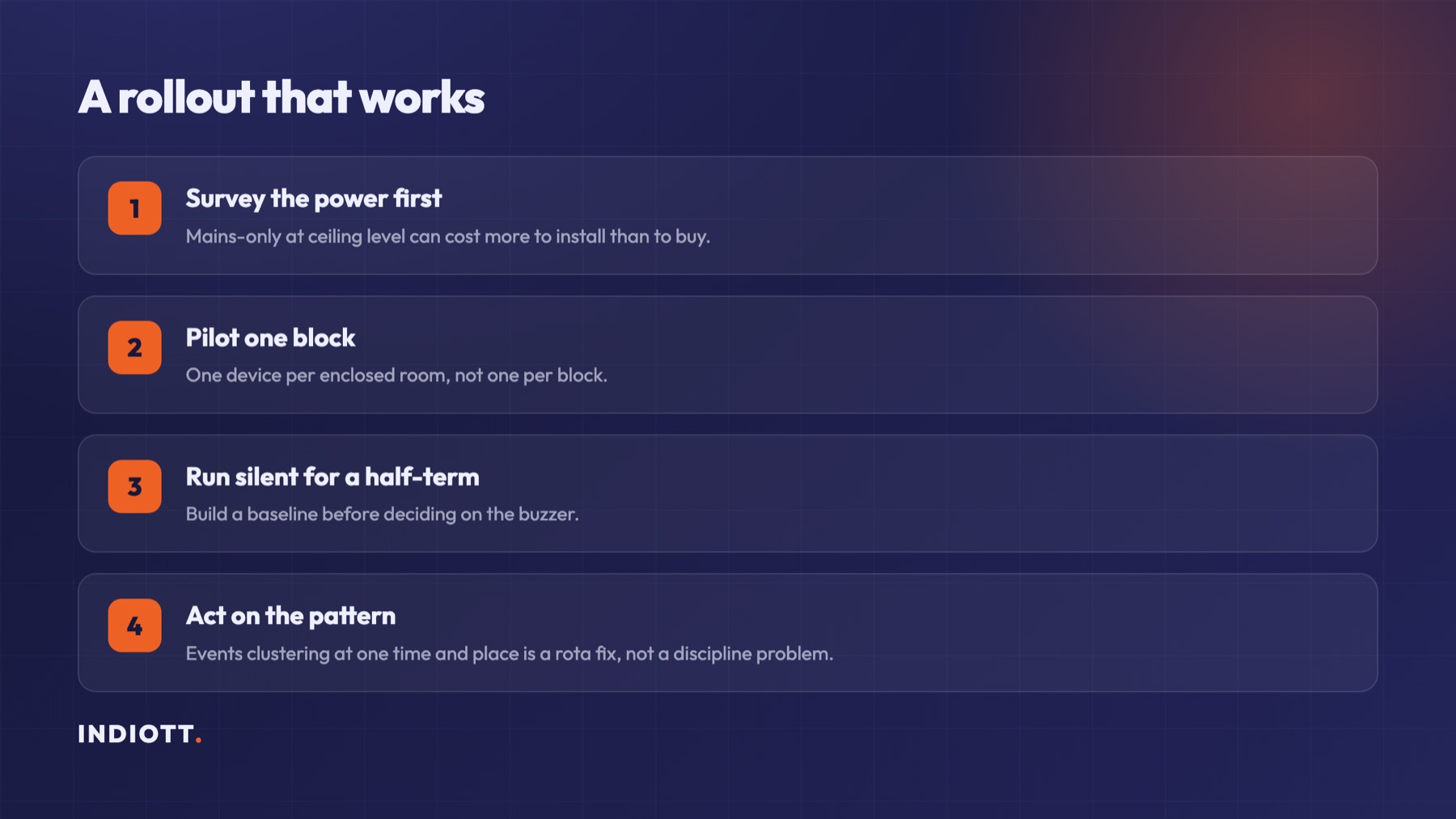
Budget for that honestly. In a building with structured cabling in the ceiling void, a PoE splitter is straightforward. In a building without, you are asking an electrician for a fused spur and a USB supply per location, and on a multi-block secondary that cost can approach the hardware cost. Get it surveyed and priced before committing to a rollout number.
The upside of mains power is that reporting is not rationed to preserve a battery, so the device can sample continuously rather than on a duty cycle. For an event that lasts seconds, continuous sampling is the difference between catching it and missing it, and a battery-powered vape detector would face a real trade-off here.
Where to mount them, and how many
Start with three or four locations, not the whole estate. The places a vape detector earns its cost are toilet blocks, changing rooms, stairwells and any enclosed corridor with poor sightlines, which is exactly the list Milesight positions the product for.
Mount the vape detector on the ceiling near the centre of the space, because the aerosol rises and disperses. Avoid mounting directly above a hand dryer, an extract grille or an open window, because forced air movement dilutes the plume before it reaches the sensor and produces exactly the false negatives that make people distrust the system.
On numbers, one vape detector per enclosed room is the honest answer for a toilet block, since a device in the lobby will not reliably see an event behind a closed cubicle door. That has a direct bearing on cost: a six-cubicle block is not a one-device problem. Pilot one block, measure the detection rate against what supervision already tells you, then scale.
Turning alerts into a policy that works
A vape detector does not change behaviour; the response to its alert does. Decide before installation who receives an alert, how quickly someone attends, and what happens when they do. An alert that lands in an unmonitored inbox is money spent on a graph.
The buzzer is a policy decision in itself. Set to sound, it interrupts the behaviour immediately and acts as a deterrent, but it also tells pupils exactly where the threshold is and invites experimentation. Set to silent, it preserves the data for pattern analysis and targeted supervision. Most schools we speak to start silent for a half-term to establish a baseline, then decide.
Use the pattern rather than the incident. Data showing that 70% of events occur in one block between 12:20 and 12:40 is a rota problem with a cheap solution. Our guides to indoor air quality monitoring and people counting sensors cover the wider estate-monitoring picture that this fits into, and smart radiator retrofits covers another common school sensor project.
Frequently asked questions
Can a vape detector identify which pupil was vaping?
No. It reports that an air quality event occurred in a named room at a given time. It has no camera and no microphone, so identification still depends on staff attending or on other information the school already holds.
Is it legal to put a vape detector in a school toilet?
The device captures no images or audio, which is why it can go where a camera cannot. That said, how you use the alerts is what engages data protection law, so involve your data protection officer and update your privacy notice before deployment. This is general information, not legal advice.
Will it false-alarm on deodorant or hairspray?
Aerosols raise particulate and TVOC, so any air quality device can be triggered by them. The GS601 derives a dedicated vape index from the combination of signals rather than reacting to particulate alone, which reduces but does not eliminate false positives. Plan for investigation rather than automatic sanction.
Does a vape detector need a network cable?
No. It reports over LoRaWAN to a gateway, so no data cabling is needed at the device. It does need permanent power, either 5 V USB-C or a PoE splitter, which is the real installation constraint.
How many vape detector units do I need for one toilet block?
Plan on one per enclosed room rather than one per block. A device in a shared lobby will not reliably detect an event behind a closed cubicle door, and under-specifying here is the most common cause of a disappointing pilot.
Should the vape detector buzzer be switched on?
It depends on your aim. Sounding it deters immediately but reveals the detection threshold. Silent operation builds a clearer picture of when and where events happen. Running silent for a half-term first gives you a baseline to make that decision from.
The bottom line
Buy a vape detector to target supervision, not to catch individuals, and say so publicly. Survey the power situation before you count devices, because a mains-only ceiling sensor in an old toilet block can cost more to install than to buy. Pilot one block silently, look at when the events cluster, and let the pattern rather than the alert drive the response. The GS601 is £164.60 ex VAT in live UK stock — browse the range, or send us a site plan and we will spec the coverage and quote within one working day.
Next step
Get a priced kit list for your site
Answer three quick questions and tell us where to send it. An engineer replies within one working day with the parts, the prices and the lead time.
Rather talk it through? Call 023 9223 3611
Received. An engineer has it.
You will hear back within one working day with the parts, the prices and the lead time. A confirmation is on its way to your inbox.
If it is urgent, call 023 9223 3611.