Radar Fall Detection for Care Homes: What the VS373 Sees, and What It Costs
Last updated: 15 September 2026
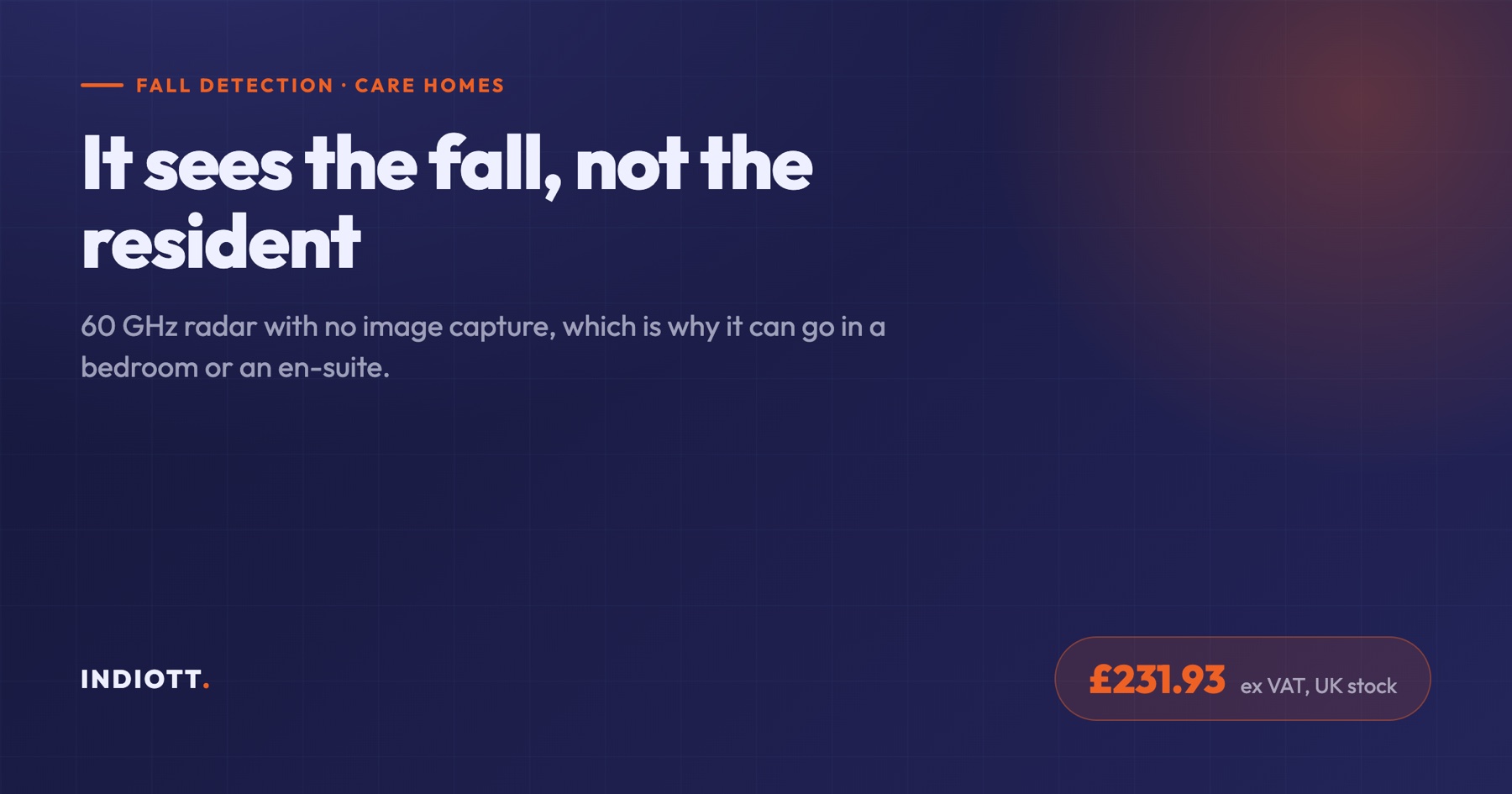
Short answer: radar fall detection lets you monitor a bedroom or an accessible toilet without putting a camera in it. The Milesight VS373 (£231.93 ex VAT) uses a 60 GHz radar array with no image capture at all, covers between 2 m × 2 m and 4 m × 5 m depending on mounting height, and reports falls, bed presence, room occupancy and extended inactivity over LoRaWAN.
The reason this technology matters in care is not detection for its own sake. It is time on the floor. A resident who falls at two in the morning and is found at seven has had a very different night from one found in four minutes, and nothing about the fall itself changed between those two outcomes.
On this page:
- How common are falls in older people?
- How does radar fall detection work?
- What the VS373 detects
- Dignity: why radar and not a camera
- Where to install, and the coverage trade-off
- Power, and the honest install cost
- Making the alert mean something
- Frequently asked questions
How common are falls in older people?
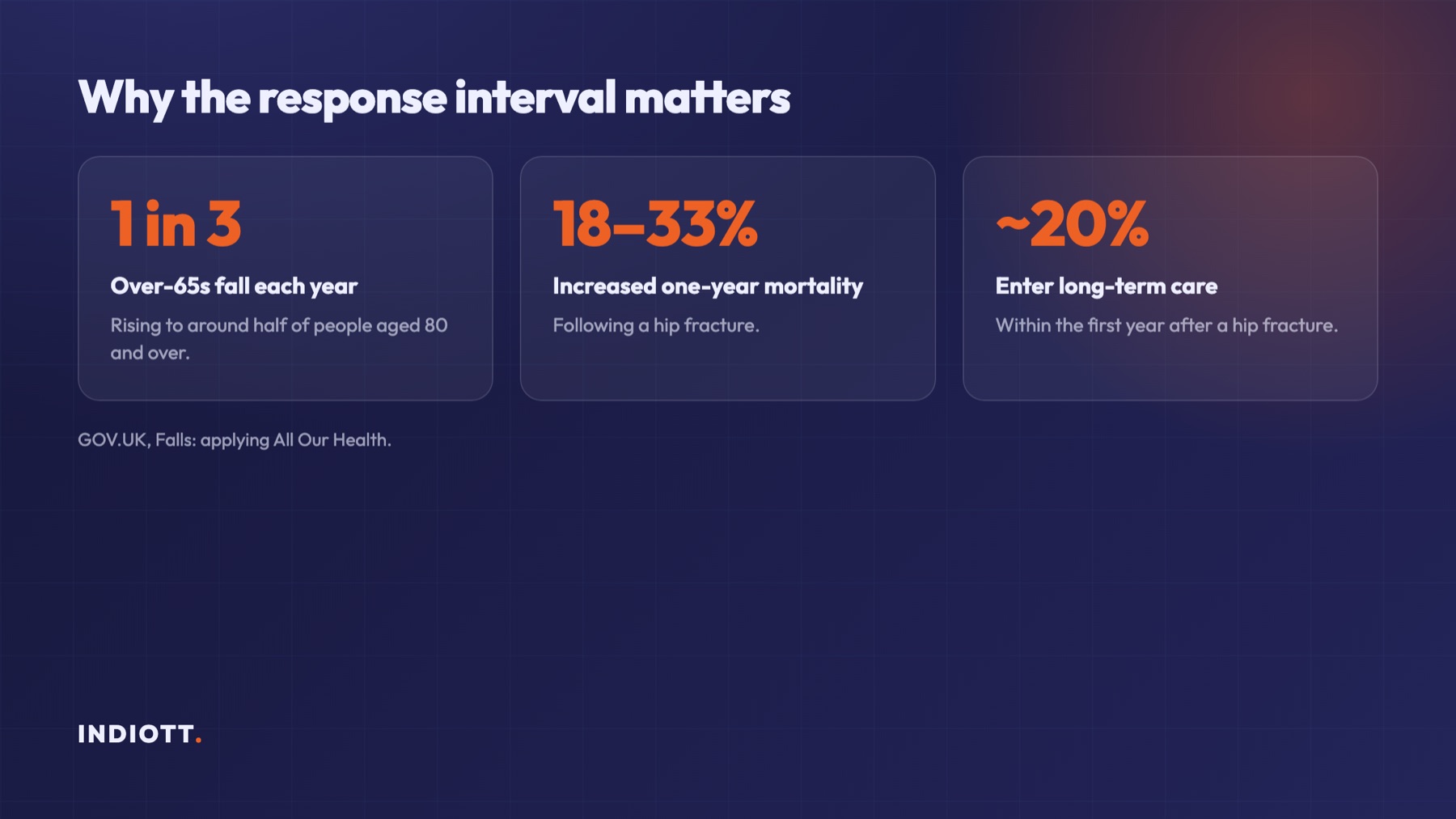
About a third of people aged 65 and over, and about half of people aged 80 and over, fall at least once a year. Those figures come from the UK government’s Falls: applying All Our Health guidance, which is the standard reference for the population picture.
The same source puts the scale of the consequences in context. There were around 220,160 emergency hospital admissions related to falls among patients aged 65 and over in 2017 to 2018, with around 146,665 of those, or 66.6%, aged 80 and over. Falls in hospitals are the most commonly reported patient safety incident, with more than 240,000 reported across acute hospitals and mental health trusts in England and Wales.
The outcomes after a serious fall are what justify investment. Hip fractures alone account for 1.8 million hospital bed days and £1.1 billion in hospital costs every year, with an increased one-year mortality of between 18% and 33% following hip fracture, and around 20% of hip fracture patients entering long-term care within the first year.
No sensor prevents a fall. What fall detection changes is the interval between the fall and the response, and in a population where a fifth of hip fracture patients lose their independence within a year, that interval is worth engineering.
How does radar fall detection work?
Radar fall detection measures the shape and motion of what is in the room without forming a picture of it. The device transmits at 60 GHz, receives the reflections, and builds a coarse point cloud of moving mass. Software then classifies what that motion means, and a fall detection event is one of the classes.
A fall has a distinctive signature: a rapid vertical drop followed by a body remaining at floor level. That is quite different from someone sitting down, lying on a bed, or bending to pick something up, and the discrimination between those cases is where the processing effort goes.
Radar fall detection has two practical advantages over the alternatives in a care setting. Unlike a wearable pendant, it needs nothing from the resident, which matters because the residents most likely to fall are often the least likely to wear or press a device. Unlike a camera, it produces no image, so it can go in a bedroom or a bathroom.
Milesight claims up to 99% fall detection accuracy for the VS373 through radar and AI algorithms. Treat that as a vendor figure from a controlled test rather than a guarantee for your rooms, and validate it during a pilot before it goes into a care plan.
What the VS373 detects
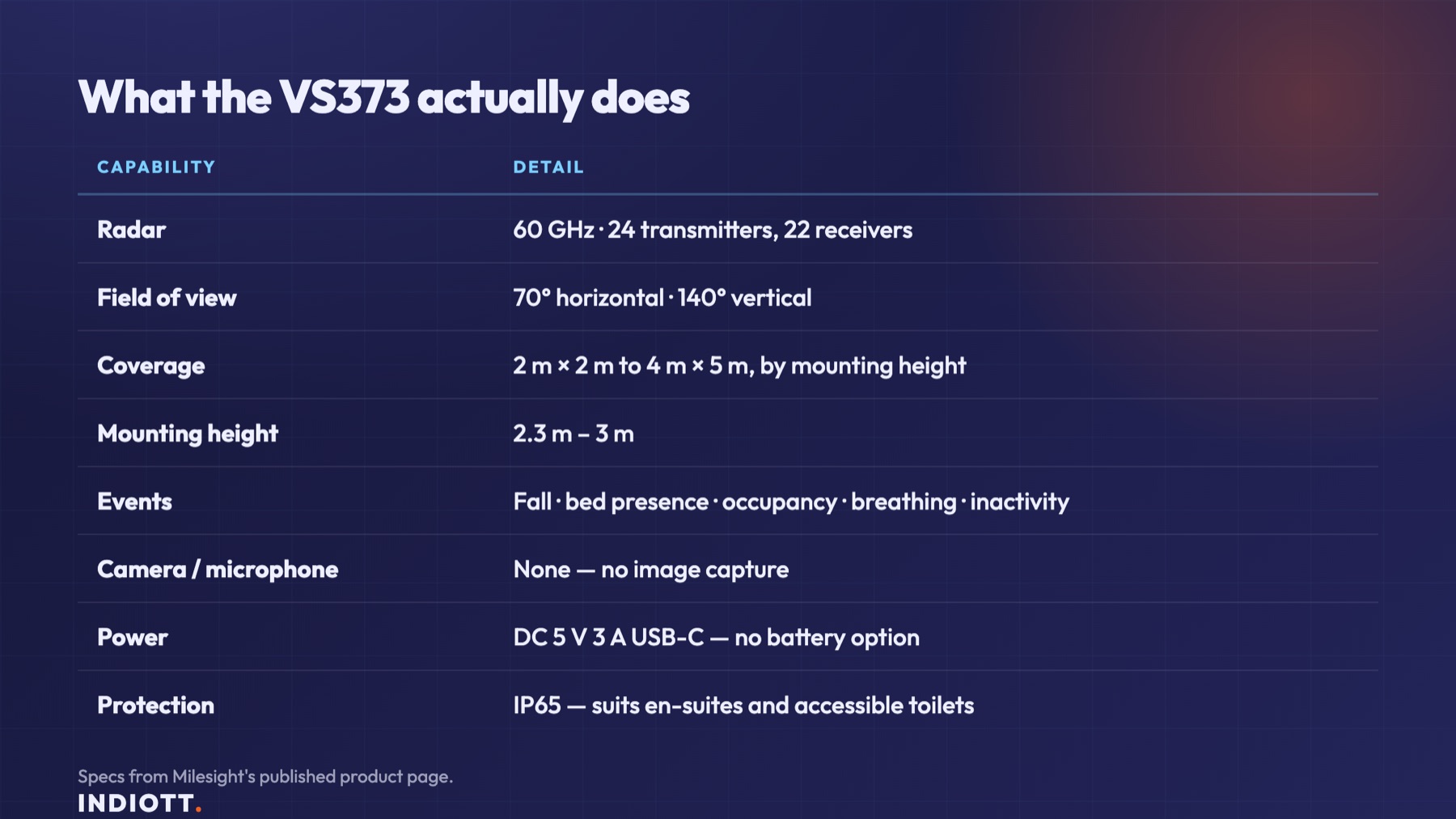
The VS373 is the fall detection sensor we stock. Specifications are from Milesight’s published product page; the price is live UK stock ex VAT.
- Radar — 60 GHz with 24 transmitters and 22 receivers, field of view 70° horizontal and 140° vertical.
- Coverage — 2 m × 2 m up to 4 m × 5 m, depending on installation height.
- Mounting height — recommended 2.3 m to 3 m.
- Events — fall detection, bed presence, room occupancy, breathing detection, extended inactivity, multi-bed presence and human in-place detection.
- Imaging — contactless with no image capture; no camera and no microphone.
- Power — DC 5 V 3 A over USB-C. There is no battery option.
- Protection — IP65, 114 × 84 × 15 mm.
- Price — £231.93.
The fall detection event list is worth reading twice, because several of those outputs are useful independently of falls. Bed presence tells you whether someone has got up in the night. Extended inactivity flags a resident who has not moved when they normally would. Room occupancy supports night checks without opening a door and waking someone.
Dignity: why radar and not a camera
A camera in a resident’s bedroom or bathroom is almost never proportionate. A device with no image capture changes that calculation entirely. This is the argument that gets a fall detection project past relatives, staff and a safeguarding lead.
The VS373 produces classifications and timestamps, not pictures. There is no footage to store, no footage to be requested, and no footage that could be shared inappropriately. For a bathroom or a bedroom, that is the difference between a scheme that can be justified and one that cannot.
It is still personal data, and it still needs doing properly. A record that a named resident fell at 02:14 is health-related information about an identifiable person. That means a data protection impact assessment, a lawful basis, a retention period, and a decision about who can see it. Involve your data protection lead early, and where the resident lacks capacity, follow your usual best-interests process. This is general information, not legal advice.
Tell residents and families what the device does in plain terms: it watches the shape of movement in the room, it cannot see them, and it raises an alarm if someone falls. Homes that explain it that way tend to find families supportive rather than suspicious.
Where to install, and the coverage trade-off
Fall detection coverage and mounting height are linked, so the room decides the number of devices. The quoted range runs from 2 m × 2 m to 4 m × 5 m within the installation height, mounted between 2.3 m and 3 m.
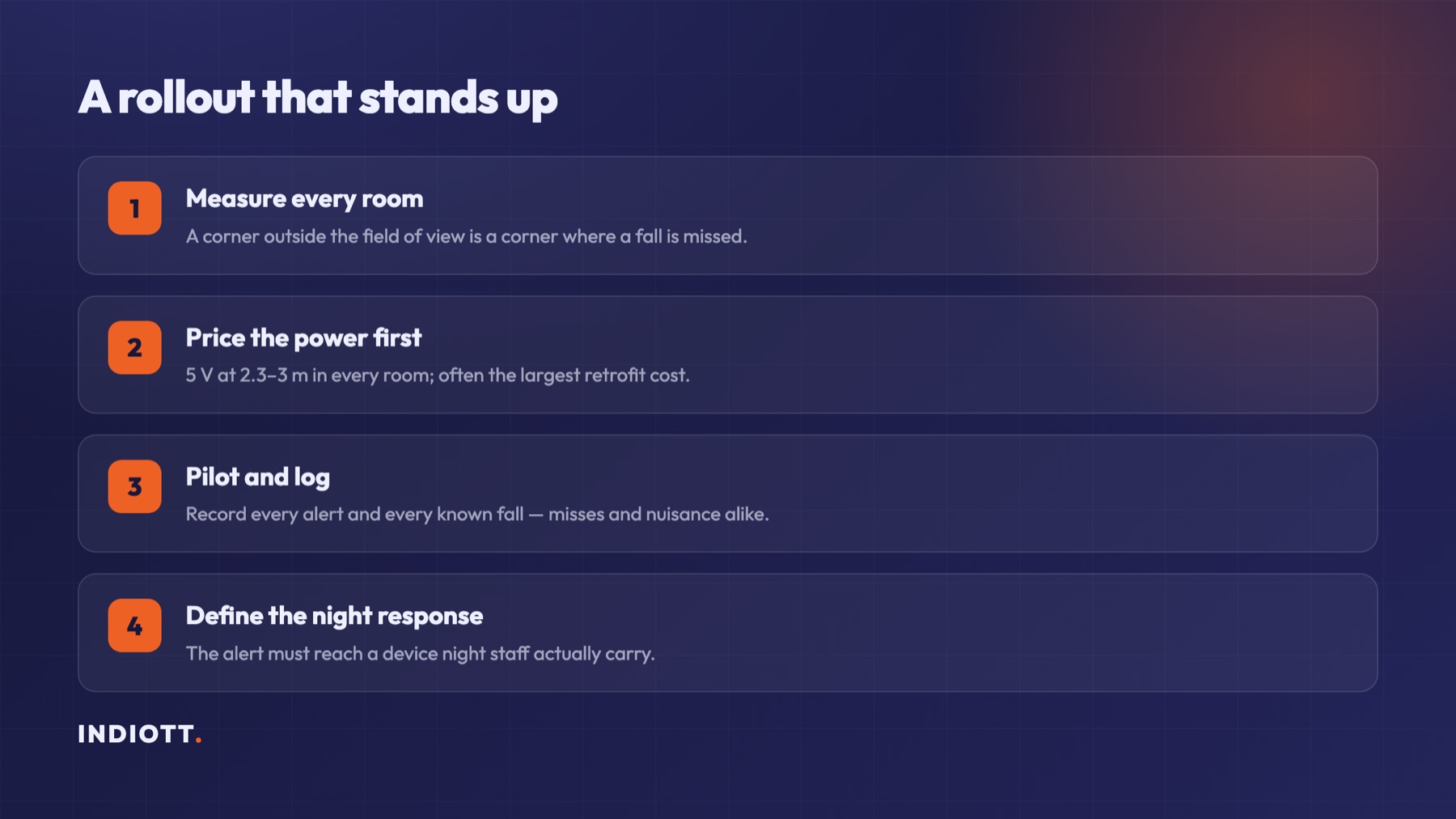
In practice that means a standard single bedroom is usually a one-device room, while a large or awkwardly shaped room may not be. Measure before you order, and remember that a corner of the room outside the field of view is a corner where a fall will not be detected, which is worse than no system if staff assume total coverage.
The highest-value locations are not always bedrooms. Accessible toilets and en-suite bathrooms are where falls concentrate and where nobody can be watching, and they are exactly the rooms a camera cannot enter. The IP65 rating is what makes the bathroom case workable. Our VS330 bathroom occupancy sensor covers the simpler occupancy-only case at £67.34 where full fall detection is not needed.
Site the fall detection unit away from a curtain track, a hoist rail or a wardrobe will sit inside the field of view, and keep the device clear of anything that vibrates, since motion is the signal being measured.
Power, and the honest install cost
This fall detection sensor needs 5 V at 3 A over USB-C and has no battery option. That is a permanent supply at 2.3 m to 3 m on a wall or ceiling in every monitored room, and in an older care home it is the line item that surprises people.
Price the fall detection scheme properly. Twenty rooms of hardware is £4,638.60 ex VAT, and the electrical work to get a fused spur and a USB supply to twenty high-level positions can be a comparable figure depending on the building. Get an electrician to walk the corridor before you commit to a room count.
The compensation is that mains power means continuous radar sampling rather than a battery-preserving duty cycle. For an event that happens in under a second, continuous sensing is not a luxury. It also means no battery replacement programme across a home full of ceiling-mounted devices, which would be its own recurring cost.
Reporting is over LoRaWAN, so no data cabling is needed at the device and one gateway typically serves a floor or a wing. Our gateway buyer’s guide and LoRaWAN primer cover that side.
Making the alert mean something
An alert with no defined response is a liability rather than an improvement. Decide before installation where the alert lands, what the target attendance time is, and what gets recorded when someone attends.
Nights are the case to design for, because that is when staffing is thinnest and when an undetected fall turns into hours on the floor. If the alert goes to a device that a night staff member actually carries, the system works. If it goes to a screen in an office nobody sits in overnight, it does not.
Use the secondary outputs too. Bed presence and extended inactivity data, gathered over weeks, shows which residents are getting up repeatedly at night, and that pattern is often visible well before the fall that puts someone in hospital. Fall detection that only ever reports falls is being under-used.
Finally, validate during a pilot. Run a small number of rooms, log every alert and every known fall, and compare. You are looking for both missed events and nuisance alerts, and you want that evidence before the system is written into anyone’s care plan.
Frequently asked questions
Does fall detection radar record video or audio?
No. The VS373 is a contactless radar device with no image capture, and its specification lists no camera and no microphone. It reports classified events and timestamps, which is why it can be used in bedrooms and bathrooms.
Does fall detection need residents to wear anything?
No. That is the main advantage over a pendant alarm. Radar fall detection needs no cooperation from the resident, which matters most for people with cognitive impairment who may not wear or press a wearable device.
How much area does one fall detection sensor cover?
Between 2 m × 2 m and 4 m × 5 m, depending on the installation height, which Milesight recommends at 2.3 m to 3 m. Measure the room first; a large or L-shaped room may need more than one device or will have blind corners.
Is it accurate enough to rely on?
Milesight quotes up to 99% fall detection accuracy from radar and AI algorithms. That is a vendor figure under test conditions. Validate it in your own rooms during a pilot, logging both missed events and false alerts, before relying on it in a care plan.
Can it be used in a bathroom?
Yes, and that is one of the strongest use cases. The device is IP65 rated and captures no images, so it suits accessible toilets and en-suites where falls concentrate and a camera would be unacceptable.
What power does it need?
DC 5 V at 3 A over USB-C, with no battery option, at a mounting height of 2.3 m to 3 m. Getting that supply to every monitored room is usually the largest single cost in a retrofit, so survey it before setting a room count.
The bottom line
Buy fall detection to shorten time on the floor, not to prevent falls, and be clear with everyone that this is the goal. Radar earns its place because it works in the two rooms that matter most and needs nothing from the resident. Measure each room against the coverage figures, get the power surveyed by an electrician before you count devices, and pilot with a proper log of hits and misses before it enters a care plan. The VS373 is £231.93 ex VAT in live UK stock — browse the range, or send us a floor plan and we will spec the coverage and quote within one working day.
Next step
Get a priced kit list for your site
Answer three quick questions and tell us where to send it. An engineer replies within one working day with the parts, the prices and the lead time.
Rather talk it through? Call 023 9223 3611
Received. An engineer has it.
You will hear back within one working day with the parts, the prices and the lead time. A confirmation is on its way to your inbox.
If it is urgent, call 023 9223 3611.