Wi-Fi HaLow vs LoRaWAN: Which Long-Range Wireless Wins in 2026?
TL;DR: Wi-Fi HaLow vs LoRaWAN is not a close fight once you name the constraint. LoRaWAN wins on reach and fleet size: one gateway covers 15 km line of sight and over 2,000 nodes. Wi-Fi HaLow wins on payload: 1 km line of sight, over 200 nodes, and up to 32 Mbps against LoRaWAN’s tens of kilobits. Peer-reviewed field testing puts HaLow at 4,985 kbps at 50 m but only 141 kbps at 1 km, while LoRa held under 1.6% packet loss at the same 1 km. Pick by payload first, range second.
Last updated: 28 July 2026
On this page
Key takeaways
- Wi-Fi HaLow vs LoRaWAN comes down to payload size, not marketing range claims.
- A LoRaWAN gateway on our shelf covers 15 km line of sight and over 2,000 nodes. The HaLow gateway covers 1 km and over 200 nodes.
- HaLow returns that with throughput: up to 32 Mbps, enough for images, against LoRaWAN’s tens of kilobits.
- Peer-reviewed testing measured HaLow at 4,985 kbps at 50 m falling to 141 kbps at 1 km, with heavy packet loss beyond 500 m. LoRa held packet loss to a maximum 1.6% at 1 km.
- HaLow is IP-native, so a sensor is a network device. LoRaWAN needs a network server, which is a feature when you want a fleet and a cost when you want one camera.

What is Wi-Fi HaLow?
Wi-Fi HaLow is low-power Wi-Fi built on IEEE 802.11ah, operating in the sub-1 GHz band instead of 2.4 or 5 GHz. Dropping below 1 GHz buys penetration and distance that ordinary Wi-Fi cannot reach, at data rates far above any LPWAN. The Wi-Fi Alliance describes roughly 1 km of range, narrowband OFDM channels, native IP support, several device power-saving modes, and coin-cell operation measured in months or years.
The phrase that matters in that list is native IP support. A HaLow sensor gets an IP address and behaves like any other network device, with no proprietary hub and no network server in between. LoRaWAN works the other way: a gateway forwards packets to a network server, which decodes and routes them. That single architectural difference drives most of what follows.
Anyone weighing Wi-Fi HaLow vs LoRaWAN should also know the honest state of the market. LoRaWAN has a decade of deployed hardware, a mature UK ecosystem and network servers to choose from. HaLow is newer, with fewer sensor types on the shelf. That gap is closing, and it is closing fastest where the payload is too big for LoRaWAN.
Wi-Fi HaLow vs LoRaWAN: the head-to-head numbers
Rather than quote spec-sheet maxima from two different vendors, here are two gateways we actually stock and price, read from their own datasheets. It is the fairest comparison we can give you, because both figures come from the same manufacturer.
| LoRaWAN gateway | Wi-Fi HaLow gateway | |
|---|---|---|
| Line of sight | up to 15 km | up to 1 km |
| Urban coverage | about 2 km | indoor and site-scale |
| End nodes per gateway | more than 2,000 | more than 200 |
| Data rate | tens of kbps | up to 32 Mbps |
| Addressing | via a network server | native IP |
| Backhaul | Ethernet and 4G | Ethernet and 4G |
| UK price from, ex VAT | £98.76 | £112.23 |
Read the table as one trade, made twice. LoRaWAN gives you fifteen times the reach and ten times the fleet. HaLow gives you roughly a thousand times the payload. Nothing in Wi-Fi HaLow vs LoRaWAN is subtle once the numbers sit side by side, which is why the decision is usually settled by a single question about what the sensor has to send.

What the field data actually shows
Datasheet range is measured in conditions your site does not have. So the useful evidence in Wi-Fi HaLow vs LoRaWAN is independent field testing, and there is a good peer-reviewed example: Kane, Liu, McKague and Walker, An Experimental Field Comparison of Wi-Fi HaLow and LoRa for the Smart Grid, published in Sensors in August 2023. They ran both technologies over the same outdoor paths.
- HaLow throughput collapses with distance. Up to 4,985 kbps at 50 m in ideal conditions, but 141 kbps at 1 km with direct line of sight, and 3.55 kbps at 1 km in non-ideal conditions. The paper notes throughput drops sharply past the 200 m mark.
- HaLow packet loss rises past 500 m. Substantial loss at 500 m, and very significant loss at 700 m and 1,000 m. At 200 m loss stayed relatively low.
- LoRa stayed reliable at 1 km. Packet loss was consistently low across configurations, at a maximum of 1.6% with 255-byte packets.
- LoRa is slow by design. 20.4 kbps at spreading factor 7 with 500 kHz bandwidth, down to 0.145 kbps at SF12 with 125 kHz.
- HaLow latency is usable. 8 to 11 ms at 50 to 200 m, rising to 95 ms at 1 km.
- Security is close to free on both. WPA3 cost HaLow at most 248 kbps, and ChaCha20-Poly1305 on LoRa showed no discernible throughput impact.
The authors’ own conclusion is the sentence to keep: for use cases requiring transmission over 1 km with no line of sight, Wi-Fi HaLow has shortcomings, with LoRa performing significantly better. Note also what they did not test. Power consumption was explicitly out of scope, so treat battery-life comparisons between the two as vendor claims, not measured findings.
Six tests that decide it
Run your deployment through these six in order. Most sites get a clear answer by test two, and the rest of the list is confirmation.
- How big is one message? A temperature reading is a few bytes and belongs on LoRaWAN. A snapshot image, a waveform or a firmware update does not fit and belongs on HaLow.
- How far is the furthest node? Past about 1 km, or through significant obstruction, the field data says LoRaWAN. Inside a site boundary, either works.
- How many nodes? Over 200 per gateway starts to favour LoRaWAN, which is rated beyond 2,000.
- How often does it send? LoRaWAN duty cycle limits in EU868 constrain frequent transmission. If you need seconds rather than minutes, that is a HaLow argument.
- Who owns the back end? LoRaWAN needs a network server, self-hosted or subscribed. HaLow is IP-native, so existing network tooling applies.
- What is the power budget? Both claim multi-year battery life on the right duty cycle. Insist on figures for your actual reporting interval, not a best case.

What each one costs in the UK
Gateway cost is not the deciding factor in Wi-Fi HaLow vs LoRaWAN, and it is worth saying so plainly. The two sit within about fourteen pounds of each other. Every price below is the current listed figure on indiott.com, excluding VAT, verified on 28 July 2026.
| Unit | Role | From, ex VAT |
|---|---|---|
| Milesight UG63 Mini LoRaWAN Gateway | 8-channel indoor, 2,000+ nodes | £98.76 |
| Milesight Wi-Fi HaLow Gateway | 200+ nodes, 1 km, up to 32 Mbps | £112.23 |
| Milesight UG65 Semi-industrial LoRaWAN Gateway | 15 km line of sight, 2 km urban | £279.82 |
| Milesight VS135 Ultra ToF People Counter | Supports LoRaWAN, HaLow, cellular and Ethernet | £568.61 |
The real cost difference sits downstream. A LoRaWAN deployment carries a network server, self-hosted or on a subscription. A HaLow deployment carries whatever your IP network already costs, plus the fact that fewer sensor types exist, so a specialist device may simply not be available in HaLow yet.

When to run both
Treating Wi-Fi HaLow vs LoRaWAN as a single sitewide decision is the most common mistake we see. On a mixed estate the answer is usually both, split by what each group of sensors has to send, because the two radios do not compete for the same job.
A typical split: LoRaWAN for the scattered, tiny, long-life estate, which is level sensors in remote chambers, leak detectors under plant, temperature and CO2 across a campus, and anything past a kilometre. HaLow for the dense, data-heavy cluster, which is image-capable counters, higher-frequency reporting, and devices you want addressable on the network directly. Hardware like the VS135, which supports LoRaWAN, Wi-Fi HaLow, cellular and Ethernet in one unit, means the radio can be a deployment decision rather than a purchasing one.
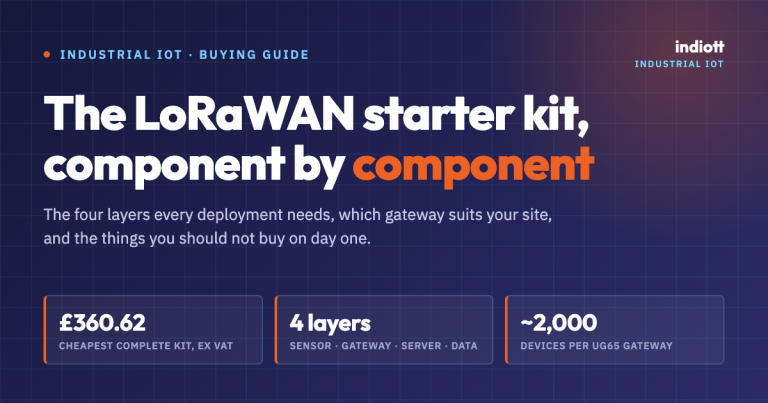
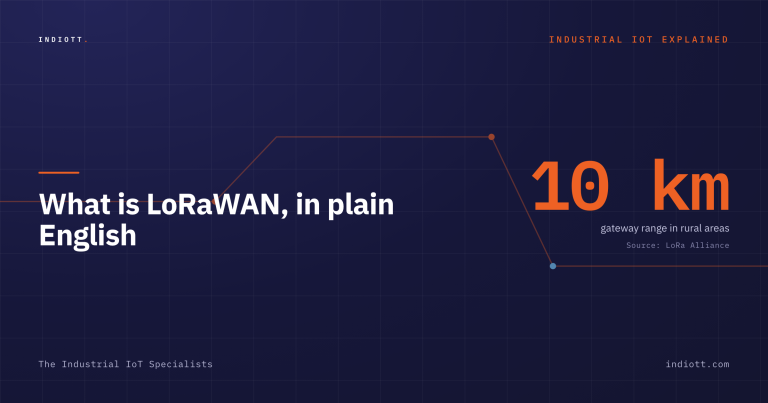
If you are starting from nothing, start with the payload audit in test one and build the network around the answer. Our LoRaWAN starter kit guide covers what to buy first, and what is LoRaWAN covers the fundamentals if the terminology here is new.

Frequently asked questions
Is Wi-Fi HaLow better than LoRaWAN?
Neither is better in general. HaLow carries far more data at shorter range, up to 32 Mbps within about 1 km. LoRaWAN carries tiny payloads much further, up to 15 km line of sight, and supports ten times the nodes per gateway. Choose by the size of one message, then by the distance to the furthest node.
What is the real range of Wi-Fi HaLow?
About 1 km line of sight, but the useful range is shorter. Peer-reviewed field testing found throughput dropping sharply past 200 m, substantial packet loss at 500 m, and only 141 kbps remaining at 1 km even with direct line of sight.
Does Wi-Fi HaLow need a network server like LoRaWAN?
No. HaLow is IP-native, so devices are addressable on your network directly and existing tooling applies. LoRaWAN requires a network server such as The Things Stack or ChirpStack to decode and route packets from the gateway.
Can one sensor use both?
Some can. The Milesight VS135 lists LoRaWAN, Wi-Fi HaLow, cellular and Ethernet as connectivity options on the same unit, which lets you commission on one radio and move to another without replacing hardware.
Which has better battery life?
Both claim multi-year operation at low duty cycles, and the Wi-Fi Alliance cites coin-cell devices lasting months or years. The Sensors field study explicitly excluded power consumption, so ask for figures at your actual reporting interval rather than relying on a headline claim.
Get the radio decision checked
Send us the payload size, the furthest node and the node count, and we will tell you which radio fits and what it costs, inside one working day. Every gateway above is listed with its price and datasheet on our gateway range, or request a quote and we will price the network around your sensors rather than the other way round.
Next step
Get a priced kit list for your site
Answer three quick questions and tell us where to send it. An engineer replies within one working day with the parts, the prices and the lead time.
Rather talk it through? Call 023 9223 3611
Received. An engineer has it.
You will hear back within one working day with the parts, the prices and the lead time. A confirmation is on its way to your inbox.
If it is urgent, call 023 9223 3611.