Bin Fill Level Sensors: Collecting on Data, Not on a Calendar
Last updated: 7 September 2026
In short: A fill level sensor in the lid of a bin turns collections from a calendar into a decision. The technology choice is not about range, because both options easily reach the bottom of a bin. It is about what is in the bin, because laser sensors struggle with dark absorbent surfaces and ultrasonic ones struggle with soft irregular ones.
England’s local authorities managed 25.2 million tonnes of waste in 2024/25, and the recycling rate for waste from households was 43.8% in 2024, down slightly on the year before, according to Defra’s annual figures.
Behind those tonnages sit an enormous number of vehicle movements, and a meaningful share of them are journeys to containers that did not need emptying. Fill level data is how you stop making those journeys.
What does a fill level sensor actually measure?
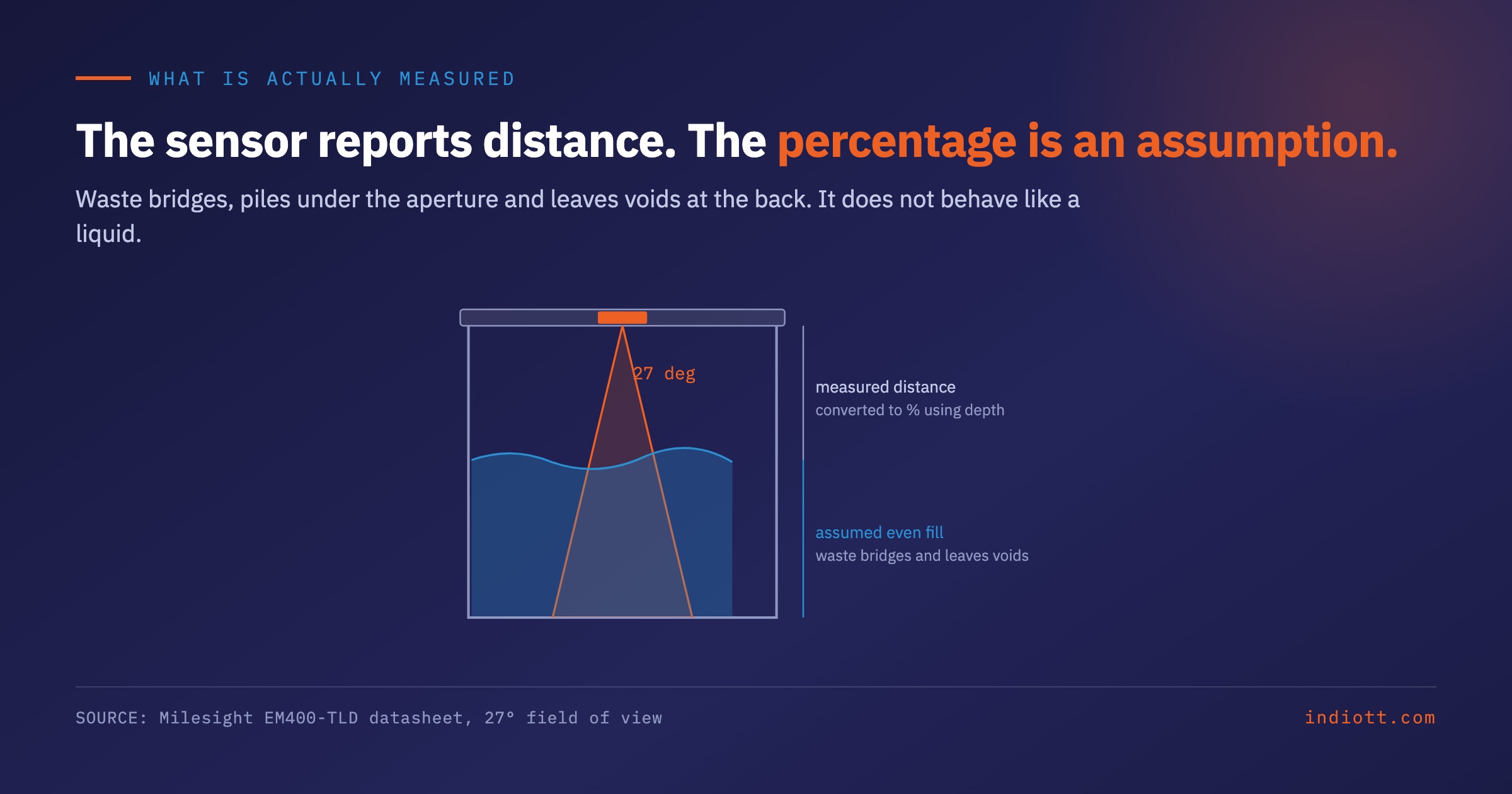
A fill level sensor measures distance, not volume. It sits in the lid, measures how far away the top of the waste is, and the software converts that into a percentage using the container’s known depth.
That conversion is where the assumptions live. An empty bin reads maximum distance, a full one reads minimum, and everything between is interpolated as though waste filled the container evenly, like a liquid.
Waste does not behave like a liquid. It arrives in bags, it bridges, it piles under the aperture and leaves voids at the back. A fill level reading of 60% means the waste directly under the sensor is at 60%, which is a good proxy for a wheelie bin and a poor one for a large open skip.
Understanding that single limitation prevents most disappointment with fill level projects, and it also tells you where to mount the sensor.
Laser time-of-flight against ultrasonic
Both fill level technologies measure time of flight. One sends light, the other sends sound, and the difference in what they bounce off decides which one suits your waste stream.
A laser time-of-flight sensor emits infrared and times the return. It is precise and its beam is comparatively tight. The Milesight EM400-TLD datasheet specifies a 27° field of view, a detection range of 2 to 350 cm, accuracy of ±2 cm between -20 and 70°C, and 1 mm resolution.
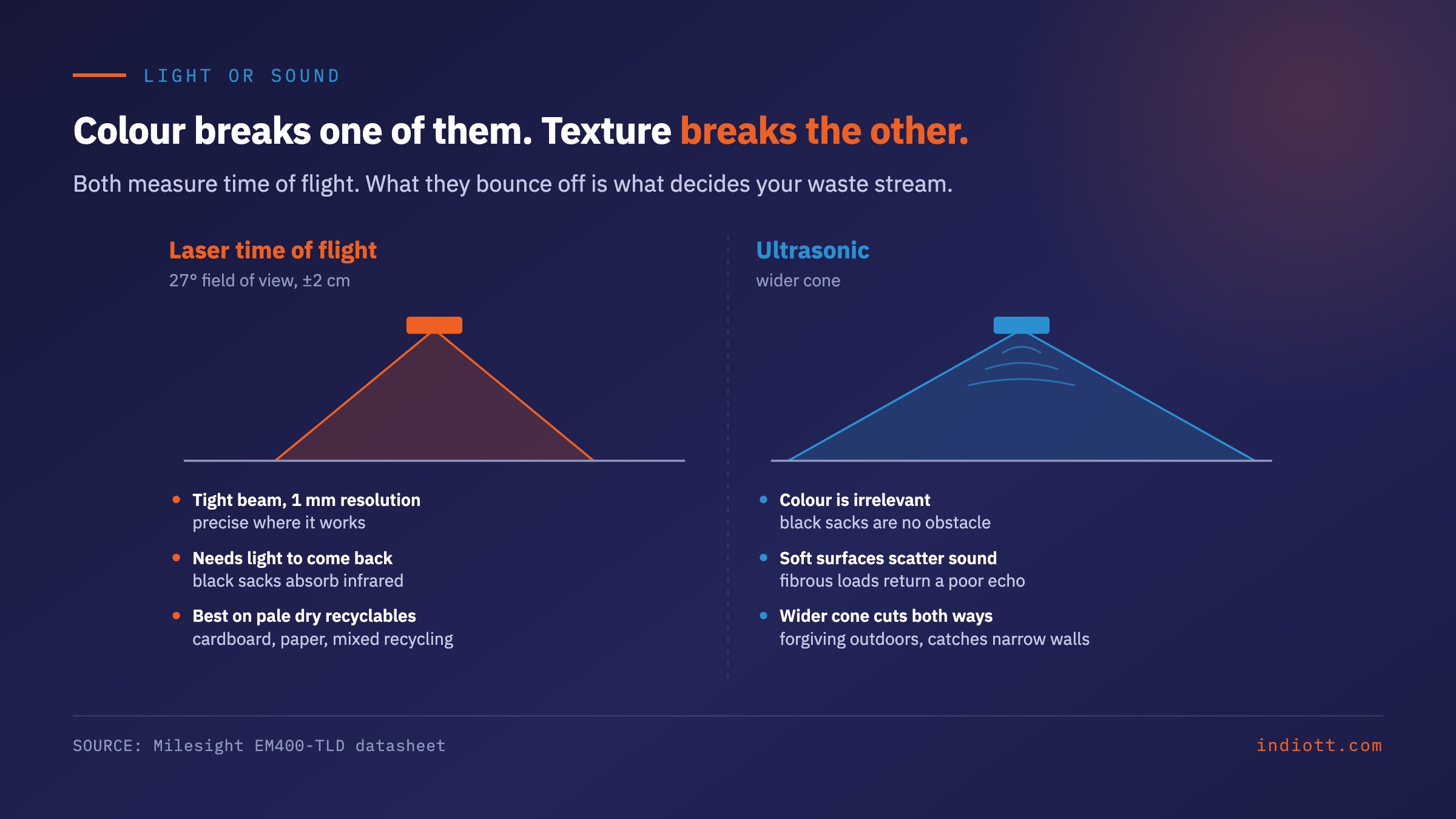
Its weakness is reflectivity. Infrared measurement depends on enough light coming back, and dark matt surfaces absorb rather than reflect. A bin lined with black sacks is close to the worst case for a laser fill level sensor, and readings can come back short, noisy or missing entirely.
Ultrasonic works the opposite way round. Sound does not care what colour the target is, so black sacks are irrelevant. What it cares about is texture and shape, because soft, fibrous and irregular surfaces scatter and absorb sound rather than returning a clean echo.
Ultrasonic beams are also wider, which cuts both ways. A wider cone is more forgiving of a target that is not directly beneath, and less forgiving inside a narrow container, where it starts detecting the walls instead of the contents.
Choosing by what is in the container
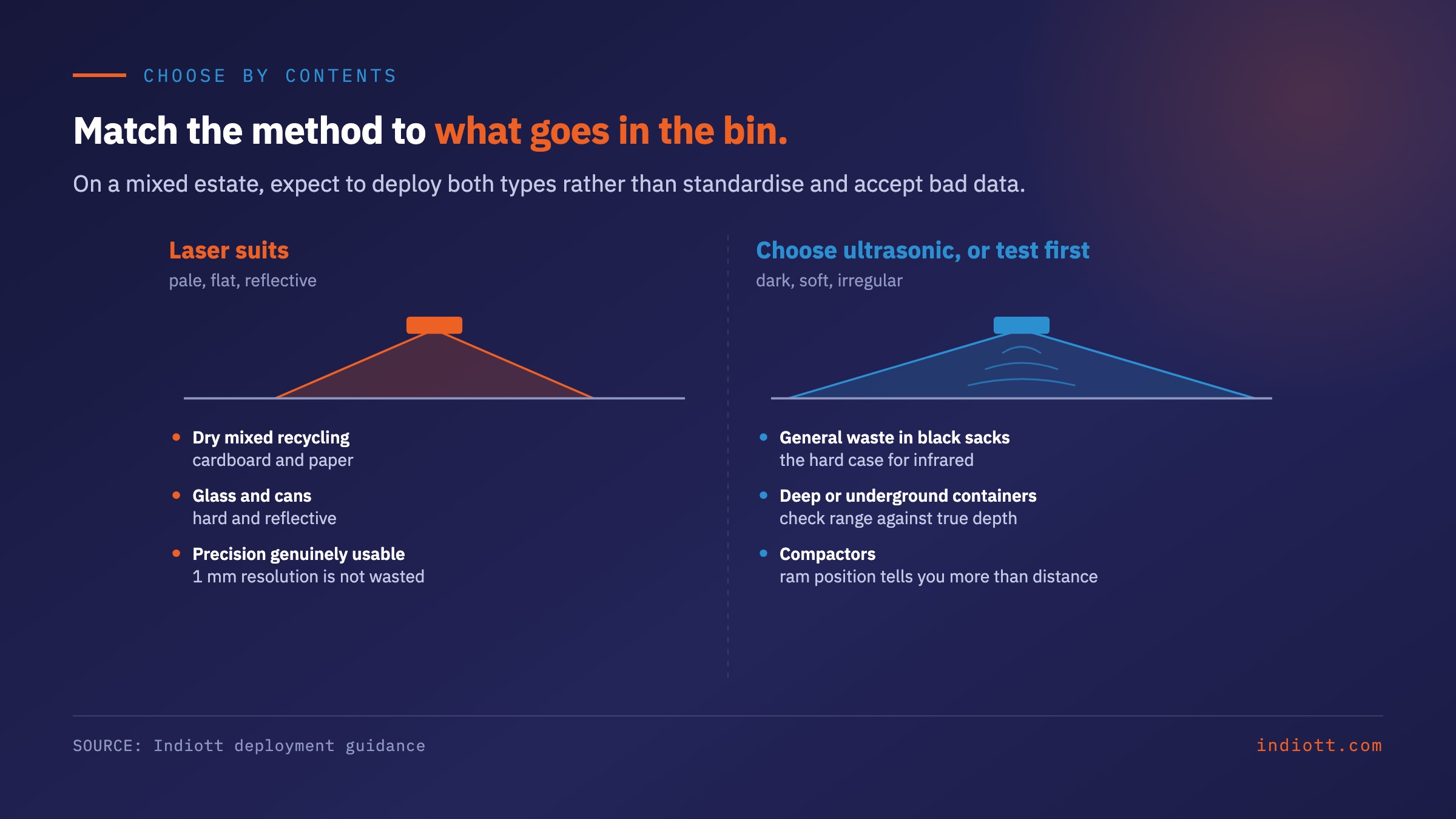
Match the fill level method to the waste stream rather than to a spec sheet preference.
- Dry mixed recycling, cardboard, paper. Pale, reflective and reasonably flat. Laser is excellent here and its precision is genuinely usable.
- General waste in black sacks. The hard case for laser. Ultrasonic is usually the safer fill level choice, or laser with a validated mounting position and expectations set accordingly.
- Glass and cans in a bottle bank. Hard, irregular, highly reflective in places. Both work; the wider ultrasonic cone copes better with a very uneven surface.
- Open skips and large containers. Depth may exceed a short-range sensor entirely. Check the range against the container’s real internal depth, not its nominal size.
- Compactors. Neither is ideal. Pressure or ram position tells you far more about a compactor than a fill level distance reading does.
If the estate has mixed streams, expect to deploy both types rather than standardising on one and accepting bad data on half the fleet.
Underground and semi-buried containers deserve their own check. They are deeper than they look from the surface, and a sensor chosen against the visible portion frequently cannot reach the true base, which produces a container that reports empty forever.
Mounting, and the mistakes that produce nonsense
A fill level sensor goes in the centre of the lid, aimed straight down. That sounds obvious and it is routinely got wrong.
Mounted off-centre, the beam clips the side wall and reports a permanently full bin. Mounted at an angle, it measures a diagonal and reports a distance longer than the true depth. Mounted too close to the aperture, it reads the pile of freshly deposited waste rather than the average.
Check the geometry before ordering. A 27° field of view spreads to roughly half a metre across at one metre of range, so in a container narrower than that the cone is touching the walls before it ever reaches the contents.
Tilt detection earns its place here. The EM400-TLD reports device position as normal or tilt, which tells you the bin has been knocked over, the lid is open, or the unit has been tampered with. All three produce garbage fill level readings, and all three are worth knowing about directly rather than inferring from strange data.
What the data changes operationally
Fill level sensors do not save money by themselves. Changed rounds save money, and the data only helps if somebody is allowed to act on it.
Three patterns deliver most of the value:
Skip the empties. The simplest win. A container below a threshold on collection day comes off the round. This needs no routing software, just a list the driver sees before leaving the depot.
Rebalance the schedule. Weeks of fill level history show which containers are consistently overflowing and which are consistently half empty. Move frequency between them and the total number of collections often falls while service improves.
Right-size the containers. The most valuable and least used. A bin that never exceeds 40% is the wrong size, and swapping it is a permanent saving rather than a routing tweak.
Fly-tipping and contamination alerts are a fill level bonus rather than a reason to buy. A bin that jumps from 20% to 100% in one reporting interval has had something dumped in it.
Running a fill level pilot that proves something
The mistake is fitting sensors to the whole fleet and hoping. A four week pilot on a representative sample answers the questions that decide the full deployment, and it costs almost nothing to run.
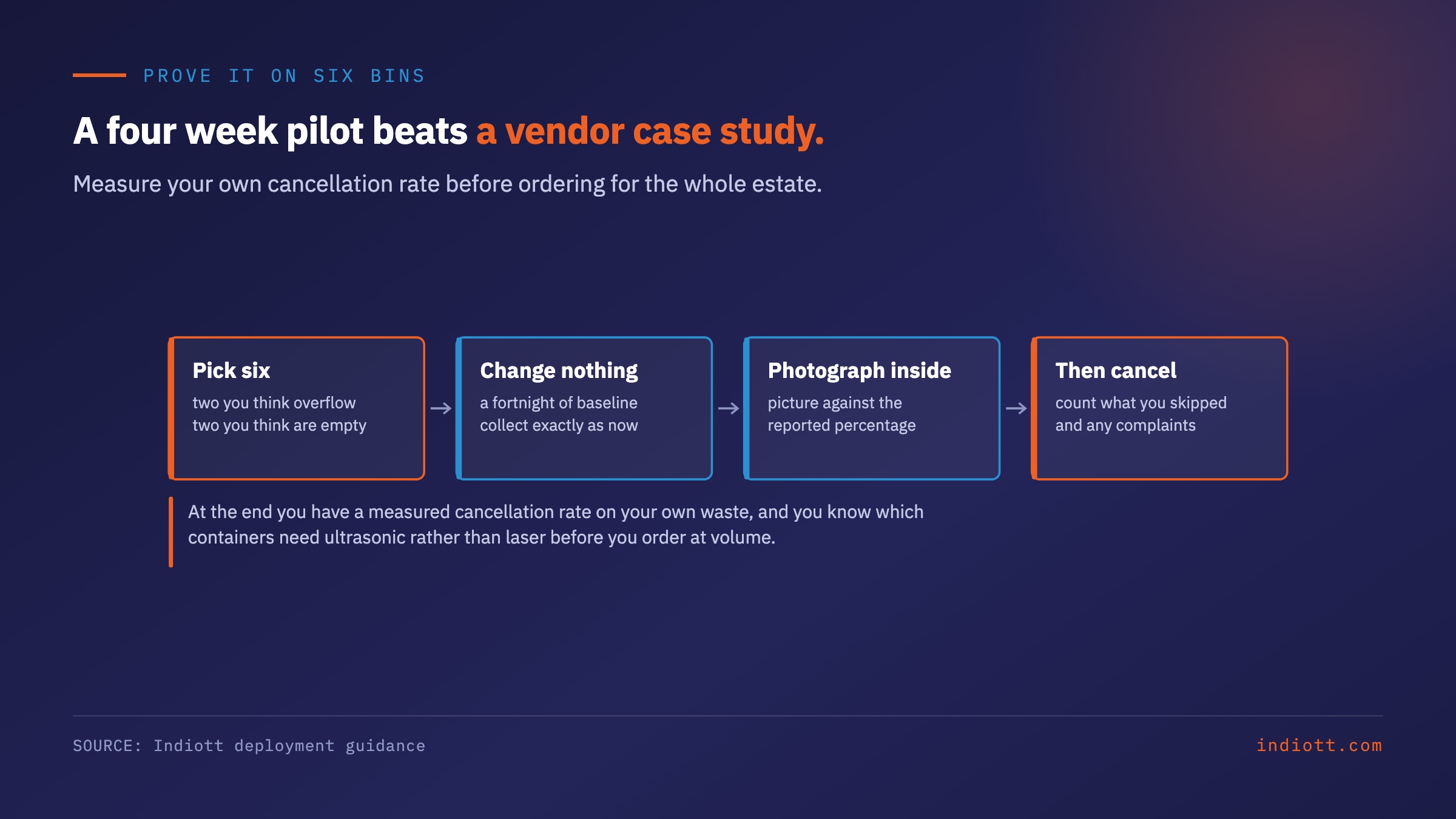
Pick containers you already argue about. Two you believe are always overflowing, two you suspect are always empty, and two of the awkward waste stream. Six is enough to expose whether the fill level readings behave.
Change nothing operationally for the first fortnight. Collect exactly as you do now and simply record what the sensors say. This gives you the baseline, and it is the only chance you get to capture it.
Have someone photograph the inside at collection. A picture against the reported percentage is how you find out whether the fill level figure is trustworthy for that waste stream, and it takes a driver ten seconds.
Then change one thing. Cancel collections below a threshold, and count how many were cancelled and whether a single one produced a complaint or an overflow.
At the end you have a measured cancellation rate on your own waste, not a vendor’s case study, and that number multiplied across the estate is the business case. It also tells you which containers need ultrasonic rather than laser before you order at volume.
Reporting interval and battery life
Fill level changes slowly, which is fortunate, because it means a long reporting interval and a long battery life.
The EM400-TLD carries two 9000 mAh replaceable batteries which the datasheet states can work for up to 10 years without replacement, and it quotes LoRaWAN range up to 15 km line of sight, which comfortably covers a town centre from one well-sited gateway.
Four to six readings a day is plenty for most containers. Hourly reporting gives you a prettier chart, shortens the battery life and changes no decision, because nobody dispatches a vehicle on an hour’s notice.
Set the reporting schedule around the round, not around the clock. A container read hourly through the night has told you nothing new by morning, and it has spent a measurable amount of battery capacity doing it.
Time the readings to the operational day instead. A reading at 05:00 that lands before the round is planned is worth more than twenty-four readings that arrive after the vehicles have left.
Frequently asked questions
How accurate is a fill level sensor?
The distance measurement is accurate to a couple of centimetres. The percentage is only as good as the assumption that waste fills the container evenly, so treat the number as a reliable band rather than a precise figure.
Will a laser sensor work with black bin bags?
Less reliably than with pale materials, because dark matt surfaces absorb infrared. Test it on your actual waste before committing to a fleet, or choose ultrasonic for black sack streams.
Do fill level sensors survive being in a bin?
Lid-mounted units are designed for it, and the EM400-TLD operates from -20 to 70°C. The realistic risks are physical damage during emptying and theft, so mount inside the lid rather than proud of it.
How many collections can fill level data actually save?
It depends entirely on how over-serviced the estate is now. Sites collecting on a fixed calendar with no idea of actual fill typically find a substantial share of visits were unnecessary, but the honest answer is that a month of data on a sample of containers will tell you before you commit.
Can I retrofit to existing bins?
Yes, that is the normal deployment. The sensor mounts inside the existing lid and needs no power or cabling, so a container is out of service for minutes rather than being replaced.
The short version
Pick the sensing method by what goes in the container, not by the datasheet headline. Laser for pale dry recyclables, ultrasonic for black sacks, and a real check of container geometry against the beam angle before you order. Then make sure someone is actually permitted to cancel a collection, because that is where the saving lives.
For related work, our LoRaWAN explainer covers the network side, our tank level monitoring guide covers liquids, where the even-fill assumption genuinely holds, and the level sensor comparison covers choosing between the specific models.
The Milesight EM400-TLD laser distance sensor is priced and in stock. Add it to a quote and we will come back within one working day.
Next step
Get a priced kit list for your site
Answer three quick questions and tell us where to send it. An engineer replies within one working day with the parts, the prices and the lead time.
Rather talk it through? Call 023 9223 3611
Received. An engineer has it.
You will hear back within one working day with the parts, the prices and the lead time. A confirmation is on its way to your inbox.
If it is urgent, call 023 9223 3611.