Milesight EG71: The Building Gateway for BACnet, KNX, Modbus and LoRaWAN
TL;DR: The Milesight EG71 is a building gateway that reads wired building protocols (Modbus RTU and TCP, BACnet MS/TP and IP, KNX) and LoRaWAN sensors in one DIN rail box, adds its own inputs and outputs, and passes everything on over BACnet/IP, Modbus TCP, MQTT or HTTP. It earns its price when a building has several protocols to join up. If you only need LoRaWAN sensors on a BMS, a UG65 or UG56 already does that for a quarter of the cost.
Last updated: 14 September 2026
On this page
Key takeaways
- The EG71 building gateway combines a LoRaWAN gateway, a multi-protocol converter and a remote I/O module in one 123 × 90 × 36 mm DIN rail unit.
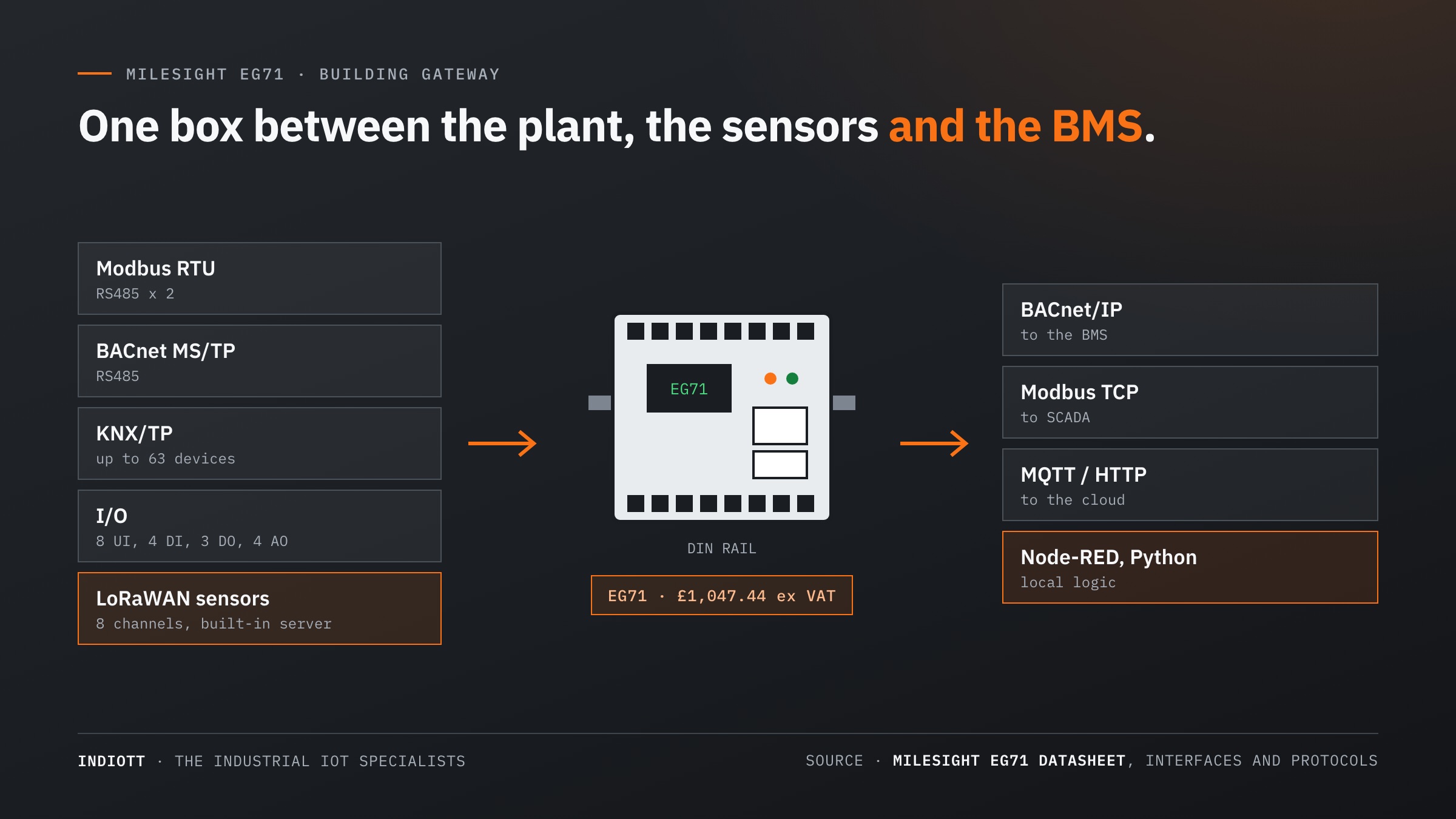
- It acquires data over Modbus RTU, BACnet MS/TP, KNX/TP, BACnet/IP, Modbus TCP and Modbus RTU over TCP, and forwards over MQTT, HTTP, BACnet/IP and Modbus TCP.
- It carries 8 universal inputs, 4 digital inputs, 3 relays and 4 analogue outputs, so small plant can be wired straight to it.
- The M-Bus port is listed on the datasheet as under development, and the universal inputs and M-Bus do not work properly on USB power.
- It is listed at £1,047.44 ex VAT. A UG65 at £279.82 already publishes LoRaWAN sensor data as BACnet/IP, so the EG71 only pays back when the wired side matters.
What is the Milesight EG71?
The Milesight EG71 is a building gateway: one device that collects data from the wired systems already in a building and from wireless LoRaWAN sensors, then hands all of it to a building management system or a cloud platform in a protocol that system understands. Milesight launched it in April 2026 as a single box for jobs that normally need several.
Milesight’s launch announcement describes the problem plainly: building protocols run in isolation, so integrators end up stacking gateways and protocol converters. The EG71 is its answer. The same release claims support for up to 2,000 devices and 20,000 data points, and the EG71 product page lists the full interface set.
Inside is a quad-core 64-bit ARM Cortex-A53 processor with 2 GB of RAM and 32 GB of storage, which matters because this building gateway is also meant to run your own logic in Node-RED, Python or Docker rather than just translate packets.
What can the EG71 connect to?
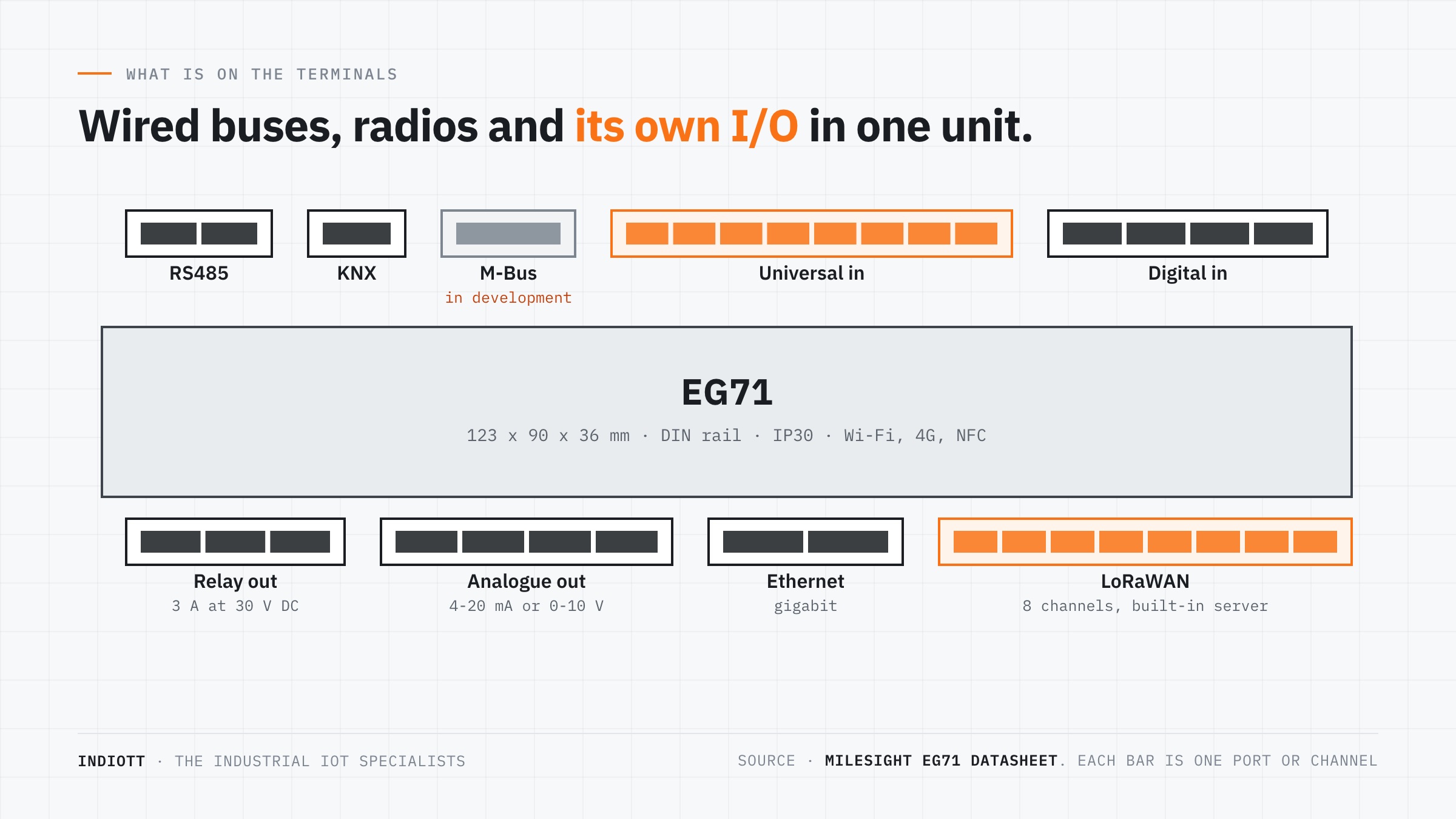
The EG71 connects to almost everything a commercial building already runs: two RS485 buses for Modbus RTU and BACnet MS/TP, a KNX/TP bus, Ethernet for BACnet/IP and Modbus TCP, eight LoRaWAN channels for wireless sensors, and its own set of inputs and outputs for plant that has no bus at all. Here is what is on this building gateway’s terminals, from the datasheet held on our EG71 product page.
| Interface | What the datasheet says |
|---|---|
| RS485 | 2 ports, 1,200 to 115,200 bps, up to 128 devices per port |
| KNX | 1 × KNX/TP1, up to 63 devices |
| M-Bus | 1 port, up to 20 devices, marked under development |
| Universal inputs | 8, each set to digital, 0-10 V, 4-20 mA, PT1000, Ni1000, NTC or resistance |
| Digital inputs | 4 dry contact, also usable as pulse counters at 1,000 Hz or more |
| Relay outputs | 3, up to 3 A at 30 V DC or 110 V AC |
| Analogue outputs | 4, switchable between 4-20 mA and 0-10 V |
| LoRaWAN | 8 channels, built-in network server, around 2,000 devices at a 10 minute interval |
| Networking | 2 × gigabit Ethernet, Wi-Fi, 4G LTE Cat 1 |
The universal inputs are the quiet star. A single terminal can read a 4-20 mA pressure transmitter, a PT1000 pipe probe or a volt-free status contact, which is how a building gateway replaces the separate remote I/O module that usually sits beside a converter in a plant room panel.
How is a building gateway different from a LoRaWAN gateway?
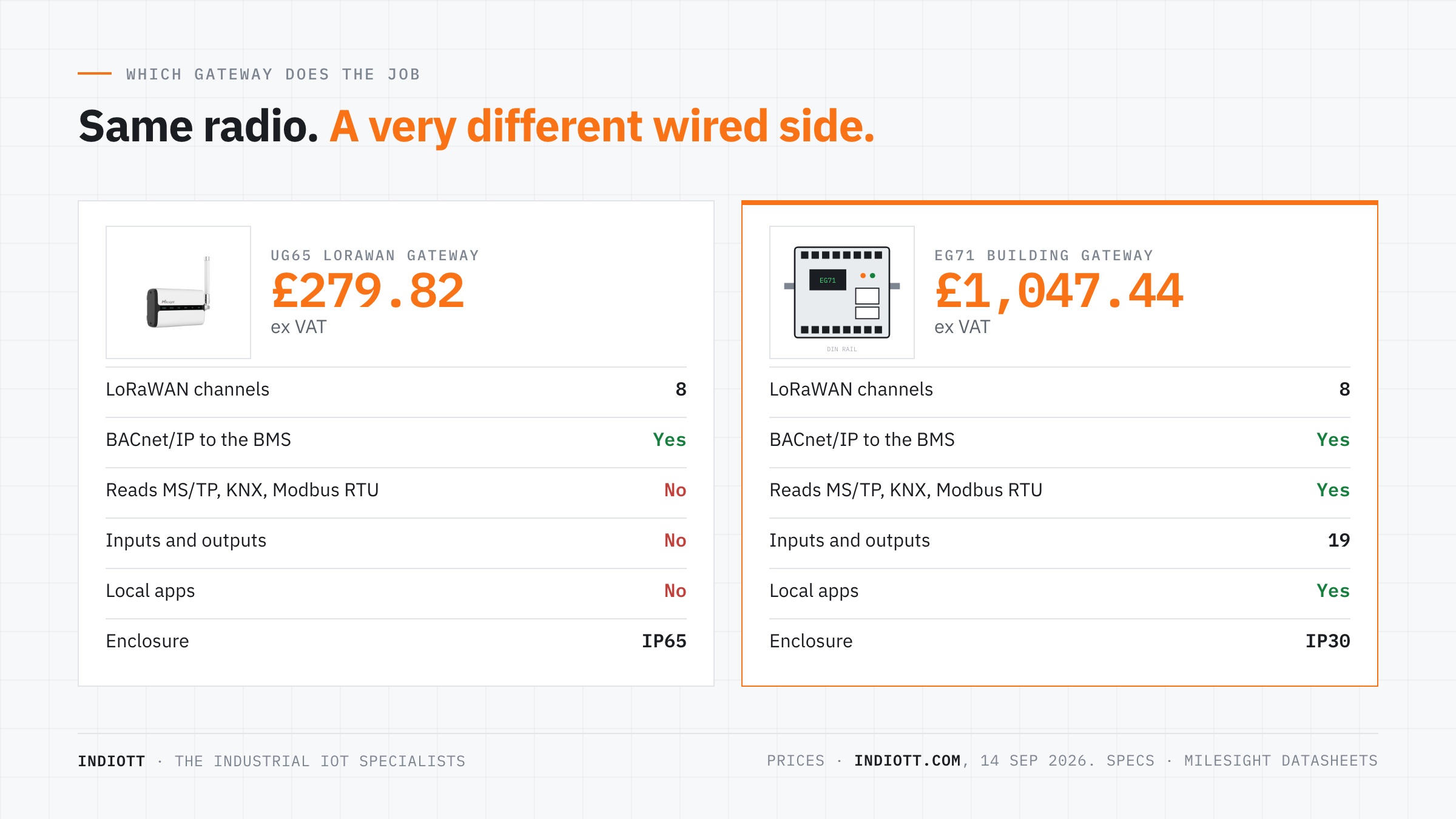
A LoRaWAN gateway such as the UG65 receives wireless sensors and forwards their data. A building gateway also reads the wired building systems, drives outputs and runs local applications. The difference is not the radio: both have 8 LoRaWAN channels and a built-in network server. The difference is everything on the wired side.
This is where honesty saves money. The UG65 and the UG56 both list BACnet/IP and Modbus TCP among their integration options, so they can already present LoRaWAN sensor data to a BMS as BACnet objects. If your job is adding wireless temperature, CO2 or leak sensors to an existing BMS, you do not need the EG71 at all.
| UG65 LoRaWAN gateway | EG71 building gateway | |
|---|---|---|
| Price ex VAT | £279.82 | £1,047.44 |
| LoRaWAN channels | 8 | 8 |
| Publishes to BMS as BACnet/IP | Yes | Yes |
| Reads BACnet MS/TP, KNX, Modbus RTU | No | Yes |
| Inputs and outputs | No | 8 UI, 4 DI, 3 relays, 4 AO |
| Local apps | No | Node-RED, Python, Docker |
| Enclosure | IP65 | IP30, for a panel |
The EG71 becomes the right choice the moment the building has wired systems that need to talk to each other or to the cloud: a Modbus heat meter, a BACnet MS/TP chiller controller, a KNX lighting system and a handful of LoRaWAN sensors, all needing to land in one place. Our LoRaWAN gateway buyer’s guide covers the wireless-only options in more depth.
What does an EG71 replace in a real building?
In a typical retrofit an EG71 building gateway replaces three or four boxes: a LoRaWAN gateway, a Modbus or KNX to BACnet converter, a small remote I/O module and sometimes an industrial PC running the integration logic. One building gateway on the DIN rail means one power supply, one configuration and one device to secure and update.
Consider a mid-size office where the BMS speaks BACnet/IP. The heat meters are Modbus RTU, the lighting is KNX, an older air handling unit controller talks BACnet MS/TP, and the facilities team wants LoRaWAN sensors for CO2 and leaks. Without a building gateway, each of those needs its own route into the BMS. With the EG71, the RS485 ports take the meters and the air handler, the KNX port takes the lighting bus, the sensors join over LoRaWAN, and the BMS reads it all as BACnet/IP from one address.
BACnet itself is defined by ASHRAE Standard 135, which covers both the MS/TP bus found on older field controllers and the BACnet/IP form most modern supervisors use. A building gateway that speaks both is what lets an old field bus appear on a new supervisor without rewiring.
The local applications matter too. Node-RED on the gateway can keep a plant room alarm working even when the internet link drops, which a cloud-only design cannot.
What are the EG71’s limits?
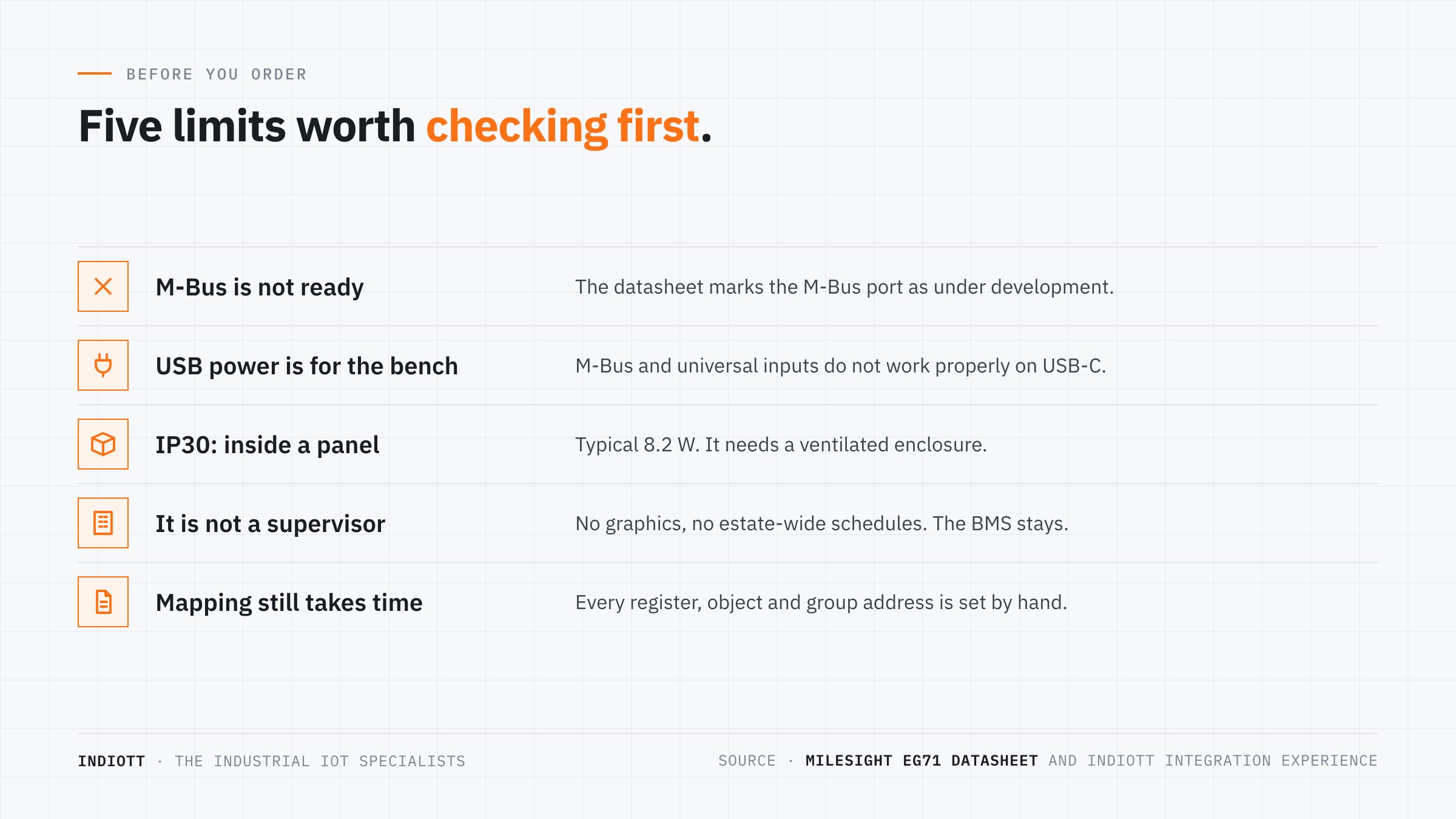
Five limits are worth checking before ordering an EG71. None of them are reasons to avoid it, but each has caught out a project that assumed a building gateway does everything on its box.
- M-Bus is not ready. The datasheet marks the M-Bus port as under development. If reading M-Bus heat or water meters is the reason for buying, confirm the firmware status first.
- USB power is for bench work only. The datasheet notes that M-Bus and the universal inputs will not work properly when the unit is powered over USB-C. Use the 24 V terminal block or 802.3af PoE in the panel.
- IP30 means inside a panel. The EG71 is rated IP30 and draws a typical 8.2 W, so it belongs in a ventilated enclosure or plant room, never on an exposed wall.
- It is not a supervisor. The EG71 moves and processes data. It does not draw graphics, run schedules for a whole estate or replace a BMS head end.
- Integration still takes engineering. Every Modbus register, BACnet object and KNX group address has to be mapped. The gateway saves boxes, not the survey of what each system exposes.
How much does an EG71 cost in the UK?
The EG71 building gateway with 4G is listed at £1,047.44 ex VAT on Indiott, typically dispatched within 14 working days, with UK delivery at a flat £14.25 ex VAT per order. There is no subscription built into the price: its network server, protocol conversion and local apps run on the device itself.
Whether that is good value depends on what the building gateway replaces. Against a UG65 alone this building gateway is almost four times the price, which is why a wireless-only project should not buy one. Against a LoRaWAN gateway plus separate converters, I/O and an edge PC, one DIN rail unit with one configuration usually wins on both parts and installation time.
How do you set up an EG71?
Setting up an EG71 follows the order you would use for any building gateway: power and network first, then each field bus, then the northbound connection to the BMS or cloud.
- Mount and power it. DIN rail in the panel, 24 V DC or AC on the terminal block, or PoE on ETH1.
- Connect the network. Ethernet for BACnet/IP and Modbus TCP, with 4G as a backup link if the site network is unreliable.
- Wire and map the buses. Set baud rates on the RS485 ports, then add Modbus registers, BACnet MS/TP objects and KNX group addresses one system at a time.
- Add LoRaWAN sensors. Milesight devices can be added over NFC from the gateway’s own interface, then decoded by the built-in network server.
- Publish northbound. Expose the points as BACnet/IP objects or Modbus TCP registers for the BMS, or send them over MQTT or HTTP to your platform.
Our guide to getting legacy plant into SCADA over Modbus and MQTT goes deeper on register mapping, and the network server comparison explains when the built-in LoRaWAN server is enough.
Frequently asked questions
Is the Milesight EG71 a LoRaWAN gateway?
Yes, and it is also a building gateway. It has 8 LoRaWAN channels and a built-in network server for around 2,000 devices at a 10 minute interval, plus wired inputs for Modbus, BACnet and KNX and its own inputs and outputs.
Can the EG71 replace a BACnet converter?
It can read BACnet MS/TP, Modbus RTU, Modbus TCP and KNX devices and present them as BACnet/IP, so in most retrofits it replaces the separate converter. Every point still has to be mapped during commissioning.
Does the EG71 need a cloud subscription?
No. Protocol conversion, the LoRaWAN network server and Node-RED, Python or Docker applications all run on the gateway. A cloud platform is optional.
Where should an EG71 be installed?
Inside a panel or plant room. It is rated IP30, mounts on DIN rail, and runs from -40°C to 60°C on 24 V or PoE power.
Should I buy an EG71 or a UG65?
Buy a UG65 if you only need LoRaWAN sensors on a BMS or platform. Buy an EG71 when the building also has Modbus RTU, BACnet MS/TP or KNX systems to integrate, or plant to wire directly to its inputs and outputs.
The short version
The EG71 is the building gateway to buy when a building’s systems speak different languages and you want one box, one configuration and one point of support. For wireless sensors alone, a UG65 does the job for far less.
See the EG71 on Indiott for live pricing, compare it with the UG65 semi-industrial gateway, or send us the list of systems in your building and an engineer will tell you which gateway fits, within one working day.
Next step
Get a priced kit list for your site
Answer three quick questions and tell us where to send it. An engineer replies within one working day with the parts, the prices and the lead time.
Rather talk it through? Call 023 9223 3611
Received. An engineer has it.
You will hear back within one working day with the parts, the prices and the lead time. A confirmation is on its way to your inbox.
If it is urgent, call 023 9223 3611.