People Counting System Cost in the UK: What You Actually Pay Over Three Years
TL;DR: Most of a people counting system cost is not the sensor. Published subscription pricing runs to $135 per sensor per month billed annually on top of a $300 one-off unit, which is $5,160 over three years with 94% of it software. The alternative is buying the hardware outright: a passage counter from £74.82 ex VAT, a ceiling-mounted ToF counter accurate to 99.8% from £568.61 ex VAT, and no recurring per-sensor fee at all. This guide breaks the people counting system cost into the four lines that actually appear on the invoice.
Last updated: 28 July 2026
On this page
Key takeaways
- Hardware is usually the smallest line in a people counting system cost. Recurring software is the biggest.
- One published subscription model charges $300 per sensor once and $135 per sensor per month billed annually, which totals $5,160 per sensor over three years.
- Buying the sensor outright removes the recurring line from the people counting system cost entirely. Indiott lists a passage counter at £74.82 ex VAT and a ToF ceiling counter at £568.61 ex VAT.
- Accuracy is the other cost axis: beam counters land at 80 to 90%, ToF at 95 to 98%, and the VS135 is rated up to 99.8%.
- Size the system before you price it. The British Council for Offices has cut its utilisation benchmark from 80% to 66%, so the number of sensors you need is a question worth answering with data.
What does a people counting system cost?
A people counting system cost is made of four lines: the sensor, the software that turns counts into reports, installation, and connectivity. Only the first is a one-off in every commercial model. The other three are where the quotes diverge, and where a cheap-looking sensor turns into an expensive decade.
The published entry point for hardware is low. Beam devices start under €100, and thermal or camera-based units run to a few hundred per sensor. That is the number most buyers anchor to. It is also the number that matters least, because on a subscription platform the sensor is effectively a deposit against a monthly fee.
So the useful question is not what a counter costs. It is what the whole people counting system cost looks like on the day you renew for the third time, with every sensor still billing.
The three fees that hide inside the quote
Three recurring or one-off lines sit behind the headline hardware price. None of them are unreasonable in themselves. They become a problem when the quote does not separate them, because that is when a people counting system cost gets compared on the wrong number.
1. The per-sensor software subscription
This is the big one. One vendor publishes its pricing openly: $300 as a one-time hardware cost per sensor, then $150 per month per sensor, or $135 per month billed annually. Note the unit. It is per sensor, not per site, so a four-door store multiplies the fee by four rather than absorbing it.
2. Installation
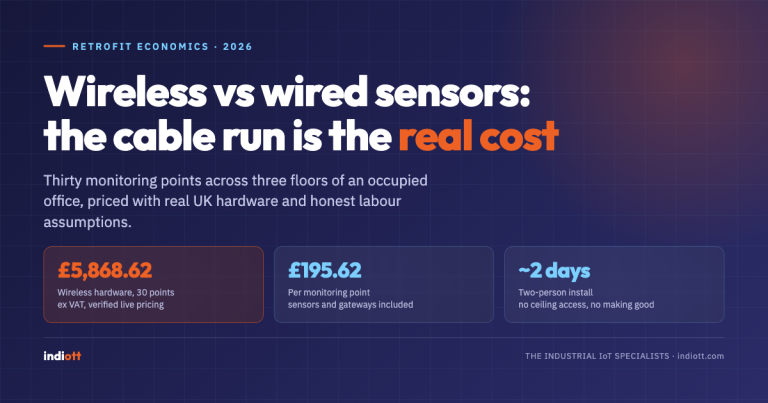
Ceiling-mounted counters need a mounting position, a power or PoE run and a calibration pass. Some suppliers bundle it, some bill it per site. Either way it is a real number and it repeats every time you add a door. A wireless sensor that avoids a cable pull genuinely removes cost here, which is the case we set out in wireless versus wired sensors.
3. Connectivity
Counts have to reach a dashboard. LoRaWAN sensors need a gateway on site, which Indiott lists from £98.76 ex VAT for the Milesight UG63 Mini. That gateway is a one-off shared across dozens of sensors. A cellular sensor instead carries a SIM and a monthly data line per unit, which behaves much more like the subscription in point one.
Three-year people counting system cost, two models
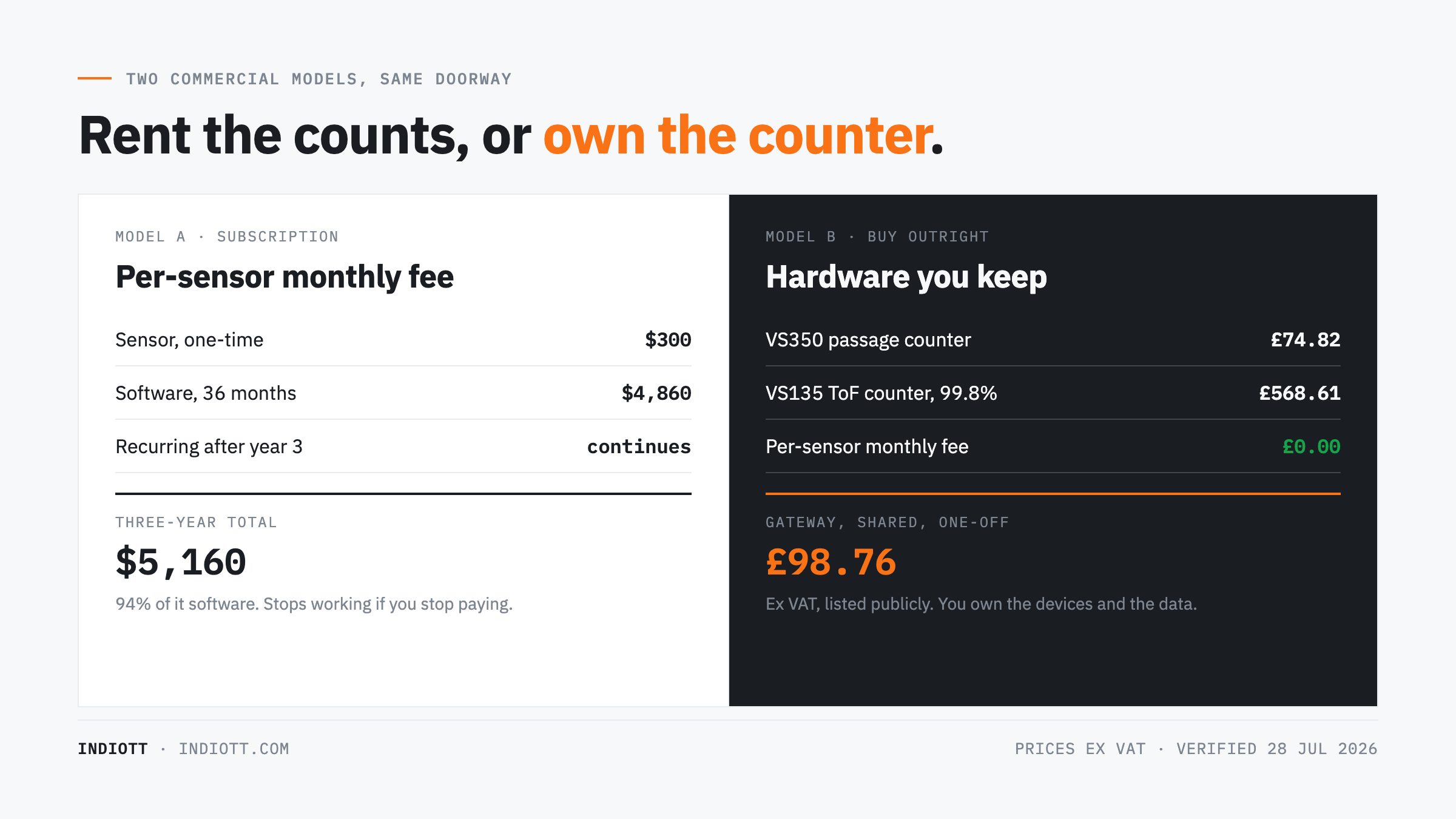
Take one counted doorway and run it for three years. On the published subscription figures above, the arithmetic is $300 for the sensor plus 36 months at $135, which is $4,860 of software against $300 of hardware. Total $5,160 per sensor, of which 94% is the recurring fee.
Now the outright model. A Milesight VS350 Passage People Counter is £74.82 ex VAT. A Milesight VS135 Ultra ToF People Counter, rated up to 99.8% counting accuracy with LoRaWAN, Wi-Fi HaLow, cellular and Ethernet options and an IP65 rating for ceilings up to 6.5 m, is £568.61 ex VAT. Add a gateway once at £98.76 ex VAT and the recurring line is whatever your own dashboard or integration costs, not a per-sensor rent.
The two models are not equivalent, and it is worth being straight about that. A subscription buys a finished analytics product, support and someone else’s uptime. Buying outright means you own the data and the devices, and you are responsible for where the counts land. The point is only that a people counting system cost should be compared over the life of the deployment, not at the point of purchase, because the ranking flips somewhere in year one.
What accuracy costs
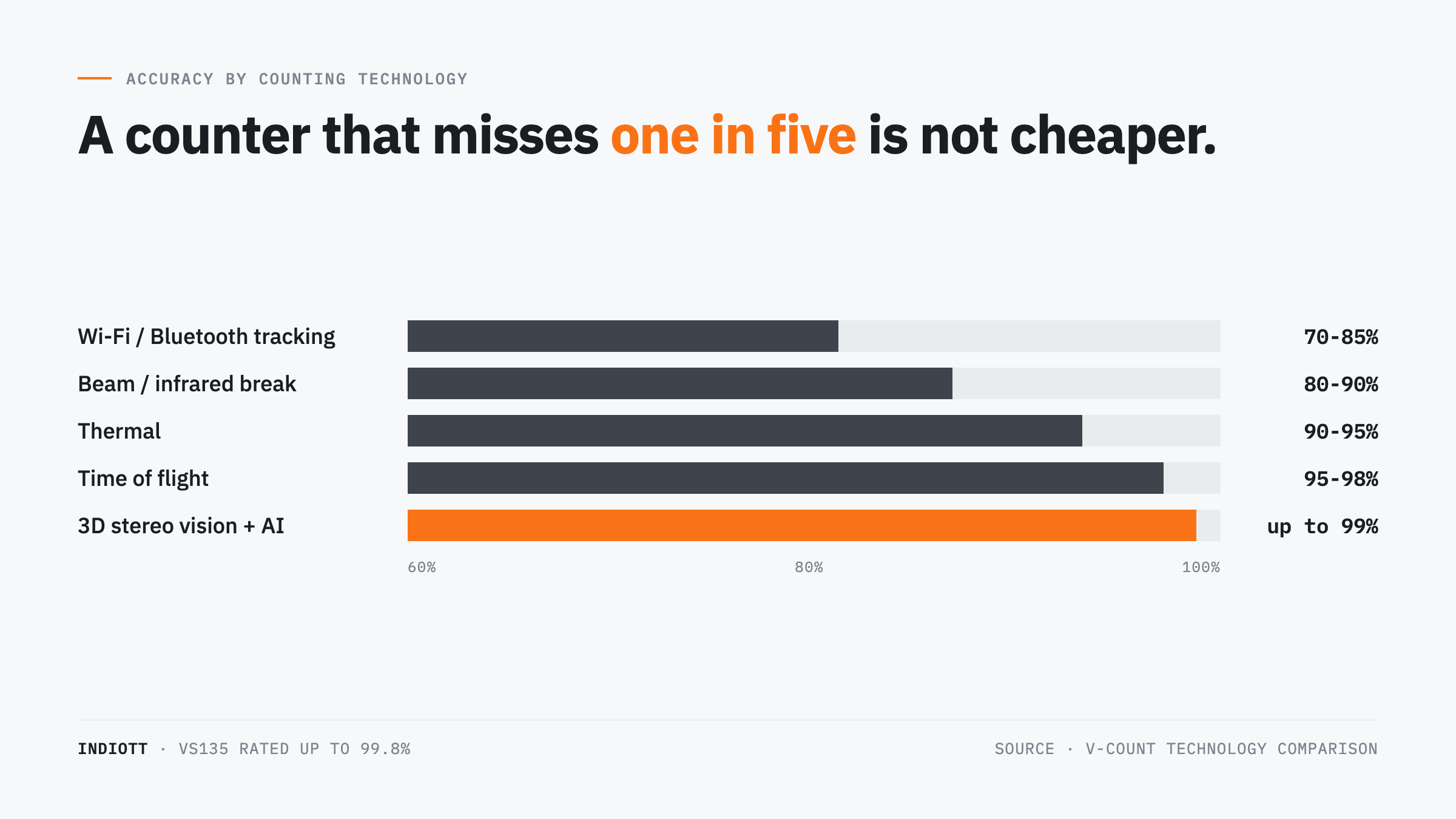
Accuracy is the second axis of a people counting system cost, and it is the one that decides whether the data is worth having. A counter that misses one visitor in five does not produce a slightly worse conversion rate, it produces a conversion rate you cannot act on.
| Technology | Typical accuracy | What it suits |
|---|---|---|
| Wi-Fi and Bluetooth tracking | 70 to 85% | Rough dwell and footfall trends |
| Beam and infrared break counters | 80 to 90% | Single narrow doorways, low budget |
| Thermal counters | 90 to 95% | Privacy-sensitive entrances |
| Time of flight | 95 to 98% | Retail and venue entrances, bi-directional |
| 3D stereo vision with AI | up to 99% | Wide or high-traffic entrances |
Read the table as a cost-per-usable-count rather than a price list. A £40 storefront sensor at 85% is excellent value for a trend line and poor value for a staffing model. Match the tier to the decision the data has to support, then let the people counting system cost follow from it.
UK hardware prices, published
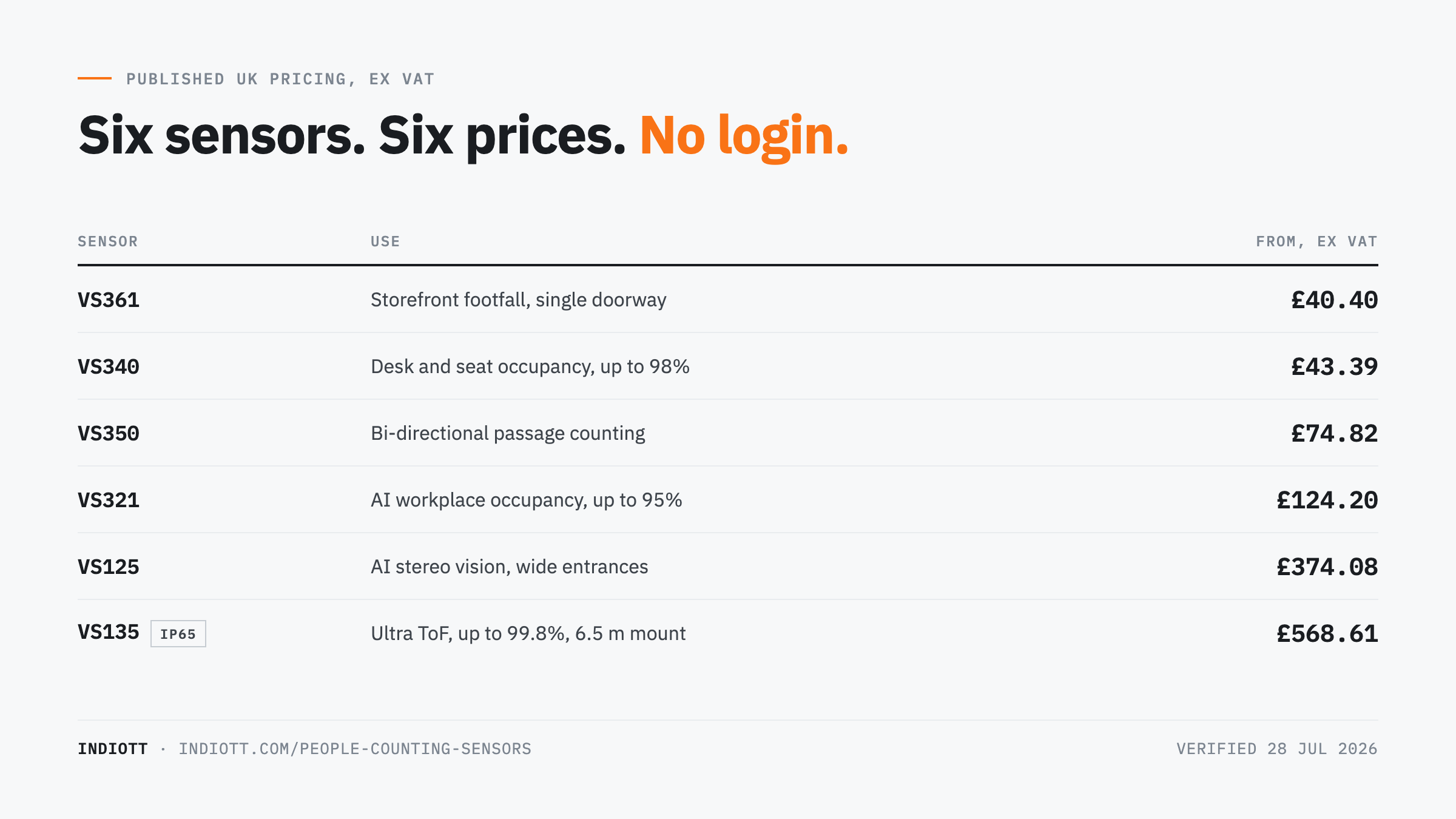
Most suppliers in this category quote on request. We publish, so a people counting system cost can be built up on a spreadsheet before anyone speaks to a salesperson. Every figure below is the current listed price on indiott.com, excluding VAT, verified on 28 July 2026.
| Sensor | Use | From, ex VAT |
|---|---|---|
| VS361 Storefront Footfall Sensor | Single shop doorway | £40.40 |
| VS340 Desk & Seat Occupancy Sensor | Per desk, up to 98% accuracy | £43.39 |
| VS350 Passage People Counter | Bi-directional corridor counting | £74.82 |
| VS321 AI Workplace Occupancy Sensor | Room occupancy, up to 95% accuracy | £124.20 |
| VS125 AI Stereo Vision People Counter | Wide entrances | £374.08 |
| VS135 Ultra ToF People Counter | Up to 99.8%, IP65, 6.5 m mount | £568.61 |
If you would rather not assemble the parts, the Smart Building Occupancy Kit bundles occupancy, air quality and a gateway from £531.21 ex VAT.
How to size a system before you price it
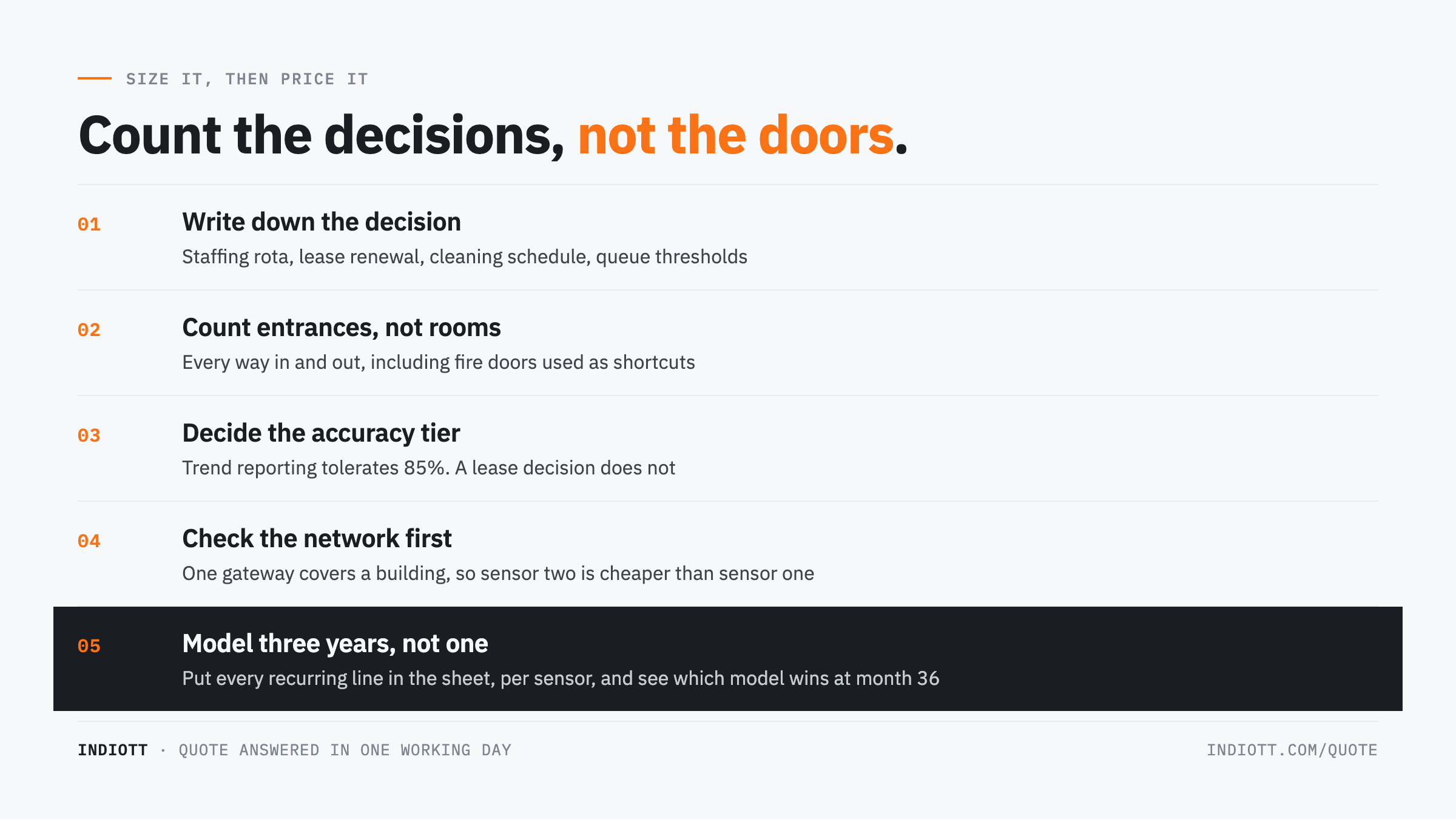
Sizing first is what stops a people counting system cost running away. Count the decisions, not the doors, and the sensor list, and with it the people counting system cost, usually gets shorter.
- Write down the decision. Staffing rota, lease renewal, cleaning schedule, queue thresholds. Each one needs a different granularity.
- Count entrances, not rooms. Net occupancy needs every way in and out counted, including fire doors used as shortcuts.
- Decide the accuracy tier. Trend reporting tolerates 85%. A headcount that feeds a lease decision does not.
- Check the network first. One gateway usually covers a building, so the second sensor is far cheaper than the first.
- Model three years, not one. Put every recurring line in the sheet, per sensor, and see which model wins at month 36.
Step one is worth dwelling on, because the benchmark moved. The British Council for Offices has revised its office utilisation benchmark down from 80% to 66%, taking effective density from 12.5 to 15 sq m per occupant, on a study built from sensor data, observation and swipe card records. Mid-week desk utilisation averages 40% and the all-weekday figure is 30%. If your space plan still assumes 80%, measurement is not an analytics project, it is a rent conversation.
Frequently asked questions
What is included in a people counting system cost?
Four lines: sensors, software, installation and connectivity. Published UK hardware prices run from £40.40 ex VAT for a single-doorway storefront sensor to £568.61 ex VAT for a ToF ceiling counter rated up to 99.8%. Software, installation and connectivity sit on top, and on a subscription platform those can exceed the hardware within the first year.
Is there a people counting system without a monthly fee?
Yes. Buying the sensors outright and sending the counts into a dashboard you already run removes the per-sensor subscription. You still pay for wherever the data lands, but that part of the people counting system cost does not multiply with every extra door.
Do people counting sensors need a gateway?
LoRaWAN sensors do, and one gateway serves many sensors, from £98.76 ex VAT. Sensors with Ethernet or PoE connect directly. Cellular variants need no gateway but add a per-unit data line, which reintroduces a recurring cost.
How accurate does a people counter need to be?
It depends on the decision. Beam counters at 80 to 90% suit trend reporting. Time-of-flight at 95 to 98% suits retail conversion and venue capacity. Anything feeding a lease, a staffing model or a safety limit should sit at the top of the range.
Are these sensors GDPR-safe?
PIR, thermal and time-of-flight counters detect a body shape rather than an identity, and the AI models on the Milesight units process on the device. We covered the privacy design in detail in our desk occupancy monitoring guide. Always confirm the specific model’s data handling before deployment.
Price your own system
Every sensor above is listed with its price and its datasheet, so you can build a people counting system cost yourself before you talk to anyone. If you would rather have it checked, send us the doorways and the decision behind them and we will come back inside one working day. Start with the people counting sensors buyer’s guide, the occupancy and space utilisation solutions page, or request a quote.
Next step
Get a priced kit list for your site
Answer three quick questions and tell us where to send it. An engineer replies within one working day with the parts, the prices and the lead time.
Rather talk it through? Call 023 9223 3611
Received. An engineer has it.
You will hear back within one working day with the parts, the prices and the lead time. A confirmation is on its way to your inbox.
If it is urgent, call 023 9223 3611.