Workplace Temperature: The 16°C Minimum, the Maximum That Does Not Exist, and the Thermometer the Law Requires
TL;DR: UK law says the temperature in an indoor workplace must be reasonable during working hours. The Approved Code of Practice puts the minimum at 16°C, or 13°C for strenuous work, and there is no legal maximum, because heat is treated as a hazard to be risk assessed instead. Less well known, the Workplace Regulations also require a sufficient number of thermometers so people at work can check the workplace temperature. A sensor with a display does that job and keeps the record.
Last updated: 14 September 2026
On this page
Key takeaways
- Regulation 7 of the Workplace (Health, Safety and Welfare) Regulations 1992 requires the temperature in indoor workplaces to be reasonable during working hours.
- HSE’s guidance puts the minimum at at least 16°C, or 13°C where much of the work involves rigorous physical effort.
- There is no maximum workplace temperature in law. HSE says heat is a hazard with legal obligations like any other, handled through risk assessment.
- The same regulation requires a sufficient number of thermometers so that people at work can find out the temperature, a duty that is easy to overlook.
- A thermometer is not a heat stress assessment. HSE lists work rate, humidity, air movement, heat sources and clothing alongside air temperature.
What is the minimum workplace temperature in the UK?
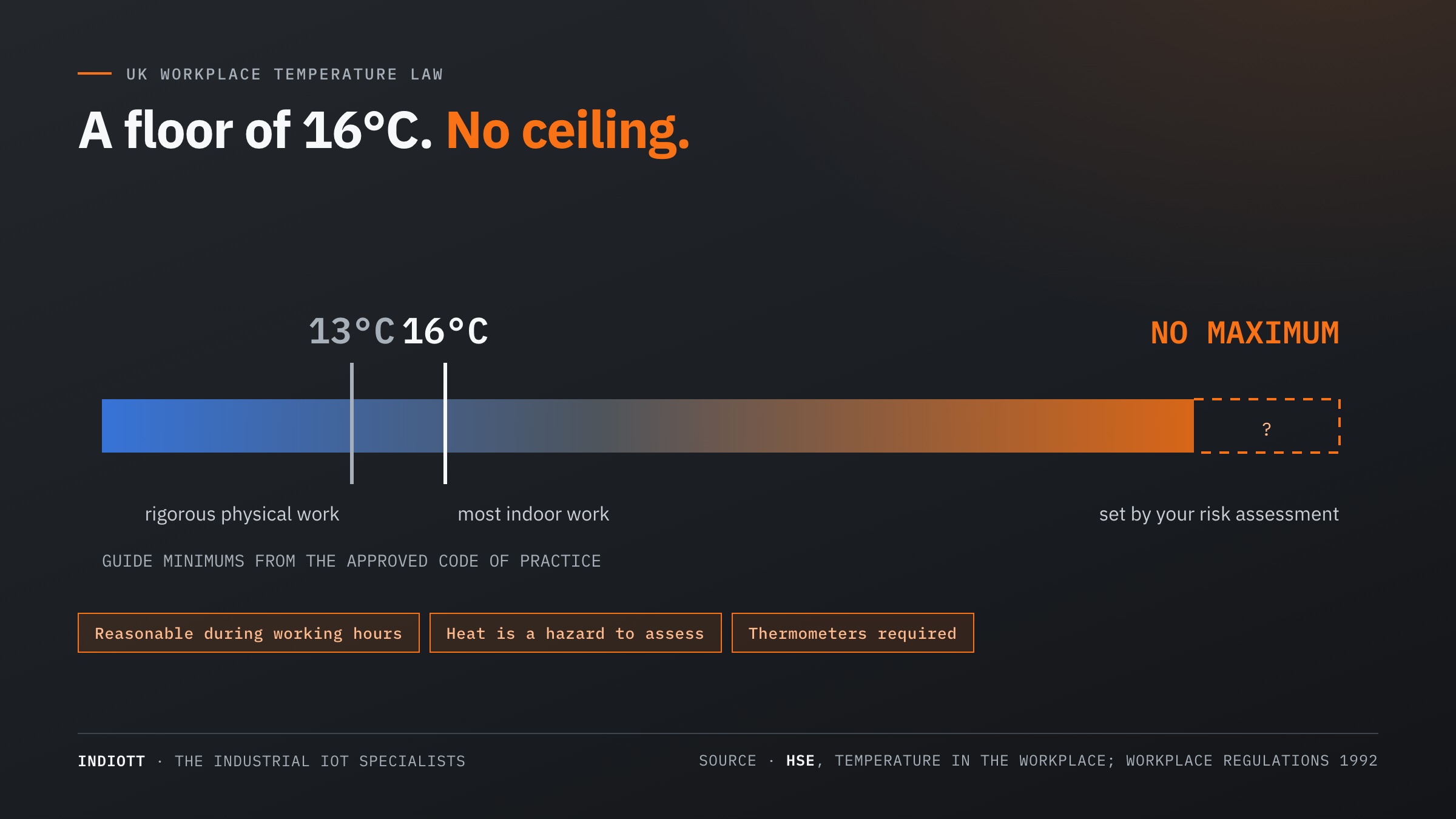
The minimum workplace temperature for indoor work should normally be at least 16°C, or 13°C if much of the work involves rigorous physical effort. The figures come from the Approved Code of Practice on the Workplace (Health, Safety and Welfare) Regulations, and HSE repeats them in its guidance on temperature in the workplace.
The regulations themselves do not print a number. Regulation 7 says that during working hours the temperature in all workplaces inside buildings shall be reasonable. The code of practice is how that word becomes something you can measure, which is why the 16°C figure is the one inspectors and employees tend to quote.
Two details matter in practice. The duty applies during working hours, so a cold office at 6am before anyone arrives is not the question. And it applies to workrooms, so the reading that counts is the workplace temperature where people sit or stand, not the figure on a thermostat in the corridor.
Is there a maximum workplace temperature?
No. HSE’s guidance is direct: there is no law for maximum working temperature, because every workplace is different. It explains that no meaningful upper limit could be set, because in many indoor workplaces high temperatures are created by the work itself, in bakeries or foundries for example, rather than by the weather.
That does not leave employers without a duty. HSE’s page on what the law says states that all workers are entitled to an environment where risks to health and safety are properly controlled, and that heat is classed as a hazard with legal obligations like any other hazard. Under the Management of Health and Safety at Work Regulations, workplace temperature is one of the risks employers must assess and control.
So the upper limit on a site is a decision, not a statute. The employer assesses the risk, decides what is reasonable, acts on it, including temporary or seasonal controls, and uses HSE’s heat stress checklist where people may be exposed to extreme heat. A sensible monitoring plan records workplace temperature against that decision, so the evidence exists if it is ever questioned.
Does the law require a thermometer at work?
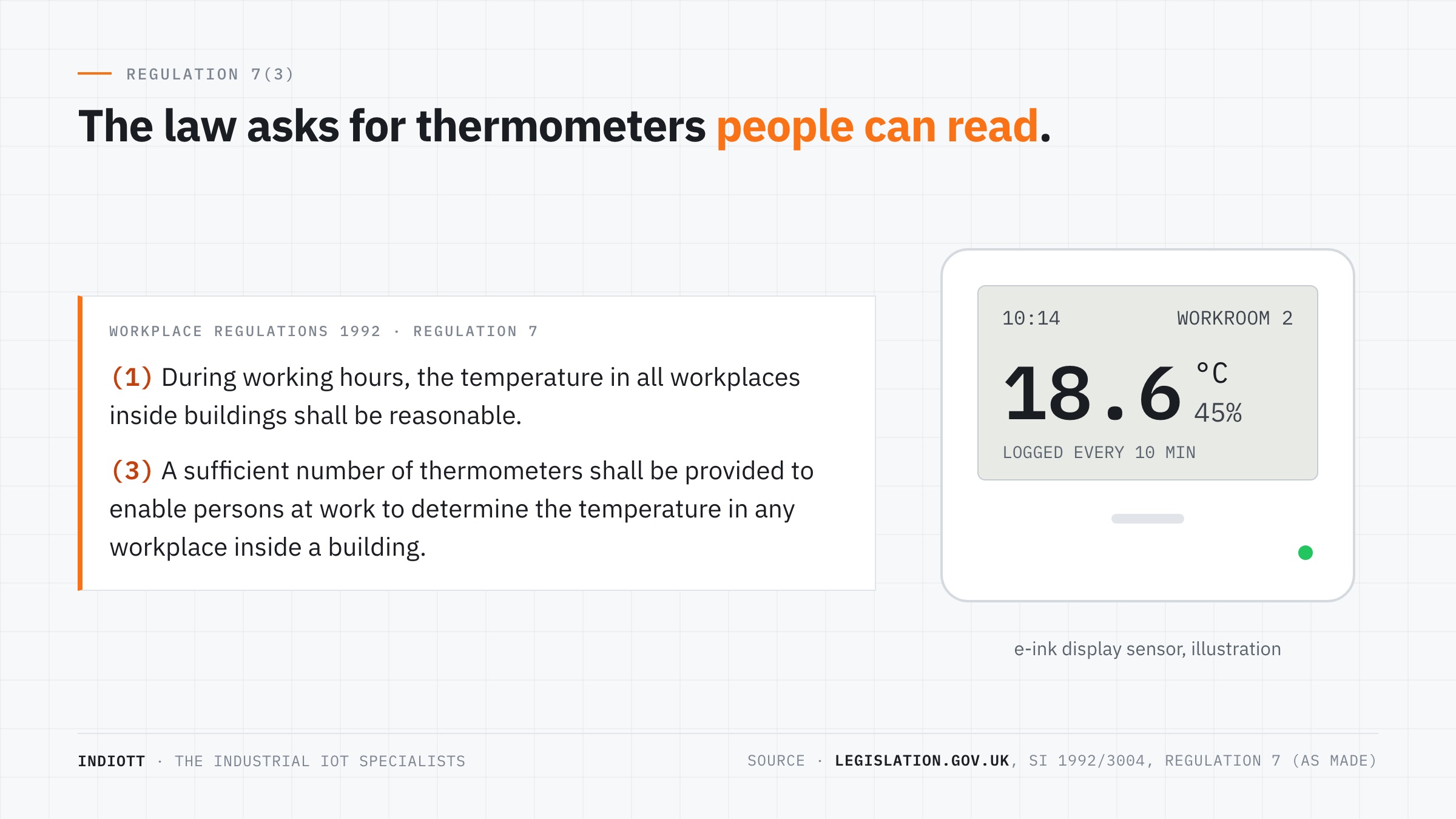
Yes, and it is an easy line to miss. Regulation 7(3) says a sufficient number of thermometers shall be provided to enable persons at work to determine the temperature in any workplace inside a building. It is a duty on the employer, and it is about the people doing the work being able to check, not only the facilities team.
Sufficient is a judgement. A single thermometer in reception tells nobody in a warehouse, a plant room or a top floor office what their own workplace temperature is. A reasonable reading of the duty is one visible reading per workroom, placed where people work, away from radiators, windows and direct sun.
This is where a sensor with a screen earns its place. The Milesight AM102 shows temperature and humidity on a 2.13 inch e-ink display, reads temperature to a typical ±0.2°C between 0 and 60°C, and sends every reading over LoRaWAN for logging and alarms. It is listed at £47.88. People can see the number, and the employer keeps the record.
Why is a thermometer not enough for heat stress?
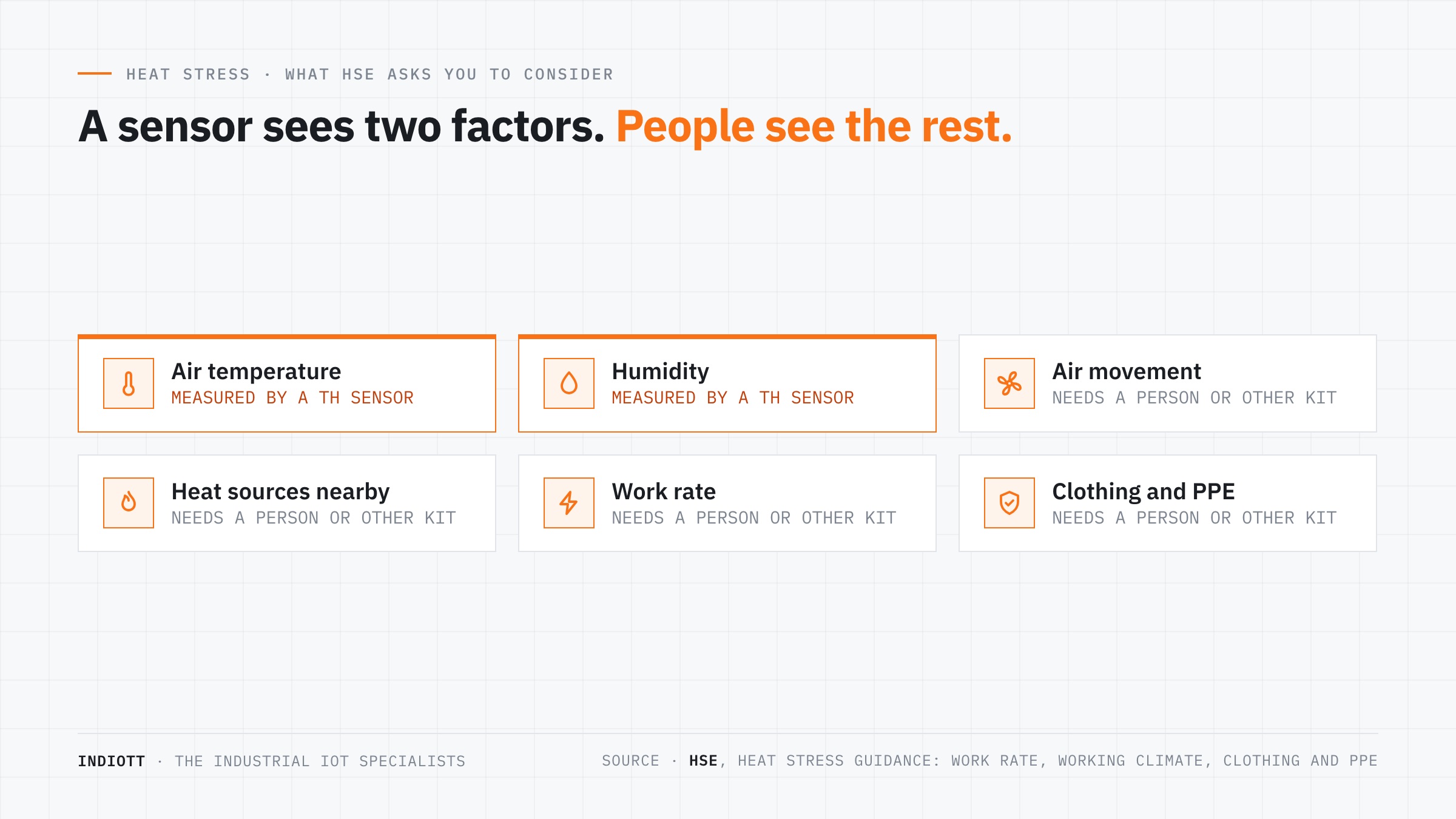
Because heat stress depends on more than air temperature. HSE explains that heat stress happens when the body’s way of controlling its internal temperature starts to fail, and its heat stress guidance asks employers to consider work rate, the working climate, meaning air temperature, humidity, air movement and nearby heat sources, and work clothing and protective equipment.
A temperature and humidity sensor covers two of those climate factors. It does not measure radiant heat from an oven or a furnace, air movement from a fan, how hard someone is working, or what they are wearing. It can tell you that a room is getting hotter and more humid, and when. It cannot tell you on its own that a worker in protective clothing is safe.
That is the honest limit, and it is a useful one. Use workplace temperature and humidity data to find the hot spots, the hours and the seasons that need attention, then apply HSE’s checklist and a proper heat stress assessment where the data says the risk is real. HSE lists boiler rooms, bakeries, catering kitchens, laundries and foundries among the places heat stress occurs.
How do you monitor workplace temperature without the paperwork?
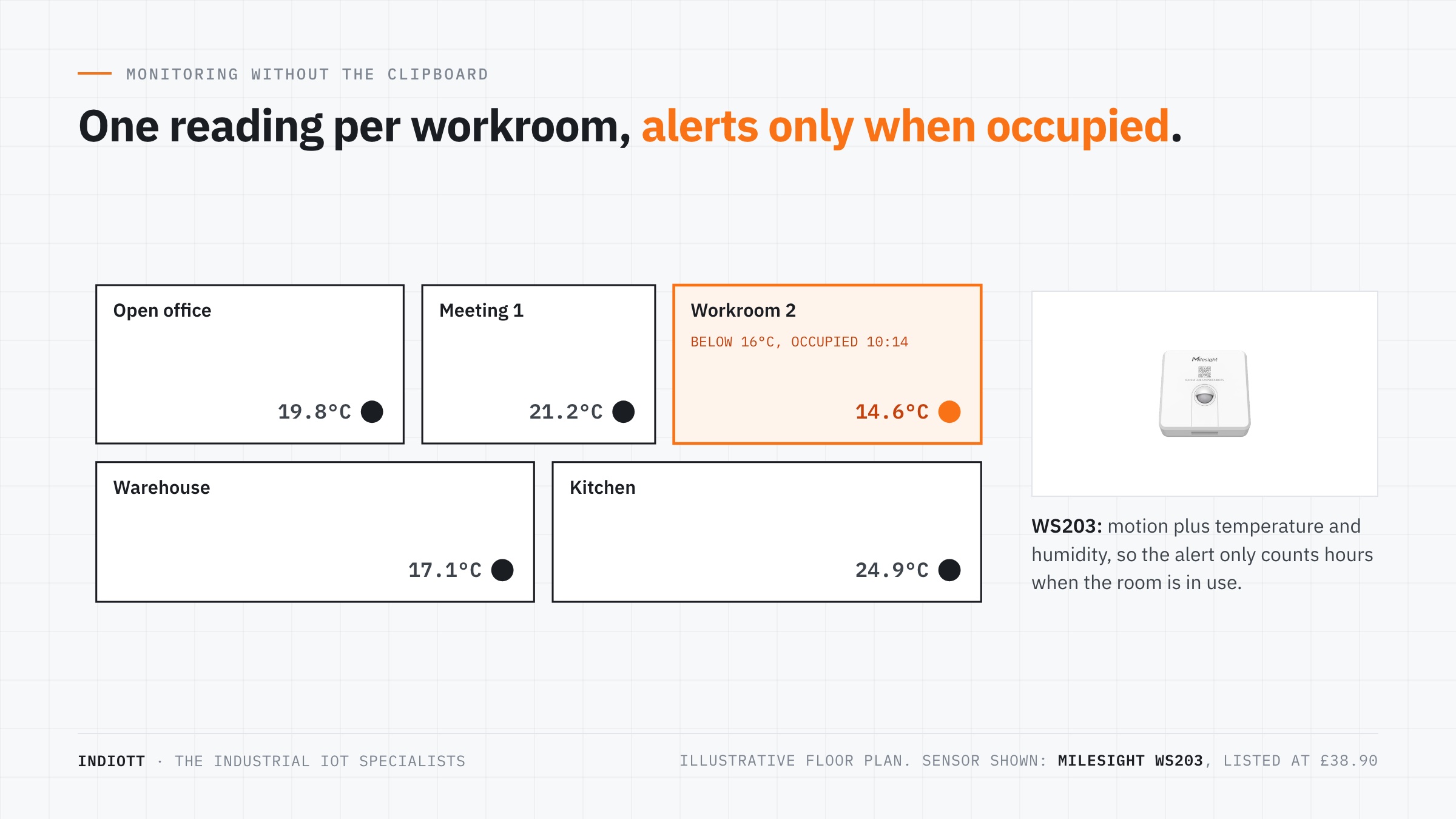
Put a small wireless sensor in each workroom, log continuously, and alert on your own thresholds during working hours. The log replaces clipboard readings, and a threshold alarm means somebody acts on a cold morning or a hot afternoon while it is happening rather than after a complaint.
Three sensors cover most buildings:
| Sensor | Measures | Best for | Listed price |
|---|---|---|---|
| AM102 | temperature and humidity, e-ink screen | workrooms where staff should see the reading | £47.88 |
| WS203 | motion, temperature and humidity | separating occupied hours from empty rooms | £38.90 |
| AM103 | CO2, temperature and humidity | rooms where fresh air is also a question | £127.19 |
The Milesight WS203 is the quiet hero for the working hours question. Its PIR sensor records when a room is occupied, so a workplace temperature of 14°C in an empty meeting room at 7am can be told apart from 14°C at 10am with a team inside. The AM103 adds CO2, which matters because HSE’s guidance pairs a comfortable temperature with clean and fresh air.
All three are LoRaWAN, so they need a gateway. One gateway covers a typical office floor or warehouse, and our LoRaWAN starter kit guide explains what to buy first.
Frequently asked questions
What is the legal minimum workplace temperature in the UK?
The Approved Code of Practice sets a guide minimum of at least 16°C for indoor workplaces, or 13°C where much of the work involves rigorous physical effort. The regulations require the temperature to be reasonable during working hours.
Is there a maximum temperature for working in the UK?
No. HSE says there is no law for a maximum working temperature, because high temperatures are often created by the work itself. Heat is treated as a hazard that employers must assess and control.
Do employers have to provide thermometers?
Yes. Regulation 7(3) of the Workplace Regulations requires a sufficient number of thermometers so people at work can determine the temperature in any indoor workplace.
What should an employer do if the office is too hot?
Assess the workplace temperature risk and put controls in place. HSE suggests fans, air cooling, shading from sunlight, moving workstations away from heat, cold water and flexible working patterns, and a heat stress checklist where there is a risk from extreme temperatures.
Can a temperature sensor measure heat stress?
Not on its own. Heat stress depends on work rate, air temperature, humidity, air movement, heat sources and clothing. A temperature and humidity sensor measures two of those and is best used to find where and when a fuller assessment is needed.
Where to start
Walk the building and count the workrooms that have no thermometer anyone can read. That number is the gap to close under regulation 7(3).
Start with the rooms where workplace temperature draws complaints, add a sensor to each, and let a month of data set your thresholds. Our guide to indoor air quality monitoring covers the CO2 side of the same rooms, our temperature and humidity sensor comparison helps you choose between models, and the Kit Builder will price the sensors and gateway for your floor plan.
Next step
Get a priced kit list for your site
Answer three quick questions and tell us where to send it. An engineer replies within one working day with the parts, the prices and the lead time.
Rather talk it through? Call 023 9223 3611
Received. An engineer has it.
You will hear back within one working day with the parts, the prices and the lead time. A confirmation is on its way to your inbox.
If it is urgent, call 023 9223 3611.