BUYING GUIDE · UK STOCK
Commercial Heating Controls: Wireless TRVs & Thermostats
Most UK commercial stock heats like it's 1985: one boiler schedule for everyone, radiators governed by whoever touched the valve last. Wireless controls zone it room by room — without a controls contractor.
Zone-by-zone heat, retrofit in an afternoon
Commercial heating controls used to mean a BMS project: cabling, controls contractors, months. The wireless generation changes the economics — a LoRaWAN TRV screws onto an existing radiator valve in two minutes, a wireless thermostat governs the fan coil above the ceiling tile, and every room joins a schedule you set centrally.
The savings mechanism is unglamorous and reliable: stop heating empty rooms. Offices heated evenings and weekends, meeting rooms held at 22 °C for two meetings a week, radiators fighting the aircon — room-level commercial heating controls end all three, and organisations like the Carbon Trust consistently rank heating schedules and zoning among the fastest-payback measures in UK buildings.
The commercial heating controls range
TRVs for radiator estates, thermostats for boilers and fan coils, and feedback sensors to prove the result. All wireless, all centrally scheduled, all in UK stock at ex-VAT prices.
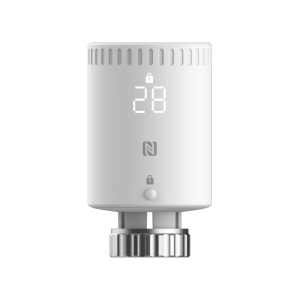 Radiator estatesMilesight WT101 Smart Radiator Thermostat
The workhorse wireless TRV: fits standard valve bodies, schedules centrally, reports temperature back.
£59.85 ex VATView → No-battery TRVMilesight WT102 Smart Radiator Thermostat
Self-powered by thermal energy harvesting — the TRV you never revisit with a screwdriver.
£97.26 ex VATView →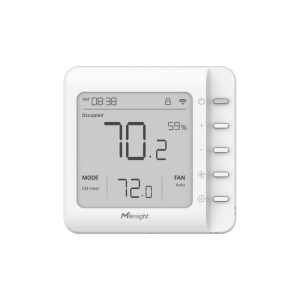 Boiler & zone controlMilesight WT201 Smart Thermostat
Wireless thermostat for boiler-fed zones and smaller buildings — schedules without rewiring.
£97.26 ex VATView →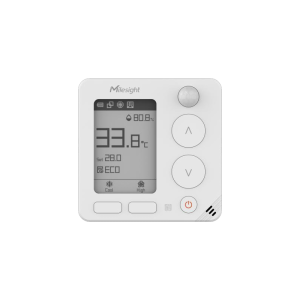 PTACs & heat pumpsMilesight WT401 Smart Thermostat
The multi-system thermostat: PTACs, furnaces, heat pumps and radiator circuits under one controller.
£112.23 ex VATView → Feedback sensingMilesight EM300-TH Temperature and Humidity Sensor
Independent room temperature/humidity sensing to verify every zone actually hits setpoint.
£38.90 ex VATView →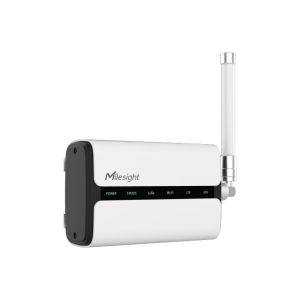 Site gatewayMilesight UG65 Semi-industrial LoRaWAN Gateway
One semi-industrial gateway carries every TRV, thermostat and sensor in the building.
From £279.82 ex VATView →Compare controls and prices
| Product | Best for | Connectivity | Price (ex VAT) |
|---|---|---|---|
| Milesight WT101 Smart Radiator Thermostat | Radiators, standard TRV | LoRaWAN® | £59.85 |
| Milesight WT102 Smart Radiator Thermostat | Radiators, self-powered | LoRaWAN® | £97.26 |
| Milesight WT201 Smart Thermostat | Boiler zones | LoRaWAN® | £97.26 |
| Milesight WT401 Smart Thermostat | PTAC/heat pump/furnace | LoRaWAN® | £112.23 |
| Milesight EM300-TH Temperature and Humidity Sensor | Room feedback | LoRaWAN® | £38.90 |
| Milesight UG65 Semi-industrial LoRaWAN Gateway | Building gateway | LoRaWAN® gateway | From £279.82 |
Matching controls to your heat source
Radiator buildings are the easy win: wireless TRVs fit standard valve bodies (adapters cover the common thread types), so a fifty-radiator office converts in a day without draining the system. Schedule by zone — core hours for open plan, on-demand for meeting rooms, frost-protect for stores — and let occupancy data trim from there.
Packaged-unit buildings swap the wall thermostat instead: the WT401 spans PTACs, furnaces and heat pumps. Whichever path, add independent room sensors — commercial heating controls without feedback sensing is how systems drift back to waste within a year. Pair the controls with energy monitoring on the boiler and plant circuits and the savings become a graph the FD can read.
- TRVs: standard M30-type valve bodies, adapters included for common variants
- Setback beats switch-off: 16 °C empty-hours setpoint avoids condensation and cold-start spikes
- Meeting rooms: on-demand schedules recover the most wasted heat
- Self-powered WT102 removes the battery round on big TRV estates
- Room sensors verify delivery — every zone, not just the thermostat wall
- Works alongside (not inside) an existing BMS — no integration project required
Rollout without a controls contractor
One UG65 gateway covers the building; TRVs and thermostats join it like any sensor. No cabling, no ceiling access beyond the FCU swap, no BMS points to negotiate. A phased rollout — worst floor first — proves the case with the building’s own data.
Schedules and setpoints manage centrally; occupants keep local adjustment within limits you set. Housing associations and schools follow the same pattern at estate scale — see IoT for housing associations and the smart heating solution for the architecture.
Why buy from Indiott
Indiott is the trading name of PSI Technologies Ltd, a UK industrial-communications specialist. Every device on this page is priced in GBP, held in UK stock and dispatched with UK-based support — no grey imports, no marketplace resellers, no guessing which regional frequency band you have been shipped.
Frequently asked questions
Will wireless TRVs fit our existing radiators?
Almost certainly — they mount on standard thermostatic valve bodies, and adapters cover the common thread variants found across UK commercial stock. The swap is two minutes per radiator with no draining. Send us a photo of an existing valve if you want certainty before ordering.
How much can commercial heating controls save?
It depends how badly the building over-heats today, which is exactly what the first month of data shows you. The mechanism is concrete: rooms stop being heated when empty and stop overshooting when occupied. Buildings moving from one-schedule-fits-all to room-level zoning typically find double-digit percentage savings on heat.
Do occupants lose control of their rooms?
No — local adjustment stays, within bands you define (say ±2 °C around the zone setpoint). That balance stops the radiator-war problem without the ‘facilities has locked the heating’ revolt.
Can this control cooling too?
Where heating and cooling share the terminal unit — fan coils and PTACs — yes, the same thermostats govern both and prevent the classic simultaneous heat-and-cool fight. Chiller-plant control itself stays with your existing plant controls.
Zone the worst floor first
Tell us radiator and FCU counts per floor and we will spec commercial heating controls for a phased rollout with volume pricing — quote within one working day.
Next step
Scope it with an engineer.
Tell us the site, the assets and the constraint. You get a bill of materials and a straight answer within one working day.
- A bill of materials sized to your site
- Priced ex VAT, UK entity, no login wall
Rather talk it through? Call 023 9223 3611
Received. An engineer has it.
You will hear back within one working day with the parts, the prices and the lead time. A confirmation is on its way to your inbox.
If it is urgent, call 023 9223 3611.
More buying guides